PART 1
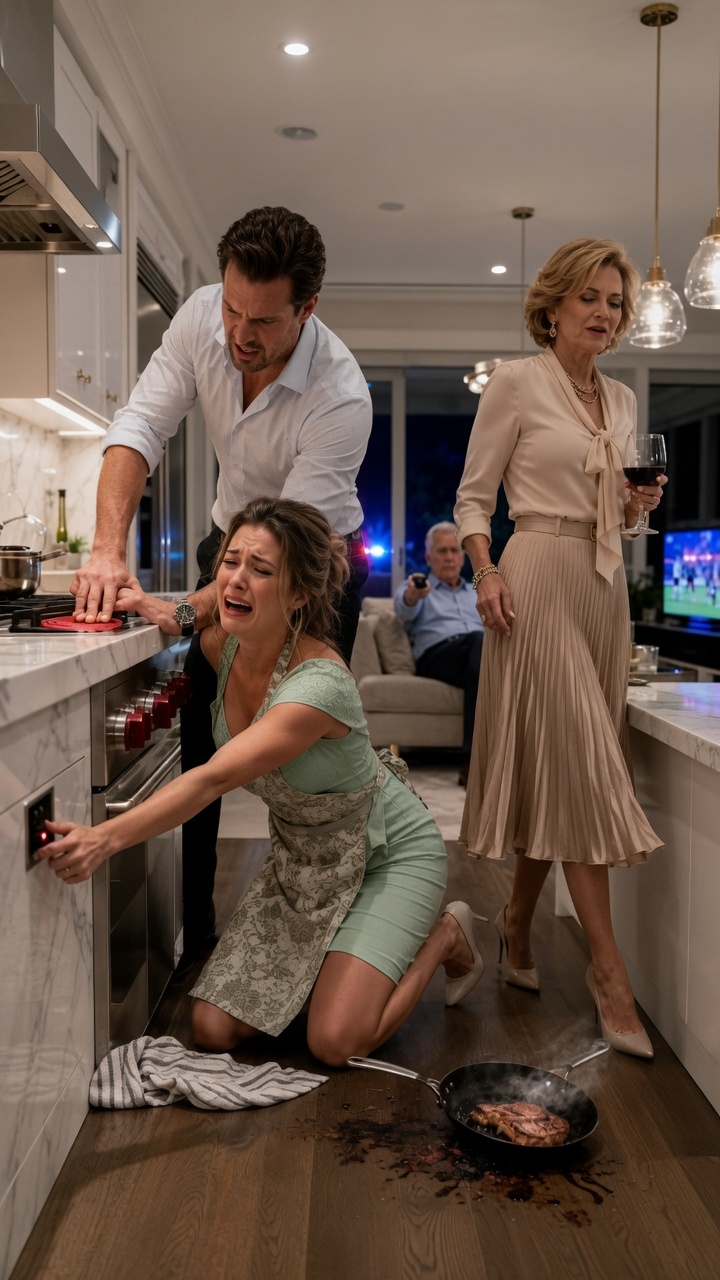
"I’m going to teach you not to serve me peasant food," Adrián said, before shoving her hand against the hot comal.
Mariana's scream bounced off the stone kitchen walls as if the entire house had shattered.
The pan clattered to the floor.
The overcooked meat, loathed by her husband, lay discarded beside her knees, amidst hot oil and charred onion bits.
Adrián didn’t let go right away.
He gripped her wrist with a chilling calm, as if he weren’t hurting his wife but merely correcting a domestic error.
When he finally released her, Mariana doubled over.
Her hand burned as if fire had seeped into her bones.
From the bar, her mother-in-law, Beatriz, didn’t even rise.
She strolled past with her glass of white wine in hand, careful not to stain her shoes.
Then she poured herself more, glanced at Mariana on the floor, and let out a chuckle.
“It was about time she understood her place.”
In the living room, Don Ramiro, her father-in-law, turned up the volume on the television.
The América game blared, drowning out Mariana’s sobs.
And at that moment, something inside her stopped pleading for help.
For two years, that house in Juriquilla had been a pretty prison.
On the outside, everyone saw gardens, new trucks, elegant dinners, and family photos on Facebook.
On the inside, Mariana lived under strict permissions.
Permission to use the car.
Permission to see her mom in Celaya.
Permission to buy even a shampoo.
Adrián claimed it was all for her own good.
That she was scatterbrained.
That without him, she wouldn’t even know how to pay for gas.
Beatriz called her "ungrateful" every time Mariana tried to defend herself.
Don Ramiro repeated that modern women couldn’t handle anything.
But Mariana had endured.
She endured humiliations in front of Adrián’s cousins.
She endured having her cards taken away.
She endured him changing the passwords to her email.
She endured bruises she explained away as silly falls.
What Adrián never imagined was that Mariana wasn’t enduring out of weakness.
She was gathering evidence.
Because that house he flaunted as "his achievement" hadn’t come solely from his pocket.
The down payment had been made by Mariana with the money her grandmother left her in a trust.
Adrián's construction materials business had been built on a client system she designed from scratch.
And every false invoice, every strange deposit, every scanned signature without permission had been saved on a backup he didn’t know about.
Three weeks prior, a lawyer from a women’s collective in Querétaro had helped her.
A technician installed a tiny camera under the granite island.
It looked like a black charger stuck to the wood.
No one noticed it.
Adrián never cleaned.
Beatriz only entered the kitchen to criticize.
And Don Ramiro never saw anything that didn’t suit him.
Mariana, still on the floor, stretched her healthy hand toward the bar.
Adrián thought she was looking for a napkin.
But her trembling fingers pressed the hidden button.
One press began recording.
Two uploaded the file to the cloud.
Three sent a live feed to attorney Natalia Torres, her lawyer, and agent Lucía Hernández, who already had a protection order prepared.
Mariana pressed three times.
A small blue light flickered under the bar.
Tiny.
Almost invisible.
Adrián bent down, grabbed her by the hair, and lifted her face.
"Now you’re going to clean, make another steak, and apologize to my mom."
Mariana gasped for breath.
"My hand... please..."
"What a drama queen," Beatriz said. "As if she were dying."
Don Ramiro turned up the volume again.
Adrián smiled, proud, as if he had just established order.
"See? This is how she learns."
Mariana looked at the oven clock.
It was 9:48 PM.
Lucía had promised her something clear: if the signal arrived with active video, they wouldn’t send a patrol to ask questions.
They would arrive prepared.
Adrián mistook her silence for obedience.
He yanked her up, wrapped her burned hand in a dry cloth, and pushed her toward the sink.
"Come on. And no crying, you’re getting on my nerves."
Then, from the private street, a siren wailed.
First distant.
Then louder.
Beatriz stopped laughing.
Adrián turned toward the window.
And he still didn’t know that the siren wasn’t coming to calm a family dispute.
It was coming to open the door to the hell he had built himself.
PART 2
Adrián stood frozen for just one second.
Then he bolted to the living room window.
When he saw the red and blue lights reflected on the neighbors' trucks, he turned to Mariana with eyes full of rage.
"What did you do, you bitch?"
Beatriz lowered her glass.
"Mariana, tell me you weren’t that stupid."
Adrián grabbed Mariana’s phone from the bar and smashed it against the floor.
The screen shattered.
Then he kicked the pieces under the refrigerator.
"Ramiro, close the door. Mom, clean that up."
Don Ramiro stood up annoyed, as if the police were an unwanted guest.
"Tell them it burned by itself. That’s what happens when someone doesn’t know how to cook."
Beatriz caught on quickly.
She spilled her wine near Mariana.
The liquid spread across the tiles like a prepared stain.
"She was drunk," she said, adjusting her necklace. "She got aggressive."
Adrián tossed the meat in the garbage, wiped the comal with a cloth, and approached Mariana.
He spoke softly, teeth clenched.
"You’re going to say you fell. If you open your mouth, I swear you hit my mom. We’re three against you. Who will believe you?"
There was a knock at the door.
"Municipal police! Open up!"
Don Ramiro took a deep breath and opened the door.
Four officers entered with body cameras on.
Behind them was agent Lucía Hernández, black jacket, hair tied back, and a steely gaze.
Her eyes went straight to Mariana's bandaged hand.
The skin around the cloth was red, swollen, damp.
Lucía clenched her jaw.
Adrián opened his arms, acting like a victim.
"Thank goodness you’re here. My wife had another crisis. She burned herself and started breaking things."
Beatriz clutched her chest.
"My son just wanted to help her. She went crazy."
Don Ramiro pointed at the wine on the floor.
"She drank too much. You know how some women get when they feel less."
Lucía didn’t answer them.
She walked towards Mariana and leaned down.
They had agreed on a phrase.
If Mariana was still in danger, she had to say it, even if everyone was watching.
Mariana swallowed hard.
"Dinner didn’t turn out how Adrián wanted."
Lucía closed her eyes for a moment.
When she opened them, her expression had changed.
She no longer looked like someone arriving to hear versions.
She looked like someone coming to trap a predator.
An officer positioned himself between Adrián and Mariana.
Another separated Beatriz from Don Ramiro.
Adrián raised his voice.
"What are you doing? Ask my parents. She’s lying."
Lucía pulled out her phone.
"That’s exactly what we’re going to do. We’re going to listen to everyone."
The video began to play from the kitchen.
First, Adrián's voice.
"I’m going to teach you not to serve me peasant food."
Then, Mariana's scream.
Next, Beatriz’s dry laughter.
"It was about time she understood her place."
And in the background, the TV volume rising to drown out the cries.
Beatriz turned pale.
Don Ramiro opened his mouth, but no words came out.
Adrián tried to lunge for Lucía’s phone.
He didn’t reach it.
Two officers shoved him against the wall and cuffed him.
"That recording is illegal!" Beatriz shouted.
Lucía stared at her unblinking.
"Illegal is burning a woman, threatening her, and fabricating a scene to blame her."
Adrián struggled.
"This house is mine! Everything here is mine! She has nothing!"
Mariana lifted her gaze.
She trembled.
It hurt to breathe.
But her voice came out clear.
"No, Adrián. It was never yours."
For the first time, he felt fear.
Not from the handcuffs.
Not from the police.
But because he understood that Mariana hadn’t just recorded that night.
She had saved much more.
The ambulance arrived minutes later.
As a paramedic removed the cloth stuck to her skin, Mariana gritted her teeth to avoid screaming again.
Her hand had deep burns on the palm and three fingers.
The paramedic told her she needed to go to the hospital immediately.
Beatriz, from the living room, was still talking on the phone.
"Get me Mr. Ortega. This is an exaggeration. Mariana has always been problematic."
Don Ramiro repeated it was all a misunderstanding.
Adrián screamed that he would sue them all.
But the house no longer obeyed them.
Every corner was being photographed.
The comal.
The wine.
The broken phone.
The dry cloth.
The camera under the bar.
In the hospital, Mariana didn’t cry when the doctor explained she might need therapy to regain mobility.
She cried when Lucía sat by her bed and said:
"You’re never going back to them."
That night, attorney Natalia Torres arrived with a gray folder and a laptop.
She didn’t bring comfort.
She brought war.
"Mariana, the camera had motion activation," she said. "It recorded conversations from this week. Adrián and his dad were moving money from the company."
Mariana closed her eyes.
"I suspected as much."
Natalia lowered her voice.
"Beatriz also appears discussing a forged signature of yours. They used a copy of your ID to apply for a loan against the house."
Mariana felt cold in her chest.
They hadn’t just hit her.
They hadn’t just isolated her.
They had also tried to take away the only asset her grandmother had left her.
But here came the twist Adrián never saw coming.
Months earlier, Mariana had installed an internal change log in the company’s accounting system.
It wasn’t a virus.
It wasn’t hacking.
It was a legal auditing function she created herself when she worked there.
Every edited invoice, every user who logged in, every uploaded document, every used signature, was marked with time, computer, and session name.
Adrián thought he had erased her from the company.
But he could never erase what she built.
In the first hearing, Adrián arrived pressed, perfumed, and with the face of a decent man.
His lawyer tried to paint Mariana as unstable.
He said she was resentful.
He said she exaggerated to keep the house.
He said a burn could happen in any kitchen.
Then the prosecutor played the video.
The courtroom went icy.
Adrián’s voice rang clear.
Mariana’s scream made several people look down.
Beatriz’s laughter was worse than a confession.
And when Don Ramiro was heard saying they had to blame her for being drunk, even the defense attorney stopped writing.
The judge ordered preventive detention for Adrián.
But Natalia wasn’t done yet.
She stood up and handed over a USB drive.
"We request to include elements for fraud, forgery of documents, economic violence, and possible diversion of resources."
Adrián lost color.
There ended his role as the tough guy.
Because he understood that the burned hand was just the door.
Behind it lay everything else.
The investigation revealed that Adrián had used false invoices to siphon money from the company.
Don Ramiro, a former municipal official, had helped secure contracts in exchange for commissions.
Beatriz had submitted documents with a forged signature of Mariana to process a loan, putting the house up as collateral.
The perfect family from Juriquilla began to crumble in front of everyone.
Neighbors who once greeted Beatriz with smiles began to cross the street.
Adrián’s clients reclaimed lost advances.
The bank reported the fraudulent loan.
And the same relatives who called Mariana "dramatic" started to delete photos with them from Facebook.
But the hardest blow came in the final hearing.
Adrián entered in gray uniform.
He wore no expensive watch.
He wore no smile.
Only sunken eyes and handcuffed hands.
He asked to speak.
"I made a mistake," he said. "I lost control one night. My wife is destroying my life over a steak."
Mariana stood up slowly.
The bandaged hand hurt with every heartbeat, but she didn’t lower her gaze.
"It wasn’t over a steak," she said. "It was for every day he thought my fear was obedience. It was for every blow his mother called teaching. It was for every silence his father drowned with the television. It was because they thought a woman alone had no memory, no evidence, no voice."
No one spoke.
Neither Beatriz.
Nor Don Ramiro.
Nor Adrián.
The judge sentenced Adrián for aggravated injury, domestic violence, threats, evidence tampering, and fraud.
He received nine years in prison.
Don Ramiro was sentenced for obstruction, forgery, and participation in diversions related to contracts.
Beatriz was sentenced for concealment, forgery, and restitution of the fraudulent loan.
The house was recognized as Mariana’s property.
She also obtained a protection order for ten years.
But Mariana didn’t stop there.
She sold the house.
She didn’t want marble.
She didn’t want a garden.
She didn’t want a kitchen that had learned to store screams.
With part of the money, she rented a small apartment in Cholula.
It had a window with bougainvilleas, a wooden table, and a simple stove.
No one yelled at her if the food got cold.
No one banged cutlery to demand anything from her.
Physical therapy was slow.
Some days she could move her fingers.
Others, the pain returned like a hidden ember.
She also started psychological therapy because she understood that she didn’t just have to heal her hand.
She had to teach her body that she no longer lived in fear of the next blow.
One year later, Mariana opened an association called Blue Light.
She helped women victims of domestic and economic violence securely store documents, messages, account statements, deeds, audios, and digital evidence.
She didn’t promise storybook endings.
She promised something more valuable: a plan.
On the day of the inauguration, Lucía arrived with flowers.
Natalia placed on the wall a small framed piece: the fake black charger that had been under the bar.
Many women looked at it as if it were an amulet.
Mariana always said the same thing:
"This didn’t save me. It just showed who they were when they thought no one was watching."
One night, long after everything, Mariana cooked a steak.
She overcooked it a little.
The edge was charred.
For a moment, the smell left her frozen.
Then she opened the window, took a deep breath, and sat down to eat.
There was no one laughing behind her.
There was no television blaring.
There was no voice telling her what her place was.
And as she cut the first piece with the hand she had learned to heal, Mariana understood something many women need to hear:
Sometimes justice doesn’t come making noise.
Sometimes it starts small, hidden, blinking blue... just when the abuser thinks he has already won.





