PART 1
The message arrived for Mateo Herrera on a Tuesday morning while he sat in his old truck outside a construction site in San Pedro Garza García.
His coffee had long since cooled in the cup holder. His boots were dusted with cement, his hands smelled of freshly cut wood, and on the passenger seat lay rolled-up plans for a luxury kitchen he was supposed to deliver that week.
Then his phone vibrated.
It was the group chat.
His father, Arturo Herrera, had just written:
"Don’t come to my retirement party. It’s a family-only event."
Mateo stared at the screen.
He expected another message. A correction. A bad joke. Something that would say, "I texted the wrong chat."
But no.
A few seconds later, another text appeared.
"Your presence would make the evening uncomfortable. You don’t fit in with the type of people who will be attending."
Mateo didn’t reply.
The group fell silent for exactly four seconds, until his older brother, Julián, wrote:
"Honestly, Dad is right. It’s a formal event. It’s not the time to show up smelling of varnish."
Then, his cousin Rodrigo sent a sticker of a construction worker carrying a bucket, with Mateo’s face plastered over it.
Several reacted with laughing emojis.
Mateo’s mother, Doña Teresa, wrote something that hurt more than all the insults:
"Son, understand. We don’t want Elena to feel out of place. She doesn’t belong in that environment either."
Elena was Mateo’s wife.
The woman who had never answered back with insults. The one who always brought desserts to family gatherings even when they left her sitting in the kitchen with the kids. The one who hugged Mateo when he pretended he didn’t care about his family’s disdain.
What none of them knew was that Mateo had paid the full advance for the party.
$15,000.
The hall at the Valle de Bravo Nautical Club. Dinner for 80 guests. A jazz trio. White flowers. The golden sign that would read: “Thank you for your legacy, Arturo Herrera.”
All of this existed because Mateo had secretly covered it after his mother called him crying, saying his father “deserved a dignified farewell.”
Mateo took a deep breath.
He didn’t insult. He didn’t argue. He didn’t send screenshots.
He simply opened his contacts and called the club coordinator.
“Good morning, this is Mateo Herrera. I want to cancel Arturo Herrera’s retirement event.”
On the other end, there was a pause.
“Mr. Herrera… the $15,000 deposit is non-refundable.”
“I know.”
“Do you wish to cancel everything?”
“Everything. Hall, dinner, music, flowers, and sign.”
When he hung up, the confirmation email arrived almost immediately.
Event canceled at the request of the payer.
Mateo looked at the screen, closed his eyes, and for the first time in years, didn’t feel shame.
He felt peace.
That same night, while his father tried on the suit he planned to wear in front of businessmen, politicians, and wealthy friends, Mateo came home, placed the phone on the table, and showed Elena the messages.
She didn’t cry.
She just hugged him from behind and asked:
"What do we do now?"
Mateo looked at his children, Diego, 8, and Sofía, 5, playing in the living room with wooden blocks he had made for them.
"We’ll never beg for a place at a table where they never wanted to see us."
Elena squeezed his hand.
"Then we build another life."
And while the Herrera family continued to mock in the group chat, no one imagined that this canceled party would be just the beginning of a downfall that would leave them speechless.
PART 2
In the following days, Mateo didn’t leave the group.
He muted it.
That was it.
He didn’t write sermons. He didn’t defend himself. He didn’t explain that the party his father boasted about had come from his pocket. He didn’t say that the “son who didn’t fit in” had been the only one willing to pay to make Arturo Herrera feel important for one last night.
He simply became unavailable.
That silence confused everyone.
Julián sent another private message:
"What happened, dude? Did you get burned?"
Mateo left it on read.
His mother called six times.
Mateo didn’t answer.
Rodrigo sent more stickers.
Mateo blocked his number.
That same week, he called an old high school friend, Sebastián, who had a marketing agency in Guadalajara.
“I need a serious website for my work,” Mateo told him. “Fine carpentry, restoration of old houses, luxury kitchens, hidden doors, complete libraries. I don’t want to charge as if I have to ask for permission for being good anymore.”
Sebastián laughed.
“Finally, man. It was about time you stopped selling yourself short.”
He also called his uncle Ernesto, the only brother of his mother who never treated him like a family embarrassment.
Ernesto lived in Querétaro and had contacts with architects, investors, and owners of restored colonial houses.
“Come over here,” he said. “There are people paying a fortune for work that no one knows how to do well. You have talent, Mateo. You just need to stop showing it to blind people.”
Three weeks later, Mateo and Elena packed their life.
They sold their small house in Monterrey. Loaded tools, toys, books, clothes, photos, and two mattresses into a moving truck. Diego wrote “dad’s workshop” on a box with a blue marker. Sofía decorated another with butterfly stickers.
Before leaving, Mateo took a photo of the empty living room.
He uploaded it to Facebook with a simple phrase:
“Family is also chosen. We are going to build where there is respect.”
He tagged no one.
But everyone saw it.
On the night of the supposed party, Arturo arrived at the Nautical Club in a dark suit, expensive watch, and the smile of a powerful man.
Doña Teresa wore pearls. Julián went with his wife, bragging that there would be important businessmen that night. Rodrigo was recording stories for Instagram.
Behind them came Arturo’s former partners, real estate brokers, a former local deputy, and two men who had laughed at his jokes all their lives.
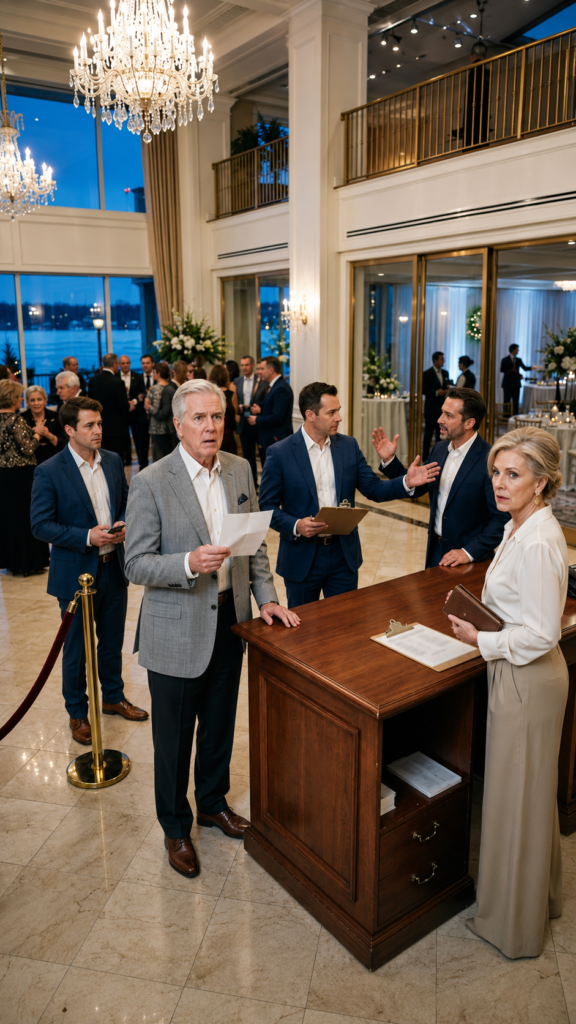
Arturo approached the front desk.
“Good evening. We’re here for the private event of Arturo Herrera.”
The coordinator checked the tablet.
“I’m sorry, sir. We have no event under that name.”
Arturo frowned.
“There must be a mistake. It’s my retirement party.”
The coordinator swallowed hard.
“The event was canceled by Mr. Mateo Herrera, who appears as the payer.”
The color drained from Arturo’s face.
“Mateo?”
“Yes, sir. Here is the record. $15,000 deposit. Cancellation authorized by the payment holder.”
Behind the glass, another event was being set up. A charity dinner occupied the hall. The white flowers were still there, but they weren’t for Arturo. The music played, but not for him.
The guests began to murmur.
Julián tried to raise his voice.
“This is illegal. We’re going to sue.”
The coordinator showed him the receipt.
“Only the payer could modify the reservation.”
Doña Teresa clutched her chest.
Rodrigo stopped recording.
And Arturo, the man who had banned his son because he “didn’t fit in,” understood that the only reason he would have fit in that night was Mateo’s money.
The humiliation was brutal.
They ended up having dinner at a roadside restaurant because no one wanted to go home so early. Several guests invented excuses and left. Others stayed out of morbid curiosity.
At the table, Arturo didn’t speak.
Julián did.
“This proves that Mateo was always resentful.”
Doña Teresa lowered her gaze.
But Camila, Mateo’s younger sister, who had remained silent until then, unleashed the truth in front of everyone.
“No, Julián. This proves that you used him all your lives.”
The table froze.
Camila continued, her eyes filled with rage.
“When your basement flooded, Mateo came at 3 in the morning and you said you’d hired ‘some guy.’ When Mom needed to fix the roof of the house, Mateo did it for free and Dad said he was at least good for something. When Dad wanted this party, Mateo paid for it. And you still had the nerve to tell him he wasn’t family.”
Arturo slammed the table.
“Shut up!”
Camila didn’t shut up.
“No. That’s enough. Seriously, that’s enough.”
That was the first crack.
The second came months later.
Without Mateo around to repair, lend, resolve, silence, and support, the cracks in the Herrera family started to show.
Julián, the perfect son, was investigated at the firm where he worked for moving client money without authorization. He lost his position and then his professional license.
Arturo, who had spent years boasting about enormous real estate projects, turned out to have more debts than properties. His partners discovered inflated contracts, overdue payments, and promises that never existed.
The big house in San Pedro was foreclosed.
The club canceled his membership.
Doña Teresa went from organizing elegant meals to counting sales at the supermarket.
Camila moved out to live alone and stopped answering family calls.
Meanwhile, in Querétaro, Mateo built his own workshop.
At first, it was a small warehouse with a metal roof and four employees.
Then architects arrived. Later came clients from San Miguel de Allende, Juriquilla, and Mexico City. They wanted handmade doors, walnut staircases, hidden kitchens behind clean walls, furniture that looked like it had been part of the house for 100 years.
Mateo hired carpenters that other companies treated as cheap labor and paid them like masters.
Elena opened a small educational center for children. Diego learned to sand wood without hurting himself. Sofía filled the patio with painted pots.
In three years, Mateo’s workshop was no longer a workshop.
It was a luxury construction firm called Raíz Fina.
It had an office with large windows, a meeting room, 27 employees, and projects featured in architecture magazines.
Mateo no longer entered rooms feeling lesser.
He entered knowing exactly what he was worth.
On a Monday morning, his assistant, Mariana, knocked on the door of his office.
“Mr. Herrera, the candidate for the development consultant vacancy has arrived.”
Mateo didn’t look up from the plans.
“Name?”
“Arturo Herrera.”
The pencil froze between his fingers.
For a moment, the noise of the office disappeared.
Mateo picked up the resume that Mariana left on his desk.
There it was.
Arturo Herrera.
Former director. Real estate developer. Experience in investor relations. Over 40 years in the sector.
The sheet tried to sound powerful, but it felt old. Like an expensive suit kept too long in a damp closet.
Mateo breathed.
“Send him in.”
Arturo entered with the same gesture he used when he wanted to impress, but it no longer had the same weight. His hair was gray, his shoulders slumped, the watch less shiny, the shoes worn at the tips.
He carried a folder under his arm.
“Good morning, I’m Arturo Herrera. Thank you for having me.”
Then he saw Mateo.
The folder almost slipped from his hands.
“Son…"
Mateo pointed to the chair in front of the desk.
“Mr. Herrera, have a seat. This is an interview.”
Arturo blinked, wounded by the formal treatment.
“Are you the owner?”
“Yes. Founder and director of Raíz Fina.”
Arturo looked at the large windows, the models, the framed awards, the photographs of finished houses. He looked at everything as if searching for a lie.
But there was none.
“I didn’t know…"
“No. You never wanted to know.”
Arturo sat slowly.
For a few seconds, he didn’t speak.
Then he tried to smile.
“Mateo, we can talk as family.”
Mateo crossed his hands on the desk.
“You came for a job.”
“I need to work.”
“I understood that when we received your application.”
Arturo lowered his gaze.
“Things got tough. We lost the house. Your mother is unwell. Julián can’t help us. I thought maybe…"
“Maybe the son who didn’t fit in could hold you up again?”
Arturo’s face hardened.
“Don’t say that.”
“Why? Because it sounds ugly or because it sounds true?”
The silence weighed heavily.
Arturo pressed his lips together.
“I made mistakes.”
Mateo nodded.
“Yes.”
“I was hard on you.”
“It wasn’t hardness. It was disdain.”
Arturo swallowed hard.
“I was ashamed of your trade.”
“I know.”
“I wanted you to be more…”
“More like Julián?”
Arturo didn’t answer.
Mateo took the resume.
“This company works with transparency, respect for trades, and real responsibility to clients. Your experience doesn’t fit our culture.”
Arturo looked up.
“Are you denying me the job?”
“Yes.”
“To your own father?”
“To a candidate who doesn’t meet the profile.”
Arturo breathed with contained rage. For a second, Mateo saw the man from before. The one who raised his voice and everyone obeyed. The one who could make him feel small with a phrase.
But that office belonged to Mateo.
That desk belonged to Mateo.
That name on the door belonged to Mateo.
Arturo no longer commanded there.
“I gave you life,” said the father, his voice broken.
Mateo thought of Elena packing boxes. Of his children sleeping on mattresses on the floor their first week in Querétaro. Of the nights without money but with peace. Of all the times he had tried to buy love with favors.
Then he replied:
“Elena helped me build one.”
Arturo closed his eyes.
The phrase hit him harder than any insult.
Mateo pressed the intercom.
“Mariana, please escort Mr. Herrera to reception. The interview is over.”
Arturo stood up slowly.
At the door, he paused.
“Do you hate me that much?”
Mateo looked at him without resentment.
“No. I just stopped needing you to love me.”
Arturo left without saying anything.
And that was the true defeat.
Not losing the job. Not losing the house. Not losing the surname as a symbol of power.
The true defeat was discovering that the son he had humiliated was no longer waiting for an apology to be able to live.
A year later, Mateo celebrated Diego’s 12th birthday in the patio of his house in Querétaro.
There was no luxury hall or convenient guests.
There was grilled meat, children running, Elena laughing with friends, Camila sitting under an umbrella, and Sofía showing everyone a box of dried flowers she called “her scientific collection.”
Diego approached Mateo with a small pine board.
“Dad, will you teach me to make it smooth?”
Mateo handed him a sander.
“Follow the grain. Don’t fight it. The wood tells you where to go.”
The boy smiled and began to sand carefully.
Mateo watched him in silence.
His father had taught him that a man was worth by the applause, the suits, the halls, and the important people surrounding him.
He was teaching his son something different.
That what is solid is worth more than what is shiny.
That family shouldn’t feel like a conditional invitation.
That no one has the right to humiliate you and then call you selfish when you decide to leave.
That night, when everyone had left, Mateo found Diego’s small board on the patio table. One side was perfectly smooth, and his name was written on the back in crooked pencil.
Mateo ran his finger along the wood and smiled.
For years, he wanted his father to call him successful.
Now he understood the truth.
He didn’t need the wrong man to name his right life.





