PART 1
Mariana arrived at her mother's house at 12:37 AM, the baby sleeping against her chest and a bag of diapers hanging from her arm.
She didn’t bring a suitcase.
She didn’t have any money.
All she had was her phone with the message that had shattered her life.
“Iván, love, I can’t hide anymore. Tell your wife or I’ll tell her myself.”
The name of the other woman was Dania.
Mariana had read that message six times before waking Iván. He didn’t deny anything. He just sat on the edge of the bed, ran his hands over his face, and said the worst thing he could say:
—I didn’t want you to find out like this.
Then came the argument, the shouting, the baby crying, and the phrase that broke her completely.
—If it hurts that much, then go to your mom’s.
And Mariana left.
She thought her mother would open the door, embrace her, and tell her that no daughter of hers should endure such humiliation.
But Doña Elvira, standing in the entranceway, wearing a robe and a hardened expression, looked at the child, looked at Mariana’s tears, and said:
—A good wife endures, honey. We all endure.
Mariana didn’t understand.
—Mom, he cheated on me.
—And for that, you’re going to destroy your home? Leave your child without a father? No, miss. Don’t come here with your drama.
The baby wriggled in her arms. Mariana felt her knees tremble.
—I have nowhere to go.
Doña Elvira lowered her voice but not her gaze.
—I don’t want shame in my house at midnight.
And she closed the door.
Just like that, without touching her grandchild. Without asking if he had eaten. Without asking if she had bus fare.
Mariana stood on the sidewalk, under the yellow streetlight, with her heart in pieces and her pride scattered on the ground.
She called two friends.
One didn’t answer.
The other sent a message: “We’ll talk tomorrow, sis.”
The bus passed almost empty on its way to the Roma Sur neighborhood, where Doña Amparo, Iván’s mother, lived.
Mariana didn’t even know why she got on.
Maybe because she had no one else left.
Maybe because a part of her wanted someone from that family to feel a little shame.
She arrived at an old house, with pots of aloe vera at the entrance and a little Virgin of Guadalupe stuck next to the doorbell.
She knocked just once.
The door opened before the second knock.
Doña Amparo was awake, wearing slippers, a flowery apron, and her hands covered in flour, as if she had been making tortillas at that impossible hour.
She didn’t ask what had happened.
She didn’t look surprised.
She just opened the door wider.
—Come in, my daughter. And bring the baby. No one gets left outside.
Mariana felt something crack in her chest.
Doña Amparo served her hot noodle soup. She brought sweet bread. She gently took the baby so Mariana could eat.
—Did you eat anything today?
Mariana cried with the spoon in her hand.
Because it had been three days since anyone had asked her that.
Then she was taken to a room in the back. The bed was made with clean sheets. Next to the window, there was a crib set up, with a little blue blanket folded at the edge.
—How lucky I was to have this ready —Mariana murmured, trying to smile.
Doña Amparo didn’t smile.
—I always have it ready.
Mariana looked at her oddly, but she was so tired that she didn’t ask.
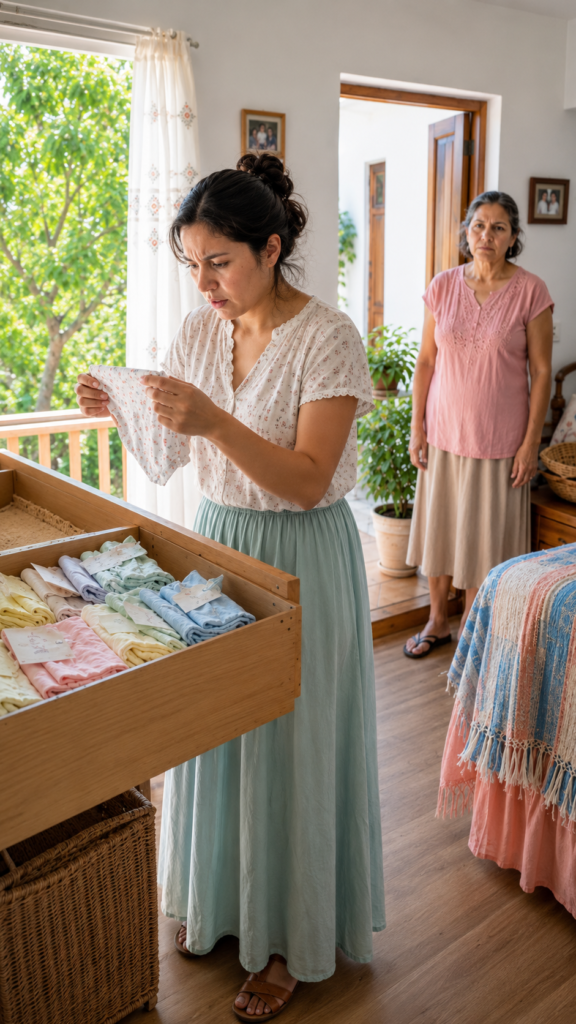
The next morning, while looking for a blanket, she opened the drawer of the nightstand.
Inside, there was baby clothing perfectly folded.
Dresses.
Pink socks.
Girl hats.
Her baby was a boy.
—Leave that there —Doña Amparo said from the door.
Mariana jumped.
—I’m sorry, I just...
—It’s not yours.
The woman closed the drawer with a calmness that chilled Mariana’s spine.
That afternoon, Mariana told her about Dania.
Doña Amparo wasn’t surprised.
She just stopped chopping onions for a second.
—Dania —she repeated—. Uh-huh.
—Do you know her?
—I know many stories, my daughter.
That night, Mariana couldn’t sleep.
She got up for water and saw light in the kitchen.
Doña Amparo was sitting in front of an old notebook, writing names. When she saw Mariana, she slammed it shut.
But Mariana managed to read one.
“Brenda.”
And a date from four years ago.
On Saturday, someone knocked at the door.
It was Iván.
He came with flowers.
But he didn’t ask about Mariana.
—I’m here for Dania —he said—. She told me she’d be here.
Behind him, on the sidewalk, appeared a girl with a broken suitcase and a baby in her arms.
She had the same look as Mariana the night before.
—Does the mother-in-law live here? —Dania asked, crying—. They told me I’d be welcomed here.
Mariana couldn’t breathe.
Doña Amparo looked at her son, then at Dania, then at the flowers.
And without blinking, she slammed the door in Iván’s face.
Then she opened it again.
Not for him.
For Dania.
—Come in, my daughter. And bring the baby. No one gets left outside.
Mariana ran to the room, opened the forbidden drawer, and found folded clothes with little papers attached: Brenda, Caro, Yesenia, Marisol.
At the bottom, there was a new space, with clothes the size of her baby.
And a little note already written.
With her name.
She couldn’t believe what was about to happen...
PART 2
Mariana knelt in front of the drawer, the little note between her fingers.
Her name was written in blue ink, in Doña Amparo’s tight handwriting.
“Mariana — baby 5 months.”
It wasn’t a coincidence.
It wasn’t that her mother-in-law was just kind.
That crib wasn’t ready by chance.
That soup wasn’t hot for no reason.
Doña Amparo knew Mariana was coming before she even realized she had no other refuge.
Outside, in the kitchen, Dania was crying softly. Her baby was crying too. Doña Amparo spoke to her with a tired sweetness, as if she were repeating a scene she already knew by heart.
—Sit down, my daughter. Breathe. First, you eat. Then you cry.
Mariana gritted her teeth.
She felt fear.
Then anger.
Then a strange rage, the kind that burns even at the nape of your neck.
She stepped into the hallway with the note in hand.
—How many of us are there? —she asked.
Doña Amparo froze.
Dania raised her face, confused, with swollen eyes and hair stuck to her cheeks.
—What are you talking about? —she whispered.
Mariana showed her the note.
—How many women have passed through this house? How many did you know that Iván was going to destroy?
Doña Amparo set the spoon down on the table.
For the first time since Mariana had known her, she didn’t seem strong.
She looked older.
Much older, all of a sudden.
—Come —she said—. Now that you’ve opened the drawer, open it all.
Mariana followed her to the back room. Dania stayed in the kitchen, hugging her baby as if someone was going to snatch him away.
Doña Amparo took out the entire drawer and placed it on the bed.
She didn’t try to deny anything.
She didn’t defend herself.
She just pulled out the clothing, one by one, like someone opening a tomb.
—Brenda —Mariana read.
There was a tiny yellow dress wrapped in tissue paper.
—Caro.
A green onesie.
—Yesenia.
A little blanket with bears.
—Marisol.
White diapers, still smelling of Roma soap.
At the bottom was the old notebook.
The same one Doña Amparo had closed in the kitchen.
Mariana opened it with trembling hands.
She expected to find dirty secrets. Proof that her mother-in-law helped Iván. Maybe addresses to hide lovers. Maybe money. Maybe threats.
But no.
They were names.
And next to them, addresses.
“Caro — taco stand in front of the Cholula market. She’s doing well.”
“Yesenia — went back to study nursing. Lives in Toluca.”
“Marisol — opened a beauty salon in León. Sends a message every Mother’s Day.”
“Fernanda — works in a stationery store in Iztapalapa. Her kid started kindergarten.”
Mariana was speechless.
Doña Amparo sat at the edge of the bed, her back bent.
—I don’t keep them as trophies, my daughter.
Her voice came out hoarse.
—I keep them so I don’t forget them. To know they made it out alive.
Mariana swallowed hard.
—And Brenda?
Doña Amparo closed her eyes.
Brenda’s name was underlined.
But it didn’t have an address.
The space next to it was empty.
—Brenda was the first —the woman said.
Mariana felt the room shrink.
Doña Amparo took the yellow dress in her hands. She caressed it gently with her fingers, as if a little girl were still inside.
—I was 19 when Iván’s father kicked me out. I was pregnant. I knocked on my mother’s door and she didn’t open. I knocked on my mother-in-law’s and she threw me to the dog.
Mariana lowered her gaze.
The phrase sounded too much like her mother’s.
“I don’t want shame in my house.”
—I slept on a sidewalk in February —Doña Amparo continued—. With Iván in my belly. A woman from a diner saved me. She took me in, gave me coffee, and asked if I had eaten.
The old woman took a deep breath.
—Since then, I vowed that if any woman knocked on my door with a child in her arms, I would never leave her outside.
Mariana wanted to say something, but she couldn’t.
—I raised Iván alone. I gave him everything. Too much. That was my sin. I never let him lack for anything, or suffer any consequence, or bear any shame or hit from life.
She wiped her eyes with her apron.
—And he turned out just like his father.
The phrase fell heavy.
Like a stone.
—When he married Brenda, I could already see signs. The phone face down. The new perfume. Late arrivals. Silly lies. But I played dumb. I thought: “Don’t get involved, Amparo. Don’t be that mother-in-law who ruins marriages.”
Mariana tightened the paper with her name on it.
—Brenda called me one night. Crying. She told me Iván had another. That he had pushed her. That she didn’t know what to do with her baby.
Doña Amparo swallowed.
—And I told her to endure.
Mariana looked up.
—What?
—I told her the same thing your mom told you. That a good wife endures. That men make mistakes. That a family shouldn’t break over a fleeting moment.
The silence hurt.
From the kitchen, Dania could be heard blowing her nose.
—A week later, Iván kicked her out of the house. I didn’t go for her that night. I waited. I waited for dawn. I waited to not exaggerate. I waited for someone else to do what I should have done.
Doña Amparo looked at the yellow dress.
—When I went to look for her, it was too late.
Mariana felt a punch in her stomach.
—What happened to her?
—She died of pneumonia. She spent three nights on the street with her baby. The girl survived because a neighbor found her crying next to her.
Mariana’s eyes filled with tears.
The rage dissolved into something worse.
Pain.
—Brenda’s mother took the girl to Zacatecas. She never let me see her. And she was right. With what face was I going to raise her when I couldn’t even open the door for her mother?
Doña Amparo folded the yellow dress with a delicacy that broke the soul.
—Since then, I no longer wait. As soon as Iván starts his nonsense, I prepare the room. I buy diapers. I wash clothes. I set up the crib. I pray I’m wrong.
Mariana looked at the new clothes.
The ones for her baby.
—When did it start with me?
Doña Amparo didn’t look at her.
—Three weeks ago.
Mariana felt the blood drain from her face.
—Three weeks? And you didn’t tell me anything?
—Would you have believed me?
The question hung in the air.
Mariana thought of herself, defending Iván in front of her friends. She thought about how angry she got when someone said he was too flirty. She thought about how she checked his phone once and then apologized for being “intense.”
No.
Maybe she wouldn’t have believed her.
—I could have warned you —Doña Amparo said—. I should have. But I also learned that women don’t leave when someone tells them. They leave when the blow falls completely. All I can do is keep the door open when that happens.
Mariana wanted to hate her.
She really did.
But she couldn’t.
Because that woman wasn’t hiding Iván.
She was picking up the pieces that Iván left scattered.
Though it was also true that, for years, she had let him break.
That was the bitterest part.
Doña Amparo wasn’t a saint.
She wasn’t a villain either.
She was a guilty mother trying to pay a debt that no soup could erase.
Suddenly, there were loud knocks on the door.
—Mom, open! —Iván shouted from outside—. Don’t do your little theatrics!
Dania jumped in the kitchen.
Mariana picked up her baby from the crib. Doña Amparo stood up, but Mariana stopped her.
—No. I’m opening now.
She walked to the entrance with her heart pounding against her ribs.
She barely opened the door.
Iván was there, disheveled, furious, with the flowers crushed in his hand.
—What are you still doing here? —he spat—. I came for Dania.
Mariana looked at him as if she were seeing him for the first time.
She no longer saw the man she married.
She saw a big kid, throwing a tantrum, used to having women clean up his life.
—Dania isn’t going with you.
Iván let out a dry laugh.
—Don’t get involved. This isn’t about you.
—It is about me. And Brenda. And Caro. And Yesenia. And all the women you left crying while you kept living your life, dude.
Iván paled a little at hearing those names.
—What did my mom tell you?
—The truth.
He tried to push the door, but Mariana didn’t budge.
Then Doña Amparo appeared behind her.
She didn’t shout.
She didn’t raise her hand.
She just spoke with a calmness that was more frightening.
—Iván, this house is no longer yours.
—I’m your son.
—And for that, I should have stopped you long ago.
He scoffed.
—Oh, mom, don’t exaggerate. They all play the victim.
Doña Amparo closed her eyes for a second.
When she opened them, she was no longer trembling.
—Brenda also said I was exaggerating. Until they buried her.
Iván was frozen.
The street, the neighbors, the night, everything seemed to freeze.
—Don’t ever knock on this door again looking for a woman you tossed out —Doña Amparo said—. We don’t accept returns here.
And she closed it.
This time it wasn’t a funny phrase.
It was a sentence.
That night, Mariana didn’t sleep.
Dania didn’t either.
The two stayed in the kitchen, drinking coffee from the pot while Doña Amparo heated more soup. They spoke little. Sometimes pain doesn’t need many words. It just needs someone to sit next to you without judgment.
At dawn, Mariana called her mother.
Doña Elvira answered with a dry voice.
—Has the tantrum passed?
Mariana looked at her baby sleeping in the stroller.
—It wasn’t a tantrum, mom. It was my life falling apart.
—Well, go back to your husband. Nobody dies from infidelity.
Mariana looked toward the back room.
She thought of Brenda.
—Yes, mom. Sometimes they do.
And she hung up.
She didn’t ask anyone for permission to save herself again.
Months passed.
Dania found work at a daycare in the neighborhood. Mariana started selling home-cooked meals in a small kitchen near the Metro Portales. They took turns watching the kids.
Doña Amparo helped them however she could. She taught them to stretch the rice, to detect lies in an eye, and to never confuse love with endurance.
Iván returned twice.
The first time, he cried.
The second time, he threatened.
Neither worked.
When he tried to say that his mother was ruining his life, Doña Amparo replied from the window:
—No, son. I just stopped building you a hiding spot.
Later on, Doña Amparo fell ill.
It wasn’t sudden.
She faded away little by little, like a candle at the end of the night.
Before she died, she called Mariana to her room and handed her the notebook.
—Don’t let it become a museum of sadness —she asked—. Let it be a map out.
Mariana cried in silence.
—I don’t know if I can.
Doña Amparo squeezed her hand.
—Of course you can. You arrived just in time for another.
The old woman died one cold dawn, with her apron hanging on the chair and a pot of soup ready on the stove.
The house was left in Mariana’s name.
Iván tried to claim it.
But Doña Amparo had left signed papers, witnesses, and a letter that said:
“My son inherited too many opportunities. This house is for the women who need an open door.”
The whole neighborhood found out.
Some criticized.
What a shame.
Why get involved in others' problems?
A separated woman with a child shouldn’t be receiving strangers.
But there were also those who started knocking.
A neighbor brought a bag of diapers.
The lady from the little store left milk.
A mechanic fixed the door lock for free.
And when a young girl appeared at the bus stop with a baby in her arms and swollen eyes, someone would say:
—Go to Mariana’s house. They don’t leave anyone outside.
Now there are two cribs set up in the back rooms.
Always.
Even if weeks pass without anyone arriving.
The notebook already has new pages.
Dania opened a small daycare two blocks away and takes care of Mariana’s son while she works.
Caro continues with her taco stand in Puebla.
Yesenia sends photos every December.
Marisol visited once, with her nails painted red and a laugh that no longer sounded broken.
They all made it out.
All but Brenda.
That’s why, in the last drawer, underneath the clean clothes that Mariana folds every Sunday, there’s a space that no one touches.
There lies the yellow dress.
Tiny.
For a girl.
Mariana doesn’t give it away.
She doesn’t wash it for another baby.
She just takes it out occasionally, smooths it with her hand, and puts it back.
Not to live in pain.
But to remember that sometimes a closed door can kill more than a betrayal.
And that a woman doesn’t need to be told to “endure.”
She needs someone to open the door before it’s too late.





