PART 1
Alonso Castañeda thought he was watching a defenseless girl.
That was the first mistake of the night.
He had seen her for a month in a narrow café in the Portales neighborhood, one of those places with wobbly tables, harsh white lights, burnt coffee, and display cases where the pastries hardened before midnight.
Renata Solís worked there from 6 PM to 2 AM. She wore a green apron, old sneakers, and her hair tied back with a cheap clip. She spoke little. When she smiled, it seemed obligatory, as if life charged her for even the smallest gestures.
Alonso always sat in the back, next to the broken fan.
He didn’t go for the coffee.
That coffee tasted like punishment.
He went because at his house in Las Lomas, everything smelled of expensive wood, old secrets, and betrayals waiting their turn. Because Doña Catalina, his mother, repeated that the Castañedas didn’t mix with people who served tables. And because Emiliano, his younger brother, was already murmuring that Alonso was softening.
—That little waitress is making you a fool, brother —Emiliano threw at him during a family meal, in front of four trusted men.
Alonso didn’t raise his voice.
He just looked at him.
And Emiliano stopped laughing.
But the phrase buried itself deep.
Renata didn’t seem to know who he was. To her, he was just the man in the dark coat who ordered black coffee without sugar, left $800 under the cup, and never asked for more.
He liked that.
In her world, everyone wanted something: favors, protection, money, silence, or revenge. Renata only served him coffee, cleared plates, and disappeared behind the bar.
That early morning, at 1:22 AM, two guys soaked from the rain walked in.
One wore a denim shirt, had a scruffy beard, and smelled of cheap alcohol. The other wore a gray cap, clean hands, and eyes too calculating to be drunk.
Alonso noticed.
So did Renata.
—Hey, queen —the denim guy said, banging on the table—. Get us some coffee and a smile, or does that cost extra?
Renata left two menus without replying.
Alonso saw something that squeezed his chest: a purple mark peeking out from under the sleeve of her apron, as if someone had grabbed her too hard.
—What are you going to order? —she asked.
The man grabbed her wrist.
—First, tell me what time you get off.
Alonso reached into his coat.
Renata didn’t scream.
She didn’t beg.
She didn’t even pull her arm back.
She just stared at the man’s fingers on her skin.
—Let me go.
—Oh, don’t be a pain. We’re just chatting.
She brushed her fingers against a thick bottle of homemade hot sauce on the table.
—I told you to let me go.
Her voice was low.
But something in her made the guy release her wrist.
The denim guy tossed the menu and stormed out, cursing. The one in the cap followed, but before crossing the door, he looked at Renata like someone confirming they’d found the right person.
Alonso stayed still.
At 2:04 AM, Renata pulled down the curtain, turned off the neon sign, and stepped out wearing a black jacket too big for her.
Alonso followed her in a Suburban without plates.
He told himself it was to protect her.
But deep down, he needed to know why a waitress with marks of a victim walked with the eyes of a hunter.
Renata walked toward some half-abandoned warehouses near Tlalpan. She didn’t walk fearfully. She scanned reflections in windows, shadows under cars, rooftops, and closed doors.
Then she entered a narrow alley.
Alonso got out, pulled his gun, and pressed himself against the wet wall.
Then the two men from the café emerged from the darkness.
They no longer pretended to be drunk.
One aimed straight at Renata.
—Hand over the memory.
She didn’t take a step back.
—Here it is.
Alonso raised his weapon.
But he didn’t get to shoot.
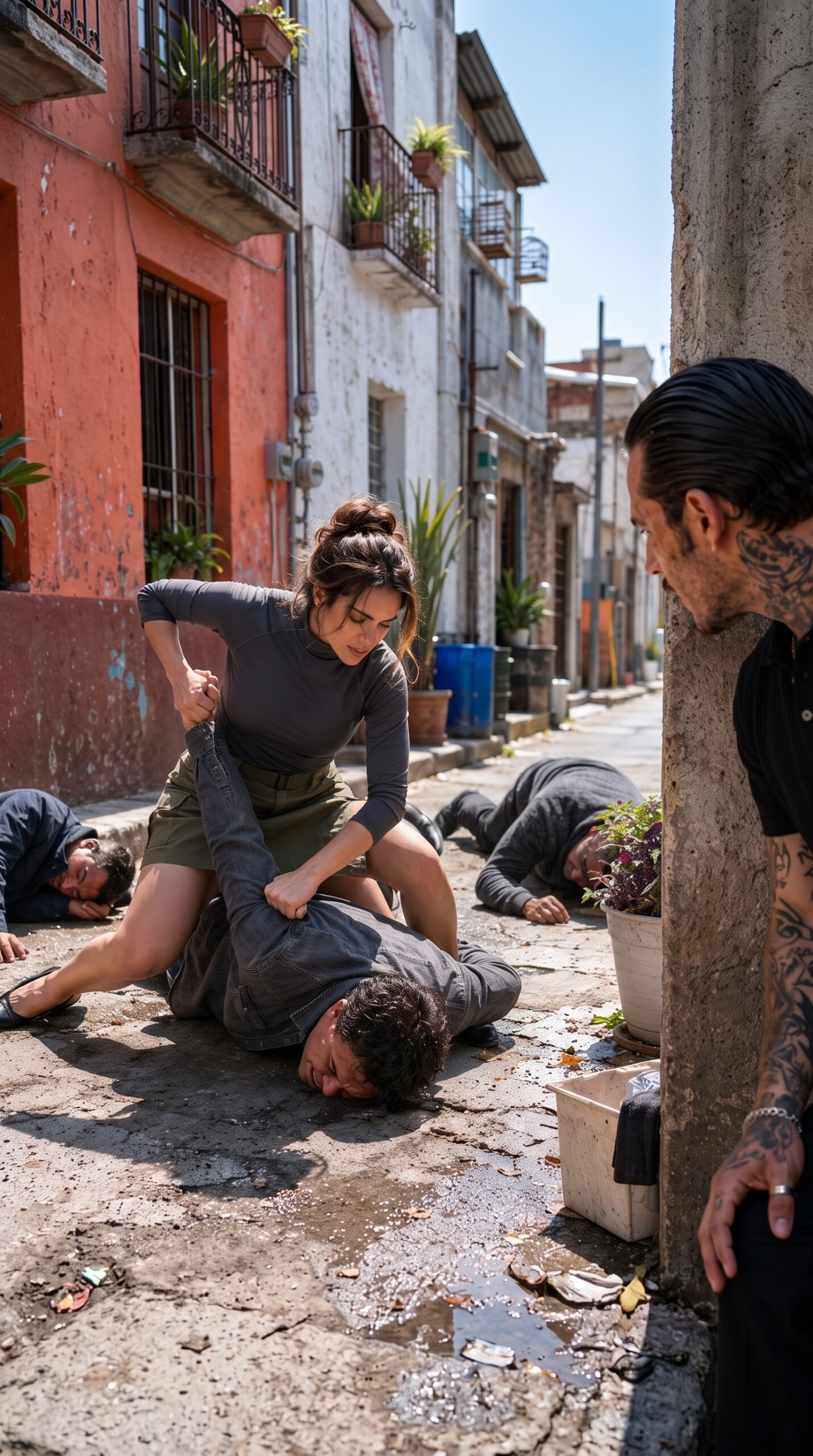
Renata moved as if she had been born for it. In six seconds, the first man fell with his knee buckled against the pavement. The second tried to pull out his gun, but she smashed his nose with the hidden sauce bottle, took the weapon from him, and pinned him against the wall, taking his breath away.
The rain kept falling.
Renata searched the cap man’s pocket and pulled out a red USB drive.
Then she walked toward the exit.
As she passed by the wall where Alonso was hidden, she didn’t look back.
She just said quietly:
—Don’t ever play bodyguard with me again, Alonso Castañeda.
PART 2
For seven days, Alonso didn’t return to the café.
But he couldn’t get Renata out of his head.
He had seen men cry before dying. He had seen partners swear loyalty with one hand and sell him out with the other. He had seen bodies disappear in Xochimilco canals and files vanish from desks at the Public Ministry.
But he had never seen a waitress with worn-out sneakers move with such dry, cold, and precise skill.
It wasn’t rage.
It was training.
And that unsettled him more than any threat.
Alonso sent Pato, his systems guy, to dig up everything about Renata Solís. Pato worked locked away in a department in Narvarte, surrounded by screens, cables, soda cans, and bags of chips. He claimed he could find even the most hidden fine of a congressman.
But with Renata, he found nothing solid.
Her ID was real but too new. Her CURP had no school history. The room she rented in La Obrera was paid in cash by a cleaning company that had no employees. There were no old photos, family, social media, debts, medical consultations, or receipts in her name.
As if Renata had appeared one random Tuesday, already an adult, already beaten, already prepared.
—Boss —Pato said, pale in front of the computer—, this girl doesn’t exist.
Alonso didn’t respond.
—Or worse —he added—. She exists because someone powerful constructed her.
That same night, Doña Catalina was waiting for him at the family home, with the table set and a rosary wrapped in her hand.
Emiliano was there, drinking expensive tequila as if he already owned everything.
—They say you keep asking about that waitress —Doña Catalina said.
Alonso took off his gloves.
—People always tell you many things.
—A woman without a past doesn’t cross paths with a Castañeda by accident.
Emiliano let out a chuckle.
—Maybe she didn’t cross paths at all, Mom. Maybe my brother is just following her like a high school kid.
Alonso looked at him.
—Watch your words.
—Or what? —Emiliano threw his arms wide—. Are you going to beat me up over a waitress?
Doña Catalina banged the table.
—Enough. This family can’t survive with sentimentality.
Alonso held his mother’s gaze.
All his life, she had asked him to be stone, to be knife, to be the monster that safeguarded the name. Now she was accusing him of not being monstrous enough.
—Renata isn’t sentimentality —he said.
Emiliano smiled, venomous.
—Then prove it. Hand her over.
Silence fell over the table.
And in that house, silence always sounded like a threat.
The answer came two nights later.
Viktor Malinov, a foreigner involved in weapons, customs, bought police, and Gulf routes, requested a meeting in an abandoned packing plant in the Central de Abasto.
The place smelled of rotten fruit, diesel, and old fear.
Alonso arrived with five men.
Malinov was waiting for him with fourteen.
—Your waitress hurt two of my men —Viktor said, his Spanish harsh—. And stole something she doesn’t understand.
Alonso kept his face steady.
—She’s not my waitress.
Viktor placed a folder on a metal table.
Inside were photos of Renata exiting the Metro, buying bandages at a pharmacy, entering the café, and walking, weeks earlier, near the port of Veracruz.
—The USB contains an encrypted list —he explained—. Real names of infiltrated agents, protected witnesses, and connections in Mexico, Colombia, Spain, and Eastern Europe. If it’s sold before Friday, over 300 people will wake up dead.
Alonso felt the pieces snap into place.
Renata hadn’t stolen money.
She had taken a bomb from the wrong hands.
—And why are you coming to me? —he asked.
Viktor smiled.
—Because your brother said you were protecting the ghost.
For the first time in years, Alonso felt cold.
Not from Viktor.
From Emiliano.
Upon leaving the packing plant, Alonso ordered to go to the café.
The place was closed. The neon was off. The chairs were on the tables. On the door, there was a paper written in marker:
“Closed for repairs.”
Alonso forced the door open.
Inside, it smelled of bleach, stale bread, and forgotten coffee.
On the back table, where he always sat, there was a sugar packet. Nothing else.
On the back, someone had written in blue ink:
“It has begun.”
Alonso understood too late.
Returning via Viaducto, an old tow truck blocked their path. Then two black SUVs appeared behind them.
Ciro, his driver, cursed.
—They’ve boxed us in, boss.
The bullets hit the armor like hail.
Alonso barely rolled down the window and fired three times. One of the attackers fell, but there were too many. Ciro took a bullet in the shoulder, and the Suburban crashed into the side wall.
The engine died.
Everything filled with smoke, rain, and shattered glass.
—Get out on my side —Ciro growled, clutching his wound.
—I’m not leaving you.
—Don’t be stubborn, boss.
Viktor’s men advanced with rifles, vests, and soldier-like movements. They weren’t corner thugs or makeshift killers.
Alonso checked his magazine.
He had four bullets left.
Then a shadow fell from the pedestrian bridge onto the hood of an enemy truck.
Renata appeared dressed in black, her hair down and a short gun in her hand.
She didn’t shout.
She didn’t threaten.
She didn’t waste a single movement.
She took down the first man from behind, snatched the rifle, shot at the tires of the second SUV, and moved between the broken headlights as if the rain covered her.
One tried to grab her by the neck.
She broke his wrist against the door.
Another tried to shoot from the ground.
Renata kicked the gun into a drain and aimed at his forehead.
—Go to sleep, asshole.
She hit him with the butt.
When it was all over, the Viaducto was filled with smoke and men groaning on the pavement.
Renata opened the door of the Suburban.
—Your driver is bleeding out. Move.
Alonso helped carry Ciro with her. They jumped into an enemy truck and fled through back streets to a clandestine clinic hidden behind a closed auto parts store in Doctores.
As a doctor pulled the bullet from Ciro’s shoulder, Renata sat in front of a broken mirror and began to clean a cut on her eyebrow.
Alonso approached with a gauze.
—Let the doctor handle it.
—He’s busy saving the only decent man who still follows you.
He didn’t answer.
He carefully held her face. Renata could have broken his hand.
She didn’t.
—Who are you? —Alonso asked.
She looked at him through the mirror.
For the first time, she didn’t seem like a tired waitress or an armed ghost.
She looked like a woman exhausted from surviving.
—I was called Sofía Duarte before I was erased from a file.
Alonso held the gauze over the wound.
—Explain.
—I worked for an international unit. We were inserted into criminal networks with false identities. If something went wrong, the government denied everything, and we became administrative dead. Renata Solís was one of my eight lives.
—And the café?
—Underneath, there’s an old fiber line connected to Malinov’s servers. I needed to copy an encryption key. The USB without that key is useless.
Alonso understood.
—That’s why you put up with horrible shifts, insults, and beatings.
Renata lowered her gaze.
—The beatings weren’t part of the job. They were from the manager. He thought a lone woman would always stay quiet.
Alonso’s jaw clenched.
—Tell me his name.
—I didn’t come to ask for revenge.
—I didn’t ask that.
Renata looked at him sadly.
—That’s your problem, Alonso. You think protecting means destroying.
He fell silent.
Because no one dared to speak such truths to him.
Renata pulled out a small cellphone and placed it in his hand.
—Before the attack, I intercepted audios. You have a rat at your own table.
Alonso played the first one.
Emiliano’s voice filled the clinic.
“My brother leaves the café after 2. He goes with Ciro. If they clean him up, the family won’t start a war. I take the chair, and you stay with the route to the port.”
Alonso didn’t blink.
The second audio was worse.
Emiliano gave plates, schedules, warehouse codes, and names of loyal men. He also offered to deliver Renata before Friday.
In the third, Doña Catalina could be heard.
She wasn’t selling Alonso.
But she knew.
“Emiliano, don’t do something stupid. Alonso is still your brother.”
And Emiliano replied:
“Then act deaf, Mom.”
Alonso turned off the cellphone.
That silence hurt more than any bullet.
At 6:45 AM, he returned to Las Lomas with his shirt stained in blood. Renata accompanied him but stayed in the truck, the USB in one hand and the gun in the other.
Doña Catalina was in the living room with the rosary.
Emiliano came down the stairs in a robe, pretending to be sleepy.
—What a miracle, brother. I thought you were still resting.
Alonso placed the cellphone on the marble table.
—Listen to yourself.
The first audio played.
Emiliano lost color from his face.
Doña Catalina closed her eyes.
—Alonso…
—Did you know? —he asked.
She didn’t answer.
That was the answer.
Emiliano tried to pull out a hidden gun from under the robe, but two of Alonso’s men were already aiming at him from the entrance.
—Kill me —Emiliano spat—. That way everyone will see what you are.
Alonso walked toward him.
For ten seconds, everyone thought he was going to shoot.
But Alonso put the weapon away.
—No. Monsters bury secrets. Today I’m going to bring them to light.
Emiliano let out a nervous laugh.
—Now you think you’re good?
—No. But you reminded me that blood can also rot.
Alonso delivered Emiliano alive, with audios, accounts, routes, and names, to the agents Renata was trying to save. He also provided information on Malinov’s businesses so the list would lose value and the infiltrators could escape before Friday.
Doña Catalina didn’t scream.
She just sank into the sofa, clutching the rosary until it marked her fingers.
—He was your brother —she whispered.
Alonso looked at her with a calm shattered to pieces.
—And you were my mother.
That phrase aged her twenty years.
At noon, Renata received confirmation: the list had been blocked, 300 identities were relocated, and Malinov was arrested in a warehouse near Veracruz thanks to the information provided by Alonso.
But that didn’t mean peace.
It meant she had to disappear again.
Alonso took her to the port in a cargo truck, among boxes of mangoes and used parts. No luxury escorts. No suits. No heavy surnames.
At the dock, the wind blew her hair. The cut on her eyebrow looked like a small signature of everything she had survived.
A ship was leaving for Belize before nightfall.
—You shouldn’t remember me —Renata said.
Alonso pulled out the sugar packet she had left in the café.
—It’s too late.
She smiled faintly.
—Ghosts don’t return.
—In Mexico, even the dead come back when they owe a truth.
Renata looked at him for a long time.
She didn’t kiss him.
She just placed two fingers over his chest, right where something human still beat.
—Then don’t let your family finish killing it.
Then she boarded the ship without looking back.
Alonso stayed at the dock until her silhouette disappeared into the Gulf.
That night he returned to the closed café. The tables remained empty. The neon was off. The smell of burnt coffee lingered like a stubborn memory.
On the bar, he found a clean cup.
Inside was another sugar packet.
This time it said:
“Thank you for not shooting.”
Alonso kept it alongside the first.
Since then, every morning, the most feared man in the city ordered black coffee in different places throughout Mexico. Some tasted decent. Others tasted like crap.
But none ever tasted like Renata’s.
And maybe that’s why he could never forget her.
Because there are people who come to save you not from the enemy pointing from across, but from the monster your own family taught you to obey.