PART 1
At 19, Mariana arrived at her parents' house in Puebla with a pregnancy test hidden in her jacket pocket.
They lived in a quiet gated community near San Manuel, the kind where the neighbor across the street knew everything before the family did.
Her mom, Teresa, was folding clean clothes in the living room.
Her dad, Rogelio, had just returned from the auto parts plant in Cuautlancingo. He still wore his gray uniform, heavy boots, and hands stained with grease.
Mariana had rehearsed a thousand times what she was going to say.
But when she stood in front of them, her voice caught in her throat.
She pulled out the pregnancy test and placed it on the coffee table.
Silence fell like a stone.
Teresa stopped folding a sheet.
Rogelio turned off the television without looking at the remote.
—Who’s the father? —he asked.
He didn’t shout.
That was what scared Mariana the most.
She tightened her fingers against her jacket.
—I can’t say yet.
Teresa’s eyes widened in horror.
—What do you mean you can’t? Is he married? Did he do something to you? Is he an older man?
Mariana shook her head.
—No, Mom. It’s none of that. But if I tell you now, everything will get worse.
Rogelio stood up so fast that the chair scraped against the wall.
—Don’t come here with drama. You’re not bringing an unnamed shame into this house.
—Dad, please. One day you will understand.
—Not here —he said, his face hardening—. Either you fix this situation… or you leave.
Teresa started to cry.
But she didn’t defend her.
Mariana begged them. She told them there was a reason, that the baby’s father wasn’t a coward, that the secret wasn’t just hers.
Rogelio refused to listen.
Before an hour had passed, Mariana was outside with an old suitcase, 480 pesos, a thick jacket, and a heart shattered into pieces.
From the window, Teresa watched her leave.
She covered her mouth.
But she never opened the door.
That night, Mariana slept sitting up at the CAPU, clutching her suitcase while the buses came and went.
The next day, she took a bus to Mexico City.
An old high school friend lent her a little room behind a beauty salon in Iztapalapa.
It wasn’t much.
It smelled of hair dye and dampness.
But there she started over.
She sold egg sandwiches before 7 in the morning.
She washed dishes in a diner until the afternoon.
At night, she studied accounting online, even when her eyes closed from exhaustion.
Months later, her son was born.
She named him Mateo.
From babyhood, Mateo looked at the world as if he understood more than he said.
He was quiet, kind, and curious.
He asked why the sky changed color, why his mom never talked about her parents, and why there wasn’t a single picture of his dad in the apartment.
Mariana always gave the same reply.
—Your dad was a good man, sweetheart.
—And my grandparents?
She smiled sadly.
—One day I’ll tell you everything.
That day came when Mateo turned 10.
As they sliced a simple chocolate cake at the kitchen table, he looked at her and said:
—Mom… I’d like to meet them at least once.
A knot formed in Mariana’s throat.
She wasn’t afraid to see her parents.
She was afraid to unearth a truth she had buried for 10 years.
But Mateo deserved to know.
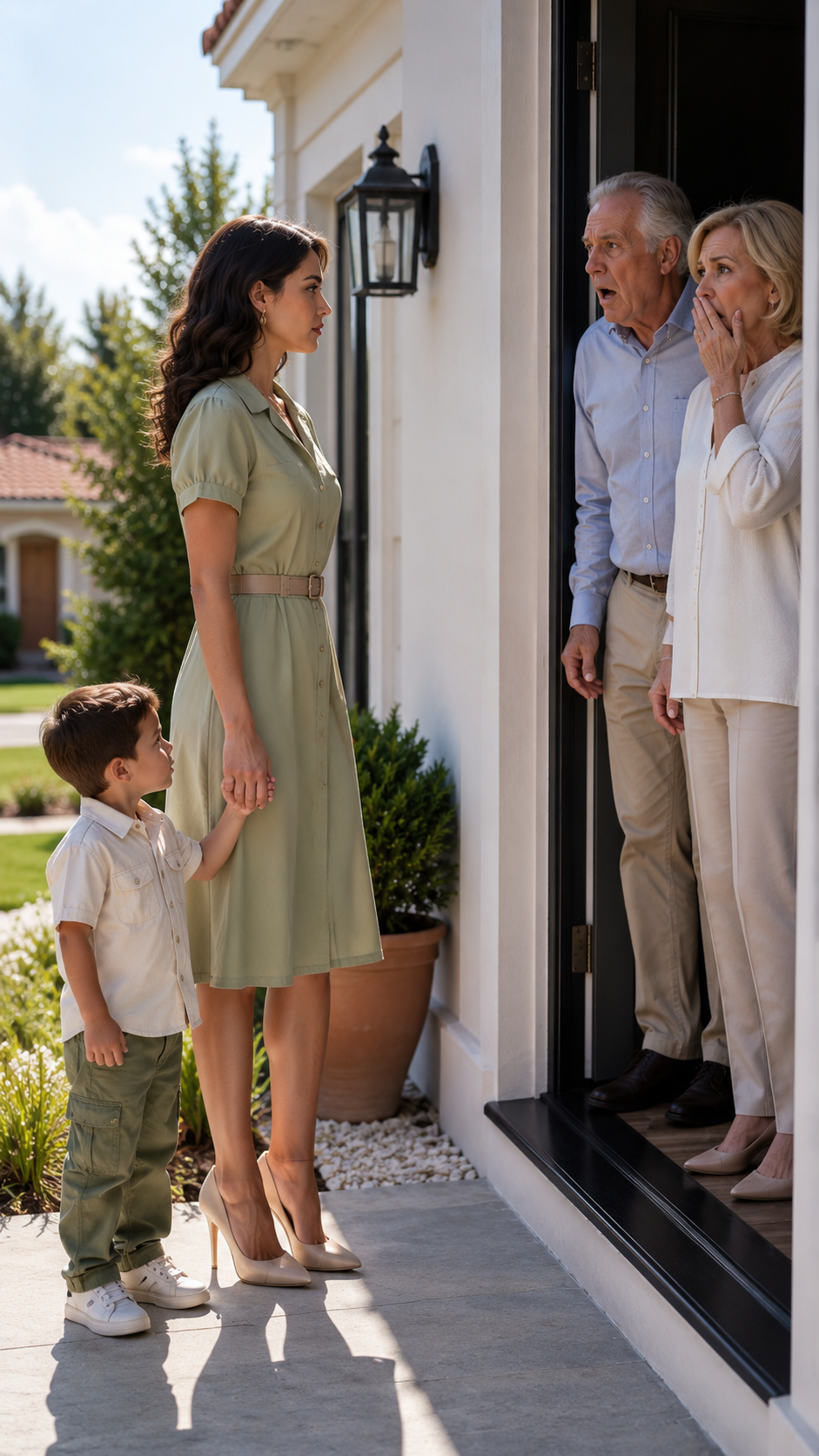
Three days later, they boarded a bus to Puebla.
Mariana carried a backpack, a worn yellow folder, and a USB wrapped in a napkin.
When they arrived at the gated community, everything seemed the same.
The same brown door.
The same bush by the porch.
The same step where she had cried at 19, her belly just beginning to show.
She knocked.
Rogelio opened.
He froze.
—Mariana?
Teresa appeared behind him.
When she saw the boy next to her daughter, she clutched her chest.
No one spoke.
Mateo inched closer to his mom.
Mariana took a deep breath.
—I’ve come because it’s time you know the truth.
Rogelio clenched his jaw.
—After 10 years?
Mariana didn’t respond.
She pulled out an old photo from the folder.
In it, a young engineer, smiling, stood next to Rogelio in front of the plant where they worked.
Teresa let out a choked gasp.
Rogelio took a step back.
Mariana placed the photo on the dining table and turned it over.
On the back, in faded handwriting, was a single phrase:
“Your father gave everything to protect us.”
Rogelio’s hands began to tremble.
Mateo looked at the photo, then back at his mom.
—Mom… is that my dad?
And Rogelio, the man who had kicked her out for “shame” ten years before, collapsed into a chair as if his soul had just been ripped away.
PART 2
Mateo didn’t understand why his grandfather looked so pale.
He only saw a large, tough man who suddenly seemed older than the entire house.
Teresa reached for the photo, but Mariana stopped her.
—Don’t touch it yet, Mom. First, listen.
Rogelio swallowed hard.
—Was Daniel…?
—Yes —Mariana replied—. Daniel Arriaga was Mateo’s father.
The name filled the room like a blow.
Daniel Arriaga had been a safety engineer at the auto parts plant.
He was 25, came from Atlixco, and was one of those men who greeted everyone by name, from managers to cleaning staff.
Rogelio knew him well.
Too well.
Daniel had worked with him on line 4, where a machine had been malfunctioning for months while the company pretended everything was under control.
Mariana met him when she went to drop off food for her dad one rainy afternoon.
Daniel helped her carry a grocery bag that had ripped at the entrance.
Then he invited her for coffee.
Then another.
And without realizing it, Mariana fell in love with the only man who treated her as if her dreams mattered.
But Daniel wasn’t just Mariana’s secret boyfriend.
He was also the man who had discovered that the plant was using defective parts and falsifying reports.
There were photos, emails, audios, and logs.
And among those papers was a signature.
Rogelio’s signature.
—I didn’t know what I was signing —Rogelio whispered, as if talking to himself.
Mariana opened the yellow folder.
She took out old copies, papers with stamps, printed screenshots, and an internal report dated ten years ago.
—Daniel knew you didn’t understand everything, Dad. He knew they used you. That’s why he wanted to protect you.
Teresa began to cry again, but this time without hiding her face.
Mariana plugged the USB into the living room TV.
A blurry video appeared.
Daniel sat inside a car, wearing a blue shirt and an engineer’s helmet on his lap.
His voice sounded tired but firm.
“Mariana, if something happens to me, don’t let them say I was a thief. I didn’t steal anything. I’m keeping this because your dad signed papers that could sink him, but he’s not the culprit. The manager pressured him. If I speak out, they’ll come for everyone. If I stay silent, someone is going to die on that line.”
Rogelio covered his mouth.
The recording continued.
“If our baby is born, tell him that his dad didn’t leave. Tell him I loved him before I even knew his face.”
Mateo stood still.
He didn’t cry.
He just squeezed Mariana’s hand tightly.
The video changed.
Now it showed a plant warehouse.
Screams.
An alarm.
Smoke.
A worker running.
Then Daniel pushing Rogelio away from a machine that sparked and exploded seconds later.
The camera shook.
Then darkness.
Teresa covered both hands with her mouth.
—Oh my God...
Rogelio began to cry silently.
For 10 years, the family had repeated a comfortable story.
That Daniel had been a problematic engineer.
That he got involved with rough people.
That he died looking for trouble.
That Mariana had probably gotten pregnant by some irresponsible guy who didn’t even show his face.
But the truth was different.
Daniel died after saving Rogelio’s life.
And the company turned him into the scapegoat to close the case quickly.
—Why didn’t you say anything? —Teresa asked, her voice broken—. Why did you let us believe so much rubbish?
Mariana looked at her with a sad calm.
—Because Daniel asked me to wait. Because there were threats. Because the company had lawyers, money, and bought people. Because I was 19, pregnant, and my own dad had just kicked me out.
Rogelio lifted his gaze.
—I didn’t know it was Daniel.
—No —Mariana said—. But you did know I was scared. You did know I asked you to listen to me. And still, you shut the door.
That phrase hurt more than any evidence.
Rogelio looked at Mateo.
The boy had the same thoughtful eyes as Daniel.
The same way of furrowing his brow when he tried to understand something.
—Son… —Rogelio said, his voice trembling.
Mateo took a step back.
—Don’t call me that yet.
The room fell silent.
Teresa collapsed into a chair.
—Mariana, I’m sorry. I should have opened the door for you. That night I saw you from the window. I saw you trembling. And I did nothing.
Mariana took a deep breath.
That confession was the wound that burned her the most.
It wasn’t just that her father expelled her.
It was that her mother watched her leave and chose silence.
—For years, I thought I would come back to scream at you —Mariana said—. To tell you I survived without you. That I paid for diapers while washing dishes. That I studied while Mateo slept. That every one of his birthdays, I wondered if one day it would stop hurting.
Teresa was crying uncontrollably.
—But I didn’t come for revenge —Mariana continued—. I came because Mateo wanted to meet you. And because Daniel doesn’t deserve to remain buried under a lie.
Rogelio stood up with difficulty.
He walked to an old piece of furniture and pulled out a metal box.
He opened it with trembling hands.
Inside were newspaper clippings, an old ID from the plant, and a folded letter.
—I kept this —he confessed—. The company paid me to sign that Daniel had ignored the protocol. They told me that if I spoke out, they would accuse me. That I would lose my job, my house, everything.
Mariana looked at him without blinking.
—How much?
Rogelio closed his eyes.
—120,000 pesos.
Teresa looked at him horrified.
—You accepted money?
—I was scared —he murmured.
—No —Mariana said—. You were ashamed. And you preferred that Daniel carry the blame.
Rogelio didn’t defend himself.
Because for the first time, there was no excuse that sounded human.
Mateo walked over to the photo.
He lifted it carefully.
—Did my dad save my grandfather?
Mariana nodded.
—Yes.
—And did my grandfather let everyone think my dad was bad?
No one answered.
But the silence was enough.
Mateo set the photo down on the table.
—So I didn’t come to meet my grandfather. I came to know the truth.
That phrase shattered Rogelio.
The man who had always believed that commanding was the same as loving fell to his knees before his grandson.
—I’m sorry, Mateo. I’m sorry for your dad. I’m sorry for your mom. I’m sorry for being a coward.
Mateo looked at Mariana, seeking permission to feel what he felt.
She didn’t tell him what to do.
She had learned that forcing a child to forgive could also be another form of violence.
So the boy simply said:
—I don’t know if I can forgive him today.
Rogelio lowered his head.
—I understand.
But Mariana still had one more thing.
She pulled out the last document from the folder.
It was a new complaint, filed with the help of a labor lawyer and an organization for victims of industrial accidents.
It included the USB, Daniel’s letter, proof of payment, and Rogelio’s testimony, if he dared to give it.
—Truth isn’t cleansed with tears —Mariana said—. It’s cleansed by signing where you were once afraid to sign.
Rogelio looked at the paper.
For 10 years, he had lived comfortably on a lie.
Now that lie had the face of a child.
And Mateo’s eyes were impossible to ignore.
He took the pen.
He signed.
Teresa also signed as a witness.
Months later, Daniel Arriaga’s case was reopened.
The company tried to deny everything, as always.
But this time there was video, documents, payments, and a worker who finally decided to speak up.
There was no perfect ending.
Daniel didn’t return.
Mariana didn’t recover the years of hunger, fear, and loneliness.
Mateo couldn’t hug his father.
But his name stopped being a shame invented by others.
In a small ceremony in Atlixco, they placed a plaque with his name:
“Daniel Arriaga. Engineer. Father. Just man.”
Mateo brought white flowers.
Rogelio arrived separately, not demanding a place in the family.
He just stood there, crying in front of the plaque.
Mariana watched him from afar.
Teresa wanted to take her hand, but she didn’t allow it yet.
Some wounds don’t heal because someone says "I’m sorry."
Sometimes regret arrives ten years late and still wants to sit at the table as if nothing happened.
Mateo looked at his mom and asked:
—Does family always deserve another chance?
Mariana took time to respond.
Then she stroked his hair and said:
—Family deserves the truth. The opportunity… that must be earned.
And that was the phrase everyone in the gated community talked about for weeks, because in Mexico, many people speak of blood, surname, and respect.
But few dare to accept that sometimes, the one who shuts the door is still family…
They just lose the right to enter whenever they want.





