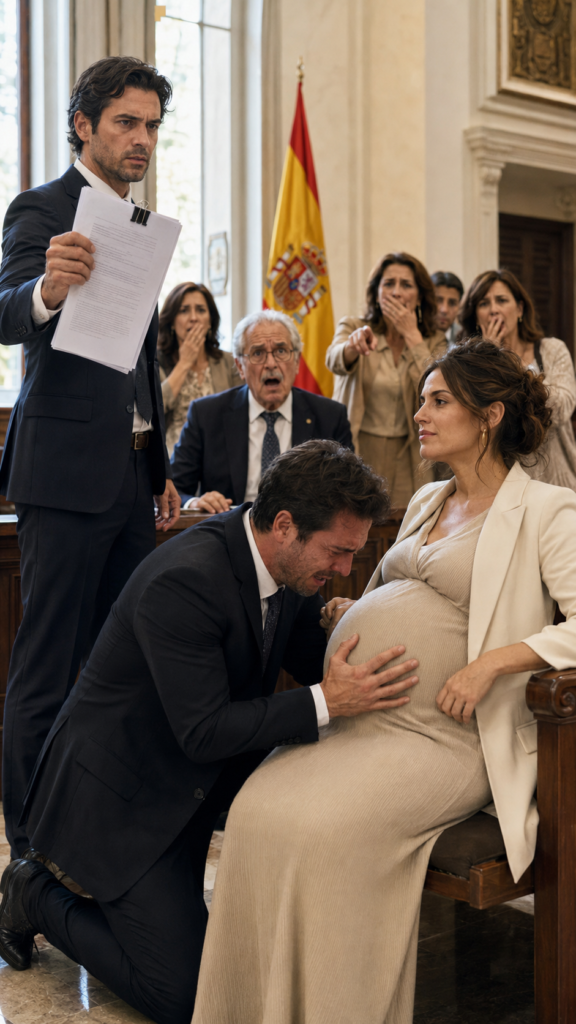
PART 1
—You’re leaving here with one suitcase, one baby in your arms, and not a single penny, Mariana.
Esteban Luján said it with a smile, as if he were closing a business deal, not destroying his pregnant wife of eight months in front of half the family court in Mexico City.
Mariana Salgado sat across the table, dressed in a simple blue dress, her ankles swollen, one hand resting on her belly.
She didn’t cry.
Not when she heard the whispers.
Not when she saw reporters pressed against the glass of the hallway.
Not when Paola Rivas, Esteban’s lover, let out a giggle from the front row.
Paola was 25, with red lips, a white dress, and a pearl necklace that Mariana recognized immediately.
That necklace had belonged to her mother.
Esteban followed Mariana's gaze and smiled cruelly.
—It looks better on her. You won't need jewelry anymore.
Paola shamelessly touched the necklace.
—Oh, how intense. But everyone gets what they deserve, right?
Mariana felt a sharp kick in her belly. As if her child understood the humiliation, too.
For six years, people had said Mariana was lucky.
She had married the owner of Consorcio Luján, a powerful construction firm with buildings in Santa Fe, Monterrey, Querétaro, and Cancun.
At dinners in Polanco, she was introduced as “the discreet wife.”
In magazines, they called her “the woman who softened Mexico’s toughest businessman.”
But no one knew that Esteban checked her phone.
No one knew he cut off her credit card when she asked questions.
No one knew he repeated:
—You don’t understand money, Mariana. That’s why I’m here.
What Esteban forgot was that Mariana had worked for seven years as a financial auditor before they married.
She knew how to read balance sheets.
She knew how to track transfers.
She knew how to find hidden lies among elegant invoices.
Judge Ramiro Medina entered the courtroom, and everyone stood up.
Esteban’s lawyer, Óscar Madrigal, opened a thick folder.
—Your Honor, the prenuptial agreements are clear. Mrs. Salgado waived properties, shares, dividends, accounts, bonds, and any benefits related to Consorcio Luján.
He placed some documents on the table.
—My client, out of consideration, offers 2 million pesos, medical coverage until childbirth, and the clothes that the lady can prove are hers.
Paola laughed again.
—He’s giving her too much.
Mariana clenched her fingers over her belly but didn’t lower her gaze.
Her lawyer, Licenciada Abril Quintana, gently touched her wrist.
It was the signal.
Not yet.
Esteban leaned toward Mariana.
—Sign today, and maybe I’ll let you stay in the house until the baby is born. If you keep up this little act, you’re out tonight.
The judge looked at Abril.
—Licenciada Quintana, does your client accept the terms?
Abril stood up calmly.
—No, Your Honor. Before executing those agreements, we request to review a special condition of the Luján family trust.
Esteban stopped smiling.
His mother, Doña Regina, sitting behind him, turned pale.
Abril opened a black folder.
—We’re referring to Clause 14, ratified by Mr. Esteban Luján in 2019.
Esteban turned to his mother.
—What Clause 14?
Doña Regina didn’t respond.
Mariana looked forward, took a deep breath, and for the first time all morning, smiled faintly.
Because while Esteban’s lawyer began to read the marked page, no one in that room could believe what was about to happen.
PART 2
The story hadn’t started in the courtroom.
It had begun three months earlier, inside the mansion in Las Lomas where Mariana lived surrounded by marble, huge windows, and icy silences.
From the outside, the house seemed perfect.
Inside, it was a cage with employees.
When Mariana found the first receipt from a hotel in Reforma, Esteban told her she was imagining things.
When she saw a bill from a jewelry store in Masaryk under Paola Rivas’s name, he told her it was a gift for a client.
When she discovered that Paola’s apartment in Polanco was being paid for from an account linked to Consorcio Luján, Esteban closed the laptop in front of her.
—You’re pregnant, hormonal, and paranoid. Seriously, Mariana, you’re embarrassing yourself.
That night he stripped her of access to the accounts.
The next day he canceled two credit cards.
A week later, her lawyer sent her the draft of the divorce.
Mariana read it sitting in the baby’s room, one hand on her belly and the other on a box of diapers she had bought herself.
The document said she would leave with almost nothing.
No house.
No shares.
No real alimony.
No protection after childbirth.
Esteban had prepared everything as if she were an old piece of furniture he could toss out the back door.
But he made one mistake.
He underestimated her too much.
That night, while Esteban was on a “business trip” in Monterrey with Paola, Mariana went to the old family home in Coyoacán.
There, in an underground archive, Doña Regina kept old documents from Grandpa Luján: deeds, minutes, contracts, trusts, and secrets the family preferred to forget.
Mariana remembered the code.
Years ago, Esteban had given it to her so she could organize papers for an internal audit. He never thought a “obedient” wife could remember something useful.
The metal door opened with a dry sound.
Inside, it smelled of dust, old leather, and hidden money.
Mariana rummaged through boxes for hours.
Her back ached.
Her feet burned.
The baby moved every time she bent down.
But she continued.
She found land deeds.
Construction contracts.
Board minutes.
Until she found a green folder with golden letters:
Luján Trust. Estate succession. Reforms 1998-2019.
Mariana opened it on a table and began to read.
Page after page.
Until she reached Clause 14.
It was not a romantic clause.
It was a bomb.
It stated that any heir with share control would lose their voting rights if it was proven that they had used family or corporate resources to sustain an extramarital relationship and, furthermore, attempted to economically rob the affected spouse through prenuptial agreements executed in bad faith.
In that case, the rights would be transferred to a trust in favor of the legitimate child of the marriage.
And the affected spouse would be the sole administrator until the minor turned 25.
Mariana read the page four times.
Then she looked at the signature.
Esteban Luján.
Year 2019.
He had ratified everything without reading it, confident that no paper could touch him.
During the following weeks, Mariana didn’t scream.
She didn’t complain.
She didn’t make scenes.
She let Esteban believe she was broken.
When he sent her messages saying “start looking for a rental,” she saved screenshots.
When Paola posted stories from the apartment in Polanco, Mariana downloaded videos.
When Doña Regina told her over the phone: “Decent women don’t make scenes,” Mariana recorded the call.
She collected hotel bills.
Jewelry purchases.
Transfers of 4 million pesos.
Rental contracts.
Internal emails.
Flight receipts.
And messages where Esteban boasted he’d leave her “without financial oxygen” before the baby was born.
Abril Quintana, her lawyer, reviewed everything in silence.
When she finished, she lifted her gaze.
—Mariana, this is no longer just a divorce. This could take control of the company from him.
But the file hid another blow.
Esteban had hired a private investigator to follow Paola.
Not out of guilt.
Out of distrust.
Paola had told him she was pregnant too.
She demanded a house in Valle de Bravo, 10 million pesos, and a personal trust before publicly announcing it.
But the report showed that the ultrasounds were fake.
The images came from a foreign medical database.
Paola had never been pregnant.
Now, in the courtroom, Abril connected a USB drive to the screen.
Óscar Madrigal jumped up.
—Objection! That information is private.
Judge Medina looked at him sternly.
—Sit down, Counsel. If it affects family assets and corporate resources, this court will review it.
The screen lit up.
First, a photo of the Gran Reforma Hotel appeared.
Esteban was entering with Paola, his arm around her waist.
Then a jewelry bill.
Next, the contract for the apartment in Polanco.
Then, transfers made from a phantom company linked to Consorcio Luján.
Paola stopped smiling.
Doña Regina closed her eyes.
Esteban clenched his fists.
—This won’t end well for you, Mariana.
She didn’t respond.
Abril placed a white envelope on the table.
—Additionally, we present the report requested by Mr. Luján regarding Miss Paola Rivas.
Paola straightened up.
—What report?
Esteban didn’t look at her.
And that silence was enough for her to understand.
Abril read firmly:
—Miss Rivas presented false ultrasounds to simulate a pregnancy. There are also messages where she conditions her stay with Mr. Luján to the delivery of assets, money, and jewelry belonging to the wife.
Paola jumped up furious.
—Did you investigate me, you jerk?
Esteban spoke through clenched teeth.
—You lied to me.
Paola let out a broken laugh.
—Did I lie to you? You told me Mariana was a deadbeat, that you’d toss her out of your house and that your child with her wouldn’t be a burden.
Mariana closed her eyes for a second.
Not because she was surprised.
But because hearing that cruelty in public hurt differently.
Paola kept shouting:
—I was promised her necklace, her room, her place in your life! You told me that after the birth, she would beg you for money!
The judge banged the table.
—Order.
But the courtroom was already boiling.
Doña Regina leaned toward Esteban and whispered, though everyone heard:
—I told you never to mix your whims with family money.
Esteban turned to her with rage.
—Fix this.
But Doña Regina didn’t respond.
For the first time, the Luján surname didn’t seem sufficient.
Abril placed herself in front of the judge.
—Your Honor, Clause 14 does not punish moral infidelity. It punishes asset misconduct: documented adultery, misappropriation of resources, and using prenuptial agreements to leave a pregnant wife without economic protection.
She pointed at the screen.
—We have hotel payments with corporate accounts, jewelry purchased with money from a related partnership, apartment rent through a phantom company, and messages where Mr. Luján declares his intention to leave my client without resources before childbirth.
The judge read in silence.
Óscar Madrigal was no longer smiling. He flipped through pages as if searching for a hidden escape among the paragraphs.
But there was no escape.
The judge removed his glasses.
—This court recognizes the validity of the prenuptial agreements. However, it also recognizes that said agreements were voluntarily linked to the Luján family trust, ratified by Mr. Esteban Luján in 2019.
Esteban stood up.
—That’s absurd! Consorcio Luján is mine!
—Sit down —the judge ordered.
Esteban froze.
The judge repeated:
—Sit down.
And for the first time in a long time, Esteban obeyed.
—Based on the documentation presented —the judge continued—, Clause 14 is provisionally activated. The voting rights corresponding to Mr. Esteban Luján’s personal shares will be suspended and transferred to the trust for the unborn minor.
Paola fell silent.
Doña Regina dropped the rosary she had been holding.
Óscar closed his folder.
—Mrs. Mariana Salgado will be the sole administrator of those rights until the minor turns 25.
Esteban paled.
—No...
—Economic protection measures are also ordered, complete medical coverage, access to the family home until the birth, and review of the corporate movements indicated. Any potential financial crime will be referred to the appropriate authority.
The courtroom fell silent.
Everyone understood the same thing.
Esteban had not only lost a divorce.
He had lost control of his empire.
Paola tried to approach him, but the guards stopped her.
—You ruined me! —she shouted.
Esteban looked at her with disdain.
—You ruined yourself.
Mariana watched that scene without feeling victory.
She felt exhaustion.
She felt pain.
She felt the immense sadness of having loved a man capable of humiliating her while their child still lay within her.
Esteban turned to Mariana.
—You planned this.
Mariana stood up slowly. Her hip, back, feet, and entire life hurt.
But her voice came out clear.
—No, Esteban. You planned everything. I just read what you signed.
He clenched his jaw.
—You don’t know how to run a business.
Mariana lifted her chin.
—Maybe I don’t know how to threaten like you do. But I know how to count. I know how to audit. And I know how to recognize a man who thought he was untouchable just before he fell.
When they left the courtroom, reporters flooded the hallway.
—Mariana! How do you feel after winning?
She stopped.
Looked at the cameras.
Then looked at her belly.
—I didn’t come to win. I came to make sure my child wouldn’t be born inheriting his mother’s fear or his father’s arrogance.
That phrase went viral that same night.
But the real scandal was just beginning.
In less than two weeks, the board of Consorcio Luján called an extraordinary session.
The banks demanded explanations.
Several partners suspended contracts.
The tax authority requested to review payments to nonexistent providers.
Esteban was temporarily removed from the general management while the investigation advanced.
Paola deleted her social media after it leaked that her ultrasounds were fake.
The pearl necklace returned to Mariana by court order.
Doña Regina tried to visit her in Las Lomas.
She didn’t come to apologize.
She came to ask for silence.
—Mariana, think of the family. A scandal like this could destroy us.
Mariana received her in the living room, wearing a simple robe and a tired face.
—Your family was destroyed when you chose to protect Esteban instead of correcting him.
Doña Regina wanted to respond, but she couldn’t.
Because it was true.
One month later, Nicolás was born.
Mariana held him against her chest in a bright hospital room. The baby breathed softly, warmly, alive.
For the first time in a long time, she didn’t feel fear.
That night a message came from Esteban:
You took everything from me.
Mariana read it while Nicolás slept.
Then she deleted it.
She hadn’t taken everything from him.
She had merely stopped allowing him to keep taking her life.
At 40 days, Mariana entered the boardroom of Consorcio Luján for the first time.
She wore a simple black suit, her hair pulled back, and her mother’s pearl necklace.
The twelve board members stood up.
Not out of pity.
Not out of courtesy.
But because the woman Esteban called a “burden” now administered the vote that could decide the future of the empire.
Mariana placed a folder on the main table.
She looked at everyone calmly.
—Gentlemen, let’s start by reviewing the accounts my husband never wanted anyone to see.
And in that room where for years only the Luján family had commanded, no one dared to interrupt her.





