PART 1
Room 3 of the Family Court in Mexico City was so tense that even the sound of the fans felt like fear.
Lawyers in expensive suits reviewed files, a clerk arranged papers, and in the back, an elderly woman clutched her purse as if it contained the last piece of calm she had left.
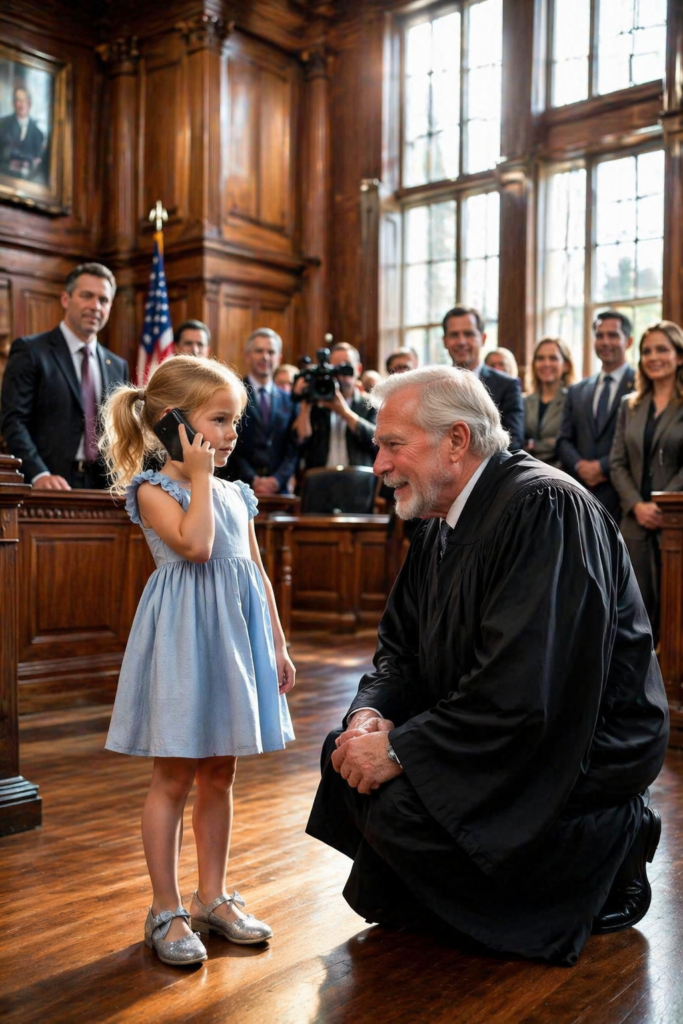
Amid it all was a five-year-old girl in a pink dress, white laces, and worn shoes.
Her name was Sofia.
No one understood why she looked so serious at all the adults, as if she were the only one who knew the truth.
Judge Arturo Salcedo, notorious for not allowing a misplaced sigh, watched from the bench in his black robe, his hardened face making even the sharpest lawyers tremble.
He had spent 27 years judging broken families.
He thought he had seen it all.
Divorces filled with shouts, inheritances laced with insults, parents using their children as currency, mothers silently crying to avoid appearing weak.
But that morning, a little girl was going to shatter his life in front of everyone.
During a brief recess, Sofia climbed down from the bench where she had been sitting with her grandmother, Elena.
She walked leisurely toward the lawyers' table.
Lawyer Octavio Rivas, representing a man named Mauricio Aranda, was preoccupied speaking with his assistant.
Sofia reached into the jacket hanging on the chair, pulled out a black cellphone, and returned to the center of the room as if nothing had happened.
No one saw her.
Or no one wanted to see her.
When the judge heard the ringtone, he lifted his gaze above his glasses.
"What are you doing, miss?"
Sofia wasn't scared.
"I'm calling."
A murmur swept through the room.
Judge Arturo raised an eyebrow.
"And who are you calling?"
The little girl looked at him with a confidence too big for her tiny body.
"Whoever I want."
For the first time in years, the judge burst into laughter.
It wasn't a discreet smile.
It was a full, loud, unexpected laugh.
The lawyers exchanged glances. The clerk bowed her head to hide a smile. Even the court officer pressed his lips together to stifle a chuckle.
Judge Arturo lightly slapped the table with his palm.
"Well then, call whoever you want."
It seemed like a tender moment.
An innocent breath in a bitter hearing.
But then the call came in.
And the laughter began to die.
A woman's voice came from the speaker.
Tired.
Scared.
With a tremor that froze the judge in place.
"Sofi? My love? Where are you?"
The girl smiled.
"Mom."
The entire room froze.
Judge Arturo felt the air vanish suddenly.
That voice was no ordinary voice.
It was Valeria.
His daughter.
The daughter who hadn't spoken to him in two years.
The daughter who had returned unopened letters, changed her number, who had told him one afternoon in his office:
"When you understand what it means to be a father, we’ll talk."
Arturo hadn’t understood.
Or he hadn't wanted to understand.
Now that voice filled his courtroom, emerging from a cellphone stolen by a girl he barely recognized.
Sofia.
His granddaughter.
The girl he had seen only three times in his life.
Once in the hospital.
Once during an awkward Christmas.
And once more from afar, when Valeria crossed the street to avoid him.
Sofia looked up.
"Are you my grandfather Arturo?"
The question cut deeper than any accusation.
The judge swallowed hard.
"Yes."
The girl brought the phone closer.
"Mom says you should talk."
Arturo stepped down from the bench.
Three steps.
Nothing more.
But in those three steps, all the pride of a lifetime crashed down on him.
He knelt before Sofia and took the cellphone with both hands.
"Valeria..."
On the other end, a soft sob echoed.
"Dad."
The word shattered his heart.
Before he could say anything else, Valeria gasped, releasing a phrase that left the courtroom soul-less:
"That man is trying to take my daughter before my surgery... and you were about to let him."
PART 2
Arturo felt the robe weigh on him as if it were made of stones.
He looked at Octavio Rivas, Sofia's father's lawyer.
The man immediately dropped his gaze.
That detail said it all.
The girl hadn’t stolen a cellphone out of mischief.
She had stolen it because that device contained her mother’s number.
And because all the adults had been talking about her for weeks as if she were a file, not a scared little girl.
"What surgery?" Arturo asked, his voice breaking.
A long silence followed.
One of those silences that hides no doubts, only pain.
Valeria replied:
"Breast cancer. Stage 2. I've been undergoing chemotherapy for four months."
The room seemed to twist around the judge.
Four months.
His daughter had been sick for four months.
She had lost strength, hair, sleep, and her sense of security.
She had vomited in hospital restrooms, signed papers with trembling hands, and had smiled in front of Sofia so that the little girl wouldn't feel afraid.
And he had known nothing.
Not because no one could warn him.
But because two years ago, he had chosen to be right over being a father.
Arturo closed his eyes.
He recalled that afternoon in his office.
Valeria had arrived with dark circles, folders, and printed messages.
Mauricio, her ex-husband, wasn’t following visitation schedules.
He left Sofia with strangers.
He didn’t take the girl to the pediatrician.
He returned her dirty, hungry, and crying.
Valeria hadn’t asked her father to break the law.
She had asked him to listen.
To guide her.
To believe her.
Arturo had responded as a judge.
Not as a dad.
"You need to follow the legal avenues," he had told her then. "I can’t intervene."
Valeria had cried out of rage.
"Sofia is three years old. She’s not a case; she’s your granddaughter."
He had hardened his voice.
"Don’t confuse my neutrality with indifference."
Valeria had looked at him with a sadness that still haunted him.
"Your neutrality is indifference in a robe."
Then she left.
And she didn’t come back.
Now, two years later, that phrase returned with all its force.
Arturo tightened his grip on the phone.
"Valeria, I didn’t know."
"No," she replied. "You didn’t know because you never asked."
That truth hurt him more than any insult.
In the back, Elena, Arturo's ex-wife and Sofia's grandmother, remained seated.
She didn’t cry.
She didn’t smile.
She just watched with that gaze of a woman who had waited too long for a man to understand the obvious.
Arturo looked at her.
"You knew."
"Yes," Elena said.
"Why didn’t you tell me?"
She slowly stood up.
"Because Valeria wanted to see if you would ever step down from your bench of your own accord."
Arturo had no answer.
Lawyer Octavio attempted to speak.
"Your honor, with all due respect, this matter must continue according to the law..."
Arturo turned toward him.
The courtroom suddenly remembered that man was still a judge.
"Mr. Rivas, be silent."
Octavio swallowed hard.
"But my client..."
"Your client filed an emergency custody request using a woman’s illness as a weapon," Arturo said. "And you, knowing the context, withheld relevant information in a hearing that involves a minor."
The lawyer went pale.
"I only represent legal interests."
"No," Arturo replied. "You are representing a miserable strategy."
The clerk stopped writing.
The court officer stood even straighter.
Arturo took a deep breath.
He knew he could no longer continue.
He couldn’t touch that file.
He couldn’t save his daughter from the very place he had abandoned her.
And for the first time in his life, he understood that doing the right thing didn’t mean controlling the outcome.
It meant stepping aside.
"The hearing is suspended," he ordered. "This matter will be reassigned due to a conflict of interest. The minor will remain temporarily under the care of her maternal grandmother until another judge reviews urgent measures. And let it be recorded everything that has transpired."
Octavio opened his mouth, but then closed it.
Sofia tugged at Arturo's sleeve.
"Is my mom going to die?"
The question shattered him.
Arturo knelt again.
No longer before a courtroom.
Before a child.
"I don’t know, my love," he said honestly. "But we’re going to do everything to make sure she’s accompanied."
Sofia studied him.
"My mom cries in the bathroom so I don’t hear her."
Arturo felt something inside him break silently.
From the phone, Valeria's voice came through:
"Don’t promise him things you won’t keep, Dad."
He lowered his head.
"I’m not going to promise. I’m going to start."
That afternoon, Arturo didn’t return to his office.
He went home to Coyoacán with Elena.
Sofia fell asleep on a couch, a turtle plush toy under her arm.
In the kitchen, Elena served him coffee without sugar.
He drank it even though it tasted like punishment.
"You lost her because of your pride," Elena said.
There was no cruelty in her voice.
Only weariness.
"I know."
"No, Arturo. You’re just beginning to know. Losing a hearing is one thing. Losing a daughter and still thinking you're innocent is another."
He held the cup with both hands.
He looked older.
Smaller.
More human.
"Mauricio always seemed like a decent guy to me," he murmured.
Elena let out a bitter laugh.
"Of course. Nice suit, office smile, measured words. Men like that, you all believe quickly. Tired women have to prove even the air they breathe."
Arturo couldn’t defend himself.
Because it was true.
That night, Valeria called.
It wasn’t a pretty reconciliation.
There was no background music or instant forgiveness.
It was a tough conversation, filled with pauses, reproaches, and truths.
Valeria told him about the diagnosis.
About the lump she found while showering.
About the biopsy.
About the doctor saying, "We need to act fast."
About how she locked herself in the car to scream because Sofia was at school and she couldn’t break down before picking her up.
She told him about the chemotherapy.
About the hair on the pillow.
About the metallic taste in her mouth.
About the fear of not reaching her daughter's 6th birthday.
And then she told him the worst.
Mauricio had found her medical information through the insurance.
He hadn’t asked if he could help.
He hadn’t offered to care for Sofia.
He hadn’t brought food.
He hadn’t sent a single decent message.
He went with his lawyer and said:
"A woman with cancer can’t raise a girl alone."
Arturo gritted his teeth.
"That bastard..."
"I don’t need you to hate him for me," Valeria interrupted. "I need you to stop being late to everything."
He closed his eyes.
"You’re right."
Valeria fell silent.
Perhaps she expected excuses.
But finally, they didn’t come.
"I failed," Arturo said. "Not just two years ago. I failed you before. Every time I chose a hearing over a meal. Every time I said, 'not now.' Every time I thought providing was the same as being there."
On the other end, Valeria cried.
"I needed a dad."
"I know."
"No. You knew. You just didn’t want to listen."
Arturo accepted the phrase without defending himself.
That was the first small justice.
The next day, he formally submitted his recusal.
The case was assigned to Judge Maribel Castañeda, a woman known for reading even the notes in the margins and for not being impressed by surnames, suits, or connections.
Mauricio arrived at the new hearing impeccably dressed.
White shirt, blue blazer, the face of a worried father.
He said he loved Sofia.
He said Valeria was weak.
He said a girl needed stability.
But Judge Maribel didn’t confuse stability with control.
She reviewed school reports.
Messages.
Medical history.
Records of noncompliance.
Photos of Sofia returning sick.
Pediatrician’s notes.
And a recording of Mauricio telling a friend:
"Right now that Valeria is sick, it’s the moment. If I take the girl, she won’t get up later."
In the room, no one spoke.
Valeria closed her eyes.
Arturo, sitting in the back, felt ashamed for not having seen earlier what was so clear.
Mauricio didn’t want to care.
He wanted to win.
The judge issued measures.
Valeria would maintain primary custody.
Mauricio would have supervised visits, psychological evaluation, and a requirement to attend parental therapy.
Additionally, there would be an investigation into possible vicarious violence and the malicious use of medical information.
Octavio Rivas left the room without looking at anyone.
Mauricio attempted to approach Sofia.
The girl hid behind Elena.
That spoke more than 20 files.
Weeks later, Arturo traveled with Valeria to a chemotherapy session.
At first, she didn’t know what to do with him there.
He didn’t either.
He arrived with flowers.
Valeria looked at them.
"I can’t handle strong smells after chemo."
Arturo turned red.
"I’m sorry. I should have asked."
She watched him.
That phrase was new.
It wasn’t "I thought."
It wasn’t "don’t exaggerate."
It was "I should have asked."
And while it didn’t heal everything, it opened a door.
The next time, he arrived without flowers.
He brought salty crackers, ginger tea, a soft blanket, and a notebook.
"And what’s that?" Valeria asked.
"To jot down what you need."
She almost laughed.
"Are you going to take notes on your daughter?"
"I took notes on strangers for 27 years. It was about time I did it with you."
Valeria looked out the window.
She didn’t want to cry.
But she did.
Arturo began to fulfill small things.
Taking Sofia to school.
Picking up medicines.
Sitting quietly during studies.
Not giving opinions when no one asked for his opinion.
Not turning every act of help into a speech.
He learned that being present wasn’t about appearing at the dramatic moment.
It was about repeating.
Showing up.
Staying.
Listening to the same fear ten times without saying, "It’s over."
One afternoon, Sofia gave him a gray pebble in the hospital park.
"It’s so you remember us when you're not here."
Arturo received it as if it were gold.
"I’ll keep it forever."
"You better, Grandpa," she said, very seriously.
He smiled with tears in his eyes.
Months later, Valeria finished chemotherapy.
The surgery went well.
The doctors spoke cautiously, but with hope.
Clean margins.
Good response.
Remission.
Arturo cried in the hospital corridor.
Elena handed him a tissue without saying anything.
She still hadn’t completely forgiven him.
Valeria hadn’t either.
But they no longer kept him out.
And sometimes, in a broken family, that’s the first miracle.
At the end of that year, Arturo announced his retirement.
The Judicial Power organized a ceremony.
There were speeches about his career, his discipline, his sentences, his incorruptible character.
He listened to it all with a sad smile.
When it was his turn to speak, he approached the microphone.
"For years I believed that justice always demanded distance," he said. "Sometimes it does. But I confused distance with greatness in the places where my family needed presence."
The room fell silent.
"I was a good judge many times. But I wasn’t a good father when it mattered most. And no position compensates for that."
Valeria sat in the front row.
With her hair growing in short waves.
Sofia was beside her, swinging her feet.
Arturo touched the gray pebble in his pocket.
"A little girl in a pink dress taught me that sometimes the most important act of a judge isn’t to pass sentence. It’s to step down from the bench."
Sofia raised her hand and shouted:
"I did it!"
The room laughed tenderly.
Arturo laughed too.
But this time his laughter wasn’t prideful.
It was gratitude.
Two years later, on a Sunday afternoon, the family was eating at Valeria’s house.
Elena had brought red rice.
Sofia placed the cutlery upside down and defended her decision by saying the table needed creativity.
Valeria laughed from the kitchen.
Arturo looked at her.
Alive.
Strong.
Sometimes tired, yes.
But present.
And so was he.
After eating, Sofia sat next to him on the patio.
"Grandpa."
"Yes?"
"Do you remember when I stole the lawyer’s cellphone?"
Arturo let out a soft laugh.
"I remember every day."
"Did I get you in trouble?"
He took her hand.
"No, Sofi. You brought me home."
The little girl rested her head on his arm.
"Then I did good."
Arturo looked up at the sky of Mexico City, filled with wires, noise, and the evening light.
He thought about all the years he had believed that his most important place was the bench.
He had been wrong.
His place was there.
In a simple chair.
With his daughter alive nearby.
With his granddaughter resting on him.
With a family that didn’t absolve him immediately, but did allow him to fulfill a different sentence:
To love while there was still time.





