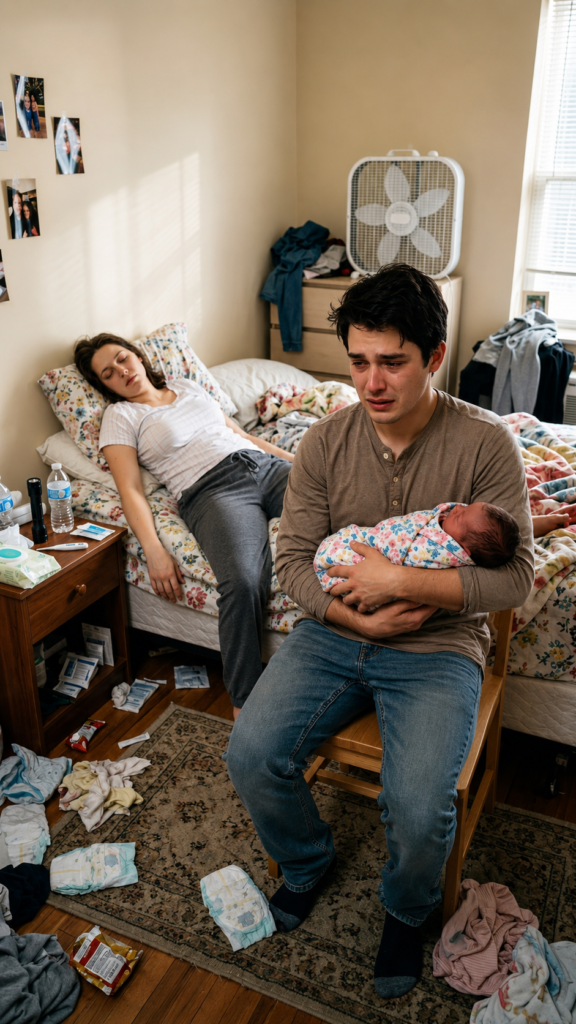
PART 1
Diego Morales believed for years that family was the one thing that would never betray you.
He lived in a rented house in Tlalnepantla, in a neighborhood where everyone greeted each other from the sidewalk and gossip traveled faster than the bus. He worked as a supervisor in a construction materials warehouse, leaving before dawn and coming home with hands smelling of dust, cardboard, and exhaustion.
His wife, Sofía, was the complete opposite of the noise of the world.
She spoke softly, thanked everyone for everything, and apologized even when someone else bumped into her at the market. With two used curtains, a borrowed crib, and a yellow blanket, she had turned a humble room into the coziest place in the house.
When Mateo, their first child, was born, Diego felt that life had finally given them something pure.
The baby was only 7 days old. He was tiny, red-faced, with clenched fists and such fragile breathing that Diego woke up every ten minutes to check that he was still alive.
Sofía left the IMSS exhausted, her body sore, with a folder full of medical instructions. It clearly stated: rest, fluids, food, medication, and immediate emergencies if there was fever, extreme weakness, fainting, or if the baby stopped eating.
Diego underlined those phrases with a blue pen.
But on the fourth day, he received a call from work.
At the Querétaro branch, inventory was missing, documents bore his signature, and a supplier was threatening a lawsuit. His boss asked him to travel for four days to fix the disaster.
Diego wanted to refuse.
Sofía couldn’t get up without feeling dizzy. Mateo cried from hunger every few hours. The house smelled of warm milk, ointment, and overdue sleep.
Then Doña Teresa, Diego's mother, arrived with her large bag and authoritative voice.
“Go, son. I raised two kids without crying. Sofía and the baby will be fine.”
Mariana, Diego's younger sister, held Mateo and let out a giggle.
“Seriously, Diego, you look like a dramatic first-timer. It’s just a baby, not a bomb.”
Diego explained everything to them. He showed them the folder. He left formula, water, diapers, medication, and prepared food.
Before leaving, he kissed Sofía's forehead.
“I’ll be back quickly.”
She tried to smile, but her eyes seemed to beg him not to go.
During the trip, Diego called many times. Doña Teresa always answered. Sofía appeared on screen for a few seconds, increasingly pale, with dry lips and a vacant gaze.
When Diego asked, his mother gave the same response:
“She’s sensitive. All women get like that after childbirth.”
On the third night, he heard Mateo crying.
It wasn’t a tantrum. It was a dry, broken sound, as if his little body no longer had strength.
Diego drove back without warning.
He arrived at 5:16 in the morning. He found Doña Teresa and Mariana asleep in the living room, covered with blankets, surrounded by pizza boxes, soda bottles, and bags of chips.
From the room came a weak whimper.
Diego ran.
The smell hit him first: sour milk, dirty diapers, sweat, confinement. Sofía lay unconscious, her skin gray, her blouse soaked. Mateo was sprawled beside her, wrapped in a stained blanket, burning with fever.
Diego screamed.
The neighbor, Don Julio, took them to the hospital.
When the doctor saw the baby, checked Sofía, and asked who was taking care of them, his face turned pale.
Then he looked towards the door, where Doña Teresa and Mariana had just entered, and said:
“Call the police.”
No one could imagine what was about to be uncovered.
PART 2
The nurse closed the emergency curtain, but the fear had already spilled into the hallway.
Diego stood with Mateo still marked in his arms, though the baby had already been taken for a neonatal check. His sweatshirt was stained with milk, his feet bare, and his expression that of a man who had just returned from work to find his life in ruins.
Sofía was placed on a stretcher. They hooked her up to IV fluids, oxygen, and antibiotics. She barely reacted when a doctor called her name.
“Sofía, can you hear me? Squeeze my hand.”
Nothing.
Only a minimal movement of her fingers.
Diego put both hands on his head.
“Please, tell me they’re going to be okay.”
The doctor didn’t want to lie to him.
“They arrived in very serious condition. Your wife has a high fever, severe dehydration, and signs of infection. And a newborn with a fever like this is an absolute emergency.”
At that moment, Doña Teresa approached crying.
“Son, calm down. Don’t make this any bigger. Sofía has always been very delicate. Since the baby was born, she hasn’t wanted to cooperate. Everything hurt her, everything bothered her.”
The doctor turned slowly.
“Cooperate?”
The word fell like a stone.
Doña Teresa lowered her gaze but did not fall silent.
“Doctor, with all due respect, nowadays girls get very weak. Back in my day, a woman would give birth and be sweeping the next day. I just wanted her to understand that being a mother isn’t about lying around waiting for everyone to serve you.”
Diego looked at her as if he didn’t recognize her.
“My wife was unconscious.”
Mariana, standing behind her mother, had red eyes but didn’t seem sad. She looked terrified.
A nurse took the diaper bag Diego had brought from home. Inside, she found the crumpled, damp IMSS folder. She opened it on the counter.
The first page had Diego’s handwriting marked in blue.
“Seek immediate help if there’s fever, fainting, extreme weakness, lack of food, or signs of infection.”
The nurse looked up.
“Who received these instructions?”
Diego answered without taking his eyes off his mother.
“I explained them to them before I left.”
Doña Teresa pressed her lips together.
“There were many sheets. Nobody understands those things.”
“But you understood that you could leave her without food so she could learn, right?” said Diego.
The silence was brutal.
Mariana started to cry louder.
“I told my mom that Sofía looked bad.”
Doña Teresa whipped her head around like a whip.
“Shut up!”
The municipal police officer who had just arrived in the emergency area noticed that reaction. He approached calmly and asked that no one leave.
Don Julio appeared a few minutes later with a supermarket bag. His hair was still wet from the light rain of the early morning.
“I went with the officer to the house,” he said. “We found this next to the trash can in the room.”
He placed the bag on a chair.
Diego opened it with trembling hands.
There were three unopened bottles of water, one can of complete formula, Sofía’s untouched medication, packets of oral rehydration salts, clean diapers, and a box of antibiotics that had never been used.
Everything was there.
Less than two meters from the bed.
Sofía had had water nearby.
Mateo had had formula nearby.
And yet, they let them get sick.
Diego felt nauseous.
“Why didn’t you give them to her?”
Doña Teresa took a deep breath, as if she were finally tired of pretending.
“Because your wife needed to learn to be a mother.”
The entire hallway went still.
Even the doctor stopped writing.
Doña Teresa continued, her face hard and her voice lower.
“Since she arrived, she’s played the poor little thing. You working like a donkey while she lies around, crying, carrying the baby as if she were the first woman to give birth in this country. I wasn’t going to let her make a fool of you.”
Diego took one step back.
Not out of fear.
Out of disgust.
“Did Mateo also need to learn?”
The question disarmed her for a second.
But she immediately lifted her chin.
“The baby cried because she didn’t know how to take care of him.”
Mariana covered her mouth.
“Mom, stop talking.”
The police officer asked for their IDs. Doña Teresa began shouting that she was Diego’s mother, that she had rights, that everything was being misinterpreted.
But Mariana’s phone vibrated.
It was a small, almost ridiculous sound, but it changed everything.
She looked at the screen and turned pale.
Diego saw it. The officer did too.
“Can you show the message?” the officer asked.
Mariana shook her head.
Doña Teresa threw her a furious look.
“You don’t have to show anything.”
There Diego understood that this was not just negligence. There was something hidden.
After several minutes, Mariana broke down.
“Sorry, Diego,” she sobbed. “I didn’t think it would turn out like this.”
The cellphone revealed what no tear could cover.
Sofía had sent messages from the room.
“Mariana, please bring me water.”
“Mateo doesn’t want to eat well.”
“I feel very hot.”
“Tell Diego to call me.”
Mariana didn’t reply at first. Then she wrote:
“My mom says to rest and not to be a bother.”
Further down, the conversation between Mariana and Doña Teresa was worse.
Mariana: “The baby has been crying for a long time.”
Doña Teresa: “Let it be. That way she learns.”
Mariana: “Sofía says everything hurts and she can’t get up.”
Doña Teresa: “She’s playing the martyr.”
Mariana: “What if we call Diego?”
Doña Teresa: “Don’t you dare. That guy always takes her side.”
Diego felt his throat closing.
But the message that finally broke him was from the night before, at 2:03 a.m.
Mariana: “Mom, Sofía isn’t responding well. Mateo is boiling.”
Doña Teresa: “Let them be. If she wanted to be a mother, she should deal with it.”
No one spoke.
Not even Doña Teresa could come up with a quick excuse.
The young doctor attending Mateo came out at that moment. She had her mask pulled down and serious eyes.
“The baby is responding, but he’s still at risk. In newborns, a few hours can make the difference between living and dying.”
Diego closed his eyes.
A strange sound came from his chest, something between crying and rage.
He didn’t cry like in the movies. He didn’t scream. He just bent a little, as if someone had put all the weight of those four days on him.
He was fixing papers in Querétaro.
While Sofía was asking for water.
While Mateo was crying until he ran out of strength.
While his mother slept in the living room, eating pizza.
Doña Teresa tried to approach again.
“Diego, I’m your mother.”
He looked up.
“And she is my wife. And he is my son. You let them die little by little to prove that you were in charge of my house.”
The phrase hit harder than a scream.
Mariana sat in a chair and confessed the rest.
She said that Doña Teresa had taken Sofía’s phone away several times. That she didn’t give her the medication because she said “the pills made her lazy.” That she closed the window in the room so that the cold wouldn’t come in, even though the room was suffocating. That she forbade Sofía from carrying Mateo too much because, according to her, Sofía was “spoiling” him.
But the cruelest twist came from Don Julio.
The neighbor recalled that his security camera pointed toward the entrance of his house but could also record part of the window of Diego's room.
The police went for the video.
At 6:41 p.m. the day before, Sofía could be seen peeking behind the glass. She could barely stand. She knocked on the window three times with her knuckles. She didn’t scream, maybe she no longer had the strength.
Seconds later, Doña Teresa entered the room, pulled the curtain shut, and came out carrying a cup.
The camera didn’t show the room, but it did show the kitchen through the open door.
Doña Teresa emptied the cup in the sink.
It was broth.
Broth that Sofía never received.
Mariana watched the video and covered her face.
“I didn’t know she had thrown away the food.”
Diego didn’t respond to her.
Because even if she hadn’t known that, she had known enough.
She had known that Sofía was thirsty.
She had known that Mateo was crying strangely.
She had known that fever wasn’t a joke.
And she chose to obey.
Hours later, the Public Ministry took notice. An investigation was opened for domestic violence, neglect of care, and whatever else came up. Medical personnel documented Mateo's abrasions, Sofía's dehydration, the fever, the unused medications, and the ignored instructions.
Doña Teresa changed her strategy.
First, she cried.
Then she got angry.
Then she played the victim.
“They want to destroy me for taking care of my grandson,” she shouted in the hallway. “Now it turns out a woman can’t educate her daughter-in-law.”
The doctor, tired, replied without raising his voice:
“Ma’am, educating is not denying water. Correcting is not ignoring fever. And caring is not leaving a 7-day-old baby burning on a dirty bed.”
For the first time, Doña Teresa had no response.
In the early morning, Diego was able to see Sofía.
She was barely awake. Her lips were cracked, her hair stuck to her forehead, and her eyes were filled with a shame that didn’t belong to her.
When she saw Diego, she wanted to speak.
“Sorry…”
He broke down.
“No, Sofi. You don’t have to apologize. I’m sorry for leaving you with them.”
Sofía cried weakly.
“Mateo…”
“He’s alive. They’re taking care of him. He’s going to fight.”
She closed her eyes and squeezed his hand.
That weak and trembling squeeze was all that kept Diego standing during the following hours.
Mateo spent two days under observation. His fever slowly came down. He started to accept food. His skin stopped feeling like burning coal.
Each improvement was small, but for Diego, it was a miracle.
When he finally got to see him through the glass of the neonatal area, the baby moved his fingers as if searching for something. Diego placed his hand against the glass and cried silently.
There he understood something that hurt more than any blow.
Blood isn’t always family.
Family was Don Julio driving in the early morning without asking anything.
Family was the nurse who photographed the dirty blanket to provide evidence.
Family was the doctor who refused to accept the word “dramatic” as an explanation.
Family was Sofía, who, almost unable to breathe, kept asking about her son.
When Sofía was discharged, Diego never lived in that house again.
With the help of Don Julio and two police officers, he collected documents, clothes, the crib, the medical folder, and Mateo's things. Doña Teresa sent messages to the entire family saying her son had abandoned her because of a manipulative woman.
The family group exploded.
An aunt wrote: “There’s only one mother.”
Diego responded with four photos: the closed formula, the untouched medication, the highlighted medical instruction, and the capture of the message from 2:03 a.m.
No one defended her with the same strength again.
Mariana apologized many times. She said she was afraid of her mother, that she didn’t know what to do, that she thought it was all an exaggeration.
Diego listened to her only once.
Then he said:
“Fear does not justify closing a door when there’s a baby burning with fever on the other side.”
He never replied to her again.
The legal process moved slowly, as many things do in Mexico: with paperwork, appointments, loops, stamps, and anger. But it moved forward.
In the hearing, Doña Teresa cried in front of the judge.
She said it was exhaustion. That she was also tired. That Sofía never liked her. That everything got out of control.
Then they presented the video of the broth in the sink.
The audio from the hallway where she said Sofía had to learn.
The messages.
The photos.
The medical report.
The highlighted folder.
Each piece of evidence stripped away her disguise of the worried mother.
Leaving only the truth: a proud, cruel woman convinced she could punish another woman because she was younger, weaker, and depended on her help.
Sofía barely testified.
Her voice trembled, but her words sank in.
“I didn’t want to fight with her. I just wanted water. And I wanted my baby to stop crying.”
Diego lowered his head.
In the courtroom, even those who didn’t know Sofía fell silent.
Because there was no drama there.
There was abandonment.
There was violence disguised as experience.
There was a grandmother who preferred to be right rather than save her grandson.
Months later, Mateo turned six months old. He was stronger, chubbier, with a laugh that filled the small apartment where they now lived in Ecatepec, near Sofía’s mother.
Diego no longer worked overtime out of town. He changed positions, earned less, but came home every evening to bathe his son and prepare tea for Sofía.
Sofía still woke up some nights in fear. Sometimes she touched Mateo’s forehead five times before sleeping. Sometimes she cried without warning when she smelled chicken broth.
Diego didn’t pressure her.
He just sat by her side.
Because some wounds don’t close with forgiveness. They close with security, with time, and with people who never minimize the pain again.
Doña Teresa never fully accepted her guilt. She claimed that justice had been unjust, that Sofía had stolen her son, that Diego was bewitched by his wife.
But in the neighborhood, the story was told differently.
It was told as a warning.
It was told in markets, in living rooms, in Facebook comments, in neighborly talks:
“Not everything that comes from a mother is love.”
“A mother-in-law can also be dangerous.”
“And a man must believe his wife before it’s too late.”
Diego never called Doña Teresa “mom” again.
Not out of resentment, he said.
But because that word was too big for someone who watched a 7-day-old baby burn with fever and chose to let him cry.





