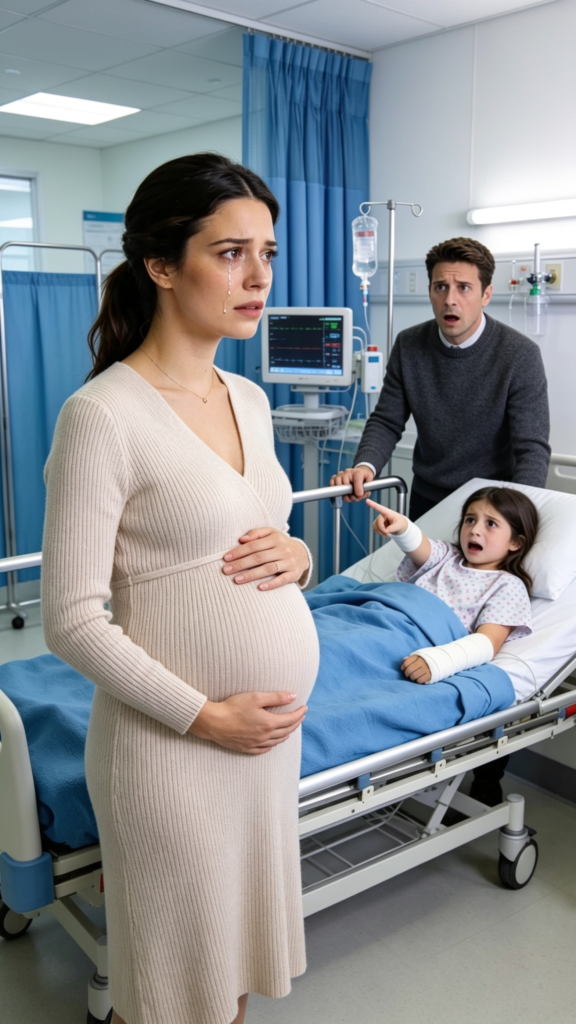
PART 1
—Please, someone help me! My daughter won’t stop crying!
Damián Arriaga rushed into the emergency area of Santa Lucía Hospital in Mexico City, cradling Valentina in his arms. The 7-year-old girl had a swollen wrist, her face drenched in tears, and her school uniform stained with dirt.
He, who always appeared in business magazines in a blue suit, expensive watch, and confident smile, looked like a different man that afternoon. His hair was disheveled, his shirt wrinkled, his voice broken, and the fear in his eyes was palpable, leaving no one to believe he was the same director of the Arriaga group.
—She fell at school —he shouted—. I don’t care how much it costs, just treat her already.
The doctor who emerged from the office looked up from the file.
It was Lucía Santillán.
She wore an open white coat over a comfortable olive green dress, her hair hastily pulled back, and one hand unconsciously resting on her seven-month pregnant belly.
Damián froze.
First, he recognized her.
Then he glanced at her pregnancy.
And all the noise of the hospital seemed to swallow him whole.
—Lucía… —he murmured, as if he had seen a ghost.
She didn’t respond to his name. She looked at the girl and approached with a calm professionalism that she barely managed to maintain.
—Hello, sweetie. I’m Doctor Santillán. What’s your name?
—Valentina —the little girl sobbed—. I fell off the railing.
—Well, Vale, let’s take a look at that little arm very carefully, okay?
The girl nodded.
Lucía lifted her gaze to Damián.
—Mr. Arriaga, I need space.
The word “Mr.” hit him harder than any accusation. Months earlier, she called him Dami. Months earlier, he swore he just needed time to talk to his mother, to sort out his life, to explain to Valentina that her dad loved someone else.
But he never did.
He let her go one rainy night outside his apartment in Santa Fe after telling her he wasn’t ready to face his family.
Lucía left with a broken heart.
And three weeks later, she discovered she was pregnant.
The X-ray confirmed a minor fracture. Valentina had to stay for a few hours under observation. When the nurses took her to pediatrics, Damián caught up with Lucía in the hallway.
—Is that baby mine?
Lucía pressed her lips together.
—Your daughter is upstairs. Focus on her.
—Lucía, please…
—Don’t show up after six months of silence to demand a truth you didn’t want to hear when there was still time.
He lowered his head.
—I was a coward.
—Yes. And your cowardice wasn’t free.
Lucía walked away before her voice broke.
That night, Valentina asked to see her. The girl was in bed, her arm bandaged, and a pink blanket over her legs.
—Doctor Lucía, will your baby have a dad too?
The question left both adults breathless.
Lucía smiled tenderly.
—All babies need love, sweetheart.
Valentina looked toward the door, where Damián stood frozen.
—My grandma says women like you get pregnant to steal inheritances.
A horrible chill ran down Lucía’s spine.
Damián turned pale.
Then the girl added in a low voice:
—And she also told Uncle Bruno that the baby shouldn’t be born because it would destroy the Arriaga family.
PART 2
The room fell silent.
The monitor continued to mark Valentina’s pulse, but for Damián, every sound felt like an accusation. Lucía clutched the edge of the bed. Not from weakness, but because that phrase had just confirmed a fear she had been trying to ignore for months.
—Who exactly said that, Vale? —Damián asked, trying to sound calm.
The girl curled up under the blanket.
—Grandma Rebeca. She was in the living room with Uncle Bruno. I went downstairs for water and heard her. She said that if you knew about the baby, you would go crazy and marry the doctor.
Lucía closed her eyes.
Rebeca Arriaga had always treated her with false courtesy. She smiled at family meals but looked at her as if her coat, her 24-hour guards, and her apartment in Narvarte were unforgivable flaws.
To Rebeca, Lucía was not a brilliant doctor.
She was “a girl without a last name.”
Damián took a step toward her.
—I swear I didn’t know anything.
Lucía let out a bitter laugh.
—That’s the sad part, Damián. You never know anything. You never see anything. You never ask anything when your mom speaks.
Valentina started to cry.
Lucía immediately reacted and stroked her forehead.
—You didn’t do anything wrong, my girl. On the contrary, you were very brave.
—Is your baby going to die? —Valentina asked, trembling.
Lucía felt a sharp pain in her chest.
—No. No one is going to hurt her.
Damián wanted to speak, but Lucía left the room before he could.
At dawn, when her shift ended, she returned to her apartment. At the entrance, she found a yellow envelope slipped under the door. It had no sender. Just one handwritten phrase:
“Lucía, you weren’t the first. And if you stay silent, you won’t be the last either.”
Inside were copies of messages, a USB flash drive, and an old photograph of Damián with an elegant dark-haired woman. Lucía recognized the woman immediately: Fernanda Larios, Damián’s ex-wife and Valentina’s mother.
For hours, she didn’t dare to open the USB.
The next day, someone knocked on her door.
It was Damián, with Valentina by his side. The girl held a cast covered in puppy stickers and a bag of churros in her hand.
—Doctor Lucía —she said cheerfully—, we brought you something because my dad cooks horrible.
Lucía couldn’t help but smile.
Damián looked exhausted. No suit, no ostentatious watch, no absurd confidence that he used as armor.
—I didn’t come to ask you to forgive me —he said—. I came to ask you to listen to me for 10 minutes.
Lucía hesitated but let Valentina in.
The girl went straight to look at the ultrasound stuck to the fridge.
—It looks like a little seed —she said.
Damián looked at the image with a mix of tenderness and guilt.
—Is it a girl?
Lucía didn’t answer.
He swallowed hard.
—My mom told me you left because you wanted money. She told me you tried to see me once, that you left a rude message for my secretary, and then disappeared.
—I went to your office four times —Lucía replied softly—. I left letters. Sent messages. Called from the hospital. Your assistant always said you were out, busy, or in a meeting.
Damián covered his face with his hands.
—I didn’t receive anything.
—Well, someone made sure you didn’t receive anything.
The doorbell rang again.
Lucía opened it to find Fernanda Larios standing in front of her. She was dressed in white pants, a navy blue blouse, and a calm that only women who have cried too much possess.
—I’m sorry for arriving like this —she said—. I sent the envelope.
Damián stiffened.
—Fernanda, what are you doing here?
She looked at him fearlessly.
—What I should have done years ago: tell the truth.
Valentina ran to hug her.
—Mom, the doctor has a baby in her belly.
Fernanda stroked her daughter’s hair but didn’t take her eyes off Damián.
—Rebeca did the same to me that she’s doing to Lucía. She invented lovers. She told Damián I wanted to take half the company. To me, she said he never wanted to be a father. She broke us slowly, with well-served lies on a silver platter.
Damián shook his head.
—It can’t be.
Fernanda left the USB on the table.
—There are the recordings. I saved them because I was afraid she would one day use Valentina too.
Lucía suddenly felt a sharp pain in her abdomen. She leaned against the kitchen counter.
Damián saw her pale.
—Lucía?
She took a deep breath.
—I’m fine.
But she wasn’t fine.
Another pang brought her knees to the ground.
Fernanda reacted first.
—Damián, carry her! Now!
The hospital was 12 minutes away, but to Damián, it felt like an eternity. He arrived with Lucía in his arms at the same place where two days earlier he had entered with his daughter.
This time, he didn’t scream for money or influence.
He screamed her name.
—Help her! She’s pregnant!
The on-call gynecologist, Dr. Jimena Ríos, ordered her to be assessed. Lucía had extremely high blood pressure and signs of severe preeclampsia. The baby was still alive, but the risk was real.
Damián stayed outside, his shirt stained with blood and his hands trembling.
Fernanda sat next to him.
—Now do you understand? —she said harshly—. Your mom doesn’t just separate couples. She destroys lives and then crosses herself at mass as if nothing happened.
Damián didn’t respond.
Hours later, Lucía woke up in a room. The first thing she did was touch her belly.
—My baby…
—She’s alive —Jimena said—. But you need complete rest. No stress. No fights. And if your blood pressure rises again, we’ll have to induce labor.
Damián was sitting in a corner. His eyes were swollen.
—Lucía, I…
—Don’t ask me to forgive you here —she whispered—. Not while my daughter is fighting because of your silence.
He lowered his gaze.
—I’m not going to justify myself. But I’m going to fix it.
That same afternoon, he asked Fernanda to connect the USB to a laptop. Lucía didn’t want to listen, but she needed to know.
The first audio was from Rebeca.
“Lucía already knows she’s pregnant. If Damián finds out, he’ll be filled with guilt and will do something stupid. Talk to Paola, the assistant. Have her filter calls, messages, everything. That girl doesn’t enter this family.”
In the second audio, the voice of Bruno, Damián’s brother, sounded nervous.
“And if the doctor files a complaint?”
Rebeca replied without hesitation:
“Then we’ll say she’s a gold digger. People always believe that about a pregnant woman without a husband.”
Lucía cried silently.
Damián stood up as if he could no longer fit inside his own body.
—My mom knew from the beginning.
Fernanda nodded.
—And not only that. She also moved papers to freeze the health insurance Damián had offered you when you worked at the foundation. She wanted you to feel alone, vulnerable, desperate.
Lucía glared at him with rage.
—She succeeded.
Damián dialed his mother’s number and put it on speaker.
—Damiancito —Rebeca answered—, it’s good to hear from you. I was told you’re near that doctor again. Don’t do anything foolish.
—Did you know Lucía was pregnant?
There was silence.
—Son, I was just looking out for your future.
—My future? Or your control?
—That woman was going to trap you.
—No, Mom. You trapped everyone. Fernanda, Valentina, Lucía, me. You used my daughter to repeat your poison.
Rebeca changed her tone.
—I’m your mother.
—And I’m a father. To Valentina and to the baby you tried to erase before meeting her.
—Don’t exaggerate, please.
—From today, no lawyer from the company will represent you. You’re out of the board. And if you come near Lucía, Valentina, or my daughter, I’ll report you with everything in those recordings.
Rebeca let out a sob.
—You’re replacing me with a nobody.
Damián clenched his jaw.
—No. I’m stopping myself from replacing my family for your approval.
He hung up.
Lucía looked at him for the first time not as the man who fled, but as someone who was finally breaking the chain.
But the damage was still there.
The following weeks were tough. Lucía returned to her apartment on strict bed rest. Damián didn’t move in without permission. He didn’t invade. He didn’t demand.
He just stayed.
He brought low-salt food, learned to measure her blood pressure, kept his phone on overnight, and accompanied her to every appointment without overstepping. Valentina would come after school with stories, drawings, and impossible questions.
—Is my little sister going to know that I defended her? —she asked one afternoon.
Lucía stroked her hair.
—I think she already knows.
Fernanda also became a strange part of that new broken family. She would come with fruit, documents, and uncomfortable truths. Sometimes she would sit with Lucía in silence, as if they both understood that the rivalry Rebeca had fabricated never belonged to them.
—Don’t forgive him easily —Fernanda told her one night—. But if you ever do, let it be because he changed, not because he cried beautifully.
Lucía laughed for the first time in weeks.
At 34 weeks, during a check-up, Jimena frowned.
—Your blood pressure rose again. We’re going to have to keep you here.
Damián took Lucía’s hand.
—I’m here.
She was about to respond when the hospital lost power for a few seconds. The emergency generator took time to kick in. The elevators stopped. A nervous murmur spread through the hallway.
Then Lucía felt warm liquid running down her legs.
She froze.
—Damián…
He understood before she finished.
—Is it time?
A brutal contraction stole her breath.
Jimena shouted instructions, but the hallway was clogged by the power failure. The stretcher was delayed. The nearest operating room wasn’t ready yet.
Lucía, a doctor even in the midst of fear, squeezed Damián’s hand.
—Listen to me. Don’t leave.
—I’m not going anywhere.
—Not this time.
The phrase pierced him.
—Not this time —he repeated, tears in his eyes.
The labor progressed too quickly. In an examination room, with emergency lights and a medical team rushing, Lucía pushed while Damián held her head, and Valentina prayed outside with Fernanda.
—Come on, Lucía —he urged—. You can do it. Our daughter can do it.
—Don’t say our if you’re going to run again —she grunted through tears.
—I’m not running anymore. Even if you hate me, I’m staying here.
A final push filled the room with tension.
Then came the silence.
A small, cruel, unbearable silence.
—Why isn’t she crying? —Lucía asked, desperate—. Why isn’t she crying?
Jimena worked on the tiny baby. Damián remained pale but didn’t move. He spoke to her as if he could pull her back with his voice.
—Breathe, my girl. For your mom. For your sister. Please.
Three seconds passed.
Then five.
And then a weak, raspy cry, but alive, broke the room.
Lucía fell apart.
Damián pressed his forehead against the bed and cried like a man who finally understood the cost of arriving late.
The baby was taken to neonatal therapy. She weighed little but fought with a strength that moved everyone. Lucía named her Clara because she was born in the midst of darkness and still brought light.
Rebeca tried to enter the hospital two days later with expensive flowers and a lawyer. Security stopped her at reception. Damián went down to see her.
She cried, screamed, said everything was done out of love.
—Don’t confuse love with control —he told her—. Love protects. You possess.
—You’re going to regret this.
—I already regretted it. For obeying you for so many years.
The trials ended in a report for threats, manipulation of internal documents, and harassment. Bruno testified to protect himself. Paola, the assistant, admitted to blocking calls by Rebeca’s orders. The perfect image of the Arriaga family shattered before everyone.
But the strongest moments didn’t make the papers.
It happened a month later when Clara finally left the hospital.
Valentina entered the room with a drawing: four people holding hands. Lucía, Damián, her, and a baby wrapped in yellow. In one corner, she drew Fernanda with a crown.
—My mom says families aren’t always like in fairy tales —she explained—. Sometimes they’re made with people who tell the truth.
Lucía cried upon hearing this.
Damián didn’t propose. It wouldn’t have been fair. Not after so much damage.
He handed her a folder.
Inside was a legal agreement recognizing Clara, a child support account, Rebeca’s resignation from any contact without authorization, and a handwritten letter.
Lucía read it in silence.
“I failed you when you needed a partner, not an obedient son of his mother. I’m not asking you to come back. I’m asking for the chance to be a father without hiding and to repair without pressuring you. If one day you love me again, let it be because you felt free, not because you felt lonely.”
Lucía closed the letter.
—I don’t know if I can forgive you soon.
—I know.
—And I’m not going to live in fear of your family.
—Never again.
She looked at Clara sleeping, at Valentina hugging Fernanda, and at Damián standing in front of her without excuses.
—Then start by keeping your word. Every day.
Damián nodded.
Two years passed.
Lucía returned to the hospital, not as a broken woman, but as the head of pediatric emergencies. Clara grew cheerful, with Damián’s eyes and her mother’s spirit. Valentina became a fierce sister, the kind that defends even with her lunchbox.
Fernanda and Lucía were never daily coffee friends, but they were allies. That was enough for Rebeca never to manipulate them again.
Damián kept his word. Not perfectly, not fairy-tale-like, not without mistakes. But he kept it.
And one afternoon, while Clara ran through Parque México and Valentina yelled at her not to go so fast, Lucía looked at Damián sitting next to her.
—I still hurt —she said.
—Me too.
—But pain doesn’t rule anymore.
He didn’t try to kiss her or promise her the sky.
He simply took her hand.
This time, Lucía didn’t pull away.
Because there are families that break apart because of a lie, but there are also truths that come too late and still save lives.
The uncomfortable question left among them was one that people debated for hours:
Can you forgive someone who abandoned you if in the end, they discover they were also a victim… or are there wounds that even the truth cannot heal?





