PART 1
—Don’t give him a plate, Consuelo. That child has learned he eats better on the floor.
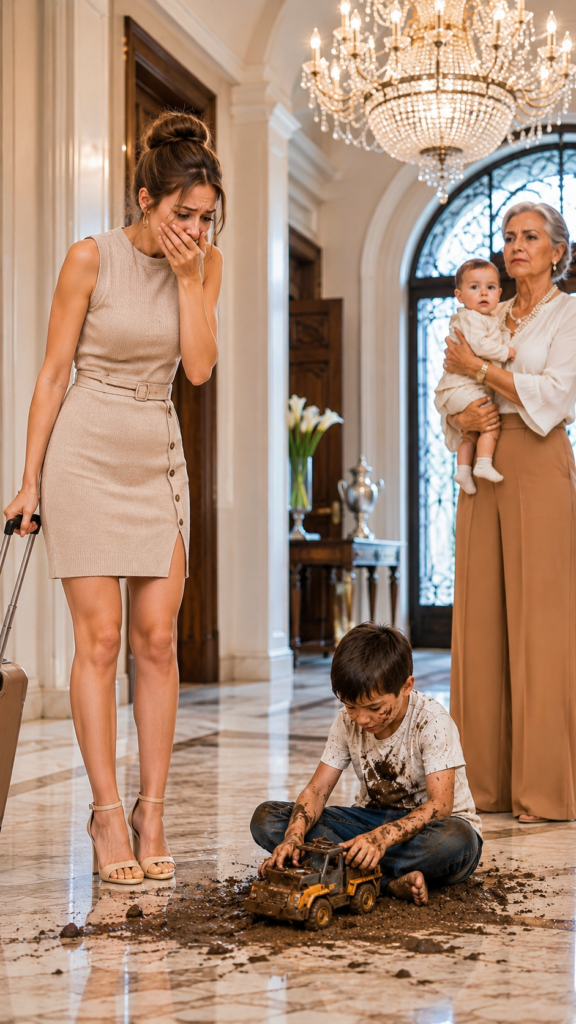
Claudia Mondragón stood frozen at the door of the residence in Jardines del Pedregal, clutching a red suitcase filled with toys, sneakers, books, and clothes she had bought over two years in Madrid for her son.
The taxi was still parked outside. The driver hadn’t even closed the trunk.
Claudia had traveled that very morning after closing a huge deal for her husband Santiago Arriaga’s construction company. She had gone to Spain because he begged her to lead the European expansion.
—It’ll just be a few months, love. My mom will help with Diego. You save the company, and then we’ll live peacefully.
But a few months turned into two years.
Diego was two years old when she left. He spoke a little, ran after the dogs in the park, and fell asleep clutching a green dinosaur.
Now he must be four.
But the child in front of Claudia didn’t look four.
He was underneath the dining table, barefoot, in a stained t-shirt, hair tangled, and knees scraped. He crawled on all fours after a broken cookie, making low whimpering sounds, as if he had learned that speaking got in the way.
Claudia felt the air clogging in her throat.
At the head of the table, her mother-in-law Beatriz cradled a chubby baby in an expensive onesie. She wiped the baby’s mouth with an embroidered napkin and kissed him as if he were a relic.
—My precious Mateo —Beatriz said—. That one brings pride to this house.
To the side was Santiago, impeccable, in a blue shirt, luxury watch, his gaze glued to his cell phone.
Next to him, a woman with red nails and a calm smile adjusted his collar. Claudia recognized her immediately: Valeria, the personal assistant Santiago hired before Claudia left.
Valeria glanced at Diego and let out a giggle.
—Oh, the weird kid is putting on a show again. What a shame if guests come.
Santiago barely lifted his eyes.
—Don’t let him get close to Mateo. He makes him nervous.
Claudia’s suitcase hit the floor with a dull thud.
A fire truck, a teddy bear, and a box of crayons spilled across the floor.
Everyone turned.
Santiago paled.
—Claudia… what are you doing here? You said you’d arrive next week.
Beatriz pursed her lips.
—Coming in like this, unannounced, is disrespectful. This house has order.
Claudia couldn’t respond. She only looked at Diego.
She took a step forward.
—My love…
Diego shrieked, retreated on all fours, and buried himself further under the table. He covered his head with his hands, as if expecting a blow.
Claudia knelt slowly, trembling.
—Diego, I’m Mom. I’m your mom, my darling.
The child squeezed his eyes shut and whimpered.
Valeria crossed her arms.
—Don’t force it. He gets really intense. Besides, he hardly recognizes anyone anymore.
Claudia turned to Santiago.
—What did you do to him?
He dropped his gaze.
—Don’t exaggerate. The kid was difficult. My mom says he has quirks.
—Quirks?
Beatriz sighed, tired.
—Your son was never normal. He cried a lot, threw tantrums, messed everything up. In contrast, Mateo is calm, beautiful, sociable. One cannot love equally what doesn’t respond equally.
Claudia felt something inside her shatter silently.
Valeria stroked the baby’s head.
—Honestly, Claudia, they did you a favor letting him live here.
Santiago said nothing.
And in that silence, Claudia understood she hadn’t returned to a home.
She had returned to a crime scene where everyone sat at the table, smiling, while her son learned to survive on the floor.
PART 2
Claudia wanted to scream.
She wanted to grab Santiago by the shirt, shove Valeria out of her house, and ask Beatriz what kind of grandmother turns a child into a source of shame.
But Diego remained under the table.
His eyes didn’t ask for justice yet. They asked for silence. They asked for nobody to raise their voice. They asked not to be the center of anger again.
So Claudia took a deep breath.
She wiped her tears with the sleeve of her jacket and said with a calmness that made Santiago blink:
—I’m tired. I need water. Then I’ll bathe Diego.
Valeria smiled, believing she had won.
—It’s good you’re taking this maturely. Things have changed here.
Beatriz added:
—And you better understand that quickly. Mateo needs peace. That child of yours disrupts everything.
Claudia walked towards the kitchen. She poured herself a glass of water. As she drank, she pulled her phone from her pocket and dialed a number she’d saved for years.
—Attorney Renata, this is Claudia Mondragón. I need everything activated. Custody, divorce, child protection, and financial audit. Yes, today. No, I can’t wait.
On the other end, the lawyer fell silent for two seconds.
—Are you in danger?
Claudia glanced toward the dining room.
Diego was still on the floor. Santiago pretended to check messages. Beatriz was making airplane noises with Mateo’s baby food. Valeria occupied the chair where Claudia had eaten breakfast during her pregnancy.
—I’m not —Claudia replied—. My son is.
She hung up.
Then she returned to the dining room and crouched at a distance.
—Diego, I won’t touch you if you don’t want me to. But I’m going to sit here with you.
The child didn’t come out.
Claudia sat on the floor in her travel clothes. For twelve minutes, she said nothing. She only placed the green dinosaur she had bought in Madrid in front of the table, similar to the one Diego had clung to as a baby.
The child looked at it.
He didn’t take it.
But he stopped trembling.
That night, Claudia slept in the guest room because Beatriz announced that the master bedroom was now "for the stable couple." Santiago didn’t even protest.
—Don’t complicate things —he told her in the hallway—. Valeria and I have a baby. You were always far away.
—I was working to pay for this house —Claudia replied.
Santiago clenched his jaw.
—No one forced you to leave.
Claudia almost smiled.
That was the phrase she needed.
Her phone was recording inside her bag.
In the following days, Claudia acted as if she were defeated.
She accepted sleeping far away. She accepted Valeria leaving dirty clothes on the stairs. She accepted Beatriz telling visitors that some women "were born to chase money and not to be mothers."
She didn’t argue.
She only recorded.
With Diego, it was different. She didn’t try to make him “normal” all at once. She brought him warm food on small plates, sat on the floor, sang softly, and let him decide when to come close.
The first time Diego picked up a spoon, Claudia had to turn away to cry without scaring him.
The second time, he sat on her lap for five seconds.
The third time, he whispered something that sounded like:
—Not in the room.
Claudia froze.
—What room, my love?
Diego hit his temple with his palm and started to rock back and forth.
He couldn’t say more.
That same afternoon, Claudia sought out Consuelo, the housekeeper who had been with them for eight years. She found her washing bottles in the service patio.
—Consuelo, I need the truth. I won’t leave you alone.
The woman turned pale.
—Ma’am, I’m sorry. I wanted to talk to you, but Mrs. Beatriz took my phone away many times. Mr. Santiago said that if I said anything, he would accuse me of theft.
—What did they do to Diego?
Consuelo looked toward the door.
—When you left, at first the child cried for you. He cried a lot. Mrs. Beatriz said that was manipulation. Then Miss Valeria came, pregnant. Mr. Santiago started sleeping with her here. When Mateo was born, things got worse.
Claudia pressed her fingers against the table.
—Go on.
—Diego was locked in the laundry room when there were visitors. If he cried, they turned off the light. Sometimes they left bread on the floor so he wouldn’t dirty plates. Mrs. Beatriz said that’s how he learned. Miss Valeria called him puppy. And Mr. Santiago… he knew everything.
Color drained from Claudia’s face.
—Did he see it?
Consuelo began to cry.
—Once Diego tried to pick up a toy from Mateo. Mr. Santiago yanked him by the arm and said, "I don’t want that child near my healthy son."
The phrase hung in the air like a sentence.
That night, when everyone was asleep, Claudia entered Santiago’s study. She didn’t need to force anything. He still hid the key in the flower pot of the ficus, just like before.
The computer had a password.
She tried Mateo’s birth date.
She got in.
—What a lowlife —she whispered.
She found transfers to Valeria's accounts, payments to jewelry stores on Masaryk, trips to Los Cabos, false invoices from suppliers, and an insurance policy where Santiago was listed as the policyholder, but Valeria as the main beneficiary.
The date was six months before Claudia’s trip to Spain.
Then she found emails.
Valeria wrote:
“When Claudia leaves, everything will be free. We just need to solve the problem with the child.”
Santiago replied:
“My mom will handle it. Diego won’t be a bother.”
Claudia photographed every screen.
Then she opened a folder labeled "Madrid."
There she discovered the twist that froze her blood.
Santiago hadn’t sent her to Spain just for the expansion.
There were emails with a partner where Santiago explained that he needed Claudia out of Mexico to “reorganize family life” and transfer assets without her reviewing the accounts.
The company Claudia saved wasn’t growing.
It was being drained.
And the money she generated from Madrid was paying for Valeria’s house, Mateo’s maintenance, and a gambling debt Santiago owed to a businessman in Monterrey.
Claudia felt nausea.
But she pressed on.
At three in the morning, she sent everything to Attorney Renata. She also sent photos of Diego, audios of Beatriz, videos of Valeria, and Consuelo’s recorded testimony.
The response arrived at 3:18.
“We have enough for urgent measures. Tomorrow a certified child psychologist will go as a private therapist. Don’t confront. We need them to trust you.”
The next day, Doctor Ximena arrived as an early stimulation specialist recommended by a friend. Beatriz didn’t even ask. She was busy organizing Mateo’s baptism.
For an hour, Ximena observed Diego.
She saw how he hid at loud footsteps. She saw how he avoided water. She saw how he shrank back when Beatriz entered the room. She saw old marks on his legs, dermatitis from neglect, and severe language regression.
In the kitchen, Ximena spoke to Claudia bluntly.
—This is not a natural delay. It’s trauma from prolonged neglect. Your son was conditioned to behave like an animal because he was treated like one.
Claudia closed her eyes.
—Can she come back?
—Yes. But not here. This house is part of the harm.
Mateo’s baptism was four days later at a fancy terrace in San Ángel.
Beatriz insisted on inviting half the world: club friends, family from Guadalajara, Santiago’s partners, and even a priest friend of the family.
—We need to present the real Arriaga grandchild —she said, without shame.
Claudia asked to attend.
Valeria laughed.
—Why? To garner pity with your weird child?
—No —Claudia replied—. To avoid causing more problems.
Santiago looked at her suspiciously, but he agreed. He believed Claudia had finally understood her place.
They arrived at the terrace at two in the afternoon. There were white flowers, soft music, waiters with trays, and a huge table of desserts.
Valeria wore a pearl color, carrying Mateo like a trophy.
Beatriz walked from table to table saying:
—This baby came to unite the family.
Diego held Claudia’s hand. He walked slowly, with fear, but he walked. He wore new sneakers and a blue shirt. To anyone, it was a small detail. For Claudia, it was a giant victory.
When the toast began, Beatriz took the microphone.
—Today I thank God for Mateo, a healthy, beautiful, educated child who returned our joy. Because sometimes blood isn’t enough. Sometimes family needs pride, not burdens.
Several guests exchanged uncomfortable glances.
Santiago tried to take the microphone from her.
—Mom, enough.
But Beatriz continued.
—And I hope some people learn that a mother who abandons for two years cannot return demanding respect.
Claudia climbed onto the small stage.
—You’re right, Beatriz. Today we’re talking about family.
Valeria let out a laugh.
—Oh, Claudia, don’t make a fool of yourself.
Claudia connected a flash drive to the projector. Attorney Renata was among the guests, dressed as just another friend. An expert from her office pretended to take pictures near the sound equipment.
The screen lit up.
First, Diego appeared under the table, dirty, skinny, eating a cookie off the floor.
The terrace fell silent.
Then Beatriz's voice played:
“Don’t give him a plate. That child has learned he eats better on the floor.”
A woman dropped her glass.
Valeria stood up.
—That’s edited.
Claudia changed the image.
Valeria’s messages appeared.
“We just need to solve the problem with the child.”
Then Santiago’s response:
“My mom will handle it. Diego won’t be a bother.”
Santiago turned red.
—Turn that off.
Claudia didn’t look at him.
The next recording was of Consuelo, recounting how they locked Diego in the laundry room, how they turned off the light, how they threw food at him, and how they prohibited him from getting close to Mateo.
Beatriz started to cry.
—I just wanted order. That child was unbearable.
Claudia took the microphone.
—No. That child was a baby missing his mom. You broke him because he got in the way of showing off a false family.
Valeria grabbed Mateo and tried to leave.
But at the entrance, two family court notice servers and child protection staff were already there, accompanied by Attorney Renata.
The screen changed again.
Now it showed transfers, policies, false invoices, and emails where Santiago planned to remove Claudia from Mexico to move money.
Murmurs turned into shouts.
One of Santiago’s partners stood up.
—Did you use company capital to pay her?
Santiago shoved him.
—This is a family matter.
Claudia stepped off the stage with Diego in her arms.
—No. This is now a legal matter.
Renata approached Santiago.
—Mr. Arriaga, you are hereby notified of the divorce lawsuit, measures for child protection, temporary suspension of visitation, and request for a financial audit. There is also a report of child abuse and fraudulent management.
Santiago looked at Claudia with hatred.
—You have no idea what you’ve just done.
Diego clung to his mother’s neck.
Claudia felt him trembling.
But this time she didn’t look away.
—Yes, I do. I just took my son off the floor.
Beatriz tried to touch Diego.
—My child, Grandma didn’t want…
Diego hid his face in Claudia’s shoulder.
Claudia took a step back.
—Don’t ever call him that again.
Valeria shouted that Mateo wasn’t to blame. And it was true. The baby bore no guilt. But that didn’t erase the fact that they had used him as a crown to humiliate a wounded child.
The party ended with waiters picking up untouched glasses, guests leaving in silence, and Santiago arguing with lawyers in front of the baptism cake.
Claudia didn’t return to the Pedregal house.
That night, she slept with Diego in a small apartment in the Narvarte neighborhood, rented by Renata that morning. It had light walls, a low bed, soft rugs, and a window where sunlight streamed in.
Diego took forty minutes to fall asleep.
Before closing his eyes, he touched the green dinosaur.
—Mom… not in the room.
Claudia lay on the floor next to him.
—Never again, my love. Never again.
The process was hard.
Santiago tried to say Claudia had abandoned her son out of ambition. But the emails proved he sent her away. The accounts proved she sustained the company. The diagnoses proved the damage. The audios proved the cruelty.
Consuelo testified.
Doctor Ximena submitted her report.
Attorney Renata requested total protection.
Within three months, Santiago lost custody and was subject to financial investigation. His partners sued him. The house was secured. The luxurious life crumbled like a wet facade.
Valeria disappeared from social media after her friends stopped inviting her. She tried to present herself as a victim, but her own messages sank her.
Beatriz sent several letters.
She said she missed Diego. That a grandmother could also err. That the family should forgive.
Claudia didn’t respond.
Because there are mistakes that break plates.
And there are decisions that break children.
Eleven months went by.
Diego started therapy four times a week. He learned to ask for water. He learned to sleep with a lamp on. He learned to eat sitting in a chair, even though at first he cried when he saw a plate.
One Sunday, Claudia took him to Parque México. Diego walked behind bubbles. He fell, scraped his hand, and for a second looked around in terror.
Claudia crouched down.
—I’m here.
Diego breathed. He didn’t crawl. He didn’t hide. He just reached out his hand.
—Mom, home.
Claudia hugged him.
—Yes, my love. We’re going home.
And as they walked together under the trees, Claudia understood that justice doesn’t always return lost years, nor erase the nights when a child feared to exist.
But sometimes it’s enough for something sacred.
For a child to walk again.
For a mother to stop blaming herself for having trusted.
And for an entire family to learn, even if late, that name, money, and appearances mean nothing when built on the pain of a child.





