PART 1
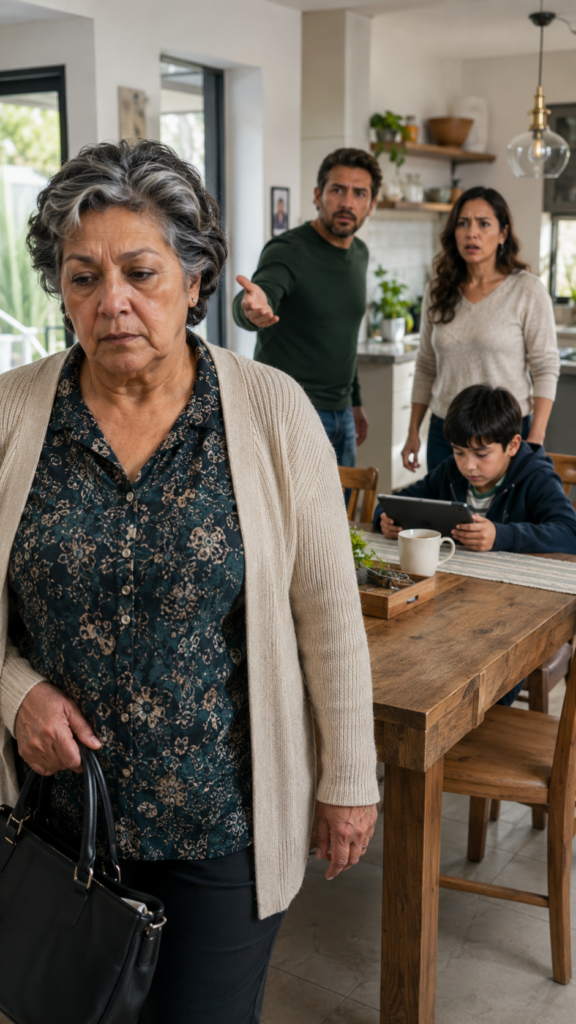
Doña Refugio turned off the flame and set the pot of beef broth in the center of the table.
The steam rose, carrying the scent of corn, carrots, potatoes, and fresh cilantro.
There were tortillas wrapped in an embroidered napkin, red rice in a clay dish, and freshly made hibiscus water.
Everything seemed like a normal dinner in a house in Puebla.
But that night, at that table, a 68-year-old grandmother was about to stop being invisible.
For the past three years, Refugio had held her son Mateo's house together, like a wall that everyone uses but no one sees.
She arrived early, swept, washed uniforms, prepared lunches, picked up the child from school, warmed food, checked homework, and still heard that “helping the family shouldn't be flaunted.”
Mateo worked at a car agency, and Brenda, his wife, was glued to her phone, reading parenting advice.
Brenda wasn’t a bad woman.
She loved her son Ian with an intensity that sometimes felt like fear.
Fear of hurting him.
Fear of traumatizing him.
Fear of him crying.
Fear of someone on the internet saying she was raising him wrong.
And because of that fear, Ian, at 8 years old, had ended up running the house.
That night, Mateo and Brenda arrived just before 8:20.
They entered exhausted, their faces lit by their phones.
Ian was sprawled on the couch, playing on his tablet with oversized headphones, screaming as if he were in the middle of the world’s final match.
“Dinner’s ready, sweetheart,” Refugio said calmly.
Mateo barely lifted his gaze.
“Ian, come to dinner.”
“No!” the boy shouted. “I’m in a game!”
Brenda sighed as if someone had asked her to carry a sack of cement.
She went to the living room and crouched beside him.
“Sweetheart, I understand you’re really frustrated, but grandma cooked. How about you try three bites and then go back to playing?”
Refugio pressed her lips together.
She said nothing yet.
Ian dragged his feet, holding his tablet.
He sat down, looked at his plate, and scrunched his face.
“Yuck. It looks like ranch food. I want nuggets.”
Silence crashed down like a broken plate.
Refugio looked at Mateo.
Mateo lowered his gaze to his phone.
He looked at Brenda.
Brenda was already opening the freezer.
“Alright, my love. I’ll make you your dinosaur nuggets. Your body knows what it needs.”
Refugio felt something cold in her chest.
It wasn’t anger.
It was weariness.
It was the sadness of understanding that her effort was worth less than a tantrum.
“Brenda, don’t make nuggets for him,” she said.
The daughter-in-law froze.
“Excuse me?”
“He’s 8. He just spoke with disdain about a meal someone prepared for hours. He can say he doesn’t like it, but he can’t disrespect it and receive a reward.”
Mateo let out a heavy sigh.
“Mom, seriously, don’t start. We’re dead tired. Don’t make a scene over a bowl of broth.”
Refugio fixed her gaze on him.
“It’s not about the broth, Mateo. It’s about what you’re teaching him.”
Brenda slammed the freezer shut.
“We raise with respect. We don’t force, we don’t impose, we don’t humiliate.”
“That’s not respect,” Refugio replied. “That’s fear. And while you’re afraid to say ‘no’ to him, he learns that everyone must revolve around his whims.”
Ian banged the table with his spoon.
“I want nuggets! The broth is gross! Grandma cooks horribly!”
Brenda rushed to hug him.
“Breathe, sweetheart. Grandma is having difficult emotions.”
That’s when something inside Refugio broke.
She didn’t shout.
She didn’t cry.
She just took off her apron.
Folded it slowly and laid it on the chair.
“You’re right,” she said, looking at Brenda. “I’m having difficult emotions. It hurts to see my son turned into a guest in his own home. It hurts to see my grandson wearing a crown that no child should have to bear. And it hurts to be treated as if I were free domestic service.”
Mateo stood up.
“Where are you going?”
Refugio grabbed her bag.
“To my house.”
“No.”
Mateo blinked.
“What do you mean no?”
“No. That word you deny him, today I say it to you.”
Brenda went pale.
“You can’t leave us like this. Family helps family.”
Refugio opened the door.
“Family helps, yes. But it also appreciates. It also respects. It also sees the person who is helping. This wasn’t a family supporting each other. It was a service station.”
She left without slamming the door.
Outside, the air smelled of rain and sweet bread.
From the door, Mateo looked at her as if he had just discovered that his mother didn’t come included with the house.
Refugio walked to her old car.
Before starting it, she saw a small light next to a tree.
Then another.
Fireflies.
She hadn’t seen fireflies since Mateo was a child, when he would run after them in his grandmother’s yard and then let them go because, Refugio would say, light can’t be caged.
Her phone started vibrating.
Mateo was calling.
Brenda was texting.
Ian was screaming in the background on an audio message.
Refugio turned her phone face down.
That night, she didn’t answer.
Because for the first time in a long time, she chose not to disappear.
PART 2
Refugio arrived home just before 10.
She lived in a small house near the market, with geranium pots at the entrance and a Virgin of Guadalupe on the living room wall.
Everything was quiet.
That silence that used to feel like loneliness now felt like rest.
She took off her shoes, put away her bag, and went to the kitchen.
There was no broth.
No dishes to pick up.
No tablets buzzing.
She made herself a coffee with milk and a bolillo with beans.
She had dinner slowly, sitting at her table, without anyone rushing her, without anyone criticizing her, without anyone asking her for “one more little favor.”
But she wasn’t at peace.
She felt pain for Mateo.
She felt pain for Ian.
She felt pain for Brenda too, even though it was hard to admit.
Because Brenda wasn’t a villain.
She was a tired woman trying to be perfect, educating with fear and confusing love with avoiding any discomfort.
That night, Refugio slept little.
Her phone vibrated many times.
She didn’t turn it off.
She just didn’t respond.
At 7 in the morning, while watering her plants, the doorbell rang.
When she opened it, she found Mateo.
He wasn’t holding his phone.
That was the first thing she noticed.
He had a grocery bag and a bouquet of flowers from the market, one of those simple ones you buy when you don’t know how to ask for forgiveness but want to try.
“Mom,” he said.
Refugio didn’t hug him.
Not out of pride.
But because if she hugged him before hearing him out, she would carry everything again.
“Come in,” she replied.
Mateo entered like a scolded child, even though he was already a grown man.
He sat in the kitchen, in the wooden chair he had repaired years before.
He took out a container from the bag.
As he opened it, the smell of the broth filled the house.
It was Refugio’s broth.
“We didn’t throw it away,” Mateo said, his voice low. “Brenda saved it.”
Refugio stared at the dish.
“And that?”
Mateo swallowed hard.
“Last night was horrible.”
“Horrible because I left or because you saw what was happening?”
He glanced down.
“Because I saw it.”
The kitchen fell still.
Outside, the tamale vendor passed by with his loudspeaker, but neither of them moved.
“Ian exploded worse after you left,” Mateo continued. “He screamed, kicked the fridge door, threw a cushion, said we all hated him. Brenda cried. I tried to promise him the tablet, the nuggets, anything... and nothing.”
Refugio squeezed the cup between her hands.
“And then?”
“Then he locked himself in the bathroom. He was trembling. It wasn’t anger, Mom. It was fear.”
Refugio’s face softened.
Because a commanding child doesn’t always feel strong.
Sometimes they command because no one has laid a solid foundation for them.
Mateo rubbed his forehead.
“I was embarrassed. I was there, not knowing what to do with my own son. I realized you weren’t the help. You were the support for everything we didn’t know how to hold.”
Refugio took a deep breath.
She didn’t want to say “I told you so.”
That phrase only serves to win arguments, not to heal families.
“Brenda?” she asked.
Mateo fell silent for a few seconds.
“Brenda’s shattered. She says she failed. That she thought setting limits was being cruel. That she was afraid of becoming like her mom, who raised her with yelling. So, she went to the other side. Letting Ian decide everything.”
Refugio then understood a part she hadn’t seen.
Brenda wasn’t just defending an idea.
She was defending an old wound.
“I don’t hate Brenda,” Refugio said. “But she hurt me. She made me feel like a woman who comes in, serves, and stays quiet.”
Mateo nodded.
“I know. And so do I. I used you, Mom. Not with bad intentions, but I used you. Every time I said, ‘my mom can,’ I didn’t even ask if you wanted to.”
Refugio felt her eyes moisten.
She didn’t cry.
But something inside her settled just a little.
“Did Ian go to school?”
“Yeah. With drama, but he went. And before leaving… he tried the broth.”
Refugio lifted her face.
“Ian?”
Mateo smiled slightly.
“One bite. He said it tasted weird. Then he asked for a tortilla. He didn’t say yuck. He didn’t scream. He just made a martyr’s face, as if he’d been asked to pay taxes.”
Refugio let out a small laugh.
Mateo did too.
The laughter didn’t last long, but it was enough to open a window.
“Mom, we want to change,” he said. “But we don’t know how.”
Refugio set the cup down on the table.
“Change doesn’t happen with pretty speeches. It happens with rules.”
Mateo straightened his back.
“Tell me.”
“First: I’m not a daycare center. I help because I love, not because it’s my obligation. If you need me to pick up Ian, it should be asked in advance and appreciated.”
Mateo nodded.
“Second: if I cook, no one criticizes my food in front of the child. If there’s something he can’t eat, it should be talked about beforehand.”
“You’re right.”
“Third: there are no screens at the table. Neither Ian’s nor yours nor Brenda’s. Because the child learned from you that there’s always something more important than looking each other in the eye.”
Mateo hung his head.
That one hit home.
“Fourth: don’t make me the bad one so you can look good. If there’s a rule, you uphold it as parents.”
“Yes.”
“And fifth: Ian can get angry. He can cry. He can say he doesn’t like something. But he can’t insult, throw things, or treat anyone like they don’t matter.”
Mateo fell silent.
Then he said:
“That’s fair.”
Refugio looked at him firmly.
“Don’t say ‘fair’ if tomorrow you’re going to go back to the same.”
Mateo pressed his lips together.
“I don’t want to go back to the same.”
That afternoon, Refugio agreed to go to Mateo’s house.
Not to rescue.
Not to prepare dinner.
Not to clean up the mess.
She went to talk.
When she arrived, the table was set.
Plates, glasses, tortillas, a pitcher of water.
Nothing luxurious.
But there was intention.
Brenda opened the door.
She had dark circles under her eyes, and her hair was carelessly tied up.
Upon seeing Refugio, tears filled her eyes.
“I’m sorry,” she said before any greeting. “I’m sorry for what I said. I’m sorry for treating you like you were exaggerating. I’m sorry for using pretty words to hide that I was also out of control.”
Refugio looked at her.
At another time, she would have hugged her quickly to stop her from crying.
But not now.
Now she needed the apology to stand up.
“Thank you for saying that,” she replied.
Brenda stepped aside.
“Please, come in.”
Ian was in the hallway.
Without a tablet.
Refugio noticed that too.
The boy looked at her with a mix of fear and shame.
“Hi, Grandma,” he murmured.
“Hi, Ian.”
She didn’t kiss him right away.
Not because she didn’t want to.
But because she wanted him to understand that affection also has doors.
They sat at the table.
Mateo spoke first.
“Ian, we’re going to talk about yesterday. Not to scare you. Not to punish you. So this house can work better.”
Ian glanced at his mom.
Brenda didn’t rush to save him.
She just took his hand.
“Yesterday you said ugly things,” Mateo said. “And you threw things. That’s not okay.”
Ian looked down.
“It’s just that I wanted to keep playing.”
“We understand,” Brenda said. “But wanting something doesn’t give you permission to hurt others.”
Refugio intervened softly.
“Sweetheart, if a meal doesn’t please you, you can say: ‘I don’t like it, thank you.’ That’s different from saying ‘yuck’ or ‘you cook horribly.’”
Ian shifted uncomfortably in his chair.
“But if you make me eat it, I feel bad.”
“We’re not going to force you to swallow a whole plate,” Mateo said. “But you will try. And you will respect. There’s a difference.”
Ian raised his face.
“And what if I get mad?”
Brenda took a breath.
It was evident she struggled not to soften everything.
“You get mad. We’re here. Getting mad isn’t bad. What’s bad is turning your anger into hitting or insults.”
The boy looked at the three adults.
For the first time, they weren’t arguing among themselves.
They weren’t negotiating against the grandmother.
They weren’t trembling before him.
They were together.
And that, even if Ian couldn’t explain it, calmed him.
“I’m sorry, Grandma,” he suddenly said. “Your broth didn’t look like mud.”
Refugio raised an eyebrow.
“Oh, really?”
Ian shook his head.
“It looked like… soup with a lot of stuff.”
Mateo burst into laughter.
Brenda did too.
Refugio smiled.
“I’ll accept that improvement.”
Ian jumped up and ran to his room.
Brenda made an attempt to stand, nervous.
“Where are you going, sweetheart?”
“To bring something.”
He returned with a folded sheet.
He handed it to Refugio.
It was a drawing.
A table.
Four people sitting.
And around it, many yellow dots.
“Dad told me about the fireflies,” Ian said. “He said you taught him that light can’t be caged.”
Refugio felt her throat tighten.
“And those dots?”
“You’re you,” Ian replied. “But we’re also us if we don’t shout.”
Brenda covered her mouth.
Mateo looked at the ceiling to avoid crying.
Refugio crouched down to be level with the boy.
“Ian, I’m your grandmother. I will always love you. But I won’t let you talk to me rudely.”
He nodded seriously.
“And will you come pick me up tomorrow?”
The question fell heavy.
There was the old trap.
The need disguised as tenderness.
Refugio looked at Mateo and Brenda.
They understood.
Mateo answered before she did.
“Tomorrow I’ll go pick you up. Grandma will rest.”
Ian’s eyes widened in surprise.
“You?”
“Me,” Mateo said. “I’m your dad, right?”
Ian thought about it.
Then he smiled a little.
“Okay.”
For Refugio, that “okay” was worth more than applause.
Not because everything was resolved.
But because finally, everyone was taking their place.
That night, they had noodle soup, quesadillas, and fruit for dinner.
Ian tried the soup without making a scene.
There were no rewards.
There were no promises.
Just a “thank you for sitting with us.”
Later, as Brenda washed the glasses and Mateo stored the tortillas, Refugio saw her apron hanging on the back of a chair.
Before, it looked like a chain.
Now it looked like a choice.
Brenda approached her.
“Will you keep helping us?”
Refugio looked at her tenderly, but without lowering her guard.
“Yes. But not as a ghost. Not as a maid. As a grandmother.”
Brenda nodded, crying silently.
“As a grandmother,” she repeated.
As she left, Refugio walked to her car.
The night in Puebla was cool.
She didn’t see fireflies this time.
But she didn’t need to.
Because sometimes, light doesn’t appear in the garden.
Sometimes it appears at a table where someone finally says sorry.
Sometimes it appears when a father puts away his phone.
When a mother stops being afraid.
When a child learns that a “no” isn’t abandonment.
And when a grandmother understands that loving her family doesn’t mean erasing herself for them.
That night, Refugio got home, put her phone face down, and slept in peace.
The family didn’t break.
They just closed for remodeling.
And when they reopened, the entrance didn’t cost money.
It didn’t cost sacrifice.
It didn’t cost holding everything in.
It cost something simpler.
Respect.





