PART 1
The office of lawyer Arriaga was so silent that even the hum of the air conditioning felt like a disrespectful intrusion.
Roberto Navarro had died three weeks earlier, and his two daughters remained seated in front of a folder containing his last will.
Camila arrived dressed as if she were heading to a bridal photoshoot. She wore a massive ring, had immaculate nails, and her phone was filled with quotes for her wedding in San Miguel de Allende.
Elena, on the other hand, hadn’t slept well since the funeral. She wore simple clothes and kept her hands tightly clasped over her knees.
—The total inheritance amounts to 9,600,000 pesos —the lawyer explained—. Your father ordered it to be divided equally: 4,800,000 for each of you.
Camila’s smile vanished.
—Equal? That’s wrong. Dad knew my wedding costs nearly 6,800,000.
Arriaga opened another page.
—He also wrote that he was concerned about those expenses. He did not authorize giving a greater part to either daughter.
Camila stood up furiously.
—That money is for my wedding.
Elena didn’t argue. She simply signed.
That same afternoon, Teresa, their mother, called to demand that Elena give up her share.
—You have a stable job. Camila is only getting married once.
The family believed Elena did “administrative things” in a hospital. No one knew she was the general director of the Metropolitan Valley Hospital, one of the most important private centers in Mexico City.
Elena had hidden her position because she was tired of Camila turning every achievement of hers into a competition.
For two weeks, she received calls, insults, and messages from cousins who hadn’t even attended the funeral.
Then, Camila showed up at her house in Coyoacán with Rodrigo, her fiancé.
—I need your 4,800,000 —she said bluntly—. The advance for the estate is due on Friday.
—No.
—Seriously, Elena, you don’t even need it.
—I’m not going to betray Dad's decision to pay for imported flowers and a party you can’t afford.
Camila trembled with rage. Rodrigo tried to convince her to cut back on the wedding, but she silenced him with a glare.
Before leaving, she leaned closer to Elena.
—You’re going to regret this.
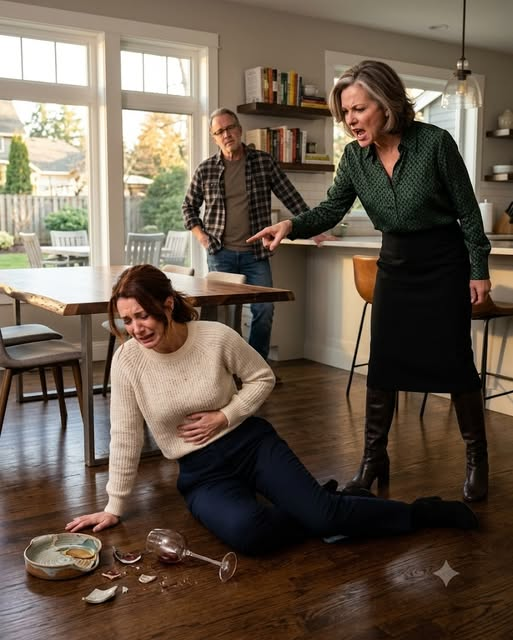
The next day, Elena was climbing up from the basement with a basket of laundry. She was two steps away from reaching the kitchen when she heard Camila's voice behind her.
—Dad’s inheritance belongs to me.
Elena barely managed to turn around.
Two hands slammed into her back.
The basket flew out of her hands.
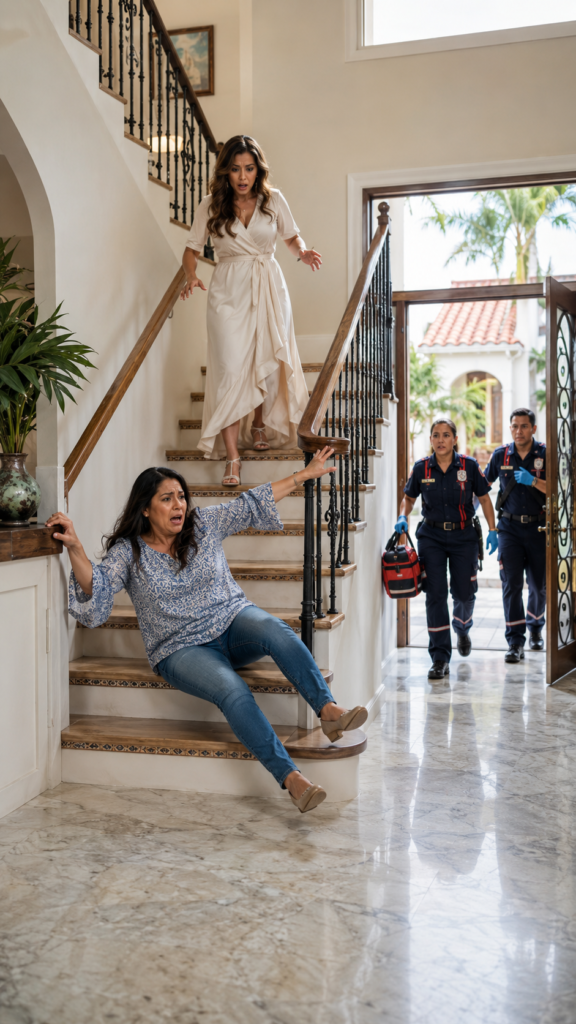
Her body tumbled down fifteen concrete steps.
When she lay motionless, blood in her hair and unable to feel her legs, Camila peered down from above.
—Get up. Stop playing the victim.
And then Rodrigo appeared behind her, pale, holding a phone he hadn’t yet dialed.
PART 2
Rodrigo looked at Elena's body at the bottom of the stairs and realized this was no longer a tantrum.
This was a crime.
—Camila, she’s bleeding.
—She’s faking it —she replied—. She always does this to make me look bad.
Elena tried to speak, but only a wet sound escaped. Each breath pierced her ribs.
Rodrigo took three steps down.
—She can’t feel her legs.
Camila grabbed his arm.
—We’re leaving.
For a moment, Rodrigo hesitated. He had spent four years giving in to her to avoid fights. He had accepted a wedding they couldn’t afford, absurd vendors, and threats disguised as tears.
But the pool of blood was growing.
He pulled out his phone and dialed 911.
—My fiancée pushed her sister down the stairs —he said, his voice breaking—. She’s conscious, but she can’t move.
Camila tried to snatch the phone from him.
—Hang up, idiot!
Rodrigo stepped back.
—Don’t touch me.
Camila ran off. Her truck disappeared before the ambulance arrived.
Paramedics stabilized Elena’s neck, controlled the bleeding, and transported her to the nearest hospital.
No one needed to ask which one.
The emergency system directed them to the Metropolitan Valley Hospital.
Her hospital.
When the stretcher crossed the trauma area, Dr. Adrián Salcedo recognized the patient, and the atmosphere shifted.
—It’s Dr. Navarro —a nurse said.
Elena could barely keep her eyes open.
The CT scan showed a fracture in T7, another injury in L3, four cracked ribs, and a small but dangerous subdural hematoma.
Dr. Jennifer Kim, the medical director and Elena’s friend, rushed in.
—What happened?
Elena managed to utter three words.
—Camila pushed me.
Jennifer requested that the Prosecutor’s Office be notified and activated the internal protocol for severe injuries to executive staff.
She also ordered the retrieval of the recordings from the house.
Elena had installed cameras after several robberies in the neighborhood. The system automatically stored everything in the cloud.
The recording showed Elena climbing up with the basket.
It showed Camila entering the basement.
It showed the push.
And the audio clearly recorded:
—Dad’s inheritance belongs to me.
Then came the sound of the fall, the impact against each step, and Camila’s voice ordering her to stop faking.
There was no accident to fabricate.
Elena was operated on for nearly five hours. The surgeons stabilized the damaged vertebra and controlled the pressure caused by the hematoma.
When she woke up in intensive care, she slowly moved her toes.
Jennifer released the breath she had been holding for hours.
—You’re going to walk, but recovery will be long.
—Camila?
—In custody.
The Prosecutor’s Office opened an investigation for aggravated assault and attempted murder. Rodrigo submitted his full statement, along with the threats and recordings where Camila talked about “removing her sister from the picture.”
The news hit Teresa like a wall.
For years, she had justified Camila’s behavior.
When she was a child, she said she was sensitive.
When she broke things, she said she was frustrated.
When she humiliated Elena, she said she just had a strong character.
Now, her favorite daughter was in a cell, and her other daughter had screws in her spine.
Teresa called 28 times.
Elena didn’t answer.
When the case began circulating among the family, the same cousins who had called Elena selfish deleted their messages. Some sent apologies; others claimed they had never understood the gravity of the situation.
Elena kept screenshots of everything.
An aunt even begged her to avoid the trial so as “not to tarnish the Navarro name.”
Jennifer, upon hearing this, replied:
—The name wasn’t tarnished when Elena reported it. It was tarnished when Camila pushed her.
That phrase reached Teresa and ended the last family campaign for silence.
Finally, no one could disguise the crime as a sisterly dispute or demand the victim protect her aggressor's reputation.
In the initial hearing, Camila’s defense insisted it was a domestic accident. The prosecutor played the video.
The judge ordered preventive detention.
Camila screamed that it was all Elena’s fault.
—If you had given me the money, none of this would have happened!
The phrase destroyed any possibility of compassion.
Rodrigo canceled the wedding that same afternoon. He also submitted documents revealing another secret.
Camila had already spent 2,300,000 pesos that she hadn’t yet received.
She had signed promissory notes, used Teresa’s cards, and forged a letter from lawyer Arriaga to assure vendors that the inheritance was “released.”
The estate, the European dress, the musical group, and the photographer had all been contracted with debt.
Camila didn’t want a wedding.
She wanted a coronation.
While Elena learned to sit up without passing out, lawyer Arriaga requested to freeze the inheritance. He argued that Camila had committed the attack to gain a direct economic benefit.
The civil process advanced alongside the criminal one.
Teresa visited Elena three weeks later.
She entered the room with swollen eyes and a bag of sweet bread that no one touched.
—I’m sorry —she whispered—. I taught her that we would all end up yielding.
Elena looked at the metal support next to her bed.
—You also taught me that being good meant enduring.
Teresa lowered her head.
—I didn’t know it would go this far.
—Yes, you did. You just thought it would always stop before really hurting me.
The truth hurt more than a scream.
Teresa began to cry.
—I still love you.
—Me too.
For the first time, the mother found no excuse.
Rehabilitation was slow. Elena needed help to stand, bathe, and walk ten steps with a walker.
The therapist, Marisol, wouldn’t let her give up.
—Look at me —she’d say—. You’re not falling.
The word “falling” triggered panic attacks.
At night, she dreamed she never reached the last step.
Yet she advanced.
First, she walked for 20 seconds.
Then she crossed the hallway.
Later, she managed to go out to the hospital garden with a cane.
The staff welcomed her with respect, not for her position, but because they had all seen how she had arrived: bloodied, nearly paralyzed, and still asking about patients before herself.
The administrative council offered her lawyers, security, and full leave.
Elena accepted the help, something she had never known how to do.
Months later, the trial began.
Camila arrived at the courthouse made up, wearing a light blouse and the same offended expression of someone who believes the consequences are a personal injustice.
Her defense claimed she was devastated by her father’s death and pressured by the wedding.
The prosecutor responded with the messages.
“Give me your share or you will regret it.”
“Dad wanted to see me happy.”
“She has more than enough money.”
Rodrigo took the stand.
He confessed that he had accompanied Camila because she told him she only wanted to talk.
—Then I saw her push her —he declared—. It wasn’t an accidental movement. She used both hands.
The defense attorney tried to discredit him.
—Aren’t you resentful because the engagement ended?
Rodrigo looked at him with shame.
—I’m resentful at myself for not having understood sooner who I was going to marry.
Then they played the recording.
The sound of Elena’s body hitting the fifteen steps filled the room.
Teresa covered her mouth.
Camila didn’t look at the screen. She glared at Elena with hatred.
Dr. Salcedo explained that the injury could have left her paraplegic or killed her due to blood loss.
The defense suggested that the hospital had exaggerated the emergency because Elena was its director.
The doctor responded:
—A broken spine is a broken spine, whether it belongs to a director, a nurse, or the person who cleans the hallways.
When Elena testified, she entered with a cane and a pain that had become part of her routine.
She recounted the inheritance dispute, the threats, and the push.
—Did you slip? —the prosecutor asked.
—No.
—Did your sister try to help you?
—No. She ordered me to get up and left.
Camila’s lawyer approached.
—Dr. Navarro, you earn a high salary. Isn’t it true that 4,800,000 pesos wouldn’t change your life?
Elena breathed slowly.
—My father didn’t divide his love according to our salaries.
—But you could have avoided the conflict.
—No. I could pay to postpone the conflict. Camila chose to use violence when she discovered that a “no” could also be an answer.
The lawyer insisted.
—So this is all about a principle?
—It’s about the safety of anyone who has ever been blamed for not handing over what someone else demanded.
There was no jury in this proceeding, but the entire room fell silent.
The court declared Camila guilty.
The sentence considered premeditation, the economic motive, the abandonment of the victim, and the absence of remorse.
Camila received several years in prison.
Upon hearing the verdict, she didn’t ask for forgiveness.
She just screamed:
—You ruined my life!
Elena didn’t respond.
But the judge did.
—The accused ruined her own life when she decided that a party was worth more than her sister’s integrity.
Shortly after, the civil court ruled that Camila could not benefit from violent conduct committed to appropriate the inheritance.
Her share was annulled.
The 9,600,000 pesos were awarded to Elena.
Teresa thought Elena would buy a bigger house or move far away.
The hospital council imagined she would invest the money.
But Elena made another decision.
She created the Roberto Navarro Fund for Victims of Domestic Violence.
The money financed rehabilitation, psychological therapy, transportation, legal advice, and security modifications in homes of patients returning to houses with dangerous stairs, broken locks, or nearby aggressors.
She also opened a program within the hospital so doctors and nurses could detect signs of abuse without interrogating victims in front of their families.
The first beneficiary was Carlos, a 22-year-old who had sustained a lumbar injury after his stepfather threw him from a rooftop.
His family claimed he had fallen while fixing an antenna.
A nurse noticed Carlos trembled every time his stepfather entered.
Thanks to the new protocol, he could speak privately.
He received protection, treatment, and a special railing in his apartment.
Months later, Carlos walked into Elena’s office.
—I thought my life was over —he said—. This fund gave me back something I no longer had.
—What thing?
—The idea of a future.
Elena cried when he left.
Not because the wound had disappeared, but because she finally had a purpose that Camila couldn’t destroy.
Two years later, Elena received a letter from prison.
Camila wrote that she missed her old life, that prison was humiliating, and that she still considered it unfair to have lost her wedding.
There was only one question written at the end:
“Was it so bad to want the perfect day?”
Elena kept the letter without responding.
That night, she went down to the basement of her house.
The stairs had a new railing, brighter lights, and a visible camera in the corner.
She paused at the top.
Her back ached.
Her hands were sweaty.
But she descended.
On the eighth step, she breathed.
On the twelfth step, her heart stopped pounding so hard.
When she reached the concrete floor, she looked at the spot where she had almost died.
—I’m still here —she said.
Then she went back up.
Teresa continued visiting Camila but stopped defending her. She also began therapy and recognized something she had avoided for decades: favoring one daughter had also been a way of abandoning the other.
Elena never fully recovered her relationship with her mother.
It transformed into something more honest.
Without manipulation.
Without obligatory silences.
Without pretending that forgiveness meant allowing.
Camila continued sending letters. In none did she fully assume responsibility.
For her, the problem remained the lost wedding, the lost fiancé, and the lost money.
Never the sister she had almost left unable to walk.
Elena then understood her father’s final lesson.
The inheritance was not the 9,600,000 pesos.
It was the opportunity to choose what to do with the pain received.
Camila chose to turn a dream into a demand and a demand into violence.
Elena chose to turn a fall into a net capable of supporting others.
And that’s why, although both received the same last name and grew up under the same roof, only one ended up understanding that family is not proven by yielding to whoever screams the loudest.
It is proven by protecting those who can no longer stand up alone.