PART 1
For 52 Sundays, Don Arturo Salgado set two plates on the table of his apartment in the Santa María la Ribera neighborhood. At 8:00 PM, he lit a candle, served hot food, and waited for Mariana, his only daughter.
And for 52 Sundays, Mariana canceled.
Sometimes it was a meeting. Other times, a dinner with clients. Almost always, she sent the same message: “Dad, I’m sorry. Next week, I promise.”
Don Arturo was 68 years old, a retired accountant who had built his life around order. Since his wife died, Sunday was the only day that still felt like family. That’s why he cooked mole, meatballs, beef broth, or lentils, even though he ended up storing everything in containers that no one opened.
That night, he prepared birria for six hours. He ironed the tablecloth from his wedding, set the silverware, and bought the sweet bread that Mariana loved as a child.
At 7:53, the message arrived.
“The closing got complicated. I won’t be able to make it. Don’t be mad, Dad.”
Don Arturo stared at the screen without replying. Then he went into the kitchen, lifted the pot, and opened the trash can.
“Enough,” he murmured. “I’m not cooking for anyone again.”
At that moment, the doorbell rang.
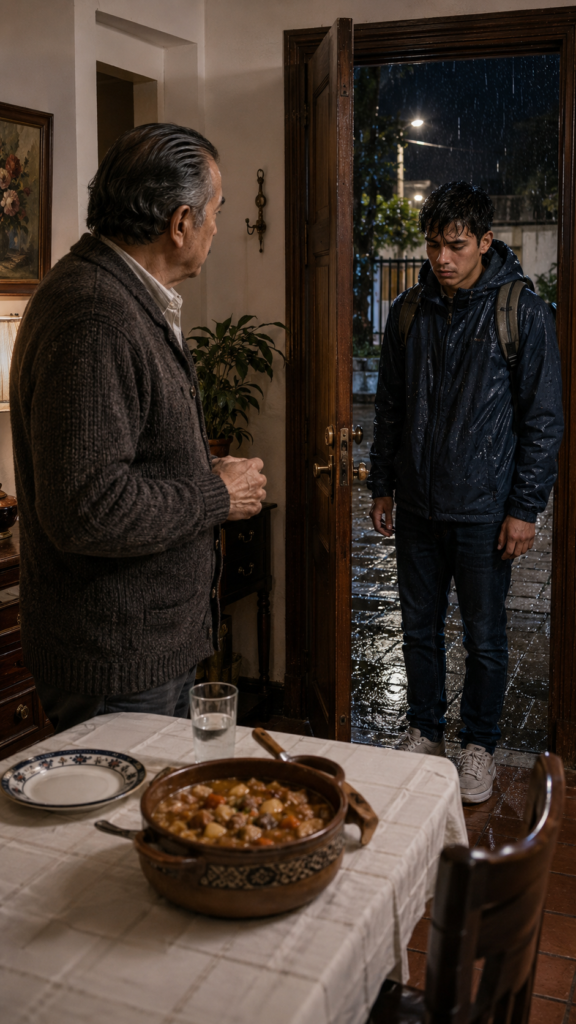
When he opened it, he found a soaked young man, with a delivery backpack and a paper bag about to tear. He looked to be about 21 years old. He wore a thin yellow jacket that was too light for the storm and canvas shoes filled with water.
“Delivery for Mrs. Robles?” he asked, shivering.
“It’s upstairs,” Arturo replied, curtly.
The young man thanked him and started to go up, but took a misstep. He grabbed the railing to avoid falling.
Arturo noticed his hands, purple from the cold. Then he looked at the pot he was about to empty.
“Hey, kid. Have you eaten?”
The delivery boy turned back with distrust.
“Not yet, sir. After my shift.”
“Well, sit down for ten minutes. I cooked too much.”
His name was Emiliano Cruz. He studied architecture at IPN in the mornings and delivered food in the afternoons. His mom and two sisters lived in Hidalgo. He rented a room with three other students and some days had to choose between paying for copies or eating.
At first, he took the spoon awkwardly. Then he devoured two plates of birria and wiped the broth with tortillas.
“Why did you invite me?” he asked.
Arturo gazed at Mariana’s empty chair.
“Because food tastes worse when you understand that no one plans to arrive.”
Before Emiliano left, Arturo gifted him a pair of leather boots that had belonged to his wife for gardening. The young man wanted to refuse, but ended up accepting them with wet eyes.
The following Sunday, he returned to bring back a container.
Arturo had already set two plates.
Thus began a ritual that lasted for months. Emiliano arrived on time, helped with the dishes, taught Arturo how to use video calls, and laughed at his scoldings. Arturo taught him how to make budgets, iron a shirt, and not spend on nonsense.
Until Mariana showed up unannounced.
She entered with her own key and found the stranger sitting in her place, wearing her mother’s boots.
Her face changed.
“Who the hell are you?”
Emiliano stood up abruptly. Arturo tried to explain, but Mariana interrupted him.
“How much money are you taking from my dad?”
Silence fell over the table.
And when Arturo defended the boy, calling him “family,” Mariana did something neither of them could forget.
PART 2
Mariana grabbed Emiliano’s plate and hurled it into the sink. The ceramic shattered, splattering mole everywhere.
“In this house, there’s already a family,” she said, trembling with rage. “And you don’t belong to it.”
Emiliano stood frozen, his face flushed with humiliation. He looked at Arturo, slowly took off the boots, and left them by the door.
“Thanks for everything, Don Arturo.”
“You’re not leaving,” the elder commanded.
“Yes, he is,” Mariana shot back. “And tomorrow, I’m changing the lock.”
Arturo slammed his palm on the table.
“You were the one who stopped coming!”
Mariana paled.
For years, Arturo had swallowed every cancellation to avoid seeming like a demanding father. That night, he unleashed everything: the cold dinners, the birthdays sent by courier, the three-minute phone calls, the time he was sick for four days and she only sent him a pharmacy contact.
“Emiliano didn’t take your place,” he said. “He found it empty.”
The phrase pierced Mariana, but she tightened her jaw.
“You know nothing about him. He could be taking advantage. Lonely old men are the perfect target.”
“And absent daughters know how to take advantage, too,” Arturo replied. “Especially when they need their father to sell the apartment to cover the down payment for a house.”
Mariana opened her mouth. Emiliano looked down. Arturo had just revealed the reason for her unexpected visit.
She had been insisting for weeks that the building was unsafe and that he should move to a retirement home. That very afternoon, she had brought documents to put the apartment up for sale.
“I just want you to be safe,” she said.
“No. You want to stop feeling guilty, managing my life from afar.”
Mariana grabbed her bag and stormed out, slamming the door. Emiliano wanted to leave too, but Arturo stopped him.
“Don’t take off those boots for someone who doesn’t know where she was when it rained.”
The young man put them back on, though that dinner had lost its flavor.
For weeks, Mariana didn’t call. Arturo pretended it didn’t hurt. Emiliano continued to arrive every Sunday, but he spoke less. He felt responsible for having opened a wound between father and daughter.
One November night, Arturo cooked lentils with chorizo. At 8:00, Emiliano didn’t show up.
At 8:15, still nothing.
At 8:30, Arturo checked the shared location that the young man had set up for him. The blue dot remained still over Circuito Interior.
He called five times. Voicemail.
He left without turning off the stove.
Two kilometers away, he found patrol cars, an ambulance, and a motorcycle wrecked against the median. The leather boots lay discarded next to a yellow backpack.
Arturo felt the world emptying inside him.
In the emergency room of the General Hospital, a nurse asked if he was a direct relative.
“I’m his family.”
“I need legal kinship.”
“I don’t have it.”
“Then you must wait.”
Arturo, who had never raised his voice in a public office, leaned over the counter.
“That boy came to my door hungry, and since then he hasn’t let me eat alone. If he wakes up, he needs to see someone. And if he doesn’t wake up, he does too. Blood makes relatives, miss, but staying when everything gets horrible makes family.”
The nurse watched him for several seconds. Finally, she opened the door.
Emiliano was unconscious, with three fractured ribs, a broken leg, and a severe head injury. Arturo sat next to him and held his hand.
“The lentils are still warm, son. Don’t you dare leave me hanging.”
He stayed there all night.
The next morning, his phone vibrated. It was Mariana. He didn’t answer. She called back seven times. Arturo turned off his phone.
Two days later, Emiliano opened his eyes.
“Sorry,” he whispered. “I’m late.”
Arturo let out a laugh that turned into tears.
“You’re grounded. Next Sunday, we’ll have mashed potatoes because you won’t be able to chew.”
The recovery would be long. Emiliano couldn’t work for months and risked failing the semester. When he received the news, he turned his face to the wall.
“I don’t want to be a burden.”
“Burden is an object,” Arturo replied. “You’re a person.”
That afternoon, Mariana appeared at the hospital. She had hastily tied-up hair, deep dark circles, and the same sale documents inside her bag.
Seeing Emiliano hooked up to monitors, she stopped.
“Dad… I didn’t know.”
“You never know because you’re never here.”
The phrase was cruel but true.
Mariana approached the bed. She recognized the boots in a transparent bag under the chair. One was cut by the paramedics.
“Did he ask for you?” Arturo said. “When he woke up, he asked if you had come back to have dinner with me.”
Mariana lowered her head.
Emiliano opened his eyes, and upon seeing her, tried to sit up.
“Don’t move,” she ordered.
“I didn’t want to take your place,” he murmured. “I just thought Don Arturo shouldn’t eat alone.”
Mariana sat down. For several minutes, she couldn’t speak.
Then she took the documents from her bag and tore them in front of her father.
“I’m not selling anything.”
Arturo didn’t smile.
“That doesn’t fix everything else.”
“I know.”
Then came the twist that neither expected.
A social worker asked to speak with Arturo. Emiliano’s backpack had been delivered by the police, and inside they found a folder with plans, receipts, and a letter.
They were not papers for asking for money.
For four months, Emiliano had developed a free accessibility project for the building: railings, lighting, and a discreet ramp for senior citizens. He had also saved every peso Arturo had given him “for transportation.” He planned to use it to pay for the first part of the work as a Christmas gift.
In the letter he wrote: “Don Arturo says a house should be ready to welcome those we love. I want yours to be ready so that he can stay for many years.”
Mariana read the sheet twice. Then she covered her face.
The boy she had accused of stealing was saving to take better care of his father than she ever had.
“Forgive me,” she said, looking at Emiliano. “I was a miserable person.”
He shook his head.
“You were scared.”
“No. I was jealous. It hurt to see that someone had done the emotional work I had abandoned.”
Arturo looked at her for the first time without anger. Mariana was no longer justifying herself. She was naming the truth.
In the following six weeks, she began to go to the hospital almost every day. She didn’t quit her job or magically turn into another person. She still had meetings, clients, and obligations. But she stopped using work as a hideout.
She also called Emiliano’s mother in Hidalgo and paid for her transportation, without trying to buy forgiveness. When Doña Teresa arrived, she hugged Arturo as if she had known him all her life.
“My son talked about you,” she said. “He said he had found a borrowed father.”
“Not borrowed,” Arturo replied. “Chosen.”
When Emiliano left the hospital, he couldn’t return to the room where he lived: it was on the third floor without an elevator. Arturo offered him to stay in his apartment.
Emiliano refused three times.
It was Mariana who convinced him.
“It’s not charity,” she said. “It’s rehabilitation with meals included. Besides, someone has to teach my dad that audio messages are not a substitute.”
Arturo protested, but ended up laughing.
The first week was difficult. Emiliano needed help to bathe, get around, and exercise. Arturo grew exhausted, though he would never admit it. Mariana organized shifts, and for the first time in years, she began to arrive before the food got cold.
One afternoon, while Emiliano was sleeping, father and daughter found themselves alone in the kitchen.
“Do you hate me?” Mariana asked.
Arturo dried a plate before answering.
“No. I’m hurt. It’s not the same.”
She began to cry.
“I thought paying your medicine, sending you gifts, and taking care of paperwork was taking care of you.”
“That’s managing, daughter. Taking care is also sitting down.”
Mariana hugged him. It was an awkward embrace, filled with lost years. Arturo took a few seconds to return it.
It wasn’t an instant forgiveness. It was the beginning.
In December, the community approved Emiliano’s project. Several neighbors contributed money, and Mariana covered the difference. When they installed the first railing, Arturo ran his hand over the new metal and understood what it meant: someone had imagined his old age with tenderness.
On Christmas night, he set three plates.
Mariana arrived with romeritos made by her. They were too salty. Emiliano brought bread and moved around with crutches. Arturo served birria, the same food from that storm.
“Three places?” Mariana asked.
“For now,” he replied. “If someone else arrives hungry, we’ll set four.”
During dinner, Emiliano raised his glass of water.
“To the people who open the door even if they have their own sadness inside.”
Arturo looked at his daughter.
“And to the people who learn to knock before it’s too late.”
Mariana nodded with teary eyes.
Since then, Sundays were not perfect. Sometimes Mariana arrived late. Sometimes Emiliano had exams. Sometimes Arturo got angry over trivialities and made more food than necessary.
But no one ever allowed silence to decide for them again.
Months later, Emiliano walked without crutches for the first time. He did it leaning on the railing he had designed himself. Arturo was on one side. Mariana, on the other.
Neighbors applauded.
Arturo thought of the 52 Sundays he had cooked for an empty chair. For a long time, he believed all that food had ended up in the trash.
He was wrong.
The wait, the pain, and even the open door in the storm had led three broken people to the same table.
Because a daughter can return. A stranger can become a son. And a family doesn’t always begin when someone arrives in the world.
Sometimes it begins when someone finally decides to arrive on time.





