PART 1
For 52 Sundays, Don Ernesto Salgado set two plates on the table of his apartment in the Santa María la Ribera neighborhood. For 52 Sundays, he cooked as if his daughter Mariana would still keep her promise to dine with him. And for 52 Sundays, nearly all the food ended up in the trash.
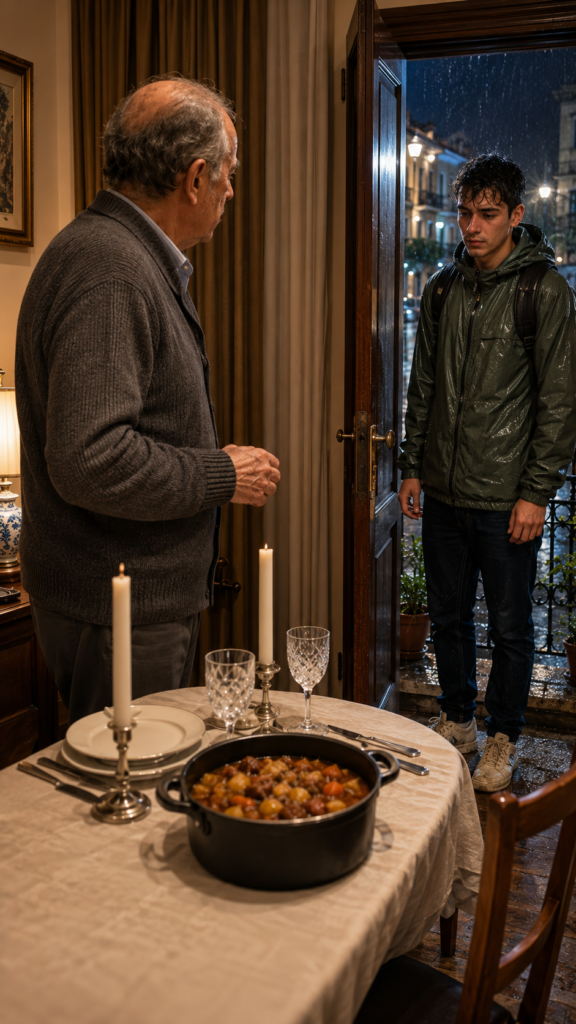
That Sunday, he prepared mole de olla starting at 1:00 PM. He cleaned the embroidered tablecloth that had belonged to his wife, aligned the silverware, and placed a pitcher of hibiscus water next to the candles. At 68 years old, the retired accountant still believed that punctuality was a form of affection.
At 8:47 PM, his cellphone vibrated.
"Dad, I’m so sorry. A meeting with the investors ran long. I promise I’ll come next week."
Ernesto read the message three times. "Next week" had been Mariana’s favorite phrase ever since she had ascended at a tech company in Santa Fe. He knew she worked too much. He also knew she hadn’t sat across from him in eight months.
He turned off the stove and lifted the pot with both hands. The smell of epazote and guajillo chili, which minutes earlier had seemed delicious, now churned his stomach. He was about to dump it all in the trash when the doorbell rang.
On the other side stood a young man of about 22, soaked under a green delivery jacket. He held a paper bag nearly ruined by the rain.
"Package for Mrs. García?" he asked, shivering.
"It’s at 402," Ernesto replied tersely. "This is 302."
The young man apologized and turned to leave. Then Ernesto noticed his canvas shoes, soaked through, and the way he dragged one leg. Outside, a storm had turned Circuito Interior into chaos.
"Hey, kid," he called. "Have you eaten?"
The delivery boy froze.
His name was Emiliano Cruz. He studied architecture at IPN, rented a room with three other young men, and worked delivering food until dawn. He tried to say he wasn’t hungry, but his stomach betrayed him with a noise so loud that they both laughed awkwardly.
Five minutes later, Emiliano was sitting in the chair reserved for Mariana. He ate slowly out of politeness, though it was evident he hadn’t tasted anything for hours. Ernesto served him twice and then wrapped another portion for him to take.
Before he left, Ernesto gifted him a pair of leather boots he had kept for years.
"They belonged to my son," he lied. "No one wears them anymore."
Ernesto had never had a son.
From that day on, Emiliano returned every Sunday. He taught Ernesto how to use video calls, music apps, and memes. Ernesto taught him how to iron a shirt, tie a tie, and cook rice without turning it into mush.
Without realizing it, one stopped eating alone, and the other stopped feeling invisible.
But on the 52nd Sunday, Emiliano didn’t arrive.
At 9:26 PM, Ernesto checked the location the young man shared for safety. The blue dot had been stationary on Avenida Insurgentes for 19 minutes. He grabbed his keys, ran downstairs, and drove into the rain.
He found a wrecked motorcycle against the median, a green backpack discarded, and the leather boots covered in blood.
A police officer stopped him.
"The delivery boy was taken to the General Hospital. He’s in critical condition. Are you family?"
Ernesto looked at those boots and replied without hesitation:
"I’m his father.
PART 2
In the emergency room, an administrative worker asked for identification and proof of relationship. Ernesto only had a photo of Emiliano laughing in front of a pot of pozole.
"You can’t go in. Only direct family."
"His parents live in Oaxaca and won’t make it in time. I know he’s afraid of hospitals, that he hates cilantro, and that he saves coins to open an office. Doesn’t that count?"
The woman insisted on the rules. Ernesto, who had never altered an invoice in 40 years, slammed the countertop.
"Blood makes relatives. Being there when everything falls apart makes family. If he dies alone because of a piece of paper, tell me who will carry that burden."
A nurse opened the side door.
"Cubicle 7. You have 5 minutes. I didn’t see anything."
Emiliano lay unconscious, connected to monitors, with a leg immobilized and his face bruised. Ernesto took his cold hand.
"The enchiladas are still on the table, son. Don’t you dare tell me you’re not coming now, either."
The 5 minutes turned into the entire night.
At 6:40 AM, the surgeon explained that Emiliano had a fractured femur, three broken ribs, and a hemorrhage that was now controlled. He would live, but recovery would take months.
Then Ernesto called Mariana five times. When he got no response, he left a message:
"I’m at the General Hospital. A young man I care for could die. I don’t know how to ask you to be here anymore."
Mariana arrived almost three hours later, without makeup, hair messy, still wearing her company badge. Seeing her father aged over a chair, she froze.
"Who is Emiliano?"
"The young man who sat in your place for 52 Sundays."
The phrase landed like a slap. Mariana looked at the boy connected to tubes.
"Did you replace me?" she murmured.
"No. You left the seat empty. He arrived soaked, hungry, and stayed. Don’t confuse abandonment with replacement."
Mariana sat facing the wall and cried. She had lost her father while boasting on social media that she did everything "for the family."
Two days later, Emiliano opened his eyes. The first thing he saw was Ernesto.
"Sorry... I arrived late," he whispered.
"I’m going to charge you for every minute, dude."
Mariana was on the other side of the bed. Emiliano didn’t recognize her.
"I’m Mariana, Don Ernesto’s daughter."
He tried to pull his hand away, as if he had occupied a forbidden place.
"I didn’t mean to intrude on your family."
"You didn’t intrude," Ernesto replied. "You held it together when she wasn’t there."
Mariana lowered her head.
"Thank you for dining with my dad."
In the following days, she returned to the hospital. At first, she answered messages in the hallway. Then she began to turn off her cellphone before entering. She helped with paperwork, brought coffee, and listened to stories from those 52 Sundays.
On one of those visits, Mariana found in Emiliano’s backpack a perfectly washed container, labeled by Ernesto: "So you don’t eat just anything." There were 17 identical labels folded in a pocket.
She understood that her father hadn’t only shared food. He had built, Sunday by Sunday, a routine of care that she had let die. This time, she didn’t feel jealousy. She felt shame and also relief: someone had seen her father when she chose not to look.
One night, while Emiliano slept, father and daughter were left alone.
"I didn’t know you were so lonely," Mariana said.
"You did know."
She closed her eyes.
"I suspected. But accepting that you were struggling meant changing my life. It was easier to imagine you were strong."
"Being strong doesn’t mean not needing anyone."
Mariana then confessed that her company was on the verge of a sale, her boss was threatening to fire her, and she owed almost 600,000 pesos on a mortgage for an apartment bought to prove that "she was doing well."
"I was embarrassed to come. I felt like you’d ask why I couldn’t handle everything."
Ernesto understood that his daughter hadn’t pulled away out of lack of love, but because she was trapped in a life built to seem invincible. But understanding didn’t erase the damage.
"You could have told me the truth. Instead, you let me cook for a promise for 52 weeks."
"I’m not asking you to forgive me today," she replied. "Just let me start showing up."
The real turn came the next day.
A social worker located Emiliano’s parents in the Mixteca. His mother revealed they had been distant for four years. His father had rejected his decision to study architecture, and after a fight, Emiliano left for Mexico City, vowing never to return until he became someone.
Ernesto realized they had both filled the same void: a father without a daughter and a son without a father.
When Emiliano woke up, he refused to speak to his family.
"You didn’t come when I needed you."
"And you didn’t return either," Ernesto replied. "Pride keeps the back straight, but it also leaves empty chairs."
Three days later, his parents arrived after an 11-hour bus ride. His mother entered first, wearing a dark shawl. The father stayed at the door, gripping a hat.
Emiliano turned away.
"You didn’t have to come."
"Yes, we did," his father responded. "We arrived four years late, but we came."
The man placed an old notebook on the table. It was Emiliano’s first drawing notebook, filled with houses and bridges designed when he was nine years old.
"I never threw it away. I said it was useless because I was afraid you’d leave and discover you didn’t need me. Honestly, I was a coward."
Emiliano started to cry. His father hugged him carefully, and in that cubicle, four years of silence shattered.
Mariana watched from the hallway. Then she called her company and requested a leave of absence for exhaustion. Her boss threatened to replace her.
"Then replace me. I’ve replaced too many dinners with meetings."
She hung up trembling but breathed without feeling a stone on her chest.
When Emiliano was discharged, his parents had to return to Oaxaca, and he couldn’t climb the stairs to the room he rented. Ernesto decided before anyone asked.
"You’re coming with me until you walk well."
"I don’t want to be a burden."
"A burden is a pot full that ends up in the trash. You wash the dishes, so it’s cheap."
Mariana bought a shower chair, organized rehabilitation, and set up a desk by the window. At first, every object seemed like an apology. Then Ernesto noticed something more important: she no longer asked what time she could leave.
The living situation wasn’t perfect. Emiliano grew impatient with the crutches, Ernesto treated him like glass, and Mariana wanted to solve everything with lists. They argued over medications, schedules, and even burnt beans.
But they were arguments of present people.
One Thursday, Emiliano spread out some plans. He had designed a folding ramp and a handrail for the building entrance, thinking about his rehabilitation, Ernesto, and the older neighbors.
"I can’t pay you," Ernesto said.
"You’ve already paid me 52 Sundays."
Mariana got the condominium to approve the work. She didn’t use hidden money or influence; she gathered signatures, listened to the neighbors, and presented the project. Ernesto watched her use her talent without destroying herself to prove something.
The installation finished two weeks before Christmas.
That Sunday, Ernesto didn’t set two plates. He set five: for Mariana, Emiliano, and the young man’s parents, who returned with sweet bread and a bottle of mezcal.
Mariana arrived at 7:55 PM.
"There are still five minutes left," Ernesto said.
"I didn’t want to arrive late again."
During dinner, Emiliano raised his glass of water.
"To the people who open the door when one comes in soaked, hungry, or too proud to ask for help."
His father added:
"And to those who dare to knock again, even if they think they don’t deserve to enter."
Mariana looked at Ernesto.
"And to those who stop promising 'next week.'"
Ernesto lit the candles. For years, he had believed that family was a fixed list of names, like an account that had to balance. Now he knew it could also be a table capable of expanding when someone needed a place.
Nothing was resolved all at once. Mariana was still paying debts and learning to set boundaries. Emiliano needed months of therapy. His father still struggled to ask for forgiveness without hiding behind jokes.
But every Sunday at 8:00 PM, someone knocked on the door.
Sometimes it was three. Sometimes five. Once, seven arrived, eating from different plates because the dishware wasn’t enough. Ernesto no longer cared that the cutlery was misaligned.
The only thing he never allowed again was for the food to end up in the trash waiting for someone who never thought to arrive.
Because forgiving isn’t pretending that abandonment didn’t hurt. It’s opening the door without locking yourself behind it again.
And perhaps that’s the question that most unsettles: is family who shares blood… or those who sit at your table when the rest always has something "more important" to do?





