PART 1
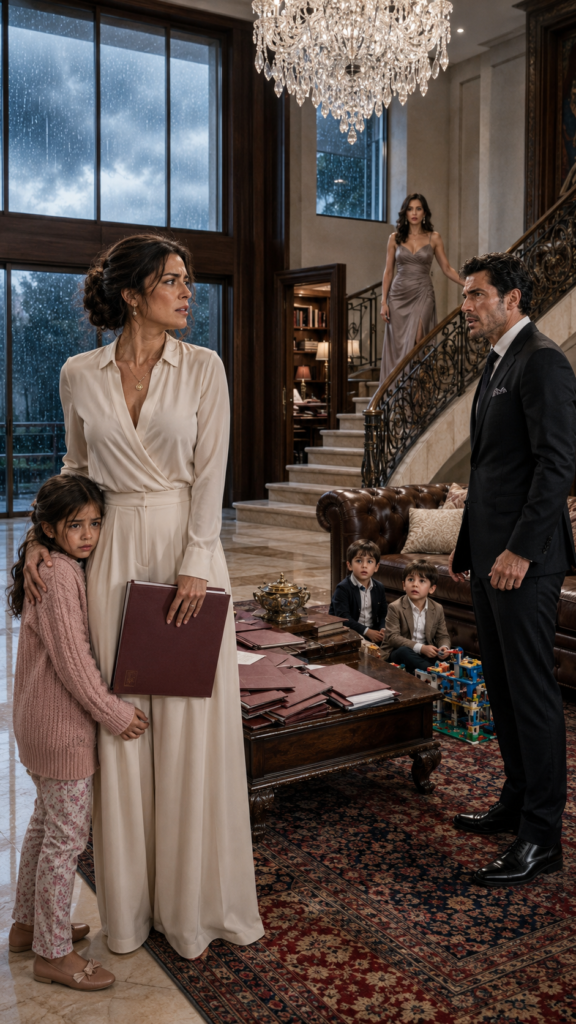
The divorce had just been finalized in the main hall of a mansion in Lomas de Chapultepec when Rodrigo Alcázar looked at Mariana Robles as if he had finally shrugged off an old burden.
On the marble table lay two black folders, a luxury pen, and five years of shattered marriage without a single tear shed on his part.
—Well, Mariana—he said, adjusting his silver cufflinks—. Now that you want to leave, tell me one thing. Which of the children are you taking?
The three little boys were playing on the carpet with an expensive electric track. Santiago was eight, Nicolás six, and Diego four. All three wore designer clothes, immaculate white sneakers, and that cruel confidence of children who learn too early to command.
But Mariana didn’t look at them.
Her eyes went straight to the corner by the window, where Camila, her seven-year-old daughter, hugged a broken doll and hid her hands under the sleeves of a worn-out sweater.
—I’m taking Camila—Mariana replied, with a calm that froze the room—. I can't take the boys. They can stay with you... and with Dr. Jimena.
Rodrigo stopped smiling.
His mother, Doña Ofelia, who sat with a cup of tea as if this were a bank transaction, suddenly looked up.
—What did you just say?
Mariana took Camila's hand.
The girl was trembling.
For years, in that house, Camila had served water, picked up other people's toys, waited in the kitchen while the others ate cake, and received scoldings for existing too quietly, too softly, too much like a girl.
—Mom, don’t take her—Diego said, pouting—. Camila brings me my cookies.
Santiago let out a giggle.
—Dad says Mariana can’t even afford an Uber. She’ll be back tomorrow begging.
Nicolás added:
—And Camila doesn’t even seem like part of this family.
The phrase fell like a stone.
Rodrigo didn’t correct him.
Mariana felt something inside her shatter for the last time. It wasn’t rage. It was clarity.
Five years earlier, she had given up her art scholarship in Oaxaca because Rodrigo promised her a quiet life in Mexico City. He told her that a wife with the last name Alcázar didn’t need to sell paintings at fairs or get her hands dirty with paint.
Doña Ofelia was more direct.
—Here, women are educated to be presentable, not to act like bohemians.
Mariana obeyed.
She took care of the house. Organized birthdays. Prepared uniforms. Attended medical appointments. Smiled in front of guests. She raised three children who never called her mom with love, but with demand.
And she protected Camila as best she could, the only daughter born of her body, the only one everyone saw as a burden.
Until one early morning, searching for medicine for Diego’s fever, Mariana entered Rodrigo’s study and found the bottom drawer of the desk open.
Inside were documents from a private clinic in Santa Fe, transfers, ultrasounds, printed messages, and three DNA tests.
All with the same female name.
Dr. Jimena Valdés.
The family pediatrician.
The woman who hugged Mariana when Doña Ofelia called her useless for not having given birth to a son.
The woman who entered the mansion in a white coat, with a sweet voice and a saintly face.
Rodrigo stood up.
—Shut up, Mariana.
She stared at him without blinking.
—No. It ends today.
From the stairs came a clumsy step.
A shadow tried to hide too late.
Mariana raised her voice:
—Come down, Jimena. I think your children deserve to know why their real mother has been pretending to be just their doctor for five years.
PART 2
Dr. Jimena Valdés appeared at the top of the stairs, her face pale.
She no longer wore a coat or stethoscope. She wore a discreet and expensive cream-colored dress, one of those that doesn't scream money but flaunts it effortlessly.
—Mariana...—she whispered—. You shouldn't have seen those papers.
Camila tightened her grip on her mother’s hand.
Santiago dropped a piece from the electric track.
—What does it mean, 'real mother'?
No one answered.
Rodrigo glared at Jimena with fury.
—Come up. Now.
But she didn’t move.
Diego, confused, took two steps toward her.
—Mommy...
The word came out softly, almost by accident, but it was enough to ignite the room.
Nicolás's eyes widened.
—Why did you call her mommy?
Doña Ofelia got up so quickly that the cup hit the saucer.
—Rodrigo, control this!
Mariana let out a dry laugh.
—Control it? That's what you did for five years. You controlled the lie, controlled my silence, and controlled my daughter’s life.
Rodrigo took a step toward her.
—You have no idea what you’re provoking.
—Of course I do—Mariana replied—. I’m provoking that, for the first time, someone speaks the truth in this house.
Jimena slowly descended the stairs.
Her eyes were filled with tears, but Mariana no longer believed in that sweetness. For years, that woman had given syrups to the children, parenting advice, and pats on the shoulder while sleeping with her husband and hiding her own children behind a facade.
—I never meant to hurt you—Jimena said.
—Wow, what nerve—Mariana murmured—. Did you never mean to hurt me when you recommended patience? When you said Camila was “too sensitive” and that’s why she cried so much? When you saw how your children treated my daughter like an employee behind my back?
Jimena looked down.
—it was a complicated situation.
—Complicated was watching Camila eat alone in the kitchen while you celebrated Santiago’s birthday with eighty guests. What you did wasn’t complicated. It was convenient.
Rodrigo slammed the table.
—Enough!
The shout made Camila flinch.
Mariana crouched down in front of her.
—Look at me, my love. You didn’t do anything wrong. Nothing.
The girl nodded, but her eyes were still full of fear.
Then Mariana pulled out her cell phone from her bag.
Rodrigo’s expression changed.
—What are you doing?
—What I should have done since I found the first document.
She opened a password-protected folder.
There were photos of the DNA tests. Santiago, Nicolás, and Diego: biological matches with Rodrigo Alcázar and Jimena Valdés. There were also transfers to a fertility clinic in Santa Fe, prescriptions signed by Jimena, and screenshots of messages where Rodrigo told her:
“Mariana must never find out. My mother will make sure her daughter doesn’t feel part of the family.”
Doña Ofelia turned pale.
—That’s taken out of context.
Mariana slid her finger across the screen.
—There are also videos.
Rodrigo tried to snatch the phone from her, but she stepped back.
—Don’t even think about it, dude.
The word surprised everyone because Mariana never spoke like that. She had always been polite, gentle, almost invisible.
But that night, she was no longer invisible.
She played the first video.
On the screen, Santiago was forcing Camila to pick up toys while Nicolás told her that if she didn’t clean up, she wouldn’t get dessert. In another, Diego took a cookie from her, and an employee pretended not to see. In another, Doña Ofelia whispered to Camila:
—If you had been born a boy, maybe Rodrigo would have loved you a little.
Jimena covered her mouth.
—I didn’t know it went that far.
Mariana looked at her with contempt.
—you were in and out of this house. You did know. You just preferred not to look.
Santiago started to cry.
—So, Mariana isn’t my mom?
Rodrigo took a deep breath.
—Son, adult matters are complicated.
—No!—Santiago shouted—. She took care of us, and you lied to us?
That scream was the first real blow against Rodrigo.
Because it didn’t come from Mariana.
It came from the son he always bragged about as the perfect heir.
Nicolás began to sob.
Diego ran toward Jimena but stopped halfway. He wanted to hug her, but something in his little face understood that he should also be angry.
Mariana felt pity for them.
Yes, they had hurt Camila. Yes, they had repeated the cruelty of adults. But they were still children used as pawns in a huge lie.
Rodrigo lowered his voice.
—Listen to me carefully, Mariana. If you walk out that door, I’ll destroy you. You have no job, no money, no last name. In this city, no one messes with the Alcázars.
Normally, those words would have paralyzed her.
But Rodrigo didn’t know something.
For the past year, while the mansion slept, Mariana had started painting again.
First in the laundry room. Then in a small shed behind the garden. She bought cheap canvases online, used old oil paints, and signed only as M. Robles.
A small gallery in Roma Norte sold her first series.
Then she sold another.
Later, a cultural foundation from Oaxaca offered her an artist residency, a workshop, and a group exhibition.
She wasn’t wealthy.
But she no longer depended on him.
—I don’t need your last name—Mariana said—. And money won’t buy you a conscience.
The doorbell rang.
Rodrigo turned his head.
The employee appeared nervously.
—Sir... a lawyer has arrived. She says she’s here for Mrs. Mariana.
Rodrigo glared at her with hatred.
—What did you do?
—Prepare myself.
Licenciada Rebeca Montiel, a family lawyer, entered, wearing a black coat and carrying a thick folder. Along with her was a social worker from the local DIF.
Doña Ofelia placed a hand on her chest.
—This is private property.
Rebeca didn’t flinch.
—And this is an urgent request for protective measures for a minor, accompanied by a psychological report, audiovisual evidence, and documents that prove sustained emotional abuse.
Rodrigo clenched his teeth.
—You can’t just enter like this.
—No one is here to make a circus, Mr. Alcázar—Rebeca replied—. We’re here to ensure that Camila leaves this house with her mother today.
Jimena stepped back.
Rebeca looked at her.
—Dr. Valdés, your name appears in paternity tests, medical prescriptions, and transfers that could implicate falsification of data and conflict of interest. It would be wise not to intervene.
The word “doctor” sounded different.
Not as respect.
As a warning.
Rodrigo moved closer to Mariana.
—You’re going to regret this.
She lifted her gaze.
—No. I regret being silent when my daughter started asking for permission to eat at the same table as everyone else.
Camila cried silently.
Mariana wiped her face with her thumb.
—Not anymore, my love. Never again.
As they walked toward the exit, Diego whispered:
—Camila...
The girl stopped.
He lowered his head.
—I’m sorry for taking your cookies.
Camila looked at him for a few seconds.
She didn’t smile.
She didn’t run to hug him.
She simply said:
—I don’t want anyone to take anything from me again.
And she kept walking.
That was her first brave sentence.
Outside, it drizzled over Mexico City. Mariana stepped out with one suitcase, one folder of documents, and her daughter’s hand in hers.
She carried no jewelry.
No armored truck.
No bodyguards.
But she carried air.
Air to breathe without fear.
The following months were heavy.
Rodrigo tried to paint her as a resentful woman. His lawyers claimed she was unstable, that she sought money, that she manipulated Camila. Doña Ofelia called half the world to say Mariana was ungrateful.
But every lie collided with evidence.
The analyses confirmed the paternity of the three children. The messages demonstrated that Rodrigo and Jimena had concealed the truth. The videos revealed the daily humiliation against Camila.
The judge ordered protective measures. Rodrigo had to pay child support and accept supervised visits until Camila felt safe.
Jimena lost her place as the trusted physician of the Alcázar family. Her name became associated with a professional investigation for manipulating clinical information and hiding personal conflicts.
And Rodrigo discovered that prestige doesn’t fall all at once.
First, it cracks.
A partner canceled a dinner.
Then a board demanded explanations.
Later, an online portal published the family scandal without mentioning the minors, but everyone in his circle understood who it was about.
The man who said Mariana was nobody began to understand that the quietest woman in a house is often the one who has seen the most.
One year later, Mariana and Camila lived in Oaxaca, in a small apartment near a market filled with flowers, sweet bread, and the smell of coffee.
The first time Camila saw her mother’s painting studio, she stood frozen at the door.
—Can I come in?—she asked.
Mariana felt a lump in her throat.
—Of course you can. This place is yours too.
Camila entered slowly, as if she still expected someone to scold her.
On a table were brushes, colors, and white sheets.
—Can I use one?—she asked again.
Mariana hugged her from behind.
—You can use as many as you want.
That afternoon, Camila painted a huge gray house, far away. In the foreground, she drew a woman and a girl walking toward a field of orange flowers.
They didn’t look back.
Weeks later, a letter arrived without a return address.
Inside was a drawing made by three children. There were four small figures holding hands. Below, in clumsy handwriting, it said:
“I’m sorry, Camila. We didn’t know how to love properly.”
Camila read it in silence.
Then she put it in a box.
—Did it hurt?—Mariana asked.
The girl thought for a moment.
—Yes. But I don’t want to hate them. I just want them to learn.
Mariana hugged her tightly.
Because that was her daughter.
Not a maid.
Not a shadow.
Not a girl destined to serve anyone.
She was a girl who had survived in a house full of luxury and little humanity.
That night, Mariana finished a new painting.
A mansion lay behind, dark and distant. In the foreground, a mother and daughter walked under a clear light.
She titled it:
“The Door We Never Crossed Again.”
It sold in three days.
But what mattered wasn’t the money.
What mattered was that, for the first time in many years, Mariana signed with her full name.
And understood that sometimes losing a house is the only way to save a daughter’s dignity.





