PART 1
"Will you give me what you won’t eat anymore, ma’am?"
The question fell in the restaurant like a sudden silence after music had been cut.
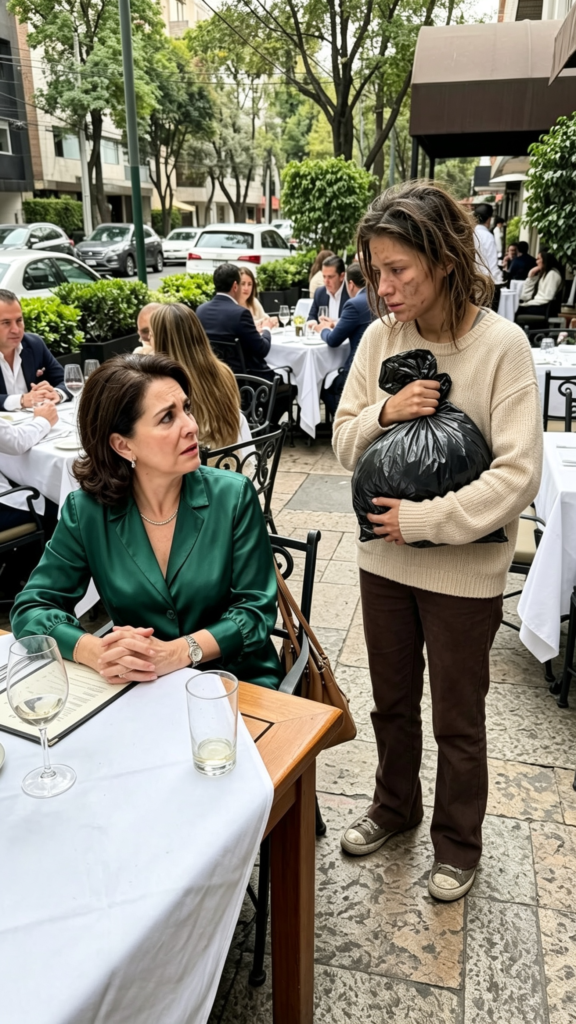
In an upscale terrace in Polanco, surrounded by fine glasses, waiters in white gloves, and people whispering to flaunt their wealth, a young woman, painfully thin, stood next to Isabel Andrade’s table.
She looked about 26.
Wearing a ripped gray jacket at the sleeves, her hair tangled from the cold, and sneakers so worn that her toes were almost visible, she hugged a plastic bag against her chest as if it contained everything she had left in the world.
Isabel, a widow from Las Lomas, lifted her gaze, the fork suspended in mid-air.
She was about to call the manager to stop the humiliation.
But then she saw her eyes.
Black.
Deep.
Just like those of the baby she had mourned for 22 years.
For a second, Isabel forgot to breathe.
The manager immediately appeared, nervous, sweating beneath his jacket.
“Miss, you can’t disturb the customers here,” he said, grabbing her arm.
The young woman lowered her face, embarrassed.
“I just wanted the bread, sir. I’m leaving.”
“Let her go,” Isabel ordered.
She didn’t shout.
She didn’t make a scene.
But her voice was so cold that even the table next door stopped moving their cutlery.
The manager released her.
“Bring her a chair,” Isabel said. “And the full menu. The best of the house.”
A jewelled lady sitting near the window wrinkled her nose.
“How horrible. One comes to eat well and they let in street people.”
Isabel stood up slowly.
“The building where you’re dining is mine, ma’am. And believe me, the poverty that brings the most shame isn’t in the clothes. It’s in the soul.”
The woman fell silent.
The young woman wanted to step back.
“No, ma’am, really. I don’t want trouble. I’ve only been without hot food for three days.”
Isabel’s chest tightened.
“Sit down, daughter.”
The word “daughter” slipped out unbidden.
The girl looked at her, frightened, as if that word hurt.
“My name is Alma,” she murmured.
At first, she ate slowly, with shyness.
Then hunger took over.
She took the soup with trembling hands, broke the bread into small pieces, and savored every bite as if someone could snatch it away.
Isabel couldn’t stop watching her.
The way she smiled just slightly to the side.
The dimple in her right cheek.
And then, when Alma tucked her hair behind her ear, Isabel saw it.
A small birthmark beneath her left ear.
Exactly where her baby had it.
The glass slipped from her fingers and shattered on the floor.
Alma jumped.
“Ma’am? Are you alright?”
Isabel didn’t answer.
She stared at that birthmark as if witnessing a tomb opening from within.
Because in that instant, she understood something impossible: the daughter they told her had died might be sitting right in front of her, asking for leftovers.
PART 2
Isabel said nothing in the restaurant.
She couldn’t.
If she was wrong, she could destroy a girl already broken by life. But if she wasn’t wrong, then someone had stolen 22 years from her — a daughter and a truth worth more than all her money.
When Alma finished eating, she wiped the table with a folded napkin, as if trying to erase any trace of having been there.
“Thank you, ma’am. I won’t bother you anymore.”
She stood up, clutching her black bag to her chest.
Isabel felt panic.
An old panic, from the hospital, from white hallways, from an empty crib.
“Come with me tonight,” she asked softly. “I’m not buying you anything. I’m just offering you a bed, a bathroom, and clean clothes. Tomorrow you decide what to do.”
Alma shook her head.
“You don’t know me. You shouldn’t trust me.”
“Sometimes the heart recognizes before the head,” Isabel replied.
Alma looked at her for a long moment.
Then she accepted.
They arrived at Isabel’s mansion in Las Lomas after dark. The house was huge, silent, spotless, but it had that sadness of places where luxury abounds and laughter is lacking.
Carmen, the maid who had been with Isabel for over 30 years, opened the door.
Seeing Alma, she paled.
“Mrs. Isabel…”
“Prepare the blue room.”
Carmen nearly dropped the keys.
The blue room had been closed for 22 years.
It was the room of the baby everyone called Mariana Andrade.
The baby who supposedly died of fever in a private hospital in Santa Fe.
While Alma bathed, Isabel went up to her office and opened a safe. She took out an old photo, protected in a folder.
In the image, she was younger, holding a newborn wrapped in a yellow blanket.
Beneath the left ear, the baby had the same birthmark.
Isabel covered her mouth to stifle a scream.
That same night, she called Esteban Robles, a private investigator who had worked for her company for years.
“I need you to find two things,” she said. “The hospital records where my daughter died and the shelter where a young woman named Alma grew up.”
“What are you suspecting, ma’am?”
Isabel closed her eyes.
“That my life was stolen from me.”
In the following days, Alma stayed at the house.
She didn’t act like someone interested in money. On the contrary, she walked carefully, asked permission for everything, and apologized even for using a towel.
She helped Carmen in the kitchen.
She watered the plants.
She read old books in the library.
One afternoon, Isabel wanted to take her shopping for clothes.
Alma accepted some simple jeans, a white t-shirt, and sneakers.
When Isabel tried to buy her an expensive coat, Alma turned red with shame.
“No, ma’am. This is enough. I don’t want to take advantage.”
“You’re not taking advantage.”
Alma lowered her gaze.
“It’s just that my entire life, I was made to feel that needing something was being a burden.”
Isabel had to step out into the garden to cry alone.
The report arrived three weeks later, on a day of heavy rain.
Esteban entered with a manila envelope and a serious face.
“I found the nurse from that night. Her name is Dolores Meza. She’s very sick. And she confessed.”
Isabel held onto the desk.
“Tell me.”
“Your daughter didn’t die. She had a fever, yes, but she recovered. Someone paid for you to receive the wrong body and a fake death certificate.”
The silence hit her ears.
“Who?”
Esteban lowered his voice.
“Your brother-in-law, Rodrigo Andrade.”
Isabel felt the world shatter around her.
Rodrigo, her deceased husband’s brother, had always hated that Mariana was the principal heir of the family group. As long as the girl lived, Rodrigo wouldn’t control the fortune or the shares.
But if the baby disappeared, he could enter the board, manipulate inheritances, and claim millions.
“Dolores didn’t dare to kill the baby,” Esteban continued. “She left her in a shelter in Iztapalapa with false documents. There, they registered a girl without a last name. They named her Alma.”
Isabel stood motionless.
Everything fell into place.
The birthmark.
The eyes.
The age.
The dimple.
The locked room.
The pain she never knew how to let die.
All that was left was the DNA proof.
They conducted it discreetly. Alma thought it was a medical test because she had been feeling weak. Isabel didn’t want to drop a bomb without being sure.
The next 48 hours were torture.
When Esteban called, Isabel answered with a trembling hand.
“It’s positive,” he said. “99.99%. Alma Reyes is Mariana Andrade.”
Isabel fell to the floor.
The daughter she had buried in her memory was alive.
And before sleeping under her roof, she had asked for the leftovers from her plate.
That night, she descended to the living room with the results in her hands.
Alma was on the sofa, reading an old novel.
“Ma’am? You look like you’ve seen a ghost.”
Isabel sat next to her.
“Alma, I need to tell you something. Twenty-two years ago, I had a daughter. Her name was Mariana. They told me she died, but it was a lie.”
Alma put the book down.
“What?”
“They stole her from me. They left her in a shelter in Iztapalapa. They changed her name. They told her that her mother abandoned her.”
Alma began to shake her head.
“No. Don’t say that. Don’t play with that, please.”
Isabel showed her the paper.
Alma saw the 99.99%.
Then she saw the names.
Isabel Andrade.
Mariana Andrade.
The paper fell to the floor.
“So… you are my mom?”
The word came out cracked, as if it hurt her throat.
Isabel opened her arms.
“Yes, my girl. I am your mom. I never abandoned you. I cried for you every day.”
Alma launched herself at her.
She cried like a 4-year-old girl, like an abandoned teenager, like a woman who finally understood that her pain had culprits.
“I thought no one ever loved me,” she sobbed.
“I loved you before I even saw your face.”
They slept together that night, embraced, as if the body could reclaim in a few hours what had been stolen from them for 22 years.
But happiness didn’t last quietly.
Alma later recounted how she ended up on the street.
She had studied pedagogy on a scholarship. She wanted to be a teacher. In college, she met Damián, a charming guy, well-dressed, one of those who speak beautifully and promise a future.
He made her fall in love.
He convinced her to sign loans in her name for “a small business.”
Then he disappeared with the money.
When the collectors came, Alma lost her rented room, her scholarship, and even her documents. She first slept in borrowed homes, then in a bus station, and finally on the street.
What neither of them knew was that Damián had followed her from the Polanco restaurant.
And when he discovered that the hungry young woman was the lost heiress of the Andrades, he ran to seek Rodrigo.
“Your niece is alive,” he said over the phone. “And if you help me, we can make her look like a scammer.”
Rodrigo agreed.
A few days later, anonymous messages began arriving on Isabel’s cell phone.
Photos of Alma talking to Damián on a corner.
Edited audio where her voice was heard saying:
“I just need you to trust me.”
There was also a supposed conversation where Alma said that “the lady from Las Lomas was falling for it.”
Isabel knew something smelled wrong.
But fear is a brutal thing.
After losing her daughter once, the terror of being deceived seeped into her blood.
One night, she entered the blue room with the printed photos.
Alma was folding clothes.
“I need you to tell me the truth,” Isabel said. “Did you know who I was before you approached my table?”
Alma looked at the photos.
She understood everything.
“You think I deceived you.”
Isabel didn’t respond.
That silence was worse than an insult.
Alma turned pale. Then she took her black bag from the closet and began to pack her few clothes.
“I’m leaving.”
“No, wait.”
“I won’t stay where I’m not believed. Keep the house, the surname, the money. I never wanted that.”
Isabel felt the shame burning her face.
“Alma…”
The young woman looked at her with tears but with dignity.
“I just wanted a mom.”
That’s when Isabel woke up.
A scammer would have begged for the inheritance.
Alma was willing to return to the street rather than live under suspicion.
Isabel hugged her with all her strength.
“Forgive me, Mariana. Forgive me, my girl. I believe you. And now we’re going to put an end to this.”
Esteban moved quickly.
He found the man who had taken the fake photos. He confessed that Damián had paid him. He also recovered the original audios, where Alma wasn’t talking about deceiving Isabel, but about trusting her to share her past.
Then they located Dolores Meza, the nurse.
She arrived at the mansion in a wheelchair, with oxygen and a guilt that seemed to weigh heavier than her illness.
In front of a notary, she confessed everything.
“Rodrigo Andrade paid me to disappear the baby. He told me that if I didn’t obey, I would be ruined. I couldn’t kill her. I left her in the shelter and kept a recording out of fear.”
The recording was clear.
Rodrigo’s voice said:
“That girl has to stop existing. Isabel must mourn her, not look for her.”
Isabel didn’t cry when she heard it.
Not anymore.
Rage kept her standing.
She prepared a trap.
She made Rodrigo believe that she doubted Alma and that she was considering removing her from the will. She summoned him to the mansion to “resolve the family crisis.”
Rodrigo arrived with Damián.
They entered confidently, perfumed, smiling.
“Dear Isabel,” Rodrigo said. “I warned you. A street girl doesn’t enter a decent family just because she has a birthmark.”
Damián smiled.
“Alma has always been good at playing the pity card.”
Isabel served coffee with a calm that chilled.
“How curious that you talk about lies,” she said. “I have Dolores’s confession, the original audios, the DNA proof, and a prosecutor listening behind that door.”
Rodrigo lost color.
Damián tried to run.
He didn’t even reach the hallway.
The police entered and surrounded them.
“Rodrigo Andrade and Damián Salcedo, you are under arrest for kidnapping a minor, fraud, extortion, falsification of evidence, and criminal association.”
As they put handcuffs on him, Rodrigo still spat venom.
“That girl will never be an Andrade. She’s just a nobody picked off the street.”
Then Alma descended the stairs.
She no longer wore torn clothes.
Nor jewels.
Just jeans, a simple blouse, and her head held high.
“You’re right about one thing, uncle,” she said. “I was from the street. I asked for leftovers. I slept in the cold. But there I learned something you never understood: people aren’t worth what they inherit, but what they do when no one is watching.”
Rodrigo had no response.
They took him away defeated.
A year later, Rodrigo received a 30-year sentence. Damián also ended up in prison for fraud and extortion.
Alma regained her papers and her legal name: Mariana Andrade.
But she asked to keep being called Alma.
“Mariana gives me back my story,” she said. “But Alma reminds me who I must help.”
Isabel wanted to give her trips, jewels, cars, everything money could buy.
Alma asked for something else.
“Let’s found soup kitchens, mom. Places where no one has to ask for leftovers.”
Thus was born the Alma Mariana Foundation.
They opened shelters in Iztapalapa, La Merced, and Tacubaya. There was hot food, clean bathrooms, dignified clothing, and a small library for children who still believed that studying was an impossible luxury.
On the inauguration day, Alma took the microphone.
She looked at the people without hiding her tears.
“The worst part of living on the street wasn’t the hunger. It was feeling like everyone looked at you like trash. One day a woman truly saw me. She sat me at her table and returned my name to me.”
Isabel cried among the crowd.
Not from pain.
But from pride.
Months later, mother and daughter returned to the Polanco restaurant.
They ordered soup, fish, freshly baked bread, and a huge chocolate dessert.
At the entrance appeared an old man in worn clothes. The manager tried to stop him.
“You can’t come in.”
Alma stood up before anyone.
“Good afternoon, sir. Are you hungry?”
The man lowered his gaze.
“I don’t have money, miss. I just wanted to see if I could get some leftovers.”
Alma arranged a chair for him.
“Here, no one eats leftovers. Here, you sit at the table.”
Isabel looked at her and understood that justice had punished the guilty, but her daughter’s kindness had achieved something greater.
She had turned hunger into dignity.
Abandonment into family.
And a 22-year lie into a truth that no one could bury again.





