PART 1
From the outside, the party looked like one of those family gatherings anyone would boast about on Facebook.
There were pink balloons tied to the gate, a table filled with jello, little sandwiches, cups of hibiscus water, and a rented bounce house that squeaked every time the kids jumped on it.
It was Renata's 6th birthday, the daughter of Maribel, the youngest sister of Tomás Arriaga.
The party was held at the grandparents' house, in a quiet neighborhood of Morelia, where neighbors still dragged chairs to the sidewalk and everyone pretended that decent families didn't hide ugly secrets.
Tomás arrived with his daughter Camila, who was 5 years old.
Since Laura, his wife, had died two years earlier due to complications during childbirth, Camila had become a silent child, the kind that asks for permission even to take a napkin.
She wasn't rude.
She wasn't impolite.
She was just scared.
She covered her ears during the fireworks, hid when someone raised their voice, and always walked closely beside her dad, as if the entire world could push her over.
Tomás cared for her without shame.
Many were annoyed.
Especially Maribel, who whispered that Camila was “too spoiled” and that Tomás was raising her like she was made of glass.
At first, Camila sat by the candy table, gazing at the cupcakes with purple frosting. Tomás saw her smile for the first time in days and felt a small relief in his chest.
But 20 minutes later, he stopped seeing her.
At first, he thought she had gone to the bathroom.
Then he looked in the kitchen, among aunts serving rice and plates of mole.
Next, he checked the room where they had placed the gifts.
Nothing.
His mother, doña Elvira, stopped him in the hallway.
—Oh, Tomás, don’t start with your nerves. She’s probably playing.
But Camila wasn’t playing with all that noise.
Tomás kept searching until he heard a faint cry, almost hidden, behind the service patio.
He opened the door.
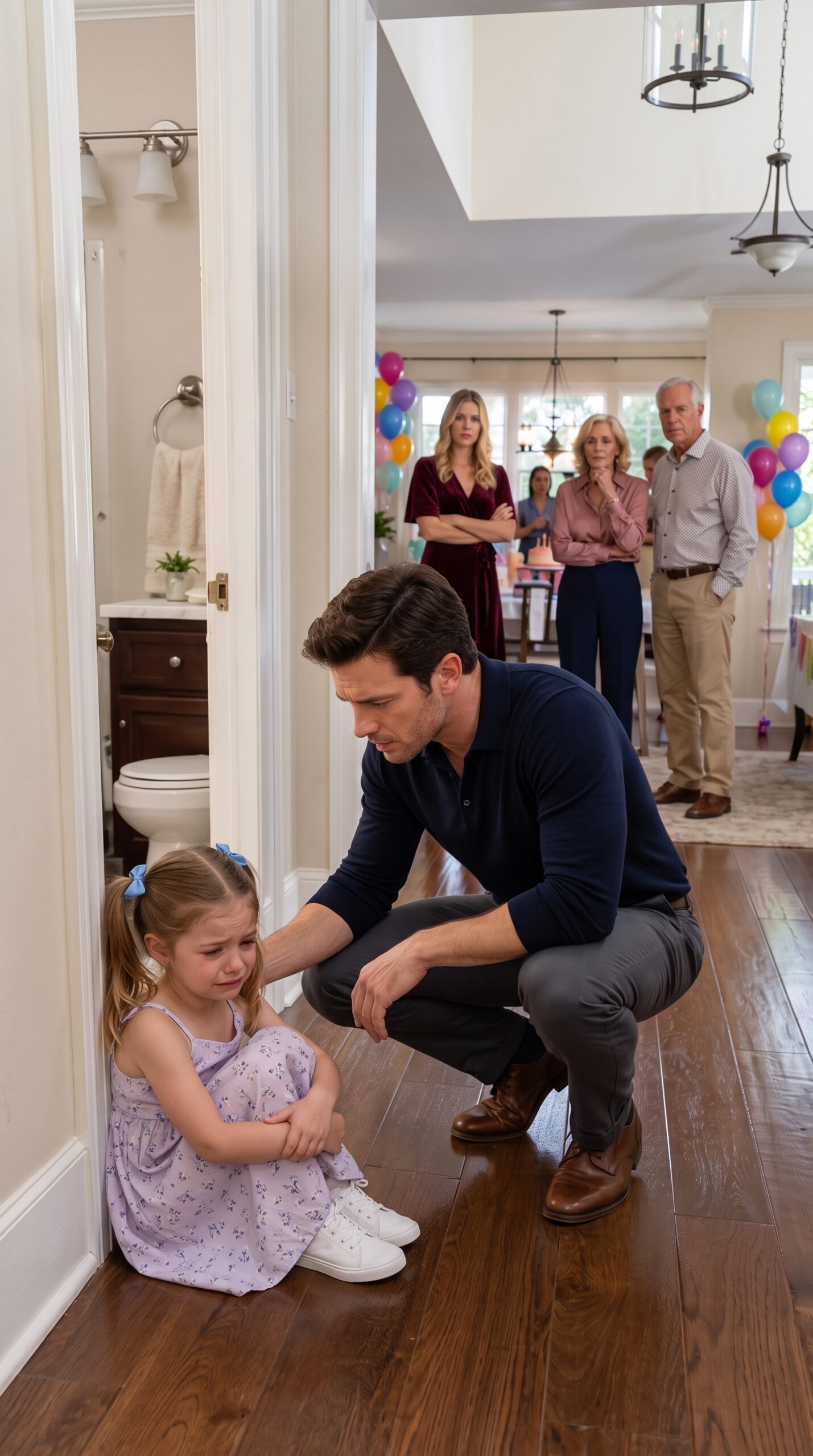
Camila was sitting next to the washing machine, her yellow dress wrinkled, knees pulled up to her chest, and a cheek marked in red.
There were fingerprints on her arms.
It wasn’t blood.
They weren’t huge bruises.
But for a father, that was enough.
Tomás felt his breath being sucked away.
He knelt slowly, without touching her abruptly.
—Cami… my love, who did this to you?
The girl looked down.
—Don’t be mad, Daddy.
That phrase broke something inside him.
Camila hesitated before hugging him, as if she still expected another reprimand. Then she clung to his neck and began to shake.
—Dad… do I have to apologize to Aunt Maribel?
Tomás closed his eyes.
He remembered Laura in the hospital, pale, squeezing his hand with the little strength she had left.
“Take care of her, Tomás. Even if everyone says you’re overreacting.”
He had promised.
And in that service patio, he understood that he had trusted too much in a word that many use without deserving it: family.
He came out carrying Camila.
The laughter faded away.
Maribel was next to the Little Mermaid cake, wearing a fake smile. Doña Elvira held disposable plates. Don Ramiro, Tomás’s father, had a beer in his hand.
Everyone saw the girl’s face.
Tomás asked in a low, but icy voice:
—Who touched my daughter?
No one answered.
Maribel scoffed.
—Oh, come on, Tomás. Your daughter knocked over half a tray of cupcakes and got all dramatic.
—What did you do to her?
—I grabbed her by the arm and brought her inside so she’d stop making her scene. Enough of treating her like a poor thing.
Camila hid her face in her dad’s neck.
Doña Elvira rushed over.
—Don’t make a scene. There are guests.
Tomás looked at her as if he didn’t recognize her.
—My daughter is marked, and you’re worried about people.
Don Ramiro spoke in an authoritative tone.
—Kids fall down. Don’t turn this into a tragedy.
Maribel crossed her arms.
—Since Laura died, you’ve made her weird, Tomás. Honestly, you’re doing more harm than anyone.
The patio fell silent.
Tomás no longer asked for apologies or explanations.
—We’re leaving.
Doña Elvira tried to grab his arm.
—Don’t humiliate us in front of the whole family.
Tomás pulled away.
—You humiliated yourselves.
He put Camila in the car and drove straight to the emergency room.
On the way, she whispered:
—Daddy… was I bad?
Tomás gripped the steering wheel.
—No, my girl. No one has the right to hurt you for being scared.
Then his phone started ringing.
It was his mom.
Tomás didn’t answer.
He still didn’t know that call was just the beginning of a much larger lie.
PART 2
In the emergency room, the doctor stopped smiling as soon as she saw Camila.
She didn’t touch her immediately. First, she knelt to her level, introduced herself, and asked if she could check her arms. Camila looked at Tomás before nodding.
Tomás stayed by her side the whole time.
The doctor took photographs, noted the time, examined the mark on her cheek, and asked that they not wash the dress yet.
Then she looked at Tomás with a seriousness that weighed more than any shout.
—This needs to be documented. By protocol, we’re also going to notify the appropriate department.
Tomás nodded.
It pained him to think about reports, paperwork, offices, and questions. But it hurt more to imagine Camila growing up with the idea that adults could hurt her and then ask her to stay silent to avoid embarrassment.
Later, a social worker from the DIF arrived.
Tomás recounted everything.
The party.
The disappearance.
The service patio.
The marks.
Maribel’s words.
His parents' silence.
Camila fell asleep on a stretcher, clutching her dad’s jacket. Every time someone opened the curtain, she shrank back.
That image etched itself in Tomás’s memory.
The next morning, he found a bag hanging on the gate of his house.
Inside were Camila’s yellow headband, a little doll, and a note written by doña Elvira.
“Tomás, think carefully about what you do. Maribel was desperate, but she’s your sister. Camila is very sensitive. In a family, you forgive. Don’t destroy everything over a bad moment.”
Tomás read the note twice.
There wasn’t a single question about Camila.
Not one line said, “How is my granddaughter?”
Before putting the bag away, messages from Maribel came in.
“You’re overreacting.”
Then another.
“If they ask, say she bumped into the door.”
Then another.
“My parents agree. Don’t make drama over a whiny little girl.”
Tomás took screenshots of everything.
At noon, don Ramiro called.
Tomás answered on speakerphone, but when Camila heard her grandfather's voice and froze, she slipped into the hallway.
—We need to fix this as a family —don Ramiro said.
—Fix what?
—Your sister works at a daycare. If you press charges, you ruin her life.
Tomás felt a cold rage.
—Are you more concerned about her job than your granddaughter?
—Don’t start. Your mother is crying. Maribel too. We’re all upset.
—Camila is upset too.
There was silence.
Then don Ramiro lowered his voice.
—Son, it’s not wise for this to escalate. The neighbors are talking. People make up stories. You know how people are.
Tomás breathed deeply.
—No, Dad. What’s not wise is teaching a girl that she should stay silent so adults don’t feel embarrassed.
He hung up.
That afternoon, he sent the DIF the medical photos, the note, the messages, and the call log.
For three days, his family bombarded him.
An aunt wrote that he shouldn’t be bitter.
A cousin said Maribel had always been “strong-willed,” but that didn’t make her bad.
Doña Elvira left crying voice messages, repeating that Laura, may she rest in peace, would never have wanted to see the family torn apart.
That was what hurt Tomás the most.
Using Laura’s name to protect the one who hurt his daughter.
Tomás didn’t respond.
He just kept everything.
On Thursday night, his cousin Iván called. Iván had placed some lights and a small camera near the cake table because Maribel wanted to record the moment to post on Facebook with nice music.
—Tomás —he said nervously—, I don’t know if I should get involved, but I checked the videos.
Tomás froze.
—What did you see?
—The camera doesn’t point to the service patio, but you can see when Maribel takes Camila away.
—Send it to me.
—There’s something else —Iván said—. You can clearly hear what she said.
The video arrived one minute later.
It lasted 28 seconds.
On the screen, Camila was next to the cupcake table. Renata, Maribel’s daughter, was beside her, wearing a birthday crown. Camila reached out to grab a napkin.
Then Renata elbowed her.
The tray tipped.
Several cupcakes fell to the floor.
Renata began to scream as if her life had been destroyed.
Maribel appeared in the frame, furious. She didn’t ask. She didn’t look at her daughter. She didn’t check what had happened.
She grabbed Camila by the arm with force and yanked her toward the house.
Before closing the door, her voice was recorded:
—Now you’re going to learn not to ruin my daughter’s party.
Then there was a dull thud.
Followed by Camila’s cries.
Tomás didn’t blink.
He replayed the video again.
Then again.
There was the truth.
Camila hadn’t knocked anything over out of a tantrum.
She hadn’t made a scene.
She had been pushed.
And Maribel had chosen to punish the easiest child to blame: the quiet one, the orphan, the one everyone called “sensitive” because they didn’t know what to do with her pain.
The next day, Tomás took the video to the Public Prosecutor’s Office and the DIF.
The lawyer watched it all the way through without interrupting.
When she heard the thud and the crying, she pressed her lips together.
—This changes everything.
Yes.
It changed everything.
Maribel changed her story three times.
First, she said Camila fell by herself.
Then she said the girl threw herself on the floor to get attention.
Then she said she just “corrected” her because Tomás didn’t know how to set limits.
Doña Elvira and Don Ramiro claimed they hadn’t seen anything.
But the messages buried them.
The note buried them.
The call buried them.
And the video broke the lie completely.
The daycare where Maribel worked temporarily suspended her while the case was investigated. The DIF documented not only the aggression but also the familial pressure to cover it up.
That made doña Elvira explode.
One afternoon, she showed up at Tomás's house unannounced, with swollen eyes and a bag of pastries in her hand.
—I’m here to see my granddaughter.
Tomás didn’t open the gate.
—Camila isn’t coming out.
—I’m her grandmother.
—Then you should have protected her as a grandmother.
Doña Elvira cried with rage.
—Maribel could lose everything. Her job, her reputation, her family.
Tomás stared at her for a long time.
—Camila lost trust in you all in one afternoon.
—It was a mistake.
—No. A mistake is spilling coffee on the tablecloth. This was hurting a girl and then asking her to lie.
Doña Elvira squeezed the bag of bread.
—Your dad says you’re not the same anymore.
Tomás felt a tremendous weariness.
—No. I’m not the same anymore. The old me still believed you had limits.
His mother looked down.
—Are you going to take our granddaughter away from us?
—No. You let her go when you chose to protect Maribel’s image.
Doña Elvira fell silent.
Tomás closed the door.
It didn’t feel like a victory.
It felt like ripping out a root with blood.
Weeks later, Maribel appeared on the sidewalk.
She was made up but with red eyes. Tomás was sweeping dry leaves from the patio while Camila watched cartoons inside.
—Are you happy? —Maribel asked—. You’ve made everyone see me as a monster.
Tomás set the broom aside.
—I didn’t lay a hand on you.
—It was just one moment. Are you going to destroy me for one moment?
—My daughter is going to remember that moment for her entire life.
Maribel let out a bitter laugh.
—She was always strange. Always crying. Always glued to you. You made her weak.
Tomás then understood there was no regret.
Only anger for having been discovered.
—Go away, Maribel.
—You’re going to be alone, dude. My parents won’t forgive you.
Tomás looked out the window.
Camila was sitting in the living room, hugging her doll, laughing softly at something on TV.
—I’m not alone. I’m with who matters.
Maribel left shouting from the sidewalk.
Tomás locked the door.
The following months were strange.
Not easy.
Strange.
The house grew quieter, but not sad.
Calm.
Camila started therapy. At first, she didn’t want to talk about the party. She drew huge houses with closed doors and little girls hiding in corners.
Tomás kept each drawing without pressuring her.
At night, Camila would wake up asking if Aunt Maribel was coming.
He would sit beside her and tuck her hair behind her ear.
—No, my love. You are safe here.
The first time Camila laughed loudly again, Tomás cried in the kitchen with the water tap running so she wouldn’t hear.
The first time she agreed to go to a classmate’s birthday party, he felt fear.
He accompanied her.
At first, Camila clung to his leg.
Then she let go of his hand to get a slice of cake.
That minimal gesture felt like a miracle.
On a Sunday in November, when the air smelled of pot coffee and Day of the Dead bread still being sold at the corner bakery, Camila sat with Tomás in the patio.
She had a blanket over her shoulders and her doll in her hands.
—Dad —she said.
—Yes, my life?
—Did my mom know that you were going to take care of me?
Tomás’s throat closed.
In the living room was the picture of Laura holding Camila, just born. She had dark circles under her eyes, messy hair, and a tired but beautiful smile.
—Yes —he replied—. She knew.
Camila rested her head on his arm.
—Because you promised?
Tomás kissed her forehead.
—Because I promised. And because you are the most important thing I have.
That night, after tucking her in, Tomás stood in front of her slightly open door.
For a long time, he thought losing Laura had been the hardest thing in his life.
He was wrong.
The hardest thing was discovering that some people with your blood could ask you to protect their reputation before protecting a little girl.
But he also understood something.
Family isn’t shown with old photos, Sunday dinners, or nice messages.
Family is shown when a small one is afraid and everyone must choose which side to be on.
Doña Elvira and don Ramiro continued to say that Tomás had overreacted.
Maribel kept saying her life was ruined because of a sensitive child.
Maybe many people believed them.
Maybe others thought Tomás was too harsh.
But every night, when Camila slept peacefully, he knew he had done the right thing.
Because a little girl should never have to wonder if she should apologize for being hurt.
Because the silence of adults also hits.
And because a promise made beside a hospital bed doesn’t end when the truth makes the family uncomfortable.
Laura asked him to take care of Camila.
And Tomás understood that taking care of her also meant keeping her away from those who wanted her silent.
Even if they were of his own blood.





