PART 1
Twelve minutes before reaching the altar, Mariana Salcedo discovered that her wedding was not a promise of love but a trap dressed in flowers.
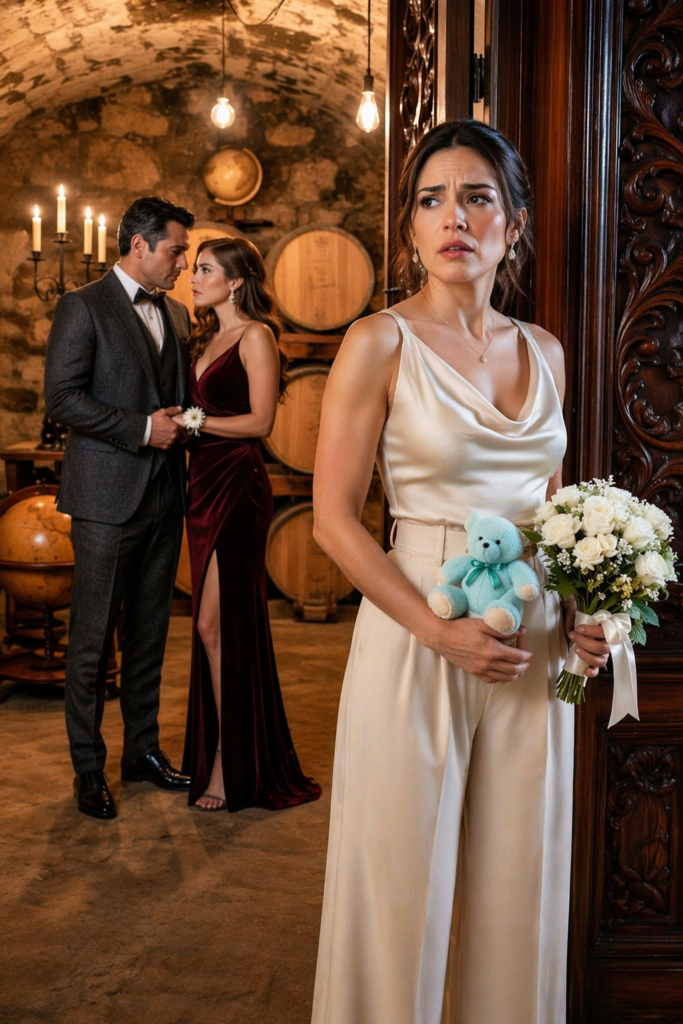
She stood in a hacienda in Tequisquiapan, wearing a lace white dress, four months pregnant, with a bouquet of calla lilies pressed against her chest.
Hidden among the flowers was a blue bunny.
Inside the bunny was the heartbeat of her baby. Mariana planned to play it during the reception to announce she was expecting a boy.
But as she passed the slightly ajar door of the cellar, she heard the voice of Rodrigo Ibarra, her fiancé.
—First, we sign the civil contract, then we make her sign the power of attorney. Pregnant, she won’t be going through papers.
Mariana froze.
The mariachi music played in the background, waiters rushed by with trays of glasses, and outside, 180 guests awaited her to walk down the aisle.
But behind that door, Rodrigo did not speak like a man in love.
He spoke like a patient thief.
—Your mom will convince her —he said—. Doña Elvira always plants in her head that a good wife trusts and doesn’t make a scene.
Chills crept down Mariana’s spine.
Then she heard another voice.
—Well, hurry up, because I’m tired of hiding like I’m the shame.
It was Lucía.
Her younger sister.
The same one who had buttoned her dress that morning, crying.
The same one who said, “Finally, you have a good man, sister.”
The same one who stayed at her house when she “felt sad” and ate at her table as if nothing was wrong.
Mariana swallowed hard.
—After she signs —Rodrigo continued—, we put the house in Pedregal as collateral. That’ll cover the hole from the real estate. Then we use her shares of Salcedo Textil to negotiate with the bank.
—And if she finds out? —Lucía asked.
Rodrigo let out a low laugh.
—Mariana never fights. She’s afraid her mom will be disappointed.
Mariana placed a hand on her belly.
The baby moved slightly, as if he too had heard.
—And your child? —Lucía asked.
—The boy is the best part —Rodrigo replied—. If she gets difficult, we’ll say the pregnancy is getting to her. If after birth she cries or gets anxious, we’ll ask for a psychological evaluation. Easy.
Mariana's throat closed up.
She didn’t scream.
She didn’t open the door.
She didn’t faint like in a cheap novel.
She just clutched the blue bunny and turned on the recorder she had hidden in the bouquet’s bow.
The click was lost among laughter, glasses, and trumpets.
—Three years waiting for this, Rodrigo —Lucía whispered—. Three years watching her flaunt your ring.
Mariana remembered family dinners, trips to Valle de Bravo, Sundays at her mom’s house, photos where Lucía was hugging her and Rodrigo smiled behind.
It had all been there.
In front of her eyes.
But the worst part wasn’t the infidelity.
The worst part was that they wanted to turn her child into a chain.
—She’s not going to cancel anything —Rodrigo said—. She’d rather die than embarrass her family.
Lucía laughed.
That laughter hurt more than the betrayal.
Mariana pulled out her phone with trembling fingers and sent three messages.
To her lawyer:
“Front row. Blue folder. Now.”
To her cousin Javier, in charge of the sound:
“Connect my phone when I lift the bouquet.”
To her uncle Ramiro:
“Don’t let Rodrigo touch the microphone.”
Then she took a deep breath.
In the hallway mirror, she saw a flawless bride: perfect makeup, long veil, calm mouth, and dry eyes.
But that woman was no longer the same who had arrived believing in promises.
The coordinator opened the door.
—Mari, it’s time. Everyone is waiting.
Mariana nodded.
—Let them wait one more minute.
Outside, Doña Elvira cried in the front row. Rodrigo smiled at the altar, confident that the world still obeyed him. Lucía was among the bridesmaids, with a pink bouquet and a saintly face.
Mariana adjusted her veil.
She held the bouquet.
And she started to walk.
Each step was a goodbye.
To the man she thought she loved.
To the sister she thought would protect her.
To the obedient daughter who learned to stay silent to avoid discomfort.
When she reached the altar, Rodrigo extended his hand.
Mariana didn’t take it.
She just lifted the bouquet.
She looked towards the sound booth.
And smiled like someone who had just decided to set fire to a lie.
PART 2
The priest was about to begin the ceremony when Mariana raised her hand.
—Father, excuse me. Before we continue, I want to share something very special about my baby.
Several aunts sighed excitedly.
Cousins pulled out their phones.
Doña Elvira covered her mouth with a handkerchief, convinced her daughter was about to reveal the baby's gender in front of the whole family.
Rodrigo blinked, confused, but held his perfect fiancé smile.
Lucía lowered her gaze.
Mariana lifted the blue bunny.
—Here’s the first sound I heard from my son —she said clearly—. I was going to play it at the party, but I think everyone should hear it now.
Javier connected the phone from the booth.
First, the heartbeat was heard.
Thump.
Thump.
Thump.
For a few seconds, the hacienda filled with tenderness.
Doña Elvira cried louder.
Even Rodrigo pretended to wipe a tear.
Then the heartbeat stopped.
And Rodrigo’s voice pierced the garden.
—First, we sign the civil contract, then we make her sign the power of attorney. Pregnant, she won’t be going through papers.
Silence fell like a slab.
A glass shattered against the floor.
Someone murmured:
—No way...
Doña Elvira stopped crying.
Her face turned white.
Rodrigo stepped towards the sound booth, but Uncle Ramiro blocked him.
—Don’t even think about it, kid.
—That’s edited! —Rodrigo shouted—. Mariana is sensitive. The pregnancy is messing with her.
Mariana didn’t even blink.
—Thanks for confirming exactly what we just heard.
The recording continued.
The power of attorney.
The house in Pedregal.
The shares of Salcedo Textil.
The hidden debt from the real estate company.
The plan to make her seem unstable if she tried to defend herself.
And then came Lucía’s voice.
—Three years waiting for this, Rodrigo. Three years watching her flaunt your ring.
The entire family turned to look at her.
Lucía squeezed her pink bouquet as if she could hide behind the flowers.
Rodrigo tried to approach Mariana.
—My love, don’t do this here. Let’s talk in private.
That phrase sounded familiar to Mariana.
“In private” had always meant the same: shut up, endure, don’t embarrass anyone.
But that woman no longer existed.
—You already talked in private —she replied—. About my house, my company, and my child.
Lucía lifted her face, crying.
—Mari, I...
—You’re not going to speak yet —Mariana cut her off—. Today it’s your turn to listen.
At that moment, Attorney Aguirre advanced from the front row with a blue folder.
He had been the lawyer for Don Alonso Salcedo, Mariana’s father, before he died.
—By instruction of Mrs. Mariana Salcedo —he said—, for the past two months, all her assets, properties, and shares have been under legal review. No document signed during her pregnancy will have any financial effect without independent validation.
Rodrigo lost color.
—That can’t be done.
—Yes, it can —the lawyer replied—. And the notary was notified today at 8:40.
Doña Elvira slowly stood up.
—Mariana... did you already know?
Mariana looked at her sadly.
—No. But Dad taught me that loving doesn’t mean signing with closed eyes.
Rodrigo let out a dry laugh.
—Your dad is dead.
The entire garden froze.
Mariana felt the blow, but she didn’t lower her head.
—And dead, he protected me more than you alive.
Uncle Ramiro clenched his fists.
Several guests from the Ibarra family began to stare at the ground.
Attorney Aguirre opened another page.
—Furthermore, any negotiation between Salcedo Textil and Inmobiliaria Ibarra is canceled. The letter of intent that Mr. Rodrigo presented to his creditors was revoked today at 9:10.
Rodrigo opened his mouth, but nothing came out.
—You can’t do this to me.
—Yes, I can —Mariana said—. The company belongs to my family. It’s not your lifeline.
Lucía turned to Rodrigo in panic.
—You said everything would be fixed after the wedding.
Rodrigo exploded.
—Shut up, Lucía!
And there, in front of 180 witnesses, the truth changed form.
Lucía no longer seemed a secure mistress.
She seemed another used pawn by the same man.
Mariana understood with painful clarity.
But she didn’t feel enough compassion to save her.
Lucía had betrayed her.
Although they had both been deceived.
Rodrigo put the mask back on.
—Think of our son.
Mariana clutched the bunny against her belly.
—My son will never be your excuse to steal from me.
The priest lowered his gaze.
The ceremony no longer existed.
Only a family breaking apart in front of everyone.
Mariana took off the ring and left it on a table decorated with white roses.
—It weighed more than love —she said—. It weighed like a trap.
Rodrigo hardened his jaw.
—We signed the civil contract this morning. You are my wife.
Attorney Aguirre raised the folder.
—That marriage will be contested for fraud, deceit, and economic violence. With this recording, the previous messages, and the present witnesses, it will be difficult to maintain another version.
Rodrigo looked at her with hatred.
—You will regret this.
Then Doña Elvira spoke.
Her voice came out broken but firm.
—Don’t threaten my daughter.
Everyone turned to her.
The woman who had spent years repeating “endure for the family” stood between Mariana and the man who had just been exposed.
—I taught her to stay silent —Doña Elvira said—. I instilled fear of disappointing everyone in her. But I won’t let her sink due to my cowardice.
Mariana felt something break.
But this time it was breaking on the right side.
That night there was no party.
The guests left in silence, as if they had witnessed a funeral with wedding music.
Rodrigo called 23 times.
Lucía sent audio messages crying.
Mariana didn’t respond.
She slept at her cousin Javier’s house, with the dress open at the back and the blue bunny on a chair beside the bed.
At dawn, when she thought nothing could hurt more, the doorbell rang.
It was Lucía.
She wore no makeup. Her eyes were puffy and she had a USB drive in her hand.
—I’m not here to apologize —she said—. I’m here to give you what Rodrigo planned to do after your baby was born.
Javier began recording with his phone.
Attorney Aguirre arrived 25 minutes later.
Only then did Lucía enter.
She left the USB on the table as if she were leaving a bomb.
Inside were screenshots, emails, audios, and a folder titled:
“After the birth.”
Mariana felt nausea before opening it.
In an audio, Rodrigo spoke with another lawyer.
—If after the birth she refuses to sign, we’ll request a psychological evaluation. We’ll say she’s not sleeping, that she’s paranoid, that she made a scene at the wedding. With that, we can request administrative control of her assets.
Mariana closed her eyes.
It wasn’t just money.
They wanted to use her motherhood against her.
In another message, Rodrigo wrote to Lucía:
“Your job is to move Elvira. Make her believe that a good mother doesn’t destroy her child’s father.”
Doña Elvira heard that audio that same afternoon in the lawyer’s office.
She didn’t scream.
She didn’t faint.
She just sat down and cried silently.
—I told you many times not to make problems —she confessed—. I taught you to please so no one would leave.
Mariana took time to respond.
It hurt too much.
—Mom, he didn’t invent that door. He just found it open.
Doña Elvira covered her face.
Lucía was also crying.
Mariana didn’t comfort her.
There were wounds that didn’t deserve haste.
Attorney Aguirre presented everything before the family and commercial court. He requested protective measures for personal, property, and business matters.
Rodrigo tried to get ahead.
He published a statement saying that Mariana had suffered an emotional crisis on the wedding day, that he was worried about her health, and that he asked for privacy for the baby’s sake.
But privacy was no longer a hiding place.
Mariana didn’t make videos.
She didn’t stream live.
She didn’t cry in front of cameras.
She delivered the full recording, Lucía’s messages, the threats, and the documents where Rodrigo had used the supposed union with Salcedo Textil to deceive his creditors.
The fall wasn’t immediate.
But it was real.
First, his partners demanded explanations.
Then two suppliers sued him for hiding debts.
After, the bank froze a credit line upon discovering that the house in Pedregal had never been legally offered as collateral.
Rodrigo went to seek Doña Elvira.
He arrived with flowers, a dark suit, and a repentant son-in-law face.
—You know I love Mari —he said—. Help me see her. I don’t want my son to be born without a father.
Doña Elvira let him finish.
Then she returned the flowers.
—My grandchild doesn’t need a dad who wanted to use him as a chain.
Rodrigo lost the mask.
—You don’t understand what your daughter is destroying.
—No —she replied—. I finally understand what my daughter is saving.
That same day, he called Mariana.
Not to give his opinion.
Not to ask her to yield.
Just to tell her the truth.
It was the first time in years Mariana felt her mother by her side without conditions.
Lucía testified a week later.
She didn’t try to play the victim.
She admitted she had been with Rodrigo for three years.
She admitted she envied Mariana: her stability, her father’s trust, her place in the company, and even that calm way of being loved without having to beg.
—I wanted to take something from her —she said—. And I ended up giving my life to the same man who wanted to destroy her.
When Rodrigo’s lawyer called her a “spurned lover,” Lucía lifted her face.
—Yes, I was a lover. Yes, I was miserable. But I brought evidence, not excuses.
Mariana listened without moving.
She didn’t delete anything.
But at least it was no longer a lie.
The annulment of the civil marriage took months.
The judge considered that consent had been manipulated through deceit, emotional pressure, and a hidden plan to obtain financial benefits.
Rodrigo lost the financial entry he needed.
His real estate business fell into crisis.
His last name, which once opened doors in Polanco dinners and meetings in Santa Fe, began to close conversations.
No one wanted to do business with a man capable of using a wedding and a pregnancy as a strategy.
He was also imposed restrictions to not approach Mariana without authorization.
The matters related to the baby were protected by the court.
Rodrigo would have to respond as a father, but he could no longer use that word as permission to control.
Lucía went to Guadalajara.
Before she left, she left a letter.
“I don’t ask for forgiveness. I don’t deserve to sit at your table again. I just wanted your son to be born without a lie on top of him. I did the minimum right thing, too late.”
Mariana read the letter once.
Then she put it away.
She didn’t tear it up.
But she didn’t respond either.
Forgiveness was not an obligation.
And blood didn’t turn a betrayal into an accident.
The last months of the pregnancy were strange.
Mariana felt fear.
She felt rage.
There were nights when she cried without making noise.
But she also started sleeping better.
She returned to Salcedo Textil.
She walked through the factory in Naucalpan where her father had started with ten machines, four employees, and a notebook full of accounts.
One day she found an old letter from him in a file box.
“My girl, don’t confuse peace with silence. True peace doesn’t ask you to disappear for others to be comfortable.”
Mariana cried over that sheet.
Because she understood her father had left her something stronger than shares.
He had left her permission to choose her dignity.
Emiliano was born on a cool October morning.
There was no miraculous reconciliation.
There was no perfect family around the cradle.
It was Mariana, Doña Elvira, Javier, and the blue bunny.
When the baby cried for the first time, Mariana remembered that heartbeat that sounded at the wedding before everything collapsed.
That bunny was no longer a humiliation.
It was proof.
Proof that something small can hold an enormous truth.
Months later, someone asked her if she regretted exposing Rodrigo in front of everyone.
Mariana looked at her sleeping son and replied:
—No. They chose to betray me in secret. I just stopped protecting them in public.
Doña Elvira changed.
Not suddenly.
Not like a pretty promise.
She changed in small details.
She stopped saying “for the family” when she really meant “endure.”
She learned to apologize without justifying her fear.
Mariana never became the bride who walked toward the altar again.
Nor did she want to become bitter.
She simply became awake.
She understood that love doesn’t demand blind signatures.
That a sister can share the same blood and still not deserve trust.
That a child doesn’t need a house full of appearances, but a mother capable of breaking a trap before calling it home.
That day, Mariana didn’t lose a wedding.
She lost a lie decorated with flowers.
She didn’t lose a husband.
She lost a man who loved his signature more than his heart.
And Emiliano didn’t lose a family.
He gained a mother who learned, before he was born, that protecting a child also means stopping forgiving those who confuse love with control.