PART 1
Lucía Montes stared at her phone as if those words had struck her straight in the chest.
"Sorry, I can't go. I didn't know you were deaf. Honestly, I'm not ready for something so complicated. Take care."
She was alone in a restaurant in Coyoacán, next to a window lit with Christmas lights. Outside, they were selling buñuelos and ponche. Inside, families laughed, couples toasted, and children fought for the last churro.
That was what hurt the most.
Everything around her seemed warm, noisy, and full of company.
She, on the other hand, was there in her blue dress, hair done, hands trembling over her phone.
She was 32 years old, a teacher at a primary school for deaf children in Mexico City, and had not accepted a date in three years.
Not because she didn’t want to fall in love.
But because the last man she loved died before they could reach their wedding.
Andrés, her fiancé, had learned Mexican Sign Language just to tell her silly things from across the room. He always added subtitles before she even asked. He always looked her in the eyes.
One morning, he left the house promising to bring tacos al pastor for dinner.
By noon, his heart stopped in the office.
Since then, Lucía hadn’t lived.
She endured.
Her sister had insisted for months.
"Lu, you’re not betraying Andrés by going out to dinner. You’re just trying to breathe."
Lucía tried.
And ended up reading that being deaf was "complicated."
She discreetly signed for the bill. She wanted to leave before crying in front of everyone.
But at a nearby table, two five-year-old girls were watching her.
Camila and Regina Ibarra were twins, with black curls, big eyes, and a dangerous habit of speaking the truth without asking permission.
Camila tugged at her dad's sleeve.
"Dad, that lady is crying."
Regina added:
"Just like you when you see mom's picture in the kitchen."
Emilio Ibarra nearly choked on his drink.
He was an architect, widowed for two years, and believed his daughters didn’t know he cried at night when he went through Valeria's albums, his deceased wife.
Apparently, he hid nothing.
"Some people have tough days," he said carefully. "We should give them space."
Then Lucía raised her hands to thank the waitress.
The twins froze.
Camila opened her mouth.
"Dad… she signs like Grandma Carmen."
Before Emilio could stop them, they hopped off their chairs and walked to Lucía’s table.
Regina lifted her little hands and signed clumsily:
"Can we sit with you? You look lonely."
Lucía gasped.
Not out of surprise.
But because, for the first time that night, someone was looking at her completely.
Emilio arrived behind them, embarrassed, signing as well.
"Sorry. They usually don’t ask before changing someone’s night."
Lucía let out a laugh mixed with tears.
"It’s fine," she replied in signs. "I think you arrived just in time."
That night, they shared hot chocolate, corn bread, and an absurd war against the carrots on the plate.
Lucía taught them a Christmas song in signs. The twins imitated her, laughing. Emilio watched as if light had just entered a house closed for too long.
When they said goodbye, Camila asked if she could come the next day to bake cookies with her grandmother.
Lucía hesitated.
Then said yes.
But the next day, as soon as she crossed the door of that house in Del Valle, a woman dressed in black appeared in the living room, glared at her with hatred, and spat:
"Who let this stranger into my dead daughter’s house?"
PART 2
Silence fell like a broken plate.
Lucía stood frozen with a bag of flour in one hand and a pot of poinsettias in the other. Camila clung to her leg. Regina hid behind Emilio.
The woman’s name was Beatriz, mother of Valeria, Emilio's deceased wife.
Though two years had passed since the accident, she still wore black. But in her gaze, there was not only mourning. There was vigilance, rage, and a fierce need to control every corner where her daughter was no longer.
Emilio took a deep breath.
"Beatriz, please. Lucía is the girls' guest."
"Guest?" she repeated. "Last night they dined with a stranger and today you bring her into the kitchen where my daughter baked cookies. Some people forget so fast."
Lucía read part of her lips. The rest she understood from the shame on Emilio's face.
She knew that rejection.
The kind that doesn’t say "leave," but makes you feel that your mere presence stains something.
From the kitchen, Carmen, Emilio's mother, emerged. She was a deaf woman, with white hair, a flowery apron, and a firm gaze.
Seeing Lucía, she signed calmly:
"Breathe. This house belongs to the living too."
Beatriz clenched her jaw.
"Of course. Since you all understand each other with your hands, now I’m the bad one."
Camila raised her hands.
"Lucía didn’t do anything wrong. We invited her."
Regina added:
"She was sad. And Dad is sad too. That’s why we thought you could be friends."
Beatriz placed a hand over her chest.
"You don’t understand. No one will replace your mom."
Lucía felt the blow in silence.
She didn’t want to replace anyone either.
She carried a dead one in her heart.
She signed slowly, and Emilio translated softly:
"I didn’t come to take Valeria’s place. That place is yours. Always."
Beatriz let out a bitter laugh.
"That’s what all of them say."
Emilio raised his voice for the first time.
"There are no all of them. I haven’t brought anyone here since Valeria died."
"Because you shouldn’t have."
"Because I was broken."
The phrase left the house still.
Emilio looked at a photo of Valeria holding the newborn twins.
"I loved your daughter, Beatriz. I still love her in a part of me. But my daughters are learning that laughing too much is a disrespect. That’s not life."
Beatriz replied harshly:
"My daughter deserved loyalty."
Carmen slammed her palm on the table.
Then she signed, and Emilio translated:
"Loyalty cannot become a prison."
Beatriz turned red.
"You didn’t lose a daughter. Don’t come teach me about pain."
Carmen looked at her sadly.
"I didn’t lose a daughter. But I lost a daughter-in-law that I cared about. I lost the cheerful son I had. And I’m watching my granddaughters ask for permission to live."
Lucía lowered her gaze.
She didn’t want to be in the middle of that war.
She placed the flowers on a small table and signed:
"I’d better go."
Emilio didn’t stop her. He understood that asking her to stay would be selfish.
But Regina ran to hug her.
"Don’t go. You made Dad smile."
Beatriz closed her eyes as if the child had betrayed her.
That day, they didn’t make cookies.
The flour remained closed. The girls cried in their room. Lucía left with a polite smile and a heart full of someone else’s guilt.
That night, Emilio texted her:
"Sorry. You shouldn’t have lived that."
Lucía took almost 30 minutes to reply.
"You don’t have to apologize for others’ pain. But I can’t enter a house where my presence hurts your daughters."
Emilio read the message four times.
The next day, he went to find Beatriz.
He found her in Valeria’s room, arranging dresses that no one wore. There were perfumes, shoes, bags, and ironed blouses as if Valeria could return any afternoon and claim that her things had been moved.
"We can’t keep going like this," Emilio said.
Beatriz didn’t turn.
"Then throw everything away. Erase my daughter. Find another mom for my granddaughters."
"I don’t want to erase Valeria. I want my daughters to remember her without fear."
Beatriz opened a drawer roughly.
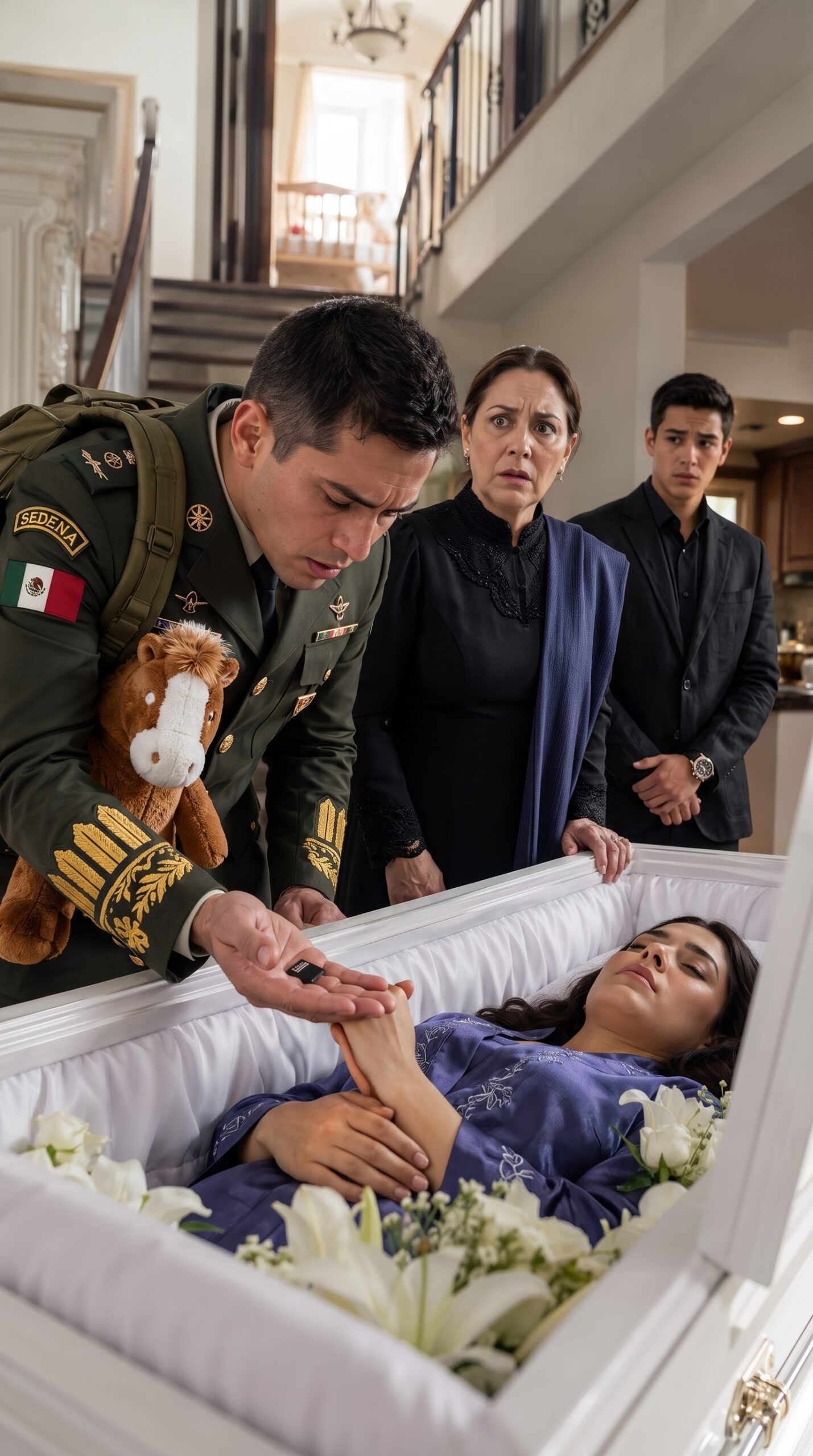
Then a little metal box fell behind some tissues.
Emilio picked it up.
Inside was a USB drive labeled in Valeria's handwriting:
"For Emilio. When you lack courage."
Beatriz went pale.
"That wasn’t there."
That night, they connected the drive to the living room TV. Emilio, Beatriz, Carmen, and the twins in pajamas were there.
The screen lit up.
And Valeria appeared.
Alive.
With her hair up, wearing an old sweatshirt, and that smile that made the house feel less cold.
Emilio covered his mouth.
"Mom," Camila whispered.
The video had been recorded months before the accident, when Valeria was about to undergo a minor surgery that scared her.
"If you’re watching this," Valeria said, "I’ve probably gotten dramatic. But listen to me, okay?"
Beatriz began to cry.
Valeria looked directly at the camera.
"Emilio, love, if I’m ever not here, don’t turn this house into a museum. Put up my pictures, tell my bad jokes, talk to the girls about me. But live. Please, live."
Emilio closed his eyes.
Valeria continued:
"Mom, if you’re there, I love you. But I know you. When something hurts you, you want to control everything. Don’t use my name to close doors. Don’t make my daughters feel guilty for laughing."
Beatriz doubled over as if she lacked air.
"I’m sorry, my girl…"
Valeria’s voice continued, sweet and firm:
"And if Emilio meets someone who takes good care of my daughters, don’t hate her for coming after. No one erases what was real. Sometimes someone comes to help carry what weighs too much."
Then Valeria raised her hands. She had learned basic signs from Carmen.
"I love you. Always. But don’t stay where I left."
The video ended.
No one spoke for a long time.
Afterward, Beatriz looked at Carmen and, with trembling hands, attempted to sign:
"I’m sorry."
The sign came out awkward.
But Carmen cried.
Because after two years, Beatriz was finally trying to speak the language of the family Valeria had loved.
Weeks passed before Lucía accepted to return.
Emilio didn’t pressure her. He just sent calm messages, pictures of the girls doing homework, and videos of Regina signing "we miss you."
Lucía smiled at seeing them.
And then she was scared of that smile.
She didn’t fear Emilio.
She feared wanting him.
She feared admitting that Andrés didn’t disappear because she started to feel something again.
One January afternoon, she accepted to have coffee with Emilio in Roma. No kids, no grandmothers, no ghosts looming overhead.
He arrived nervous, in a gray jacket with restless hands.
"Lucía, I don’t want to confuse you," he signed. "I’m not looking for a mom for my daughters or a cure for my sadness."
She looked at him in silence.
"Valeria doesn’t disappear because you’re here," he added.
Lucía felt a knot in her throat.
"Andrés doesn’t disappear because I smile."
Emilio nodded.
"Then maybe we understand the same thing."
"What thing?"
"That love doesn’t always replace. Sometimes it sits next to pain and learns to live there."
Lucía cried.
Not out of sadness.
But relief.
Over the following months, she slowly returned to the house.
One Tuesday for noodle soup.
One Saturday to help the girls with a school project.
One Sunday to make cookies that came out burned, but were celebrated as if they were from a fancy bakery.
Carmen loved her from the start.
Beatriz took longer.
At first, she would stay serious when the girls ran to Lucía. Then she began to observe her without attacking. Later she asked how to say "thank you" in signs. Eventually, she appeared with nata bread from Querétaro and left it on the table as if it were nothing.
One day, while Lucía was brushing Camila's hair, Beatriz approached.
"I was unfair to you."
Lucía put down the brush.
Beatriz swallowed hard.
"I thought that if someone entered my granddaughters' lives, my daughter would go further away. But I was wrong. Since you’ve been here, they talk more about Valeria. They ask how she danced, what she said, what made her laugh. Before, they only missed her in silence."
Lucía replied calmly:
"Valeria is their mom. Always."
Beatriz cried.
"And you’ve never tried to take that away from her."
"I couldn’t. Nor would I want to."
That day Beatriz hugged her for the first time.
It was a clumsy embrace, full of guilt and broken pride.
But it was real.
In February, the twins turned six. Emilio organized a party with a star piñata, jelly cups, lights for Carmen and Lucía to feel the music, and games where everyone learned some signs.
When Lucía arrived, Regina shouted:
"Our Lu is here!"
An aunt murmured:
"They brought her into the family quickly."
Beatriz heard it.
She would have stayed quiet before.
This time she said:
"Not quickly. Beautiful. There’s a difference."
Emilio looked at Lucía from across the patio.
She smiled.
That’s where something began that neither dared to name.
There was no kiss in the rain.
There were good morning texts, hands brushing against each other while washing dishes, comfortable silences, and two girls wedged between them on the couch.
In May, Emilio took Lucía to see a pedestrian bridge he was designing near Chapultepec.
"I like bridges," he signed. "They’re promises made of concrete."
Lucía smiled.
"That sounds very cheesy, architect."
"I’m a cheesy architect. So be it."
They walked to the middle of the bridge. Below, the city roared. Above, the sky opened after a gray morning.
Emilio took a deep breath.
"I think I’m falling in love with you."
Lucía closed her eyes.
She wasn’t surprised.
She felt it too.
"Me too," she signed. "And it scares me."
"Me too."
"What if it goes wrong? What if the girls suffer?"
Emilio replied:
"What if it goes well? What if this sadness wasn’t the end, but the place from which we learned to care better?"
Lucía cried.
He didn’t hug her until she opened her arms.
That mattered too.
When the twins found out, because they were eavesdropping from the kitchen, they screamed as if Mexico had just won the World Cup.
"We knew it!"
Carmen raised her hands with dignity.
"I said nothing. I just have eyes."
A year later, Emilio proposed to Lucía in the kitchen while the girls tried to make conchas and had covered everything in flour.
Beatriz was there.
Carmen too.
On the table were two photos: Valeria with the newborn twins, and Andrés laughing in a race shirt.
Emilio knelt.
"Lucía Montes, you arrived one night when someone made you feel too complicated. But for us, you were exactly what we needed: patience, language, laughter, courage, and home. Will you build this family with me?"
Lucía looked at the girls.
Camila and Regina had their hands ready to shout in signs.
She looked at Carmen, who was crying.
She looked at Beatriz, who held Valeria’s photo against her chest and nodded.
Lucía replied:
"Yes."
The twins jumped so much that they knocked over the flour.
The wedding was the following Christmas Eve, in a garden in San Ángel filled with white lights, hot ponche, and winter flowers.
Carmen walked Lucía down the aisle.
Beatriz walked with the twins.
In the front row were the photos of Valeria and Andrés. Not as ghosts. As roots.
Emilio and Lucía said their vows in voice and in signs.
They promised not to use pain as an excuse to close doors.
They promised to talk even when it hurt.
They promised to remember without getting trapped.
They promised to choose each other not once, but every day.
When they kissed, Camila shouted:
"Finally!"
Regina added:
"It was about time, really!"
Five years after that night in the restaurant, Lucía woke up in a house full of noise, signs, laughter, and crumbs of sweet bread.
The twins were eleven years old and called her "Mom Lu," not because they had forgotten Valeria, but because the heart, when well cared for, can have more than one light on.
Emilio continued designing bridges.
Carmen still corrected signs with the authority of a general.
Beatriz had learned enough Mexican Sign Language to tell gossip and scold everyone with elegance.
In the living room was a photo from that first Christmas: Lucía asleep on the couch, the twins leaning against her, and Emilio watching them as if he had just remembered that life could still be kind.
Below, Lucía had written:
"Family doesn’t always come complete. Sometimes it arrives broken, with fear and mourning on top. But if someone dares to stay without erasing anyone, it can become home."
That morning, Regina gave her a clay ornament with four marked hands: the twins', Emilio’s, and Lucía's.
Below it said:
"We found each other when no one wanted to be alone."
Lucía cried.
Emilio hugged her from behind.
"Do you remember that guy’s message?"
She smiled without resentment.
"Yes. But thanks to that, I changed tables."
She looked towards the kitchen, where the twins were teaching their little brother the sign for "cookie" while Beatriz pretended not to give them another one secretly.
Lucía then understood something no one had been able to explain to her during three years of mourning.
Sometimes the person who rejects you doesn’t destroy you.
They just push you away from the wrong table.
And sometimes, right on the night you think no one will come for you, two girls appear with their hands raised and ask if they can sit with you.
Not knowing that, in reality, they’re inviting you to live again.