PART 1
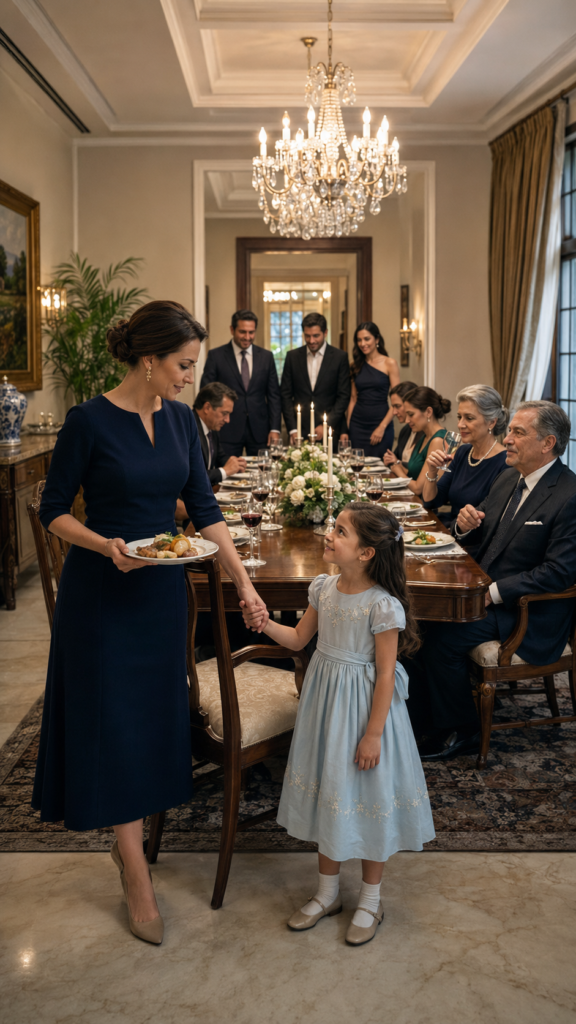
Don Ernesto Salcedo looked his nine-year-old granddaughter straight in the eyes and pointed at the cardboard plate just placed in front of her.
—Eat it or go hungry.
In the mansion's dining room, no one breathed.
The uncles lowered their gazes. The cousins stopped laughing. Doña Beatriz, her pearls shimmering under the chandelier, continued cutting her steak as if they hadn’t just placed dog food in front of a little girl on her own birthday.
Valeria Montes felt her blood freeze.
Her daughter Camila was sitting beside her, in a lilac dress she had chosen at the neighborhood market, carefully pressed with all the love in the world. She had styled her hair in two braids with white bows because she wanted to look “fancy” for her grandparents.
For two weeks, she practiced how to use her utensils.
She asked her mom if she should say “thank you very much” before or after the cake.
She even made a glitter card that said: “Grandparents, I love you very much.”
And now she was staring at that cheap plate, with smelly, brown, wet chunks, while everyone else had beef, mashed potatoes, and vegetables served on fine china.
—Mommy… —Camila whispered, her voice breaking—. What did I do wrong?
Valeria didn’t answer immediately.
Because if she opened her mouth at that moment, she was going to scream.
Don Ernesto and Doña Beatriz were known in Guadalajara as respectable businesspeople. Owners of warehouses, commercial spaces, and pricey rental properties. They attended charity dinners, graced social magazines, and spoke of “family values” every time a camera pointed at them.
But with Valeria, they were something else.
They never forgave her for marrying Julián, a neighborhood mechanic, hard-working, cheerful, and without a noble surname.
When Julián died three years earlier, run over by a trailer on his way back from the shop, his parents didn’t embrace her.
Doña Beatriz told her at the wake:
—We warned you. You chose a small life, and now you see the consequences.
Don Ernesto was colder.
—Go back home. We’ll pay for Camila’s school, but you’ll do as we say.
Valeria said no.
Since then, she worked 45 hours a week as a manager at a Coppel store. She lived with Camila in a simple apartment in Zapopan, with thin walls, a fridge full of drawings, and nights of movies with popcorn made in a pot.
They had no luxuries.
But they had peace.
Still, Camila continued to love her grandparents.
She sent them drawings. She asked if they would ever come to see her dance in the school festival. She believed, as children do, that if she behaved better, maybe they would love her more.
So when the invitation arrived in a cream envelope with golden letters, Camila screamed with excitement.
“Formal dinner for our granddaughter Camila’s birthday.”
Valeria had a bad feeling.
But she saw her daughter smile like she hadn’t in months and couldn’t take away that hope.
On the night of the dinner, the mansion looked like a museum. Marble, expensive flowers, crystal glasses, waiters in black gloves.
Camila entered nervously, clutching her card.
—Thank you for inviting me, grandma.
Doña Beatriz looked her up and down.
—What a… simple dress.
Camila swallowed, but smiled.
Dinner started tense, with comments disguised as advice.
—Poverty is also inherited —Don Ernesto said, looking at Valeria—. If a mother doesn’t aspire for more, she condemns her children.
Camila, innocent, replied:
—My mommy works hard. She just got praised at her store.
Don Ernesto let out a dry laugh.
—Oh, my girl. Being a hallway manager isn’t an achievement.
Then the main courses arrived.
Everyone was served steak on fine china.
Camila was given a cardboard plate.
Dog food.
Valeria stood up slowly.
—What is this?
Don Ernesto smiled.
—A lesson.
—She’s nine.
—And she can already learn what awaits her if she continues living like you.
Camila began to cry.
—But it’s my birthday…
Doña Beatriz took a sip of wine.
—Then learn something useful on your birthday.
Valeria looked at her brother, her sister-in-law, her elderly aunt, her cousins. All silent.
All comfortable with their fear.
Then Don Ernesto pushed the plate toward the girl.
—Eat it.
And Valeria, without saying another word, took the plate of dog food in her hands.
PART 2
No one moved as Valeria lifted the plate.
Not even the waiter.
The sour smell of dog food mingled with expensive perfume, grilled meat, and the roses in the center of the table. Camila covered her mouth, trying not to vomit, while her tears fell onto the white tablecloth.
Don Ernesto frowned.
—Don’t make a scene, Valeria.
She looked at him with a calmness that was frightening.
—I won’t make a scene.
Doña Beatriz let out a giggle.
—Good. For once, act like a well-mannered woman.
Valeria walked around her daughter’s chair, steadied the plate in one hand, and took Camila’s trembling fingers with the other.
—Let’s go, my love.
Camila stood up without looking at anyone.
The lilac dress brushed against her knees. The glitter card was left on the table, right beside Doña Beatriz’s wine glass.
The grandmother saw it and didn’t even touch it.
—If you walk out that door —Don Ernesto said—, forget any inheritance. No private school, no support, not a dime.
Valeria paused at the dining room entrance.
—Since Julián died, you haven’t given us love. Do you really think we’re scared of losing your money?
Uncle Raúl, Valeria’s brother, clenched his fists.
—Dad, that’s enough…
Don Ernesto cut him off with a glare.
—You shut up, or I’ll erase you from the will too.
Raúl hung his head.
And that was another stab to Camila.
The little girl understood, without anyone explaining it to her, that in this family, money weighed more than she did.
Doña Beatriz adjusted her pearls.
—Don’t come back. You embarrass us.
Valeria lifted the plate slightly.
—Don’t worry. This is coming back with me.
Don Ernesto scoffed.
—And what are you going to do? Post it on Facebook to get pity?
—No —she replied—. I’m going to keep it.
The smile faded for a second.
Valeria left the mansion with Camila glued to her body, walking down the marble hallway where photos of her parents with politicians, businessmen, and priests hung. No pictures of Camila. None of Julián. None of Valeria since she got married.
Outside, the fresh air hit the little girl.
Camila broke down as soon as they got into the car.
—Mommy, am I common?
Valeria placed the plate on the floor of the passenger seat, knelt beside the open door, and cupped her daughter’s face.
—No, my love. Common is what they did. You are not bad. Not at all.
—I wanted them to love me.
That shattered Valeria in a way that even Julián’s death hadn’t.
Because a mother’s pain doesn’t always begin in her chest.
Sometimes it starts in her daughter’s eyes.
They didn’t go home right away.
Valeria drove to an Oxxo, bought a plastic container, gloves, and sealable bags. Then she called Janeth, her best friend, an emergency nurse at the Civil Hospital.
—I need you to help me document something —she said with a firm voice—. They hurt Camila.
Janeth didn’t ask further questions.
When they arrived, she hugged the little girl and then checked her pulse, her trembling, her accelerated breathing. She took pictures of the plate, of the clothes stained with a drop of food, of Camila’s swollen eyes.
—This is psychological violence —Janeth said, with contained rage—. And since it involves a minor, this won’t just end here.
Valeria kept the plate as evidence.
She noted the time. The date. The names of everyone present.
Eight adults.
Eight people who preferred to stay seated.
That night, Camila slept hugging an old t-shirt of her dad’s. Valeria stayed in the kitchen until 3 AM, staring at the sealed container on the table.
She didn’t cry.
Not anymore.
The next day, while Camila was at school, Valeria went to the municipal DIF and then to a lawyer recommended by Janeth: Arturo Medina, a specialist in moral damage and domestic violence.
Arturo listened to everything without interrupting.
When Valeria finished, he opened the container, looked at the contents, and gently closed the lid.
—This will be the most disgusting and strongest evidence in the case —he said—. Their parents think humiliating a little girl is a family anecdote. We’re going to show them it’s not.
In less than 10 days, Valeria obtained a restraining order so that Don Ernesto and Doña Beatriz could not get close to Camila.
They reacted like wounded rich people.
First, they sent messages calling her excessive.
Then offered money to “settle the misunderstanding.”
Later, when they learned there would be a lawsuit for moral damages, they did the worst: they requested visitation rights with Camila, claiming grandparental rights.
That move cost them dearly.
Because by requesting visitation, they forced everything to be reviewed in front of a family judge.
And everything was documented.
Six months later, the courtroom was full.
It wasn’t a mansion, nor a gala dinner.
It was a courthouse in Guadalajara, with beige walls, noisy fans, and common people waiting for justice.
Don Ernesto arrived in a blue suit, gold watch, and three lawyers.
Doña Beatriz arrived in white, as if it were mass, with the victim’s face she had used so many times at charity events.
Valeria arrived in her only formal blazer.
Camila was not present. Arturo requested it that way to protect her. The little girl was in therapy, learning that she didn’t have to earn anyone’s love.
Judge Hernández opened the hearing.
The grandparents’ lawyer tried to soften everything.
—It was a symbolic measure, a harsh lesson about economic responsibility.
Arturo stood up.
—A lesson? Dog food was served to a nine-year-old girl on her birthday, while the adults ate steak. Then she was told: “eat it or go hungry.” That’s not education. That’s cruelty.
The first witness was Raúl.
The same uncle who had silenced.
He entered with dark circles under his eyes, thinner, not looking at his father.
—What did you see that night? —Arturo asked.
Raúl swallowed hard.
—I saw my niece crying in front of a plate of dog food.
—Did you try to stop it?
Raúl closed his eyes.
—No. My dad threatened to take me out of the will. I was a coward.
Don Ernesto slammed the table.
—Liar!
The judge silenced him immediately.
Then Mariana, Raúl’s wife, testified.
She cried before sitting down.
—Camila was asking what she had done wrong. I wanted to get up, but I was scared. And that fear shames me. No inheritance is worth a little girl’s dignity.
Aunt Consuelo, Don Ernesto’s older sister, also spoke.
She was 82 years old and had a broken voice.
—I’ve seen Ernesto be harsh his whole life. But that night was cruel. Cruel to the core. That girl was punished for being the daughter of a woman they couldn’t control.
That testimony changed the atmosphere.
But the final blow came when Arturo requested to present the evidence.
The sealed container.
The cardboard plate.
The photos.
Janeth’s notes on Camila’s emotional state.
The entire room fell silent.
A secretary covered her mouth. A man at the back murmured, “Oh my God.”
Arturo held up an enlarged photograph showing the plate in front of Camila's lilac dress.
—This is what she received on her birthday. Not a cake. Not a hug. This.
Then he looked at Doña Beatriz.
—Mrs. Salcedo, do you have dogs?
—Yes —she replied, uncomfortable—. Two French poodles.
—What do they eat?
The woman hesitated.
—Premium food.
Arturo nodded.
—More expensive than what was served to your granddaughter?
Doña Beatriz lowered her gaze.
—It’s not comparable.
—You’re right. Your dogs get better treatment.
Don Ernesto requested to testify.
It was his mistake.
He went up to the stand still believing he could convince everyone with his boss voice.
—I just wanted Valeria to understand that raising a girl in poverty has consequences.
Arturo approached slowly.
—Consequences for whom? For a nine-year-old girl who got straight A’s? For a girl whose dad died? For a girl who arrived with a card saying she loved them?
Don Ernesto clenched his jaw.
—Valeria made a bad choice. She married a mechanic.
—So you punished Camila for the husband her mother chose.
—Life is hard.
—No. You were hard on a girl because you couldn’t control your adult daughter.
For the first time, Don Ernesto didn’t know what to say.
The judge issued clear measures.
Prohibition against approaching Camila.
Compensation for moral damage of 500,000 pesos.
Mandatory payment for psychological therapy.
And a phrase that became tattooed in Valeria’s heart:
—Wealth does not authorize humiliation. Much less against a minor.
But the legal justice was just the beginning.
Within 48 hours, the story leaked on social media.
“Guadalajara businessmen serve dog food to their granddaughter on her birthday.”
The post exploded.
Clients canceled contracts with Don Ernesto. A foundation removed Doña Beatriz from its board. The club where she flaunted her donations asked her not to return.
Those who had once applauded them now crossed the street to avoid greeting them.
Don Ernesto called Valeria furiously.
—You destroyed us.
She replied:
—No. You exposed yourselves.
Three weeks later, Raúl arrived at Valeria’s apartment.
He wasn’t wearing a fancy suit. He had a backpack, dark circles, and shame.
—I know I don’t deserve to come in —he said—. But I opened a trust for Camila. Her university is covered. You control it. I don’t want to buy forgiveness. I want to start making amends.
Valeria stared at him for a long time.
—Money doesn’t erase what you did.
—I know.
—If you want to see her again, you’ll have to prove to her that this time you will stand up when someone hurts her.
Raúl cried.
—I promise.
And he kept his promise.
He attended her festivals, her games, her birthdays. When Don Ernesto tried to approach a year later with a letter of “family mediation,” Raúl was the first to say:
—You have no rights.
Valeria showed the letter to Camila, who was now ten.
—Do you want to see them?
Camila read it in silence.
Then she folded it.
—They’re not sorry for what they did. They’re sorry because everyone found out.
Valeria felt a knot in her throat.
Her daughter had learned a truth that many adults never understand.
The letter ended up in the trash.
The next birthday of Camila was at the apartment. There was pizza, homemade cake, balloons bought at the market, and her friends from school. Janeth came with jello. Raúl arrived with his kids.
There was no fine china.
There was no steak.
There was no mansion.
But when Camila blew out the candles, she paused and looked at everyone.
—Last year I thought I was worth less because my grandparents had money and we didn’t. But today I know a big house is useless if there’s no love inside. Here, everyone loves me without asking me to be rich, fancy, or perfect.
No one spoke for a few seconds.
Then everyone applauded.
Valeria hugged her daughter and understood that the true victory hadn’t been the 500,000 pesos, nor the social downfall of her parents, nor the lost contracts.
The true victory was that Camila no longer asked what she had done wrong.
Now she knew that love wasn’t begged for.
And that sometimes the family that boasts blood is the first to be removed from the table.
Because no one, not even with millions, nor with a surname, nor with power, has the right to serve a child humiliation and call it a lesson.