PART 1
When Rodrigo Salazar walked into his home in Monterrey, his uniform still covered in dust, he heard no laughter, no baby cries, no voice of his wife rushing to embrace him.
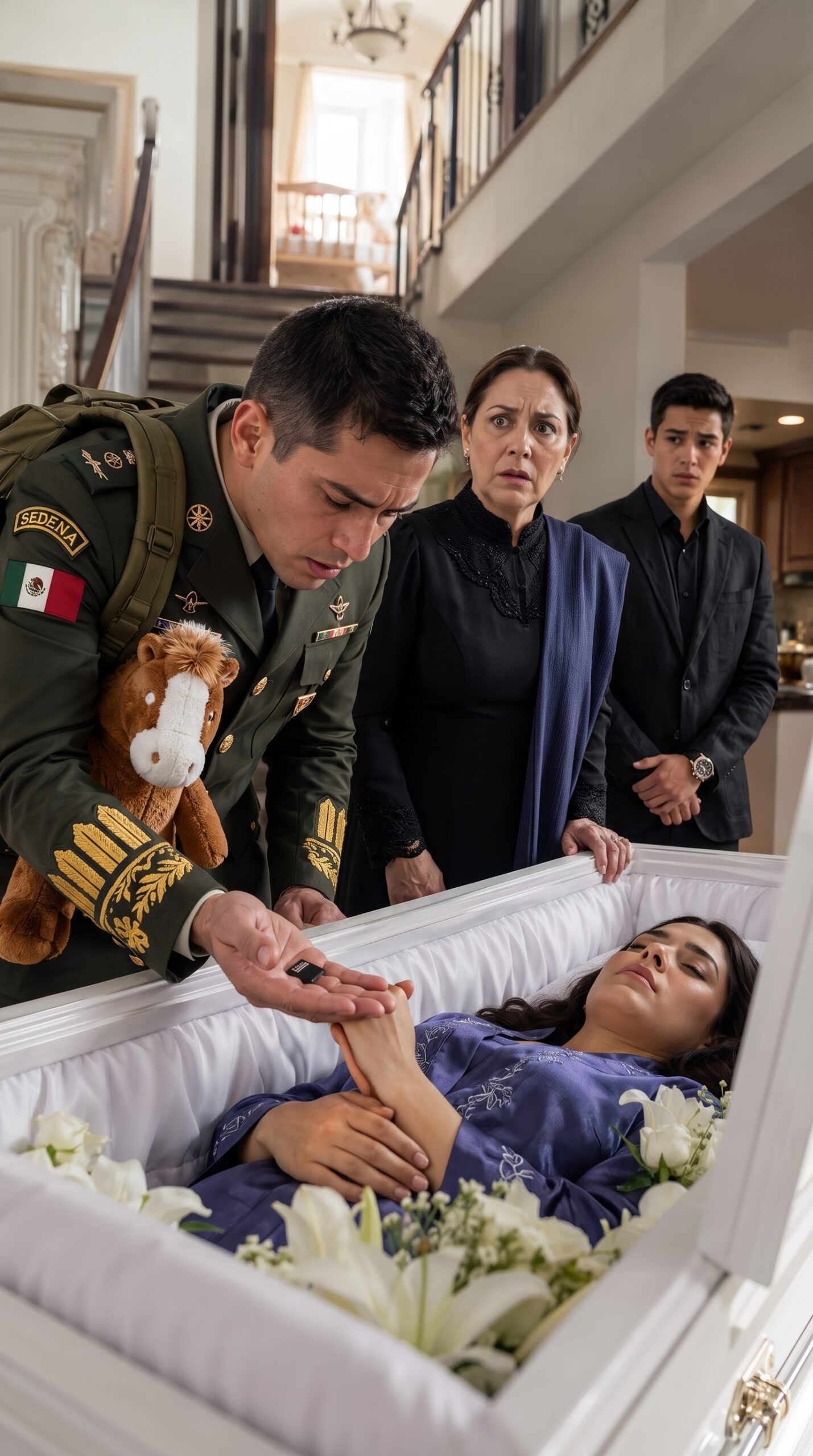
What greeted him was a white coffin in the middle of the living room.
To one side stood his mother, Doña Elvira, dressed in black, her hair neatly pinned up as if for an elegant funeral, her face hard, dry, not a single tear.
"Your wife died giving birth," she said. "And if you had been here, maybe she would have survived."
Rodrigo felt the world split in two.
He had spent nine months stationed with the Army in the Sierra de Durango. He had counted the days to meet his son. In his backpack was a wooden rattle he bought on the roadside, because Lucía had texted him that the baby calmed when he heard his voice.
But Lucía could no longer hear him.
She was in the coffin.
Wearing a sky-blue dress, the same one she promised to wear when he returned.
His younger brother, Esteban, stood by the kitchen, sipping coffee as if it were just another gathering.
"You’re late, bro," he murmured. "Like always."
Rodrigo didn’t respond.
He walked toward the coffin with stiff legs. He looked at Lucía's face. Too made up. Too still. Too ready for a burial no one had informed him about.
"Where is my son?" he asked.
From upstairs came a weak cry.
It wasn't a normal cry. It was a weary whimper, as if the baby had been begging for help for hours.
"He's alive," Doña Elvira replied. "Though that woman almost took him with her out of stubbornness."
Rodrigo lifted his gaze.
"Stubborn why?"
"We’ll talk later. Tomorrow morning we bury her. Right now, say your goodbyes and sign some papers."
Tomorrow.
Rodrigo had just crossed the threshold, and they already wanted to bury his wife.
There were no doctors. No visible records. No hospital bracelet. No friends of Lucía. Not a single neighbor crying. Nothing.
Just his mother, his brother, and a silence that smelled of lies.
Rodrigo had worked for years in military intelligence. He knew how to read a scene. He could tell when someone cleaned a stain too quickly or repeated a rehearsed version.
And that room was full of signals.
Then he saw Lucía's right hand.
It was closed.
Tightly balled into a rigid fist.
"What does she have there?" he asked.
Doña Elvira took a brusque step forward.
"Nothing. Let her rest."
Rodrigo stared at her.
"I’m going to say goodbye to my wife."
"I told you no."
She grabbed his arm.
Rodrigo glanced down at that hand and then looked directly into her eyes.
"Don’t ever touch me again."
For the first time, Doña Elvira paled.
Rodrigo gently took Lucía's hand. It was cold, but her fingers seemed to grip something. Under her nails were small dark marks, as if she had fought until the last second.
One by one, he pried her fingers open.
Something small fell into his palm.
A black memory card.
Esteban set his cup down on the table.
His face turned white.
"Give me that," he said, approaching.
Rodrigo closed his fist.
"Why?"
Doña Elvira tried to smile, but her mouth trembled.
"Lucía recorded nonsense since she got pregnant. She was sensitive, distrustful. It’s probably nothing."
The baby cried again from the second floor.
This time quieter.
Rodrigo tucked the card into his uniform and rushed upstairs.
The baby’s room was almost dark. In the crib, his son was wrapped in a gray blanket, with a red face and dry lips.
Rodrigo picked him up.
"Hello, champ," he whispered, broken.
Next to the crib was a half-empty bottle. He picked it up, smelled it, and felt a sweet, strange aroma, like syrup mixed with chemicals.
It didn’t smell like formula.
He sealed it in a bag from his military kit.
At that moment, Doña Elvira appeared at the door.
"Come down. We need to sign so the house and the baby are in the right hands."
Rodrigo held his baby tighter.
"I’m not signing anything."
His mother’s expression changed.
"You don’t know who you’re messing with."
He locked the door, with his son in his arms, the hidden memory, and the sealed bottle.
Then he understood the most terrible thing: Lucía hadn’t just died.
Someone had wanted to silence her before burying her.
PART 2
Rodrigo placed the baby in the crib with utmost care, as if any movement could break him.
The little one had his eyes half-open and was breathing with difficulty, but when Rodrigo put a finger close, the baby grasped it with minimal strength.
That gesture sustained him.
Outside, Doña Elvira knocked on the door.
"Rodrigo, open up. Don’t put on a show. We need to talk as a family."
He didn’t respond.
He searched Lucía’s desk. He found an old laptop with a blue butterfly sticker, the same one she used to store pregnancy photos.
He inserted the memory card with an adapter.
Only one folder appeared.
"FOR RODRIGO."
He swallowed hard.
Inside were four files.
The first was a video.
Lucía appeared sitting on a bed, in a hospital gown, pale, disheveled, alive. Her eyes were swollen from crying.
"Rodri," she said, looking at the camera. "If you’re watching this, please don’t trust your mom. Don’t sign anything. Don’t let them near the baby."
Rodrigo stood frozen.
Lucía took a deep breath.
"Your mom is pressuring me to sign some documents. She says it’s for safety, because you’re away and something could happen. But it’s not true. They’re papers to put my house in her name and for her to decide for our son."
Rodrigo looked around.
That house wasn’t his mother’s.
Lucía had inherited it from her father before they got married. Doña Elvira always said "the family house," but legally she had never put a penny down.
The video continued.
"Esteban owes money, Rodrigo. A lot. I heard your mom say that if they didn’t sell the house, those people were going to come for him. I refused. I told her that when you returned, we would decide together. Since that day, she treats me like I’m crazy."
Lucía lowered her gaze and wiped her tears.
"I’m scared, love. I’m really scared."
The video ended.
Rodrigo felt his pain turn into rage.
He opened the second file.
It was an audio.
First, Esteban's voice was heard.
"Mom, those guys aren’t going to wait. They already found me at the shop."
Then Doña Elvira’s voice, cold.
"Then stop shaking and help me. Lucía signs, we sell the house, and your problems are over."
"She doesn’t want to."
There was a long silence.
Then Doña Elvira said:
"Then we’ll have to make sure she has no choice."
Rodrigo clenched his teeth until his jaw ached.
He opened the third file.
They were photos of documents.
A request for temporary guardianship.
A letter where Rodrigo supposedly acknowledged "emotional instability due to military service."
A power of attorney where Lucía ceded rights over the house.
And at the end, a signature.
Rodrigo’s.
But it was fake.
It looked similar, yes. But he knew how his own "R" ended. His had a long stroke. This one was short, rigid, copied.
His mother not only wanted to keep the house.
She also wanted to take his son.
The fourth file was another video.
The image was tilted. It seemed to be filmed from the laptop hidden among diapers.
Lucía was in the baby’s room, pregnant, with one hand on her belly.
"Your mom wants to take me to a private clinic of a doctor friend of hers," she whispered. "I asked to go to the hospital, but she got angry. She says they ask too many questions."
Lucía glanced toward the door.
"I saw Esteban with a jar. He hid it in the changing table drawer. I asked what it was and he told me 'to make the baby sleep.' But the baby hasn’t even been born yet. I don’t understand what they’re planning."
Doña Elvira's voice sounded from outside.
"Who are you talking to?"
Lucía slammed the laptop shut.
The video ended.
Rodrigo didn’t cry.
The pain was too deep.
What he did was act.
He copied the files to a USB from his backpack and sent them to a military email that only he used. Then he called 911.
"My wife died after giving birth under suspicious circumstances," he said firmly. "There’s a newborn possibly exposed to an unknown substance. I need an ambulance, police, and the body preserved before burial."
He provided the address, names, times.
Without yelling.
Without exaggerating.
Like someone reporting a mission.
When he hung up, he heard voices outside.
"Don’t let them in," Doña Elvira whispered. "If he talks to anyone, everything will fall apart."
"Mom, I can’t anymore," Esteban said.
"Of course you can. I did all this for you."
The silence that followed was heavy.
Then Esteban said, his voice broken:
"I never asked you to let her die."
Rodrigo opened the door.
Doña Elvira was in front of him. Esteban, behind, crying like a reprimanded child.
"What did you say?" Rodrigo asked.
Esteban lowered his head.
Doña Elvira tried to enter the room.
"Move aside. I’m going to see my grandson."
Rodrigo blocked her way.
"You’re not getting near my son."
She glared at him with rage.
"You’re ungrateful. This family was sinking, and I had to do what you didn’t."
"What did you do?" he asked.
Esteban exploded.
"Lucía begged you to call an ambulance! She was bleeding! She said something was wrong, and you put papers in front of her!"
Doña Elvira slapped him.
"Shut up, idiot."
But it was too late.
Rodrigo didn’t need to hit anyone. He didn’t need to shout. Esteban’s words had opened the grave his mother wanted to close.
"You took her to that clinic," he said.
Doña Elvira lifted her chin.
"I took her to someone who wouldn’t get involved in family matters."
"And you let her die?"
She didn’t answer.
In the distance, sirens began to wail.
Doña Elvira lost color.
She wanted to head down the stairs, perhaps to hide something, perhaps to approach the coffin.
Rodrigo stopped her with a single phrase:
"Today your theater ends."
The ambulance arrived first.
The paramedics checked the baby, and upon smelling the bottle, requested immediate tests.
"Don’t give him anything else of this," one said. "We need to take him for observation."
Rodrigo felt the ground shift beneath him.
"Is he going to be okay?"
The paramedic looked at him seriously but calmly.
"He made it in time."
Those three words almost brought him to his knees.
Then police and forensic experts entered. Doña Elvira began shouting that her son was crazy, that the Army had messed him up, that Lucía was a hysteric and Esteban was a lying drug addict.
No one believed her.
The coffin was secured. The documents too. The jar from the drawer appeared behind some wet wipes.
In the hospital, the baby was placed under surveillance. The pediatrician confirmed that there were traces of a sedative that should never have been in his body.
"The dose wasn’t fatal," he explained, "but if they kept giving it to him, it could have been very serious."
Rodrigo leaned against the wall.
Finally, he cried.
Not as a soldier.
Not as a son.
He cried as a father who had just understood that he almost lost his son because of his own blood.
Days later, the Prosecutor’s Office opened a formal investigation.
The private clinic had expired permits. The supposed doctor wasn’t an obstetrician. The birth records had been altered. The ambulance was called too late.
The autopsy confirmed the worst: Lucía suffered a hemorrhage after childbirth and could have survived if she had been taken to a hospital in time.
But Doña Elvira had delayed everything.
First, she wanted the signature.
Then she wanted silence.
Then she wanted a quick burial.
Esteban testified.
He admitted to owing money for bets and loans to dangerous people. He said his mother promised to "fix it" by selling Lucía’s house. He confessed they forged Rodrigo’s signature with old documents.
He also said he put the jar in the room, but swore that his mother assured him it was just to help the baby sleep when he cried.
Rodrigo didn’t forgive him.
Maybe one day he could stop hating him.
But to forgive him, no.
Doña Elvira was arrested weeks later.
When they handcuffed her, she didn’t cry. She looked at Rodrigo with a coldness that no longer seemed human.
"I did everything for my family," she said.
Rodrigo held his son against his chest.
The baby slept peacefully, oblivious to the screams, the police, and the ruin of a grandmother who confused love with possession.
"No," Rodrigo replied. "You did it for your pride and ambition."
She tried to say something more, but they took her away.
Rodrigo never returned to live in that house.
He couldn’t.
Every wall reminded him of Lucía’s footsteps pleading for help, the white coffin in the living room, the closed hand that had held the truth until the end.
He moved to a small apartment near the hospital.
It had a simple kitchen, a window overlooking the mountains, and a tiny room where he placed the crib.
He named the boy Mateo, just as Lucía had chosen.
Every night, when Mateo cried, Rodrigo would hold him and tell him about his mom.
He’d tell him how Lucía danced while making coffee.
How she laughed when the tortillas burned.
How she had been brave even in fear.
How she protected him even after dying.
On the dresser, he left the wooden rattle he bought on the roadside.
Not as a memory of a welcome that never happened.
But as a promise.
Months later, Rodrigo took Mateo to the cemetery with blue flowers.
He sat in front of Lucía’s grave and placed the baby’s little hand on the tombstone.
"I protected him," he whispered. "Just like you asked."
Mateo squeezed his father’s finger.
Small.
Strong.
Alive.
And Rodrigo understood something that hurt him, but also sustained him: sometimes the family that claims to love you is the first to bury you alive.
Lucía couldn’t stay to raise her son.
But she left evidence.
She left truth.
She left a closed hand that no one could open in time, except the man who returned thinking he would find happiness… and ended up discovering that justice can also be born in the midst of a coffin.