PART 1
—Where's Lucía?
Daniela asked the question as soon as she saw her sister walk through the door of their mother's house in Chapalita, Guadalajara.
Renata came alone, with bags from Andares hanging off her arm, her phone in hand, and a calmness so pristine it felt ominous. Lucía wasn’t with her. No laughter filled the air. No yellow bow in sight. No little hand reaching out for her mother in crowded places.
Renata dumped the bags on the dining table.
—Oh, Dani, don’t start —she said, as if asked about a lost ticket—. I think she stayed at the store.
Daniela felt the air vanish.
—What do you mean she stayed?
Her mother, Carmen, was pouring coffee from a clay pot into mugs. She didn’t drop the spoon. She didn’t flinch. She didn’t even turn fully around.
—Don’t make a scene —she said—. She must be around. You’ll find her.
Renata let out a low chuckle.
—Let’s see if this teaches her that she can’t steal all of Emilia’s attention all the time.
That’s when Daniela understood it hadn’t been an accident.
Lucía was 5 years old. Just 5. She believed family was a safe place because Daniela had repeated it every time she swallowed humiliation at that same table. She believed in her grandmother Carmen because Daniela wanted her daughter to have something resembling a family. She believed in Renata because she was her aunt.
And they had left her alone in a department store as punishment.
Daniela was 33, working in a dental clinic managing administration and, at night, invoicing for two small food businesses. She rented an apartment in Zapopan with furniture bought from Marketplace, a plant that refused to die, and a little girl who gave meaning to everything.
Lucía’s father left when she was 8 months old. He said fatherhood was too much for him. Carmen only commented:
—Well, you chose it.
Renata added:
—At least the girl turned out cute.
It had always been this way. Renata was the brilliant daughter, the one married to an architect, the one with the beautiful house, perfect nails, and a little girl named Emilia whom everyone called “the princess.” Daniela was the one who solved problems, the one who didn’t complain, the one who had to be grateful for any invitation.
That afternoon they had organized a family lunch because Emilia was turning 7 in three days. Carmen called it “the week of the queen.” Lucía arrived happily with a beaded bracelet she made in kindergarten for her cousin.
But Emilia shot her a nasty look.
—I don’t want little girl stuff.
Renata pretended not to hear. Carmen adjusted Emilia’s dress and said:
—Today everything is for her, Lucía. Learn not to seek attention all the time.
Later, Renata announced she would go to Liverpool for a gift.
—Do you want to come, Luci? —she asked with an overly sweet smile—. A girls' outing.
Daniela hesitated. Something squeezed her stomach.
But Lucía looked at her with excitement.
—Can I, Mommy? I promise I’ll behave.
Carmen interjected:
—Let her. Don’t be intense, Daniela. That’s why the girl is so attached to you.
Daniela relented.
—They’ll be back in an hour.
Lucía hugged her before leaving. She smelled of strawberry shampoo and vanilla cookies.
Then 60 minutes passed. Then 75. Then 90.
Daniela called 12 times. Renata didn’t answer. Carmen said they were probably looking at dresses. After 2 hours, Renata returned without the girl.
Daniela didn’t scream. She didn’t cry. She just took the car keys.
As she drove towards Andares, her hands icy on the wheel, she understood something that shattered her world: her daughter was alone because she had trusted people who shared her blood but not her heart.
And when she found Lucía, what the little girl whispered in her ear made Daniela stop shaking and start planning.
PART 2
Lucía was sitting next to the customer service desk, on a gray chair too large for her little legs. Her eyes were swollen, the beaded bracelet broken in her hand, and a cheap teddy bear clutched against her chest.
A young employee, wearing a name badge that read Paola, was next to her. She spoke softly, as one does to someone who has already cried too much.
When Lucía saw Daniela, she didn’t run immediately. First, she looked at her as if she needed to ensure it wasn’t another trick. Then she climbed down from the chair, walked slowly, and when she touched her mother’s blouse, she broke down completely.
—Mommy, you came back.
Daniela hugged her so tightly she could barely breathe.
Paola explained that a guard found Lucía near the toy area. The girl kept saying her aunt Renata would be back “in a little bit.” She repeated it four times. Then she stopped and started asking if she was left behind for talking too much.
According to the store’s report, Lucía had been alone for 1 hour and 47 minutes.
Almost 2 hours looking at strangers, believing she had done something wrong, waiting for an aunt who left knowing exactly where she had left her.
Daniela asked for the customer service report. She asked for names. Times. Reference number. A copy of the record. Paola, her eyes filled with anger, said:
—Ma’am, if you need a witness, I’ll say what I saw. Your girl was terrified.
In the car, Lucía didn’t speak for several blocks. She was hugging the teddy bear, staring out the window.
Then she said a phrase that ripped away the last bit of innocence Daniela had left about her family.
—My aunt saw me when she left.
Daniela gripped the steering wheel.
—Are you sure, my love?
Lucía nodded.
—I was standing by the little girl’s dresses. She grabbed Emilia by the hand. I said, “Aunt, wait for me.” And she replied, “You’ll learn right now.” Then she laughed.
Daniela had to pull over.
She didn’t want to cry in front of her daughter as if the world had ended. But the world had indeed broken a little. It shattered in that phrase. It shattered in Renata’s laughter. It shattered in Carmen’s calm voice saying, “You’ll find her.”
That night, neither Carmen nor Renata called.
Not a single apology. Not a “Has she shown up?” Not a question about Lucía.
The next morning, Carmen sent a message:
“Let it go. The girl is fine. Don’t ruin Emilia’s birthday with your drama.”
Daniela didn’t respond.
Renata wrote two days later:
“I hope you don’t make a scene on Saturday. Emilia isn’t to blame for Lucía being so sensitive.”
Daniela didn’t respond either.
On Saturday, when the whole family was in the kids’ party room celebrating Emilia with a candy table, golden balloons, and photos to show off, Daniela didn’t show up. Neither did Lucía.
Carmen called 9 times. Renata 6. An aunt sent a voice message saying Daniela was resentful, that families forgive each other, that she shouldn’t do this to her niece.
Daniela listened to the audio just once.
Then she opened a new notebook.
She wrote down every ignored call from the night at Andares. The 12 attempts. The exact time Renata entered the house alone. Carmen’s phrase. Renata’s mockery. The birthday message. The reference number from the report. Paola’s name. The time they found Lucía.
She also took her daughter to a child psychologist in Providencia.
Dr. Elena explained that Lucía hadn’t just felt fear. She had felt intentional abandonment. And when a child believes abandonment is punishment, they start to monitor every adult gesture to avoid “deserving” it again.
That became evident at home.
Lucía no longer wanted to enter the bathroom alone. At the supermarket, if Daniela strayed two steps for a box of cereal, the girl would go pale. At kindergarten, she cried when the teacher took 5 minutes to open the exit door.
One afternoon she asked:
—Mommy, if I talk too much, will you leave me in another store?
Daniela felt something turn to stone inside her.
That same night she called a lawyer. Her name was Rebeca Ordaz, and she had worked on family cases before.
Daniela told her everything.
She didn’t embellish anything. She didn’t exaggerate anything. She just spoke the truth, with dates, screenshots, times, and the customer service report.
Rebeca listened in silence.
At the end, she said:
—This isn’t a family dispute. It’s deliberate abandonment of a minor in a public place. And your mother’s phrase shows she knew the risk and minimized it. We can send a formal notification, request no-contact measures, and file a report for neglect.
Daniela closed her eyes.
For the first time in weeks, she didn’t feel fear. She felt direction.
—Do it.
For 3 weeks, Daniela remained silent.
That silence enraged her family more than any scream.
Carmen started with gentle messages. “Daughter, it’s over.” Then it turned to complaints. “You’re humiliating me.” Afterward, she sent the aunts. One said Daniela was damaging her mother. Another said Renata had always been a good person. Another that “over a little thing” a family shouldn’t break.
No one asked how Lucía slept.
No one asked if she was still having nightmares.
No one asked why a 5-year-old girl now carried her teddy bear even to get water in the kitchen.
The legal letter arrived at Renata’s house on a Thursday morning.
38 minutes later, Daniela received a call.
She answered because Rebeca had indicated she could do so if she recorded the conversation.
—What the hell did you do? —Renata shouted.
Daniela was in her kitchen, with the phone on the table.
—What I should have done that night.
—Are you going to report me for a childish thing?
—My daughter isn’t a childish thing.
Renata was breathing heavily.
—I just wanted her to learn that not everything revolves around her. Emilia was crying because everyone said Lucía was so cute with her bracelet. What did you want me to do? Let my daughter feel less during her own week?
Daniela felt nauseous.
—You left her alone in a store to protect Emilia’s ego.
—Oh, please. You talk as if I had thrown her on a highway. It was Liverpool. There are cameras. There are guards.
Then a man’s voice was heard in the background.
—Renata, what did you just say?
It was Jorge, her husband.
Renata fell silent.
Daniela heard a noise, as if someone had taken the phone.
—Daniela —Jorge said, his voice broken—. Is it true that you left Lucía alone?
For the first time, Daniela felt someone on the other side understood the magnitude of the horror.
—Yes, Jorge. And I have the report.
The call dropped.
That night, Carmen arrived at Daniela’s apartment unannounced. She knocked on the door 4 times.
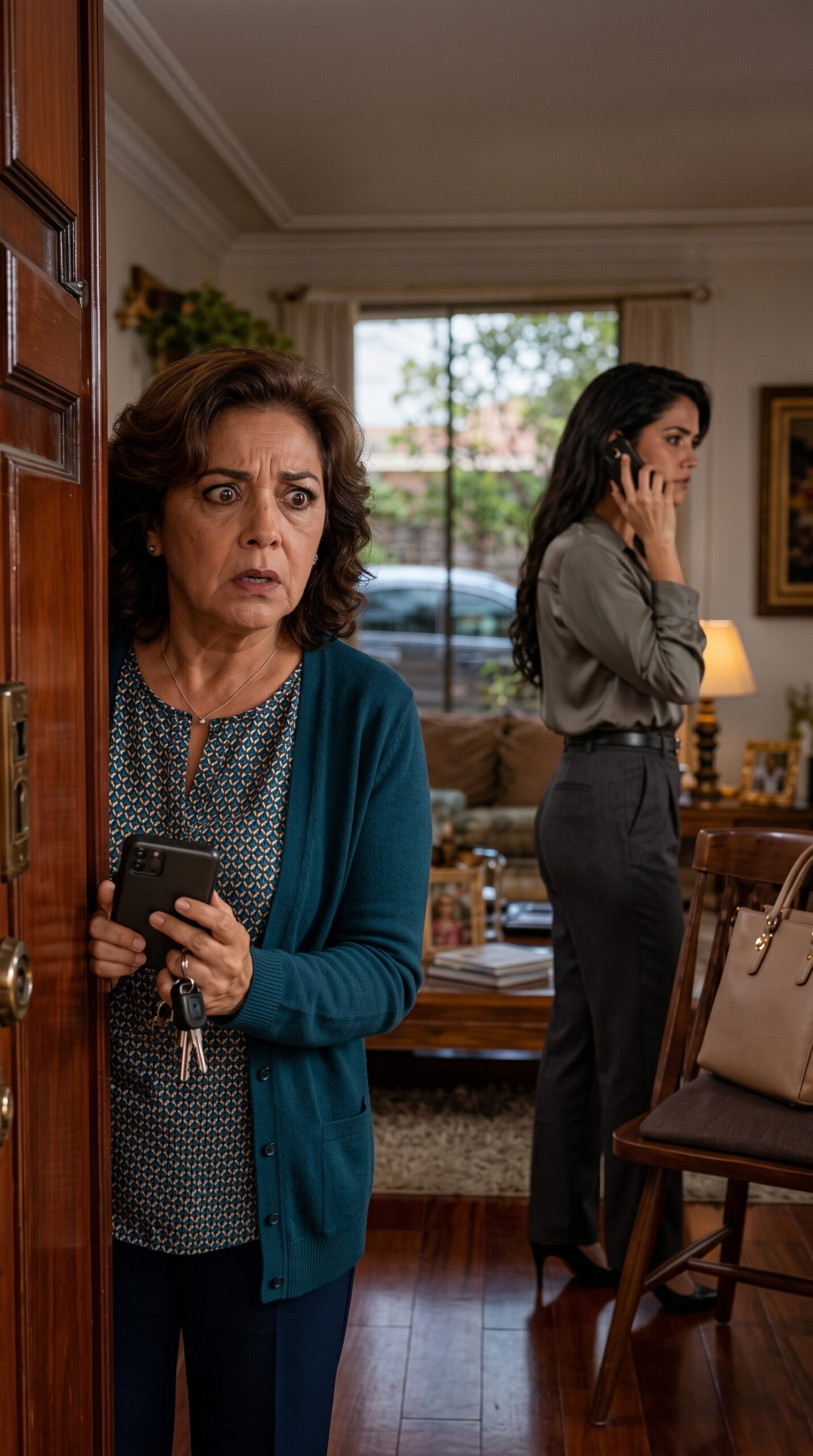
Daniela looked through the peephole. Her mother had her hair perfectly styled, an elegant bag, and a face of indignation.
She didn’t open fully. Just kept the chain on.
—What do you want?
—To fix this before it gets bigger.
—This was already big when you left my daughter alone.
Carmen pressed her lips together.
—Renata made a mistake.
—No. She made a decision. And you defended her.
—I didn’t know you’d take so long to go for her.
Daniela went cold.
That phrase was a disguised confession.
—So you knew she was alone.
Carmen blinked, as if she had just realized her mouth had betrayed her.
—I thought Renata would come back for her after giving you a scare.
Daniela felt her heart pounding against her ribs.
—A scare?
—You needed to understand that Lucía can’t be at the center of everything. Emilia is also a child. She also deserves attention.
At that moment, Lucía emerged from her room, teddy bear in arms. She stayed behind Daniela, without getting closer.
—Mommy —she whispered—, is Grandma going to take me?
Carmen heard the question.
Her face changed. Not out of complete guilt, but from the shock of seeing herself reflected as a danger to a child who once ran to hug her.
Daniela knelt beside Lucía.
—No, my love. No one is going to take you unless you want. Never.
Lucía returned to her room.
Daniela looked at her mother.
—Do you see what you did?
Carmen lowered her voice.
—I didn’t want that.
—But you wanted to scare her.
Carmen didn’t answer.
The lawsuit moved forward without a movie-like scandal, but with a force none of them could control.
There were summons. Interviews. Requests for videos. Paola’s statement. Review of the report. Call logs. Messages. The recording where Renata admitted she wanted Lucía to “learn.” And then, Carmen’s phrase at the door.
The family attempted to reduce it to a dispute between sisters, but the file had no gossip. It had timestamps.
Jorge requested to see the plaza cameras through his lawyer. When he saw the video, Renata ran out of excuses.
In the recording, Lucía could be seen walking behind them. Renata was seen glancing back. The girl lifted her hand. Emilia pulled her mother. And Renata could be seen quickening her pace toward the exit without looking back.
It wasn’t confusion.
It wasn’t a crowd.
It wasn’t negligence.
It was abandonment.
Jorge left the house that same week.
Renata called Daniela 22 times in one night. She sent messages saying she was destroying her marriage, that Emilia was crying, that Carmen had high blood pressure, that the whole family saw her as a traitor.
Daniela didn’t respond.
Rebeca answered for her:
“Any communication should be through legal channels.”
That freed her from something she didn’t know she was carrying: the obligation to explain her pain to those who caused it.
Carmen also began to pay her part.
For years she had boasted in her parish group that she was an exemplary grandmother. She organized rosaries, collections, meals, raffles. She spoke about Emilia as if she were a display doll and about Lucía as if she were an uncomfortable visit.
But serious stories walk alone.
A cousin found out. Then a neighbor. Then a lady from the prayer group asked why Carmen no longer saw Lucía. The committee asked her to stop coordinating activities “while the situation was clarified.”
For Carmen, who had used public opinion her whole life to control Daniela, the public scrutiny fell upon her like a stone.
But the hardest part wasn’t the public shame.
It was that Lucía didn’t want to see her.
In a family hearing, Carmen requested “supervised visitation.” She said she was her grandmother, that she had the right, that Daniela was using the girl for revenge.
Lucía’s psychologist presented a clear report: the minor associated Carmen and Renata with abandonment, fear, and punishment. Forcing contact could worsen the anxiety.
Carmen’s face hardened upon hearing this.
Daniela watched her from the other side of the room and understood something sad: her mother didn’t suffer for what she did to Lucía. She suffered because she could no longer decide for her.
Renata, on the other hand, broke down when Jorge testified.
He said he couldn’t stay married to someone capable of endangering a child to sustain another’s whim. He also said he would carefully review how Emilia was being raised, because he didn’t want his daughter to grow up believing love was defended by humiliating others.
That was the real twist.
Everyone had thought the scandal would be Daniela against Renata.
But it ended up being Renata in front of the mirror of the daughter she was raising.
Emilia, as a relative recounted, asked one night:
—So, could Lucía lose herself because of me?
Jorge cried with her. Renata didn’t know how to respond.
Months later, Daniela wasn’t celebrating anything. She didn’t feel victorious. She felt tired, sad, and a new peace that still felt too big for her.
Justice didn’t arrive like in the movies. It arrived in signed papers, no-contact restrictions, psychological appointments, legal expenses, and difficult conversations with a 5-year-old girl who just wanted to know if her mommy would always come back.
But Daniela did come back. Every time.
She came back when Lucía cried at the kindergarten entrance. She came back when she felt scared in the supermarket aisle. She came back when a woman with a perfume similar to Carmen’s passed by and the girl hid behind her legs.
Little by little, Lucía began to reclaim the world.
First, she left the teddy bear on the table during dinner. Then she left it on the bed to go to the bathroom. Afterward, she was able to enter a small store and choose some duck-laced shoelaces without asking 10 times if they would leave without her.
One Sunday, Daniela took her to buy sweet bread. Lucía chose a pink concha and said:
—Mommy, I know you won’t leave me.
Daniela knelt in front of her in the bakery.
—Never, my love.
Lucía hugged her with sugar on her fingers.
That night, Daniela stored the broken bracelet Lucía wore the day at Andares in a box. She didn’t throw it away. Not because she wanted to remember the pain, but because she needed to remember the boundary.
Before that night, Daniela believed keeping the family together was an obligation.
Afterward, she understood that a family that demands silence to protect the cruel is not family. It’s a trap with pretty pictures.
Carmen continued saying Daniela had destroyed everything.
Renata kept swearing she didn’t think it would go this far.
But Daniela knew the truth.
She didn’t destroy the family.
She just stopped holding a lie with trembling hands.
Because there’s a very low cruelty in using a child to punish her mother. In looking at a 5-year-old girl, with her yellow bow and open heart, and deciding she deserves fear because another girl wanted all the applause.
Renata and Carmen believed that the quickest way to hurt Daniela was to touch Lucía.
What they didn’t understand was that it was also the quickest way to wake her up.
Lucía didn’t lose a family that afternoon.
Neither did Daniela.
They lost a mask.
And even though it still hurt sometimes, even though Lucía continued to grip her hand in crowded plazas, Daniela knew she did the right thing. Because now, when she said, “I always come back,” her daughter believed her.
And that trust was worth more than any shared last name, any family meal, and any peace bought with silence.