PART 1
—If my children find out I'm still alive, they will finish burying me.
Emiliano Torres stood frozen in a forgotten corner of the Panteón de Belén in Guadalajara. He had come to lay flowers for his mother, as he did every anniversary, with a simple bouquet of daisies, a cheap candle, and the weariness of a day spent driving as a delivery man clinging to his back.
He was on his way out when he heard a moan coming from behind some old gravestones.
At first, he thought it was a cat. Then he heard it again.
—Help me… please…
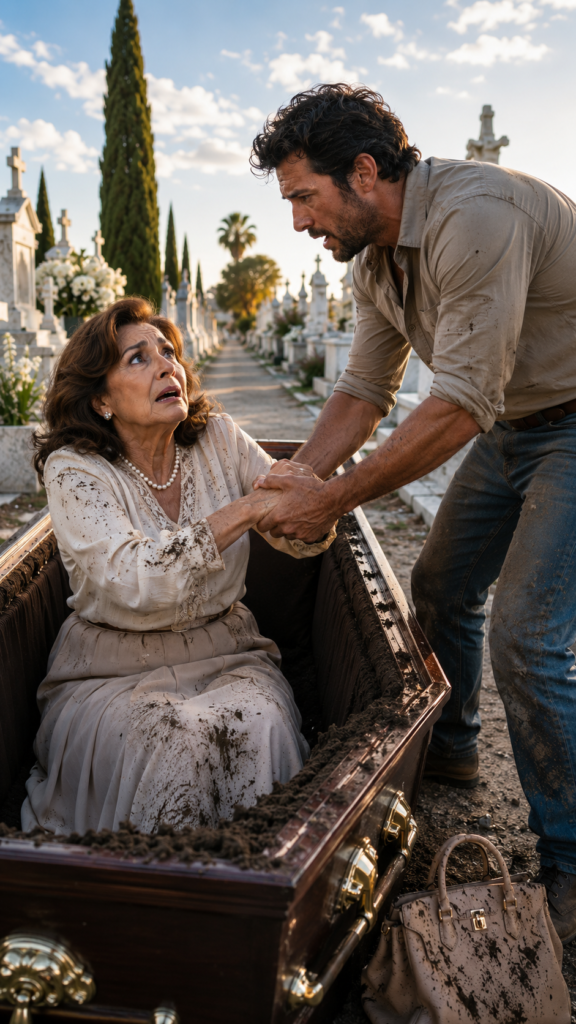
Emiliano shone his cellphone light and felt his blood run cold. Among the disturbed earth and dry flowers lay an older woman, dressed in fine clothes but covered in dust, her arms marked and her breathing fractured. She had the look of someone who had just stared death in the face.
—Ma'am, I'm calling 911 —he said, crouching down.
She gripped his wrist with desperation.
—No. They have contacts. They will find me.
—Who, ma'am?
The woman swallowed hard. Panic filled her eyes.
—My children.
Emiliano thought she was delirious. No one could do that to their own mother. But at that moment, he heard a car slowly passing by the cemetery wall. The woman trembled like a child.
—Get me out of here, boy. I beg you.
He didn’t ask any more questions. He placed his jacket over her, lifted her as best he could, and got her onto his motorcycle. He drove through dark streets, avoiding main avenues, until he reached the office of Don Ramiro, a neighborhood doctor who had been a friend of his mother’s.
The doctor took over an hour to come out.
—Emiliano, this woman didn’t fall —he said in a low voice—. They sedated her. If you hadn’t gotten her out of there, she wouldn’t have made it till morning.
When she woke up, already with an IV in her arm, she looked at Emiliano with shame and gratitude.
—My name is Mercedes Aranda.
Emiliano felt the ground shift beneath him.
All of Jalisco knew that name. Mercedes Aranda, founder of Grupo Aranda, owner of hotels, real estate developments, and construction companies across the country. A woman who always appeared in magazines alongside her two children: Alejandro and Mariana.
—It can’t be —he murmured.
—I wish it weren’t true —she replied—. They took me to a vacation home in Tapalpa. They said they wanted to protect me. They gave me something in tea. When I woke up, I felt dirt falling on my face.
Emiliano didn’t know what to say.
Mercedes recounted how she had been reviewing strange sales for months, properties sold below their value, and contracts signed without her authorization. Everything pointed to her children. When they discovered she was going to change the will, they decided to make her disappear.
That morning, news portals published a statement: “Doña Mercedes Aranda has traveled to Houston for medical treatment. Her children will temporarily assume leadership of the group.”
Mercedes stared at the screen without crying.
—They’ve already started.
By evening, a black truck parked outside the clinic. No one got out. No one knocked. It just sat there, with tinted windows, for 12 minutes.
Don Ramiro turned off the lights.
Emiliano looked at Mercedes and understood that he was no longer helping a stranger. He was protecting a mother hunted by her own children.
And when the truck slowly passed by the door again, he felt that no one could believe what was about to happen…
PART 2
Emiliano hid Mercedes in the rooftop room where he lived, in a boarding house near San Juan de Dios. It was a humble place, with a single bed, a rickety table, two plastic chairs, and a little Virgin Mary stuck to a peeling wall.
—I’m sorry for the place —he said, embarrassed.
Mercedes looked at the stained ceiling, the old blanket, and the window without curtains.
—Don’t apologize. It’s the first place where no one wants me dead.
For three days, they didn’t go out. Emiliano bought her simple clothes at the market, a used cellphone, and some dark glasses. Mercedes, still weak, managed to access a secret email account she had opened years ago out of distrust.
There she found audit reports, transfers to shell companies, manipulated documents, and signatures she had never placed.
The names repeated over and over.
Alejandro Aranda.
Mariana Aranda.
But there was a hidden folder with a strange title: “final backup.”
When Mercedes opened it, a name appeared that took her breath away.
Tomás Medina.
Emiliano looked at her carefully.
—Who is Tomás?
Mercedes closed the laptop. For the first time, her voice cracked.
—The son I lost without him dying.
Tomás was not of her blood. Mercedes had met him when he was 14 and sold sweets outside the Central Nueva. She took him in, educated him, gave him shelter, taught him the business, and over the years, he became her right-hand man.
He didn’t have the Aranda surname, but he had more loyalty than the whole family combined.
That made Alejandro and Mariana sick with jealousy.
—They accused him of stealing money from the company —Mercedes confessed—. They showed me receipts, emails, transfers. I believed them. I kicked him out one rainy night.
—And was it a lie? —Emiliano asked.
She looked down.
—Now I know it was.
Tomás had disappeared over twenty years ago. Mercedes searched for him too late, when pride had already done too much damage. She never found him.
Now she understood why her children feared her. Her husband, before dying, had left a private letter stating that Tomás was the only one capable of safeguarding the company without destroying the family. Mercedes planned to recognize him as a moral heir and new director of the board.
That’s why Alejandro and Mariana were in a hurry.
In four days, there would be an extraordinary meeting of Grupo Aranda. In front of twelve board members, her children wanted to declare her incapable, take definitive control, and sell the most valuable assets before anyone asked too many questions.
That night, the new cellphone received a message.
“Don’t hide. She will never sit in that chair again.”
Mercedes knew it was Mariana.
The next day, Emiliano saw a gray sedan parked in front of the boarding house. He didn’t wait. He took Mercedes out through the roof, crossed through a neighbor's house, and escaped on a borrowed motorcycle.
They took refuge in Don Chuy’s little house, the caretaker of the cemetery, a serious man who had known Emiliano since he was a child.
—If this boy brought her, she stays here —Don Chuy said—. But be careful, because those people don’t play fair.
Mercedes knew that hiding was no longer enough.
—We need proof —she said.
—From where? —Emiliano asked.
She took a deep breath.
—from the 14th floor of my own company.
Emiliano managed to get into Grupo Aranda as a temporary driver. To the executives, he was invisible: just a kid in a gray uniform who opened doors, carried boxes, and didn’t speak up.
But from that invisibility, he overheard too much.
He heard they were destroying contracts. He saw lawyers enter with sealed folders. He knew there was a USB drive stored in legal files and that the supposed new will had a forged signature.
One afternoon, when Alejandro and Mariana were at a lunch with investors, Emiliano went up to the 14th floor using a card he had seen on a technician's desk.
He found boxes with fake sales, deposits to foreign accounts, and inflated invoices. He also found an old photo: a young Mercedes hugging Tomás at an inauguration.
On the back it read: “For Tomás, the son who knew how to take care of me.”
Emiliano pocketed the USB, took photos with his cellphone, and stuffed the image into his jacket.
Then he heard footsteps.
—Check the file —a voice ordered—. Someone’s gotten in.
Emiliano turned off the light. His heart pounded like a drum. If they caught him there, Mercedes would never reach the meeting alive.
He slipped out behind a cleaning cart, took the emergency stairs down, and walked through the parking lot, pretending to be calm. He didn’t run. He knew running would give him away.
When he got back to Mercedes, it was already night.
He placed the USB, the contracts, and the photo on the table.
Mercedes took the image first. Upon seeing Tomás, her face crumpled. She didn’t scream. She just cried with an old sadness, the kind that doesn’t come out from pride until the truth forces it.
—I kicked him out of my house —she whispered—. And he was the only one who didn’t want to take anything from me.
On the USB, there were audios. In one, Alejandro said that his mother’s signature should look identical, “even if the old lady showed up.” In another, Mariana demanded that Tomás be found since he was the only loose end.
There were also payments to doctors, guards, notaries, and front companies.
But Mercedes understood something painful: even though all of that was strong, her children could say it was false. They needed Tomás.
With Don Chuy’s help, they found a lead in Querétaro. Tomás Medina now called himself Tomás Robles and ran a medium-sized transport company. He wasn’t wealthy, but everyone said he was upright, hard-working, and fair with his people.
They traveled that morning in an old truck.
When they arrived, Tomás was inspecting merchandise in an industrial yard. He was over 40, had gray beard, and the hard gaze of someone who learned not to expect apologies.
Seeing Mercedes, he froze.
—Tomás —she said.
He smiled without joy.
—I thought that name no longer existed for you, Mrs. Aranda.
Mercedes received the line like the deserved slap it was.
—I was wrong about you.
—You were wrong twenty years ago.
—I know.
Tomás didn’t hug her. He didn’t even step closer.
—Why are you here now?
Mercedes showed him her husband’s letter, the audios, and the photo. Tomás read in silence. Then he opened a filing cabinet and took out a folder.
—I kept things too.
Inside were the proofs of the trap Alejandro and Mariana had set for her. Computer accesses, transfers moved from internal accounts, and emails that showed they had blamed him to eliminate him from the path.
—I didn’t report it because I didn’t want to sink you —Tomás said—. How foolish, right? I still cared for you.
Mercedes lowered her head.
—There is no forgiveness that can reach that.
Tomás looked at her for a long time.
—I’m not going for the company. I’m going because no one deserves to be buried alive by their own children.
The extraordinary meeting took place two days later, in the main tower of Grupo Aranda. There were twelve board members, lawyers, investors, and internal cameras. Alejandro wore a blue suit and an heir’s smile. Mariana dressed in white, impeccable, as if guilt could be masked.
—Our mother is still receiving treatment abroad —Alejandro said—. Out of responsibility, we propose to formalize the transition.
Mariana distributed copies of the supposed will and a medical statement declaring Mercedes incapable of making complex decisions.
They were about to vote when the doors flew open.
Mercedes entered, supported by Emiliano.
Behind came Tomás with a black folder.
The room fell silent.
Alejandro’s smile faded. Mariana dropped her pen.
—Mom… thank God you’re okay —she stammered.
Mercedes looked at her with a coldness she had never used with her children.
—Don’t involve God in the filth you did.
Alejandro stood up.
—My mother is confused. She needs medical attention.
—She needed it when you left me in a grave —Mercedes replied.
The phrase fell like a stone.
Tomás connected the USB to the room’s system. The screen lit up with transfers, fake contracts, compared signatures, and simulated sales.
Then Alejandro’s voice echoed:
“If the old lady shows up, we declare her incapable. No one believes a drugged woman.”
Next, Mariana’s voice sounded:
“Find Tomás. He’s the only loose end.”
Mariana turned pale.
—That’s edited.
Tomás opened his folder.
—Then these emails from twenty years ago, when they blamed me, are edited too. And these system accesses. And these payments to the notary. And this deposit to the doctor who signed the false incapacity.
Alejandro looked at his sister.
—you saved those audios.
Mariana lost control.
—You ordered to bury her! I just did what you said!
The silence was brutal.
Mercedes closed her eyes. That was the true sentence. It was not the police entering moments later. It was not the board members distancing themselves from their children as if they were poison. It was hearing her two children fight to save themselves without shedding a single tear for her.
Alejandro tried to leave, but two agents stopped him at the door. Mariana began to cry, not out of guilt, but out of fear.
—Mom, please. We’re your children.
Mercedes approached slowly.
—My children died the day they decided my money was worth more than my life.
The following days were an earthquake. Alejandro and Mariana were investigated for attempted murder, fraud, forgery, and money laundering. Several executives fell with them. The false will was annulled. The fraudulent sales were frozen.
Mercedes returned to Grupo Aranda, but not as before. She created an independent board, submitted evidence to the authorities, and protected the employees who had reported irregularities.
Emiliano was offered money. A lot.
He refused.
—I didn’t help her for that, Mrs. Mercedes.
She insisted on doing something fair. She bought a small house in his name and founded a scholarship program for the children of delivery drivers, in honor of Emiliano’s mother.
Tomás didn’t immediately return to Mercedes. The wound was deep. But he agreed to see her every Sunday for coffee. Sometimes they talked about the company. Sometimes they just sat in silence.
One day, Mercedes asked him:
—Will you ever be able to call me mom again?
Tomás looked at his cup.
—I don’t know.
She nodded, tears in her eyes.
—That’s okay. This time, I’ll wait without demanding anything from you.
Emiliano continued to visit the cemetery every year. But he no longer always went alone. Sometimes Mercedes accompanied him and left flowers at the grave of the woman who, unknowingly, had raised the boy who saved her life.
In front of that grave, Mercedes understood what no fortune could teach her: blood inherits surnames, but it does not guarantee love.
Because there are children capable of burying their mother alive for ambition… and strangers who rescue her with an old jacket, a borrowed motorcycle, and a clean heart.