PART 1
At 19, Mariana returned to her parents' house with a pregnancy test hidden in the pocket of her jacket.
They lived in a quiet neighborhood in Puebla, in a small but immaculate house, one of those where the neighbors know who arrives late, who fought, and even who bought bread at the corner.
Her mother, Alicia, was folding clothes in the living room. Her father, Ernesto, was watching the news sitting in his old armchair, still in his gray factory uniform, his hands stained with grease even though he had washed them three times.
Mariana didn’t know how to say it.
So she took out the test and left it on the coffee table.
Alicia froze.
Ernesto turned off the television.
“Who is the father?” he asked, in a voice so cold it sounded like another man’s.
Mariana lowered her gaze.
“I can’t say.”
The silence fell heavy, as if someone had closed all the windows at once.
“How can you not?” Alicia exclaimed, bringing a hand to her chest. “Is he married? Is he older? Did he do something to you, daughter?”
“No, Mom. It’s not that.”
“Then speak,” Ernesto growled. “Because in this house, we don’t play with shame.”
Mariana clenched her fists.
“I can’t lose this baby. If I do… we will all regret it.”
Ernesto stood up so quickly that the chair hit the wall.
“Are you threatening me, girl?”
“Dad, please. One day you’ll understand.”
But he didn’t want to listen.
For Ernesto, the only clear thing was that his daughter had returned pregnant, without a husband, without a name, and with a phrase that sounded like blackmail.
“You’re not going to bring a dishonor without a surname into this house,” he said, red with anger. “Either you fix this, or you get out.”
Alicia began to cry.
But she didn’t open her mouth to defend her.
Mariana tried to explain that it wasn’t a whim, that there was a bigger reason, that she couldn’t speak yet because there were dangerous people involved. She said that the baby’s father wasn’t just any man.
Ernesto laughed mockingly.
“Oh, sure, he was a prince, right? Come on, Mariana.”
Less than an hour later, she was on the sidewalk with an old suitcase, $430 in her pocket, and a jacket that barely covered her from the cold.
Alicia watched her from the window, hand over her mouth.
But she never opened the door.
That night, Mariana slept in the CAPU bus station. The next day, she went to Mexico City, where a high school friend found her a tiny room behind a hair salon in Iztapalapa.
There she started from scratch.
She sold tortas in the morning.
She washed dishes in a small restaurant in the afternoon.
She studied accounting online when her body could take no more.
Then her son was born.
She named him Mateo.
Mateo was born with intense, dark eyes, as if from infancy, he understood more than what adults wanted to say.
He grew thin, kind, and curious.
He wanted to know why the sky turned orange, why his mom never talked about his grandparents, and why there were no pictures of his dad.
Mariana always replied the same:
“Your dad was a good man.”
“And my grandparents?”
“One day, my love.”
That “one day” came when Mateo turned 10.
While they cut a cheap chocolate cake, he looked at her very seriously.
“Mom, I want to meet them. Just once.”
Mariana felt fear rising in her throat.
Not fear of her parents.
Fear of everything she had buried.
But Mateo deserved the truth.
Three days later, they got on a bus to Puebla. Mariana carried a backpack, a yellow folder, and a USB wrapped in a napkin.
They arrived on a Saturday afternoon.
The house was the same.
The same brown door.
The same bougainvillea.
The same step where she had cried pregnant 10 years earlier.
Mariana knocked.
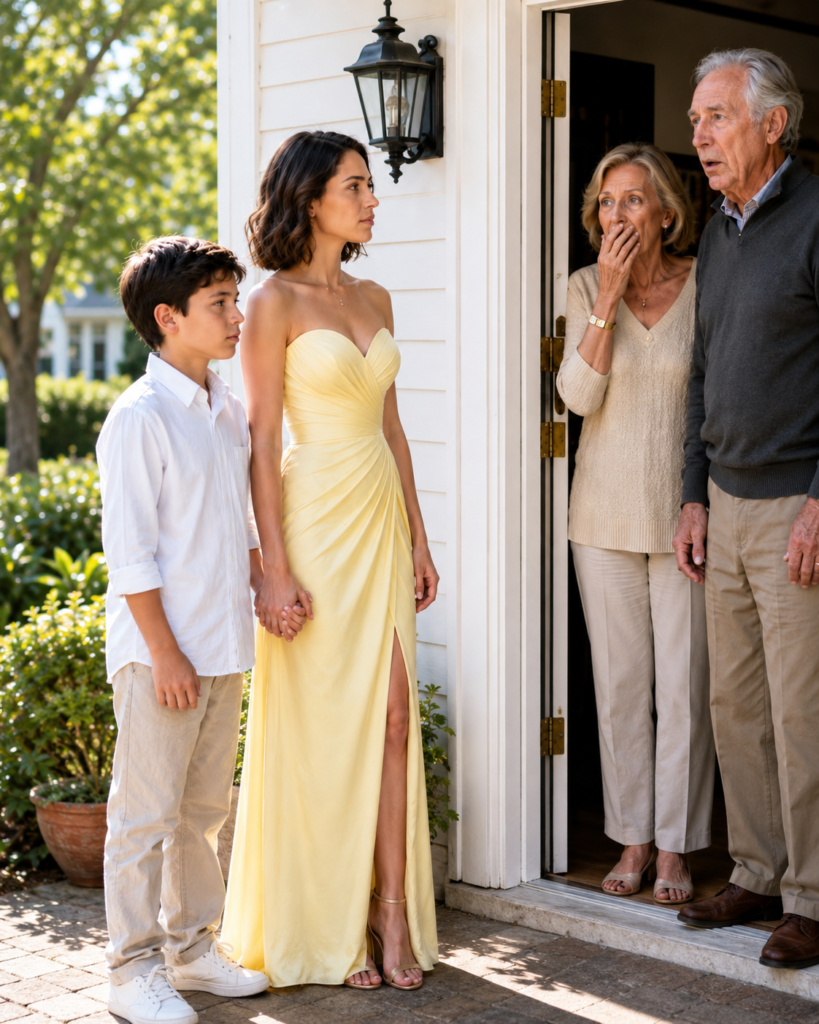
Ernesto opened.
Seeing her, he turned pale.
“Mariana?”
Alicia appeared behind him.
And when she saw Mateo, she gasped.
No one spoke.
Mateo hid a little behind his mom.
Mariana took a deep breath.
“I came to tell you the truth.”
Ernesto clenched his jaw.
“After 10 years?”
Mariana pulled out an old photograph from the folder.
In the image stood a smiling young man wearing an engineer’s helmet, next to Ernesto in front of the factory where he had worked his entire life.
Alicia covered her mouth.
Ernesto took a step back.
Mariana placed the photo on the table.
On the back, in shaky handwriting, was a single phrase:
“Your dad tried to save us.”
Ernesto began to tremble.
And Mateo, not understanding anything, asked:
“Mom… is that man my dad?”
PART 2
Mateo’s question split the living room in two.
Alicia sank into a chair, as if her legs no longer responded. Ernesto stared at the photo, lips parted and eyes filled with a long-hidden terror, buried for years.
“His name was Andrés,” Mariana said. “Andrés Salgado.”
Mateo looked at the picture again.
The young man in the photo had his same gaze. The same slightly drooping eyebrow. The same way of tightening his mouth when he smiled.
“Is he my dad?” he repeated.
Mariana nodded slowly.
“Yes, my love.”
Alicia began to cry silently.
Ernesto slammed his hand on the table.
“That can’t be!”
“Of course it can,” Mariana replied. “You knew him better than anyone.”
Andrés had been a safety engineer at the auto parts factory where Ernesto worked. He was 27, serious, educated, and always greeted the workers by name.
Ernesto appreciated him.
He said he was one of the few bosses who didn’t treat workers like machines.
Mariana met him one afternoon when she went to bring her dad food. Ernesto was working a double shift, and Andrés helped her find the correct entrance because the guards wouldn’t let her through.
From then on, they saw each other several times.
It wasn’t a movie romance.
It was a discreet love, filled with short messages, cheap coffees, and walks around the zócalo of Puebla when Mariana got out of class.
Andrés spoke little about himself, but when he talked about the factory, his voice became hard.
He had discovered that a production line had serious flaws. The presses were not stopping properly. The sensors had been altered so the company wouldn’t lose contracts.
And the worst: Ernesto worked right in that area.
“Andrés found documents,” Mariana said, pulling papers from the folder. “Falsified reports. Bought signatures. Hidden accidents.”
Ernesto sat down slowly.
“Shut up.”
“No. I’ve been quiet for 10 years.”
Mariana plugged the USB into the television.
The screen showed a blurry video, recorded in a factory warehouse. Voices could be heard.
Andrés’s voice.
A manager’s voice.
And then Ernesto’s.
Mateo clung to his mother’s hand.
In the video, Andrés said:
“If they don’t stop the line, someone is going to die. I already have copies. I’ll report tomorrow.”
The manager replied:
“Think carefully, engineer. Everyone here has a family.”
Then came Ernesto, younger, with a face full of anguish.
“Andrés, just let it go. They’ll fire us all.”
“Mr. Ernesto, if I don’t speak, you could be next.”
Ernesto looked down in the video.
And then the phrase that froze Alicia was heard:
“If that boy keeps going, you know what to do. I didn’t see anything.”
Alicia let out a choked scream.
“Ernesto… what did you do?”
He shook his head, desperate.
“I didn’t know they were going to kill him. I just… I was just scared. They told me that if I spoke, they’d leave me without a job, without severance, with nothing. You all ate from that salary.”
Mariana looked at him with tired rage.
“Andrés died two days later in a ‘car accident.’ They said he was drunk driving. But he didn’t even drink.”
Mateo’s eyes widened, confused.
“Did my dad die for helping?”
Mariana stroked his hair.
“Yes. He tried to save your grandpa and other workers.”
Ernesto covered his face.
For 10 years, he had lived convinced that his silence had been a lesser cowardice. A buried stain. A necessary mistake to feed his family.
But he didn’t know that Andrés had left something more.
Mariana took out a folded, yellowed letter.
“He gave this to me before he died. He told me that if something happened to him, to protect the baby. I was already pregnant. He wanted to talk to you, Dad. He wanted to tell you that Mateo was your grandson.”
Alicia looked at Ernesto as if she had just met him.
“Is that why she said we would all regret it?”
Mariana nodded.
“I couldn’t say Andrés’s name because the same men who threatened him were looking for me. If they knew I was expecting his child, they would take away my evidence. Or worse.”
“And why didn’t you ever come back?” Alicia whispered.
Mariana let out a broken laugh.
“Because when I needed you the most, you put me out on the street.”
Alicia cried harder.
“Daughter, I was scared of your dad.”
“And I was 19, Mom. I was pregnant. I slept in a bus station while you watched me from the window.”
That phrase hurt more than any shout.
Mateo looked at his grandparents with a mix of curiosity and sadness. He didn’t understand all the details, but he did understand one thing: his mom had been alone because of them.
Ernesto tried to approach.
“Mateo… I didn’t know you were my grandson.”
The boy stepped back.
“But you did know my mom was alone.”
No one had an answer.
Mariana took out another envelope from the folder.
“I didn’t come just for memories. I came because the case was reopened.”
Ernesto lifted his head.
“What?”
“A journalist investigated workplace accidents at that factory. I gave her copies. The prosecutor’s office already has the video, the reports, and the names. They’re going to summon you.”
Alicia froze.
Ernesto began to cry, but not like a man suddenly repentant, but like someone who finally understood that the truth doesn’t forgive just because time has passed.
“They’re going to put me in jail,” he murmured.
“I don’t know,” Mariana said. “But you’re going to tell the truth.”
“And what if I can’t?”
Mariana looked at him fixedly.
“Then Mateo will grow up knowing that his grandfather let his dad die twice: once when he stayed silent, and another when he had the chance to clear his name and didn’t want to.”
Ernesto broke down.
He fell to his knees in front of the boy.
“Forgive me, please. I was a coward.”
Mateo didn’t know what to do. He looked at his mom, seeking permission to feel whatever was breaking his chest.
Mariana didn’t force him to hug anyone.
That was love too.
Alicia stood up and walked toward her daughter.
“I don’t deserve your forgiveness,” she said. “But let me tell you something: all these years, I set your plate on Christmas. Your dad told me it was silly, but I put it there.”
Mariana closed her eyes.
For years she had imagined her mother cold, indifferent, calm. Knowing that she had also suffered didn’t erase the abandonment, but it made it more painful.
“An empty plate doesn’t shelter a daughter on the street, Mom.”
Alicia lowered her head.
There was no immediate hug.
There was no background music.
Just a family destroyed by what they had kept silent.
Weeks later, Ernesto testified before the prosecutor’s office. He named the manager, handed over documents he had hidden, and accepted that he had lied in his first statement.
The company tried to deny everything, as always.
But this time there were videos.
There were signatures.
There was a letter.
And there was a 10-year-old boy sitting in the front row of a hearing, holding the picture of his father with both hands.
Andrés Salgado’s name was publicly cleared.
The newspapers no longer called him reckless.
They called him a whistleblower.
A hero.
A father.
Ernesto received a lesser sentence for cooperating but lost the peace he had pretended to have. Alicia sold the house in Puebla and moved near Mariana, not to demand forgiveness, but to earn it little by little.
Mateo agreed to see her some Sundays.
Ernesto didn’t want to see him for a long time.
And Mariana respected that.
Because she had learned that blood doesn’t obligate love, and that forgiveness isn’t extracted with tears.
One day, after school, Mateo asked her:
“Mom, would my dad have wanted me to hate my grandpa?”
Mariana took a deep breath.
“I don’t know, my love. But he surely would have wanted you never to be taught to stay silent when something is wrong.”
Mateo looked at the photo of Andrés he now carried in his backpack.
“Then I’m never going to be silent.”
Mariana smiled with tears in her eyes.
10 years earlier, they had kicked her out for bringing a life into the world.
10 years later, that life returned to force them to face the death they had hidden.
And in that house, everyone understood too late that sometimes the shame isn’t in a pregnant daughter, but in an entire family that prefers to close the door rather than listen to the truth.