PART 1
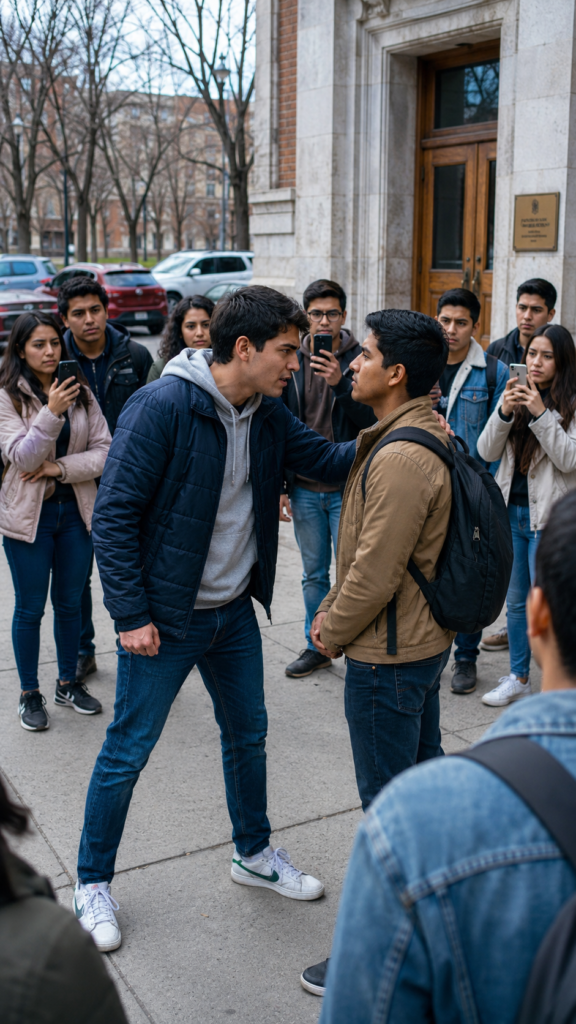
Darío Montes found his path blocked in front of the most elegant building at the Universidad del Valle de México, Santa Fe campus, just as he was holding the prototype that could change his life.
It wasn’t just any device.
It was a low-cost solar sensor system, designed by him and his team for communities in the Sierra de Guerrero where the power failed every week. They built it with recycled parts, sleepless nights, and Oxxo coffee.
But to Patricio Cárdenas, son of one of the university’s biggest donors, Darío was not a brilliant student.
He was “the scholarship kid.”
“Where do you think you’re going, dude?” Patricio said, stepping in front of him with a sneer—“This event is for people who actually belong here.”
Around them, several students began recording.
Darío pressed the black case against his chest. He was 20 years old, with dark brown skin, a plain shirt, and worn-out sneakers that had already survived too many rains in Iztapalapa.
“I’m just going to deliver this to the judges,” he replied calmly.
“That?” Patricio looked at the case—“You probably cobbled it together from junk at the market.”
Laughter erupted.
Bruno and Tadeo, Patricio’s inseparable friends, approached like trained dogs. One pointed at Darío’s sneakers. The other pulled out his phone and aimed it directly at Darío’s face.
“Smile, scholarship boy,” Tadeo mocked—“Today you’re going to be famous.”
Darío breathed.
1.
2.
3.
His grandfather Eusebio had taught him that since he was a child in a small tin dojo: control your breath before you control your body.
He didn’t respond.
He tried to sidestep them.
Patricio shoved him with his shoulder and struck the case. Something inside sounded dull, like a piece snapping loose.
Darío’s eyes changed.
“Don’t touch it again.”
Patricio grinned wider.
“Or what?”
Before anyone could react, Patricio slipped behind him and wrapped his arm around Darío’s neck. He squeezed tightly, theatrically, cruelly, as the phones rose as if it were a show.
“Say sorry, sir,” he whispered in his ear—“You don’t call the shots here.”
Natalia Rivera, Darío’s classmate, came running from the engineering table.
“Let him go, you animal!”
But no one moved.
The air started to leave Darío. The world shrank. He felt the arm around his throat, the expensive scent of Patricio’s cologne, the laughter, the murmurs.
And then he lowered his center of gravity.
He grabbed Patricio’s wrist, twisted his hip, and broke the hold with clean precision. Patricio stumbled forward, surprised.
Darío could have broken his arm.
He didn’t.
He just delivered a controlled punch to his side to knock the wind out of him.
Patricio fell to his knees.
The laughter died down.
Bruno lunged at him. Darío dodged, struck his plexus, leaving him doubled over. Tadeo tried to grab him from behind. Darío spun, swept his leg, and knocked him to the grass without hurting him further.
It was all over in less than 15 seconds.
The silence was brutal.
Darío picked up the case from the floor. One corner was broken.
Natalia saw the red mark on his neck.
“We need to report this.”
Darío looked at Patricio, still kneeling, with grass on his white shirt and hatred in his eyes.
“First the prototype.”
That night, when they thought the worst was over, the video appeared on the university’s website.
But it was edited.
It only showed Darío taking down three students.
It didn’t show the hold on his neck.
It didn’t hear the insults.
It didn’t show the hit to the case.
The title read:
“Violent Scholarship Kid Attacks Members of the Club Los Halcones During Scholarship Event.”
At 8:17 p.m., Darío received an email from the Honor Committee.
Disciplinary hearing. 9:00 a.m.
And at the end of the message was a sentence that froze his blood:
“Your scholarship is under immediate review.”
PART 2
The next morning, Darío entered the Committee building with a clean shirt, the mark on his neck, and the broken case under his arm.
Natalia walked beside him with photographs, screenshots, and the little calm she had left.
Attorney Valenzuela, the committee director, didn’t ask if he was okay.
She didn’t even look at his neck.
She just opened a folder and said:
“The university does not tolerate acts of violence.”
Darío held her gaze.
“Neither do I. That’s why I want to talk about the aggression I suffered before defending myself.”
Valenzuela raised an eyebrow.
“Aggression?”
The door opened.
Patricio entered with his right arm in a sling.
Natalia let out a dry laugh.
The day before, that same arm had held Darío’s neck. Now he wore it slung as if he were a casualty of war.
“I can’t breathe,” Patricio said weakly—“I haven’t slept since yesterday.”
Valenzuela looked at him with a tenderness she never offered Darío.
“I’m very sorry about what happened, Patricio.”
Darío clenched his fists under the table.
“That sling is fake.”
Patricio’s eyes widened, outraged.
“Excuse me?”
“My neck isn’t.”
Valenzuela slammed the folder shut.
“Mr. Montes, accusing without evidence can make your situation worse.”
Then Darío understood.
They weren’t looking for the truth.
They were looking to protect the Cárdenas name.
Patricio smiled faintly, like someone who knows the game is already rigged.
The Cárdenas Foundation funded the innovation fund. Patricio’s team was also competing for that money. If Darío was suspended, his project would be out.
That same afternoon, when he returned to the dorm, Darío found the door to his room smeared with black grease.
On a sheet taped to it, it read:
“Know your place.”
Natalia took pictures before he touched anything.
“Now we go to security.”
Darío looked at the empty hallway.
“With the same ones who didn’t see my neck?”
That night, the prototype was sabotaged.
Carlos, the third member of the team, called them from the lab, almost in tears. The sensor matrix had been forcibly recalibrated. The backups were gone. A motherboard had a fractured chip.
“This wasn’t an accident,” Carlos said—“Someone knew exactly where to hit.”
Darío stared at the table.
Patricio didn’t want to beat him.
He wanted to erase him.
But the first crack in that lie appeared thanks to Elena Becerril, a journalism student who had recorded part of the conflict’s start.
In her video, Patricio could be heard saying:
“What’s a scholarship kid like you doing on our grass?”
It also showed the hit to the case.
It wasn’t enough to save Darío, but it was enough to prove that the viral video was cut.
“We need more,” Elena said—“And if the university doesn’t want to look, we’ll make everyone look.”
The second attack happened two days later, behind the maintenance building.
Darío stepped out alone for 10 minutes to grab a tool. Patricio was waiting for him at the end of the exterior hallway.
No sling.
No audience.
No smile.
Bruno and Tadeo blocked his way.
“Now it’s your turn, scholarship kid,” Patricio said—“No cameras here.”
Darío raised his open hands.
“I don’t want to fight.”
“Of course you do,” Patricio spat—“That’s what you are, right? The dangerous brown kid everyone should fear.”
Bruno grabbed him from behind.
Tadeo hit him in the side.
The air left him.
The second blow blurred his vision.
Then it was no longer discipline.
It was survival.
Darío threw his head back and broke Bruno’s nose. He spun, swept Tadeo, and dodged Patricio’s clumsy punch. Then he grabbed Patricio’s arm and slammed it against the wall, not breaking it but leaving him without the will to continue.
Patricio fell to the ground.
“This isn’t over,” he murmured.
He was right.
Because at the other end of the hallway was a delivery truck.
And the dashboard camera had recorded everything.
The delivery guy’s name was Marcos. He was 46 years old, had two kids, and was afraid of losing his job. But when Elena found him, he handed her a USB.
“I saw what happened on the grass too,” he confessed—“Not complete, but enough. If someone did that to my son and everyone stayed quiet, I’d die of rage.”
On Elena’s computer, the truth finally appeared.
Patricio blocking.
Patricio insulting.
Patricio closing his arm around Darío’s neck.
Darío resisting.
Darío only breaking free after being attacked.
Natalia cried in silent rage.
Darío didn’t cry.
But for the first time in days, he could breathe.
The formal hearing was the next day.
This time he didn’t enter alone.
Natalia brought the lab records. Carlos brought the technical report of the sabotage. Elena brought the videos. Marcos waited outside, nervous but resolute.
Valenzuela no longer seemed so confident.
Patricio appeared with the sling again.
Elena connected the laptop to the projector.
“Before we discuss versions,” she said—“let’s look at the facts.”
The video filled the wall.
The room fell silent.
When the hold on the neck appeared, a professor on the jury stood up.
“That’s an assault.”
Patricio slammed the table.
“It’s manipulated!”
Natalia projected the timeline of the lab.
“Darío was in class when the prototype was damaged. Here’s his attendance. Here’s the access to the lab with a different credential. Here’s the hallway camera.”
Patricio paled.
Then Darío’s phone vibrated.
It was a message from Óscar, another member of the club Los Halcones.
“I have an audio. Patricio planned it all. I can’t stay silent anymore.”
Elena read the message aloud.
Patricio stood up furiously.
“My dad won’t allow this nonsense.”
And that sentence sank him deeper than any evidence.
The meeting was suspended.
But the Cárdenas family countered quickly.
Marcos withdrew his statement after receiving a call from his boss. Elena’s editor canceled her story. Security found a USB in Darío’s backpack with stolen files from Patricio’s team.
That afternoon, Darío was suspended from the competition.
His scholarship was frozen.
He returned to his room with a shattered soul.
Natalia followed him in silence.
Darío opened the bottom drawer of his desk and pulled out a black cloth. Inside was his grandfather Eusebio's old black belt, worn at the edges.
“I’ve done everything right,” he whispered—“I endured mockery. I worked twice as hard. I didn’t seek fights. What good did it do?”
Natalia sat down next to him.
“It served so that when the truth comes out, no one can say you started the fire.”
At 6:17 a.m., someone knocked on the door.
It was Óscar.
He had a split lip and a swollen eye.
“I can’t take it anymore,” he said, entering with trembling hands—“Patricio will destroy anyone who gets in his way.”
He placed his phone on the table.
The audio started.
Patricio’s voice sounded clear, drunk, arrogant.
“No one will believe the scholarship kid over me. My family practically paid for the South Wing. The story writes itself: violent brown kid attacks a student from a good family.”
Then another voice asked about the competition.
“It’s already arranged,” Patricio replied—“The files are in his backpack. Bruno has a cousin in security. My dad’s company needs that fund. People like him don’t belong here.”
Natalia covered her mouth.
Darío closed his eyes.
Óscar lowered his head.
“I’m a scholarship kid too,” he confessed—“My dad cleans offices at night. Patricio doesn’t know. I pretended to be like them to avoid fear. But I became an accomplice.”
That day was the final innovation showcase.
The same grass.
The same building.
The same phones.
But this time the stage wasn’t Patricio’s.
Elena started a live stream. Natalia had the evidence ready. Carlos had repaired the prototype all night. Óscar agreed to testify in front of everyone.
Darío arrived in a simple white shirt. Underneath his clothes, around his waist, he wore his grandfather’s black belt.
Not as a threat.
As a root.
Patricio saw him approach and let out a laugh.
“Back here again? Don’t you understand when you’re not welcome?”
Darío stopped three meters away.
“I’m in my university.”
“Your university,” Patricio repeated—“They lent you a seat, dude. Don’t confuse charity with belonging.”
The phones rose.
But this time they were recording for everyone.
Patricio shoved him.
Darío stepped back, hands open.
“I don’t have to hit you for everyone to see.”
That calm broke him completely.
Patricio threw a punch.
Darío dodged it with minimal movement. Bruno entered from the left. Darío blocked, tapped his plexus, and left him breathless. Tadeo tried to grab his arm. Darío spun and pushed him aside without hurting him.
Patricio reached for his neck again.
The same hold.
The same arrogance.
Darío grabbed his wrist before he could lock it, twisted his hip, and took him down with a clean throw.
Patricio lay on his back, staring at the sky.
Darío pinned him without crushing him.
“This,” he said, looking at the phones—“this is what happened the first time. And the second.”
Elena’s voice cut through the grass.
“We’re streaming live.”
Then the evidence appeared on the big screen.
The full video.
Óscar’s audio.
The timeline of the sabotage.
The credential used to enter the lab.
The planted USB.
The silence grew until it became enormous.
The professor on the jury looked at Valenzuela, who had just arrived pale.
“This young man was attacked,” she said—“And you punished him for surviving.”
Patricio tried to get up.
“Do you know who my dad is?”
Elena, without lowering her phone, replied:
“Now all of Mexico is finding out.”
The phrase went viral by nightfall.
The video reached millions of views. Comments were filled with outrage. Alumni demanded explanations. Sponsors distanced themselves from the club Los Halcones. The Cárdenas Foundation issued a statement so cold that no one believed it.
The next day, the university annulled all sanctions against Darío.
His scholarship was restored and expanded.
Patricio, Bruno, and Tadeo were suspended. Valenzuela was removed from the Committee. Bruno’s cousin lost his job in security and was summoned to testify. The case reached the Attorney General’s office for assault, threats, and evidence fabrication.
But the true victory came a week later.
In a small auditorium, far from the grass where he was humiliated, Darío presented his prototype alongside Natalia and Carlos.
His voice trembled at the start.
Then he saw Elena with her camera, Óscar sitting in silence, and Marcos in the back row, with the delivery cap in his hands.
“This system wasn’t built to win a competition,” Darío said—“It was built for communities that can’t wait for technology to reach them from above.”
The screen displayed stable data.
The jury announced the result:
“First place: team Montes, Rivera, and Salinas.”
Natalia hugged him.
Carlos shouted.
Elena cried.
Óscar clapped with tears on his face.
The award funded three pilot projects in Guerrero, Oaxaca, and Veracruz. Months later, the first community solar panel was installed in a village where children gathered around as if looking at a piece of the future.
An older woman took Darío’s hand.
“Did you do this?”
Darío looked at Natalia, then at the panel shining under the sun.
“We did this, many of us.”
A year later, the building where he was humiliated changed its name.
It was no longer called Los Halcones.
The university turned it into the Eusebio Montes Center for Community Innovation and Scholarships, in honor of the grandfather who taught him karate, discipline, and dignity.
On the inauguration day, Darío took the microphone in front of the same grass.
“A year ago, I was told this place wasn’t for me,” he said—“I was told with mockery, with blows, and with lies. But a scholarship isn’t charity. It’s a door. And no one with money, a last name, or fear has the right to close it.”
The applause rose like a clean storm.
That night, when the campus was empty, Darío returned alone to the grass.
He remembered the arm around his neck.
The laughter.
The edited video.
The smeared door.
The belt of his grandfather in his hands.
Then he looked at the lit windows of the new center, where the next day other scholarship students would work without asking for permission to belong.
Natalia appeared with two cups of traditional coffee.
“How do you feel?” she asked.
Darío looked at the building.
“Like this place has finally learned to breathe.”
And since then, every time a new student arrived with an old backpack, worn-out sneakers, and fear in their eyes, Darío welcomed them with the same phrase:
“Come in. This place is yours too.”
Because Patricio was right about one thing.
Everyone was watching.
Only they didn’t see Darío fall.
They saw him rise.