PART 1
Dinner started with mole poblano, expensive wine, and false smiles.
It ended with blood on the white tablecloth.
In the Altamirano household, in an upscale neighborhood of Angelópolis, everyone spoke in hushed tones, as if money had also bought them good manners.
But that night, Sofía Méndez discovered that the education of this family only existed as long as she obeyed.
Sofía was 33 years old, a civil engineer, and had purchased her apartment in La Paz after years of hard work, loans, sleepless nights, and weekends without rest.
No one gave it to her.
She didn’t inherit it.
She owed it to no man.
Still, for her husband, Julián Altamirano, and his family, that apartment already had another destiny.
"Look, Sofía," said Doña Hortensia, her mother-in-law, adjusting her pearl necklace, "this isn't just a whim. It’s a necessity. My house has too many stairs, and my knee just can’t take it anymore."
Sofía set her fork down.
She already knew where this was going.
Don Ramiro, her father-in-law, spoke as if closing a deal.
"Your apartment is on the ground floor, well located and safe. The most reasonable thing is to put it in Hortensia’s name to avoid legal problems later."
The table fell too quiet.
There were brothers-in-law, cousins, uncles, and nephews, all pretending this was normal.
Julián wouldn't look at her.
He just swirled his wine glass, his jaw clenched.
"Besides," added Beatriz, Julián’s sister, "Mom can’t live on Dad’s pension alone. Sofía makes good money. She can contribute 24 thousand pesos a month for her care."
Sofía let out a dry, incredulous laugh.
"Excuse me?"
Doña Hortensia’s eyes widened, offended.
"We’re not asking you for a mere favor. We’re asking you to act as part of this family."
Sofía looked at Julián.
She waited for a word.
Just one.
That he would say they were exaggerating.
That the apartment was hers.
That 24 thousand pesos shouldn't be demanded like change at the store.
But Julián only murmured:
"Don’t make this harder."
Then Sofía understood that dinner wasn’t a conversation.
It was an ambush.
For weeks, Julián had insisted on this matter. First with sweet tones. Then with reproaches. Finally with threats disguised as concern.
"My mom needs you."
"A real wife supports."
"Don’t be selfish."
"Seriously, Sofía, you’re making me look useless."
But that night, there were no masks left.
The whole family was seated to pressure her.
"My answer is no," she said, her voice firm.
No one breathed.
"My apartment is not up for transfer, loan, or negotiation. And I’m not going to give 24 thousand pesos a month for a decision you made without asking me."
Julián jumped up suddenly.
The chair screeched against the marble floor.
"What did you say?"
"No."
"You’re going to humiliate me like this in front of my family?"
Sofía stood up too, though inside her stomach was tied in knots.
"Humiliation is sitting here while you all divide what’s mine as if I don’t exist."
Julián’s face changed.
It wasn’t sadness.
It wasn’t shame.
It was pure rage.
That rage Sofía had seen at home when he slammed doors, broke glasses, or squeezed her arm to teach her to respect.
But never in front of everyone.
Until that night.
"Ungrateful," he spat. "My mom opened the doors of this family for you."
Sofía replied without lowering her gaze:
"Your mom wants to take my house from me."
The blow came before anyone could move.
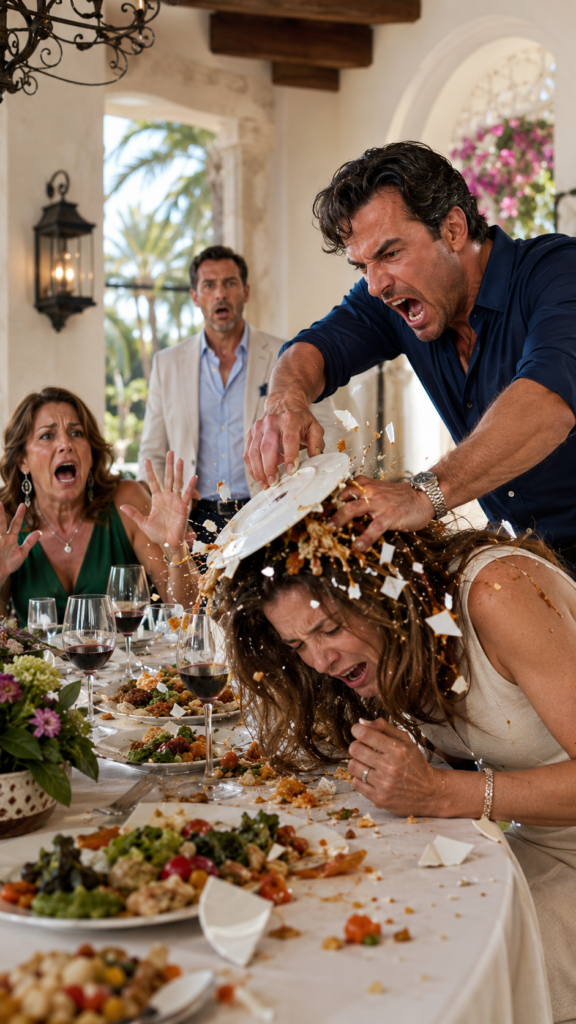
Julián took a plate full of red sauce and smashed it against Sofía’s head.
The sound of the porcelain breaking was dry, brutal.
The hot sauce splashed down her hair, neck, and beige blouse.
Then came the blood.
A red line trickled from her temple to her cheek.
The entire table froze.
No one screamed.
No one stood up.
No one said, "Julián, stop."
Doña Hortensia clutched her chest, not for Sofía, but for the scandal.
Don Ramiro looked out the window.
Beatriz whispered:
"Oh no, what a necessity."
Sofía braced herself on the table to avoid falling.
Her ear buzzed, and her vision blurred.
But she saw something with terrifying clarity.
Everyone knew Julián could do it.
That’s why no one was surprised.
Sofía took a deep breath.
She wiped the blood with a napkin.
She removed a piece of plate from her hair.
And looked at Julián, who stood panting, convinced he had put her in her place.
"You have no idea what I’m capable of," she said.
Julián let out a nervous laugh.
"Don’t start with your dramas."
Sofía pulled her phone from her bag.
The screen was smudged, but it worked.
She dialed 911.
Then the family woke up.
Doña Hortensia rushed to her.
"Sweetheart, hang up. It was an accident. They were just upset."
"It wasn’t an accident," Sofía replied. "It was violence."
Julián stepped forward.
"Hang up, Sofía."
She raised the phone.
"Take another step, and I’ll tell the operator you’re threatening me again."
The operator's voice came through on the other end.
Sofía gave the complete address.
She requested a patrol car and ambulance.
And when she said, "My husband just assaulted me in front of his family," the dining room stopped looking like an elegant home.
It looked like a crime scene.
Minutes later, the doorbell rang.
A long, loud knock, impossible to ignore.
And as everyone looked at each other in panic, Sofía understood that this night was just beginning.
PART 2
Two municipal police officers and a paramedic entered.
The house, which minutes before smelled of expensive perfume and party food, began to smell of fear.
The paramedic seated Sofía in the foyer and examined her wound.
"You need stitches," he said. "We have to take you to the hospital."
Sofía nodded, but didn’t stop talking.
One of the police officers separated Julián.
The other asked who had witnessed the blow.
Silence fell again like a dirty blanket.
Doña Hortensia was the first to pretend.
"Officer, it was a couple’s argument. My son got upset, but she provoked it too. You know how these things are."
The officer looked at her seriously.
"No, ma’am. I don’t know how 'these things' are. I see an injured woman and a broken plate."
Julián tried to approach.
"Sofía, my love, please. Don’t mess this up. We’re married."
She looked at him with the bandage on her head.
"We were also married when you broke the plate."
The officer asked if she wanted to file a report.
Doña Hortensia let out a theatrical groan.
"Sofía, you’re going to ruin his life."
Sofía replied without trembling:
"He wanted to ruin mine first."
Then she told everything.
Not just the hit.
She recounted the pressure for the apartment.
The 24 thousand pesos.
Julián's calls demanding money.
The cards he used "just for a few days" and never paid back.
The messages where he told her that if she didn’t help his mom, she shouldn’t complain about what happened next.
Sofía opened her phone and showed one.
"If you make my family look bad, don’t come crying later."
The officer read it twice.
"This is being attached," he said.
Julián lost color.
"Sofía, you’re exaggerating."
"No," she replied. "For the first time, I’m telling the whole truth."
They took her to the hospital.
She received five stitches.
They ran tests.
The doctor asked if it was the first time.
Sofía wanted to say yes.
The truth came out.
"No."
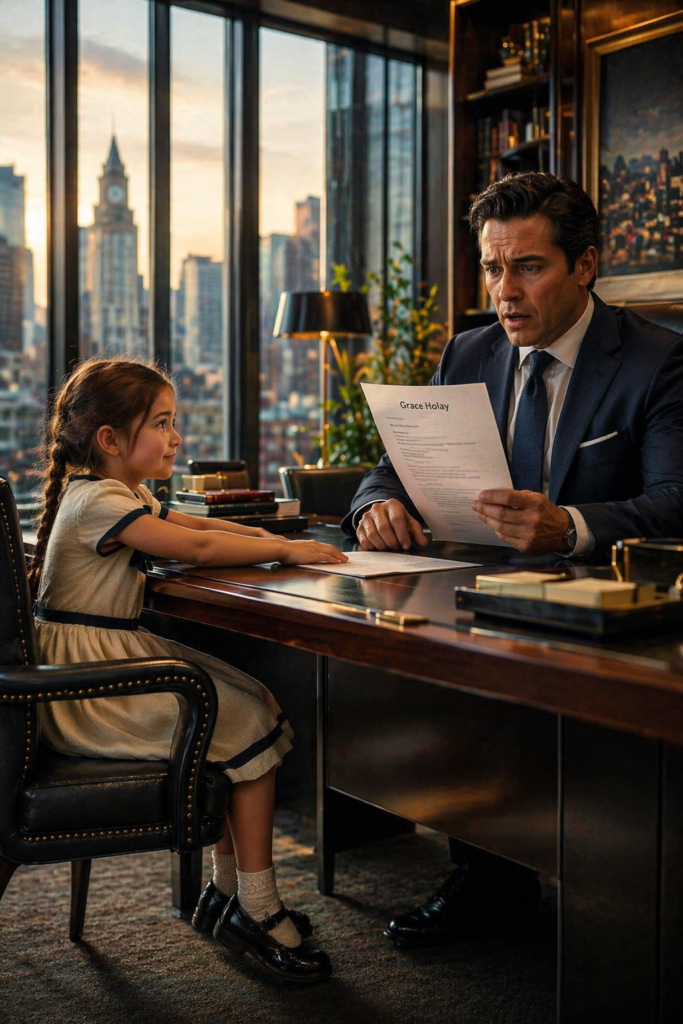
The next morning, with pain throbbing in her head, Sofía went to the office of Daniela Rivas, a lawyer who had been her classmate in college.
She brought screenshots, audio files, bank statements, photos of old bruises, and the apartment documents.
Daniela reviewed everything without interruption.
In the end, she looked up.
"Sofía, this wasn’t a moment of rage. This was a strategy."
Sofía felt cold.
"Why do you say that?"
Daniela turned the computer screen around.
In several messages, Julián talked about "securing the apartment," "convincing her before she gets smart," and "pressuring her with my mom."
"They wanted your property," Daniela said. "And if you didn’t give it out of love, they were going to try to take it from you through fear."
They requested protection measures.
Then went to Sofía’s apartment to change locks and store important papers.
Upon entering, she felt like crying.
There were her blueprints, her books, her basil plants by the window, the chipped mug she used every morning.
Her life.
It wasn’t luxury.
It was peace.
And they wanted to steal that too.
Daniela insisted on checking the building’s storage.
Among old boxes and Julián's suitcase, a black folder appeared.
Sofía didn’t remember seeing it.
Inside were copies of her deeds, appraisals of the apartment, rent calculation sheets, and a handwritten note.
The handwriting was Doña Hortensia’s.
"If Sofía gets difficult, Julián must make her feel guilty. She needs to understand that a wife doesn’t lead on her own."
Daniela put the sheet in a bag.
"This changes everything."
Sofía sat on a box.
She was short of breath.
This wasn’t a sick mother-in-law.
This wasn’t a needy family.
It was a plan to subdue her.
That same afternoon, they delivered the folder to the authorities.
But the strongest blow came two days later.
Marina, Julián’s brother’s wife, showed up at Daniela’s office wearing dark glasses and holding a USB stick tightly in her hand.
Marina had always been quiet.
At family gatherings, she barely spoke.
This time, she arrived trembling.
"I have something," she said. "But if I hand it over, the Altamirano family will destroy me."
Daniela closed the door.
Sofía stood up slowly.
"What is it?"
Marina placed the USB on the desk.
"The dinner was recorded."
Sofía felt the wound on her head sting again.
"By whom?"
"By Ramiro."
The father-in-law.
The man who had looked away while his son assaulted her.
Marina explained that Don Ramiro recorded important dinners when discussing money, inheritances, or properties.
He said this way, no one could change his version.
That night, he had placed a small camera on a bookshelf, pointing directly at the dining room.
Daniela connected the USB.
The screen showed the table.
The mole.
The glasses.
Everyone’s expressions.
Doña Hortensia’s voice was heard:
"Sofía has to understand that getting married doesn’t mean living as a single woman. What’s hers is already the family’s."
Then Don Ramiro:
"If she accepts today, tomorrow we sign with a notary."
Next, Julián, soft but clear:
"If she gets stubborn, I’ll handle her."
Sofía closed her eyes.
Marina began to cry.
The video continued.
They heard Sofía’s "no."
Julián’s insult.
The plate breaking on her head.
The silence of everyone.
And then her voice calling 911.
Daniela paused the video.
"With this, they can no longer say it was an accident."
Marina took off her glasses.
She had a yellow bruise near her cheekbone.
"I didn’t say anything that night because I’m afraid," she confessed. "But when I saw you get up with blood and call the police, I thought of my daughter. I don’t want her to grow up believing that enduring is being a good woman."
Sofía hugged her.
Not as sisters-in-law.
As two women who finally stopped feeling alone.
The following months were a war.
Julián was charged with assault and domestic violence.
They also investigated the pressure to obtain the apartment and the attempts to use Sofía’s money as a supposed 'family obligation.'
The restraining order prohibited him from approaching her, her home, and her work.
But Julián didn’t know how to lose.
He sent emails from fake accounts.
"You ruined my mom."
"All for a lousy apartment."
"No one will love you with that attitude."
Daniela saved every message.
Doña Hortensia began to tell another version.
She said Sofía was ambitious.
That she never wanted to integrate into the family.
That she exaggerated a domestic dispute to keep everything.
That the plate "slipped" during an argument.
People commented, as always.
Some said Sofía should have fixed it privately.
Others said a wife shouldn’t report her husband for "a mistake."
But Sofía was no longer there to carry others' shame.
Every lie had proof before it.
Every rumor had a document.
Every false tear from the Altamirano family clashed against the video.
At the hearing, Julián tried to appear remorseful.
He wore a white shirt.
He spoke softly.
He said he was in debt, pressured, worried about his mom.
He said Sofía provoked him.
He said he lost control "for just one second."
The judge requested to replay the recording.
The courtroom listened to everything.
Doña Hortensia planning.
Don Ramiro talking about the notary.
Julián saying he would handle her.
Then the blow.
Then the silence.
The judge didn’t need to raise her voice.
"Losing control doesn’t explain a family strategy," she said.
Doña Hortensia lowered her gaze.
Not out of guilt.
Out of public shame.
That was the only shame she understood.
When Sofía spoke, she didn’t give a pretty speech.
Her voice cracked.
Her hands were sweaty.
But she said what she needed to say.
"For a long time, I believed that protecting my marriage meant staying silent. I thought that if I endured, one day I would be respected. But that night, I understood that my silence was precisely what they needed to take everything from me."
Julián wouldn’t look at her.
Sofía continued:
"Saying no doesn’t destroy a family. What destroys a family is believing that a woman gets married to obey, pay, and give up what she built on her own."
The sentence didn’t erase the humiliation.
It didn’t take away the nightmares.
It didn’t return the nights she cried silently so the neighbors wouldn’t hear.
But it set a limit.
Julián was sentenced for assault and domestic violence.
He had to pay for damages, medical expenses, and therapy.
The restraining order remained in place.
The divorce came later, with total separation of assets.
The apartment was legally protected.
Julián received nothing.
No money.
No property.
No chance to re-enter Sofía’s life as if nothing had happened.
But the fall of the Altamirano family continued.
The investigation revealed that Julián had taken loans using Sofía’s apartment as future collateral.
Don Ramiro denied it until messages of his advising to "pressure her before she seeks a lawyer" appeared.
Doña Hortensia tried to play the victim, but her handwritten note marked her.
The elegant family began to crumble from within.
Cousins stopped visiting.
Neighbors stopped greeting the same.
Julián’s businesses sank.
And Marina, three months later, separated from Julián’s brother.
One afternoon, she called Sofía.
"I left," she said through tears. "I don’t want my daughter to learn that the peace of a home depends on how much a woman endures."
Sofía cried after hanging up.
Not out of sadness.
But relief.
Because she understood that her "no" not only saved her.
It also opened a door for someone else.
A year after that dinner, Sofía gathered people in her apartment again.
But this time, there were no luxury tablecloths or inherited glasses.
There were tacos, hibiscus water, sweet bread, and soft music.
Daniela, Marina, two work friends, and Marina’s daughter played with a puzzle in the living room.
Sofía had painted a wall olive green.
She changed the furniture.
She put new plants.
She hung a sign in front of the entrance that read:
"This house is respected."
At midnight, Marina raised her glass.
"To Sofía," she said. "Because that night she said they didn’t know what she was capable of. And they really didn’t."
Sofía smiled.
Her eyes burned.
"I didn’t know either," she replied.
And it was true.
She didn’t know she could rise with blood on her face.
She didn’t know she could call 911 while everyone tried to silence her.
She didn’t know her voice could weigh more than the last names, money, and threats of an entire family.
For years, she confused love with endurance.
But endurance was erasing her.
Loving herself was reporting.
It was changing locks.
It was keeping evidence.
It was looking the judge in the eye.
It was accepting that a quiet life is worth more than any marriage where respect depends on obedience.
Sometimes she still dreamed of the plate breaking.
But she no longer woke up feeling guilty.
She woke up in her bed.
In her apartment.
With her keys on the table.
With her blueprints open by the window.
And every time someone asked if it was worth "destroying a family" over not giving up a house, Sofía answered the same:
"I didn’t destroy a family. I escaped from a cage they called home."
Because some blows don’t just break the skin.
They also shatter the spell.
And when a woman truly awakens, there is no husband, mother-in-law, or entire family that can put her back to sleep.