PART 1
Santiago Beltrán thought that morning would be just another interview with an administrative assistant for his corporate office in Guadalajara.
He was already tired. Five rejected resumes lay on his desk, the coffee was cold, and a meeting with investors from Monterrey loomed ahead.
Then the door opened.
It wasn’t a nervous woman with a folder and a cheap blazer who walked in.
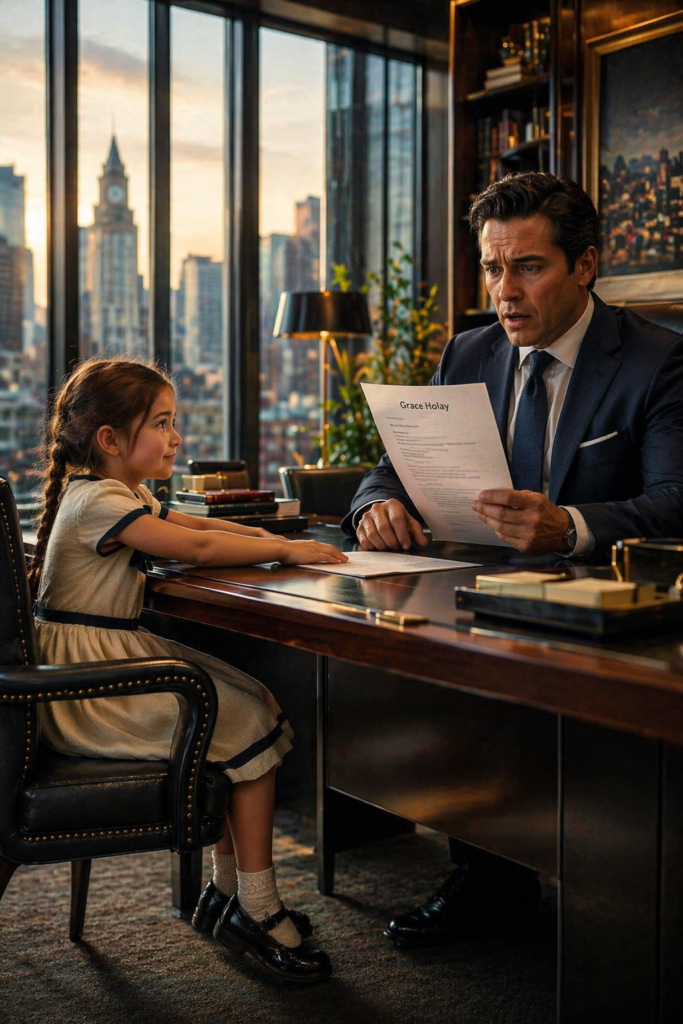
It was a five-year-old girl, her hair in crooked pigtails, wearing a worn pink sweater and old shoes that were so clean they were endearing.
The receptionist followed behind, embarrassed.
—Mr. Beltrán, I tried to stop her, but she says she’s here for an interview.
The girl walked up to the enormous desk, placed a folded folder on top, and said very seriously:
—My mom is in the hospital. I came in her place because she really needs this job.
Santiago didn’t know what to say.
At 43, he was the owner of Beltrán Investments, a company that bought land, hotels, and shopping plazas. He lived in Puerta de Hierro, had a chauffeur, discreet bodyguards, and a mother who flaunted the Beltrán name like a medal.
People said he was cold.
Elegant.
Impossible to move.
But no one knew that when he came home to his enormous house at night, the silence weighed on him more than any debt.
—What’s your name? —he asked, trying to sound calm.
—Abril —the girl replied—. My mom says she named me that because I was born when she wanted something beautiful to begin.
Santiago took the folder.
The resume was crumpled, with a juice stain in one corner. As he read the name, he felt the air leave his lungs.
Mariana Cruz Ávila.
The woman he had loved six years ago.
The girl who worked helping in his mother’s house, Doña Eugenia, in Colinas de San Javier.
Mariana had a shy smile and eyes that made him forget he belonged to a family where everything was measured in money, last names, and convenience.
For months, they loved each other in secret.
They met in the laundry room, in the garden, in the garage when everyone was asleep. They talked about leaving for Querétaro, opening a small café, and living in a house with bougainvilleas, rescued dogs, and Sunday markets.
But one afternoon, Mariana disappeared.
Her room was left empty.
Her clothes were gone.
Doña Eugenia had only said with disdain:
—That girl understood her place.
Santiago hadn’t searched for her as he should have.
Pride got the better of him.
He convinced himself that Mariana had left out of fear, for money, or because she never truly loved him.
And he turned to stone.
Until that morning.
Because before him stood Abril.
With the same eyes as Mariana.
But with Santiago’s chin.
The same raised eyebrow.
The same way of pressing her lips together when she tried not to cry.
—Is your mom alone? —he asked with a dry throat.
Abril nodded.
—In the Civil Hospital. Room 308. I memorized the number because my mom says a smart girl doesn’t get lost if she knows how to remember.
Santiago stood up abruptly.
He canceled his meetings.
He called for the car.
He took Abril’s hand and went down with her in the private elevator while his employees looked at them as if the world had turned upside down.
On the way, Abril spoke nonstop.
She told him they lived in Tonalá, in a room at the back of a tenement. That Mariana cleaned offices at dawn and sold desserts on order. That when they didn’t have enough for dinner, her mom said she had already eaten at work, but Abril knew that was a lie.
Santiago listened to every word like a slap.
While he signed million-dollar contracts, Mariana had been surviving.
While he believed she abandoned him, she was raising a girl who might be his daughter alone.
When they arrived at the hospital, Abril ran through the corridors with a sad certainty, like someone who knows that place far too well.
Mariana was in room 308, pale, thin, with oxygen and cracked hands resting on the sheet.
A doctor explained that she had severe pneumonia, severe anemia, and exhaustion. She needed to stay hospitalized, but she had no insurance.
Santiago looked at Mariana.
Then he looked at Abril.
—She’s not leaving here —he said—. Private room, specialists, medication, whatever it takes. I’ll take care of everything.
Abril hugged him around the waist.
—So my mom is going to get better?
Santiago crouched down in front of her.
—Yes, little one. She’s going to get better.
At that moment, Santiago’s phone vibrated.
It was a message from Doña Eugenia.
“I heard you found the maid. Don’t get close to that girl. You don’t know everything I did to erase them from your life.”
PART 2
Santiago read the message three times.
Not because he didn’t understand.
But because each word opened a wound he had kept closed for six years.
“Erase them from your life.”
It didn’t say “keep them away.”
It didn’t say “protect you.”
It said “erase them.”
Abril was still clinging to his leg, unaware that her life had just become evidence against a powerful family.
Santiago put his phone away.
He didn’t say anything in front of her.
He just called Patricia, his trusted assistant.
—Cancel my week. I need a family lawyer, a criminal lawyer, and someone to review old files from my mother’s house.
—Did something serious happen, sir?
Santiago looked at Abril, who was carefully adjusting Mariana’s sheet.
—Something I should have discovered six years ago.
Mariana woke up the next day.
At first, she thought she was dreaming.
She saw a private room, fresh flowers, new equipment, and Santiago sitting by the window, his shirt wrinkled and his eyes red from lack of sleep.
Then she saw Abril asleep on a chair, covered with his expensive coat.
Her face changed.
Fear.
Pain.
Shame.
—Santiago...
He moved closer slowly.
—It’s okay. Abril is fine. You’re safe.
Mariana tried to sit up.
—She shouldn’t have come. I asked a neighbor to take care of her, but she had to go to work. I couldn’t miss the interview. We didn’t have rent money.
—Abril said an opportunity shouldn’t be wasted.
Mariana closed her eyes.
A tear rolled down to her hair.
—That girl has had to be strong far too soon.
Santiago swallowed hard.
The question had been burning since he saw her in his office.
—Is she my daughter?
Mariana didn’t answer immediately.
She looked at Abril.
Then she looked back at him.
—Yes —she whispered—. Abril is your daughter.
Santiago felt something inside him break.
It wasn’t a surprise.
From the first glance, a part of him already knew.
But hearing it turned suspicion into a complete life: first steps, fevers, birthdays, drawings, fears, and hugs he never gave.
—Why didn’t you look for me? —he asked.
Mariana let out a weak laugh, devoid of joy.
—I looked for you.
He froze.
—I went to your mother’s house when I found out I was pregnant. They wouldn’t let me in. Doña Eugenia came to the gate and told me you already knew, that you were disgusted by my pregnancy and that if I came back, she would accuse me of theft.
—I never knew.
—Then I went to your office. Security kicked me out. I had a letter for you. They took it from me. They told me there was a direct order: Mariana Cruz couldn’t get close to any Beltrán.
Santiago clenched his fists.
—Mariana...
—I thought you had given that order. I thought you had used me and that was it. Then Abril was born. And when a woman has a baby in her arms, a broken heart becomes a luxury. You no longer think about claiming. You think about milk, diapers, fevers, buses, and rent.
She didn’t say it to make him feel guilty.
And that’s why it hurt more.
Santiago showed her the message from his mother.
Mariana paled.
—Don’t confront her for me. That woman has no limits.
—It’s not just for you. It’s for Abril. It’s for my daughter. And also for the coward I was for not looking for you.
Mariana turned away.
—You chose to believe the worst of me too.
The phrase hit where it hurt.
Santiago nodded.
—Yes. And I’ll carry that with me for the rest of my life.
Over the following days, Santiago completely changed his routine.
He took Abril out for soft chilaquiles for breakfast because she said she had never tried them at a restaurant. He accompanied her to Tonalá to pick up Mariana’s clothes.
They entered a humble tenement, with crossed clotheslines, old pots, and children playing with a punctured ball.
Mariana’s room was clean, though small. There was a single bed, a wobbly table, an electric stove, a Virgin of Zapopan on a shelf, and Abril’s drawings taped up.
—This is where we live —the girl said proudly—. It’s small, but my mom says that as long as it smells clean, it’s a home.
Santiago had to turn away.
In a box, he found medical prescriptions, overdue bills, rejected job applications, and an old photo.
Mariana appeared pregnant in front of a broken mirror, one hand on her belly and a tired smile.
On the back it said:
“For Abril to know she was awaited with love, even if the world closed its door on us.”
Santiago sat on the bed.
And cried.
Abril approached, worried.
—Does something hurt?
He shook his head.
—I hurt for having arrived late.
The girl put a hand on his shoulder.
—My mom says late still counts if you arrive for real.
That phrase stuck with him.
When Mariana improved, Santiago asked for permission to do a paternity test.
He didn’t impose it on her.
He didn’t treat her like a suspect.
—I already know how I feel —he said—. But I want to protect Abril legally. I want no one to be able to deny her what she deserves.
Mariana agreed.
The result arrived three days later.
99.99%.
Abril Beltrán Cruz was Santiago Beltrán’s daughter.
But the hardest blow came afterward.
Patricia managed to speak with a former driver of Doña Eugenia. The man, sick and tired, handed over a USB drive.
It contained audios, receipts, and emails.
Doña Eugenia had paid 80,000 pesos to get Mariana out of Guadalajara. She also sent her name to various employment agencies with a warning: “Do not hire, problematic, steals family information.”
Additionally, she had blocked three calls from Mariana to Santiago’s old cell phone.
And kept the letter Mariana left at the office.
Santiago read that letter in silence.
Mariana told him she was pregnant, that she didn’t want money, that she only needed to look into his eyes and know if he would be with her.
The letter ended with a line that shattered his soul:
“Don’t let me believe that our child was a mistake if you ever told me it was your dream.”
Santiago didn’t go to scream at his mother’s house.
He went with two lawyers.
Doña Eugenia received him in her marble-floored living room, wearing a pearl necklace and holding a cup of coffee.
—So the girl showed up again —she said, as if talking about a plague.
Santiago laid the folder on the table.
—Abril is my daughter.
Doña Eugenia wasn’t surprised.
That was the worst part.
—I imagined it from the beginning.
—Then you knew.
—Of course I knew. That’s why I acted quickly.
Santiago felt nauseous.
—You separated a pregnant woman from me. You let my daughter grow up in poverty.
Doña Eugenia slammed the table.
—I saved your life. That woman was an employee. You were a Beltrán. What did you want? To marry someone who cleaned bathrooms?
—I wanted to decide my life.
—You weren’t old enough to understand.
—I was old enough to be a father.
She let out a dry laugh.
—A child with that kind of woman would have destroyed you.
Santiago stepped forward.
—Don’t ever speak of Mariana like that again.
—I’m sure she’s already asked you for a house, money, and a name.
—She asked for nothing. That’s the difference between her and you. Mariana survived without selling her dignity. You sold yours to control a life that wasn’t yours.
For the first time, Doña Eugenia lost color in her face.
The lawyer explained that they had evidence of threats, manipulation, emotional damage, and direct harm to a minor. If she tried to approach Mariana or Abril without authorization, they would initiate legal actions.
—Are you going to sue your own mother? —she asked.
Santiago didn’t raise his voice.
—I’m going to protect my daughter from anyone. Even from you.
—I did everything for love.
—No. You did it out of shame.
The word fell like a stone.
Doña Eugenia didn’t cry.
Her pride wouldn’t allow it.
But Santiago saw, for the first time, a powerful woman reduced to something small: a mother who confused control with love.
When Mariana left the hospital, Santiago didn’t take her to a mansion or try to buy her forgiveness.
He rented a simple house in Tlaquepaque, near a plaza, with bougainvilleas at the entrance and a large window through which light entered.
—It’s in your name for a year —he explained—. No conditions. You can stay with Abril while you recover. I will respond as a father, but you set the boundaries.
Mariana looked at him for a long time.
—I don’t want charity, Santiago.
—It’s not charity. It’s reparation. And also responsibility.
—There are things that can’t be paid for.
—I know.
—And there are absences that can’t be erased.
He lowered his head.
—I know that too.
Abril ran to the room that had a new bed, a shelf with books, and a flowered quilt.
—Mom, there’s a window to see the sky!
Mariana covered her mouth to keep from crying.
It wasn’t the house that hurt her.
It was thinking of all the nights Abril looked at a damp ceiling while, on the other side of the city, a father existed who didn’t know she was breathing.
Weeks went by slowly.
Santiago learned that Abril hated onion but pretended to eat it so as not to waste.
That Mariana saved ten-peso coins in a jar for emergencies.
That a girl could fall asleep in the back seat with a popsicle in hand and make a millionaire drive slower, as if carrying the entire world.
At first, Abril called him “Mr. Santiago.”
Then “Santi.”
Later, one afternoon in the plaza, while he tied her shoelaces, she asked:
—Can I call you dad or not yet?
Santiago froze.
Mariana stopped breathing for a second.
He knelt in front of Abril.
—You can call me dad from the day you were born. I was the one who arrived late.
The girl hugged him tightly.
—Then, dad, will you buy me a lemon snow cone?
Santiago laughed while crying.
—Of course, my love.
Mariana watched them in silence.
She didn’t know if she would ever love Santiago like before.
But she did know that Abril had just regained a part of her story.
And that was already justice.
Months later, Mariana finished her treatment. She regained strength and decided to study administration online because poverty had paused her life but hadn’t canceled it.
Santiago created a program in his company for single mothers and women looking for work after years of invisible jobs.
When Mariana was ready, she accepted to lead it.
On the day of the presentation, several businessmen murmured.
One said softly:
—Well, the girl played her cards well.
Mariana heard him.
She took the microphone and looked directly at him.
—I didn’t play any cards well. Doors were closed on me, I raised a child alone, cleaned offices with a fever, and sent my five-year-old daughter to defend an opportunity that was denied to me. If that seems like luck to you, I hope you never have to face so much.
No one murmured again.
Doña Eugenia requested to meet Abril eight months later.
The meeting was in a public park, with Santiago and Mariana present.
Doña Eugenia arrived without large jewels, holding a doll wrapped in lilac paper.
Abril looked at her with curiosity.
—Are you the lady who made my mom cry?
The silence was brutal.
Doña Eugenia swallowed hard.
—Yes.
—And did you also make my dad not know about me?
—Yes.
Abril squeezed Mariana’s hand.
—That was really mean.
Doña Eugenia looked down.
—It was unforgivable.
—My mom says that saying sorry doesn’t fix everything.
—Your mom is right.
Abril thought for a few seconds.
—You can sit down. But don’t hug me yet. And if you talk bad about my mom, you’re leaving.
Doña Eugenia agreed.
It wasn’t forgiveness.
It was an opportunity with conditions.
And sometimes that’s more just than a pretty reconciliation for the photo.
One year after that morning, Santiago had Mariana's crumpled resume framed.
He hung it in his main office.
It had a juice stain, a torn corner, and a small drawing from Abril: three people holding hands under a huge sun.
Every time a partner asked why he had that old paper next to million-dollar contracts, Santiago would reply:
—Because this paper gave me back the only thing my pride almost made me lose forever.
Mariana never pretended that everything was healed.
One night, after putting Abril to sleep, she sat with Santiago in the kitchen.
—You should have looked for me —she said.
—Yes.
—You should have believed in me.
—Yes.
—And I should have insisted more. But I was alone, pregnant, and scared.
Santiago took her hand, without squeezing it.
—I don’t know if love can return the same after so much damage —she said.
—It doesn’t have to return the same. Perhaps it can return more humbly.
Mariana didn’t promise anything.
But she didn’t let go of his hand either.
From the room, a sleepy voice was heard:
—Dad?
Santiago got up instantly.
—I’m coming, little one.
Mariana watched him walk toward the room.
And understood something.
Being a father wasn’t showing up on a paternity test.
It wasn’t paying hospitals.
It wasn’t renting houses.
Being a father was hearing a little voice at night and getting up without thinking.
Years later, many would tell the story as if it were a viral tale: a poor girl who entered an elegant office with her mother’s resume and came out with a millionaire dad.
But the truth was much stronger.
It was the story of a humble woman who was tried to be erased and still raised a brave daughter.
It was the story of a man who confused pride with dignity and lost six years that would never return.
It was the story of a rich mother who discovered too late that controlling isn’t loving.
And above all, it was the story of a girl who believed so much in her mom that she stepped into a massive elevator, placed a crumpled folder in front of a stranger, and forced all the adults to face the truth.
Because sometimes justice doesn’t come with cameras or speeches.
Sometimes it comes with two crooked pigtails, old shoes, and a small voice saying:
—My mom is in the hospital. I came in her place.