PART 1
The silver spoon fell onto the plate, ringing out like a funeral bell.
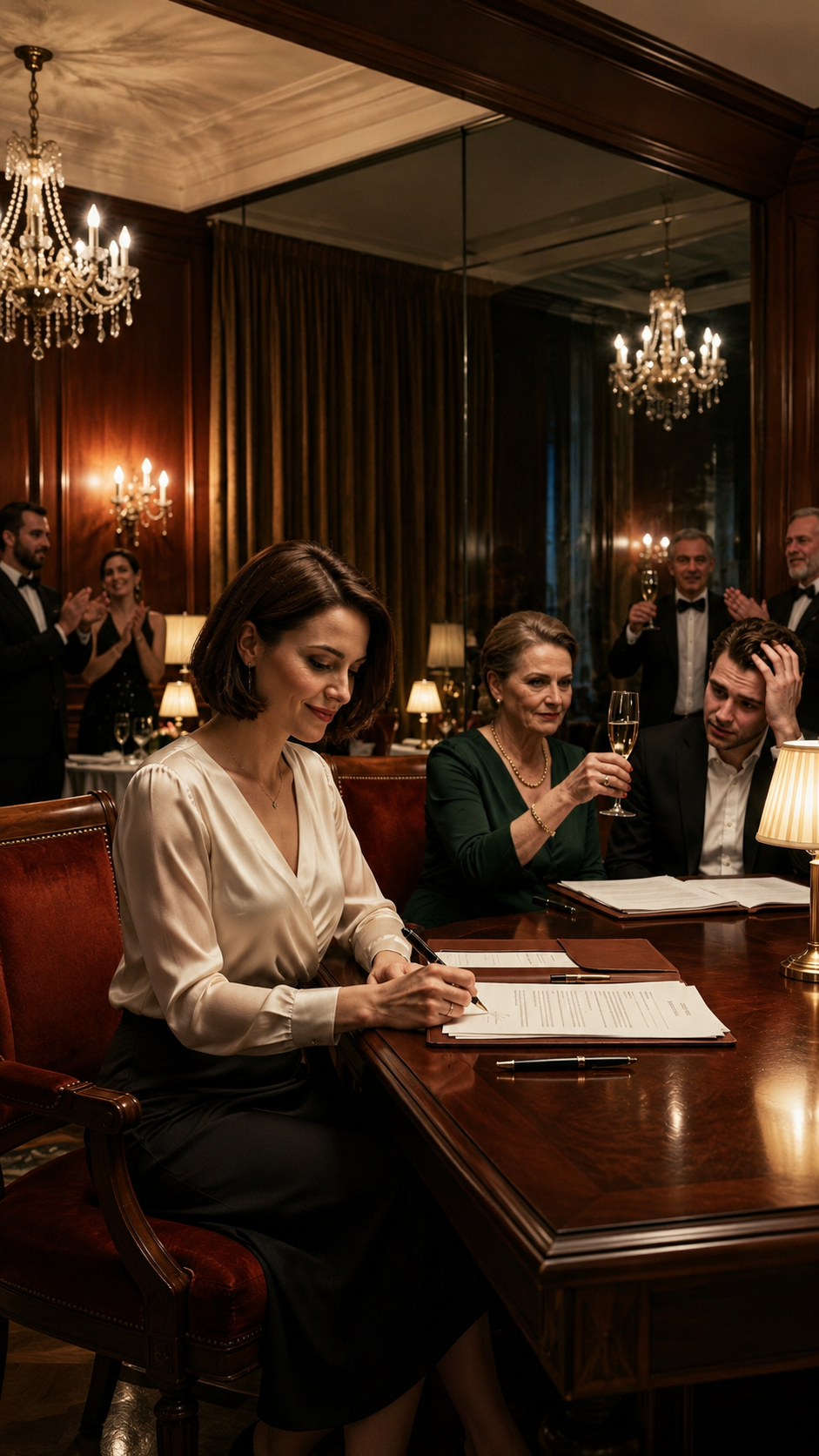
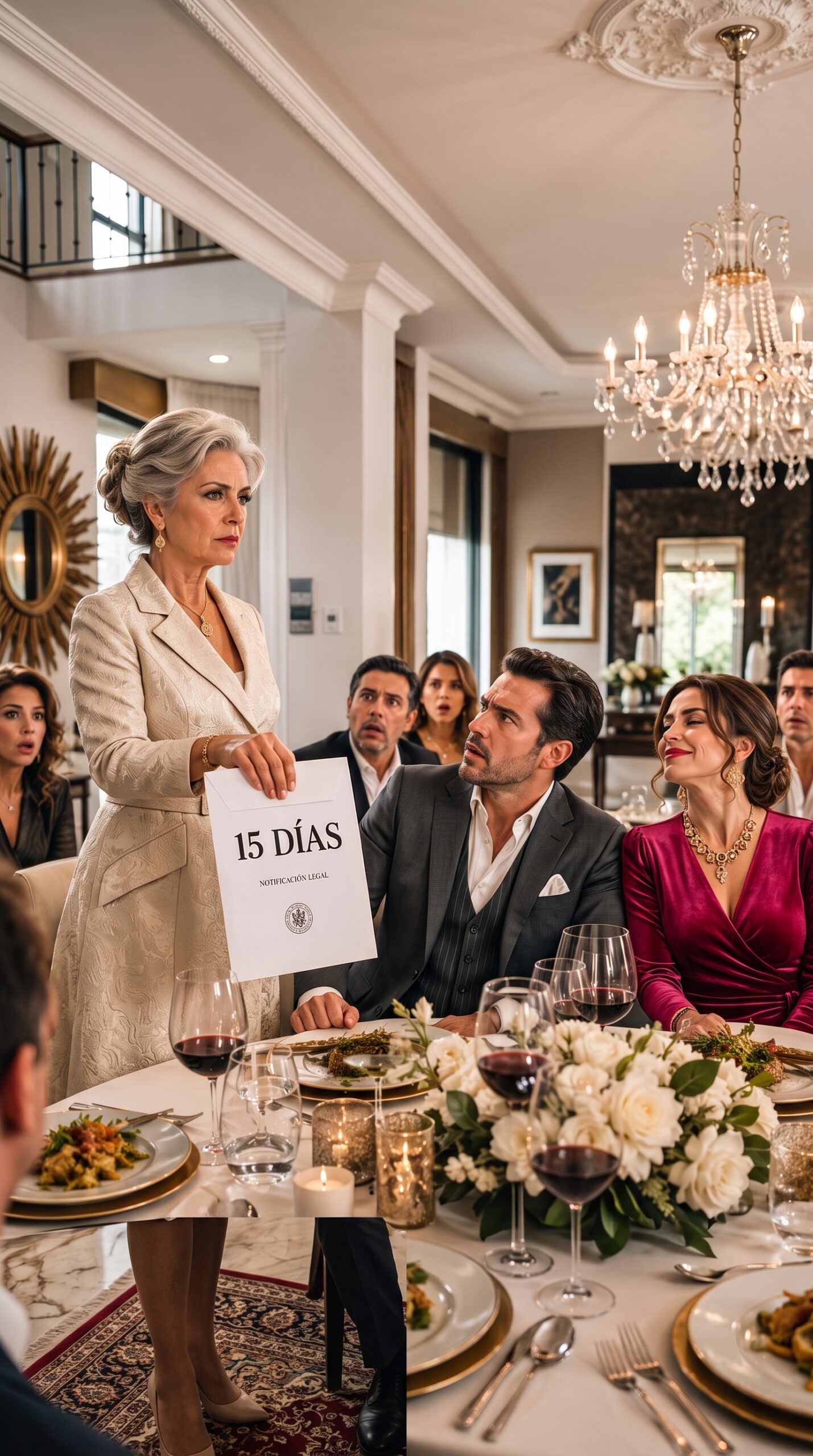
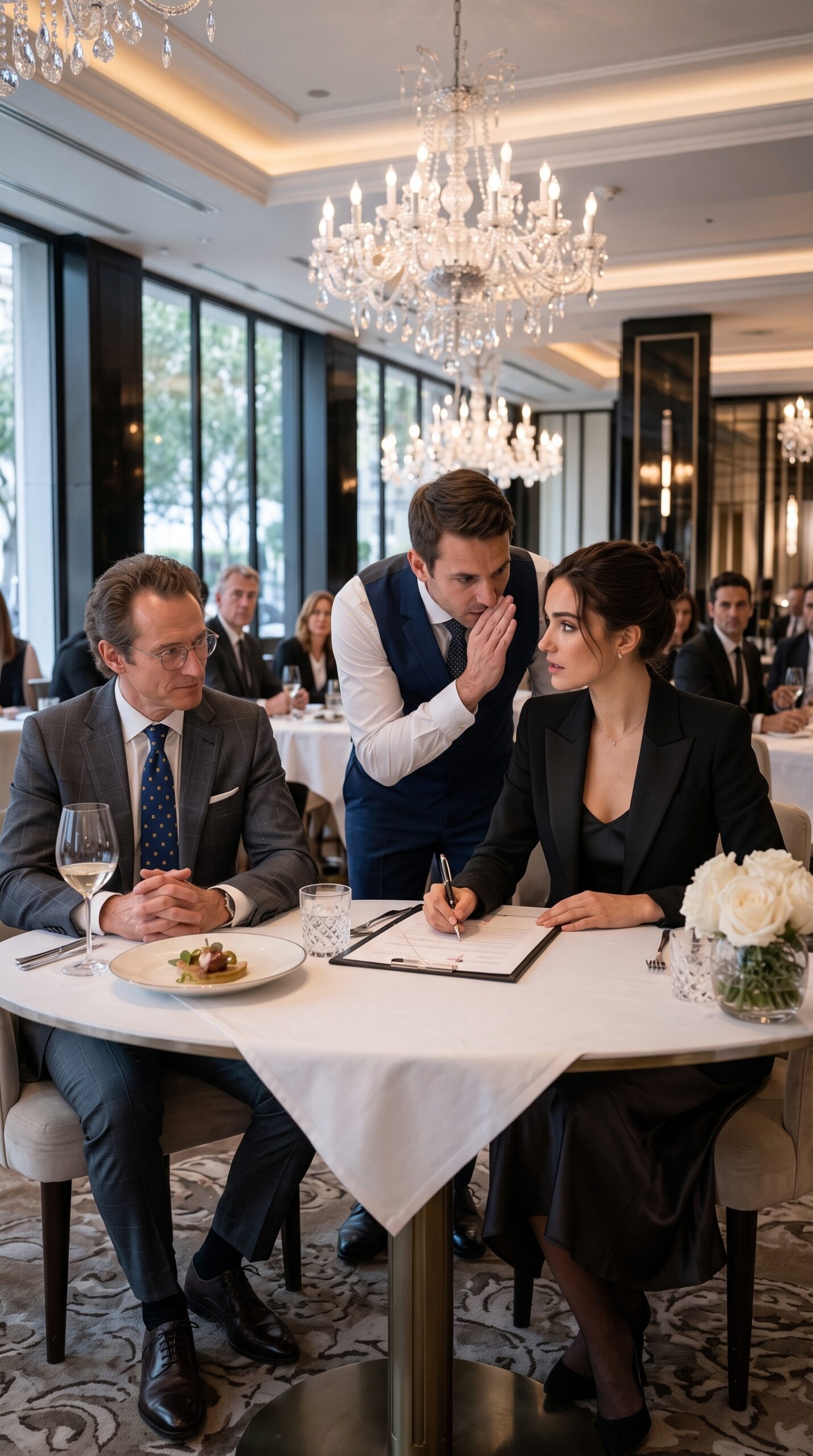
In the private room of a luxury restaurant in Lomas de Chapultepec, no one touched the food again. The waiters stood frozen, the service captain stopped breathing, and a Mexican businessman gripped his napkin so tightly it nearly tore.
At the head of the table was Étienne Valdés, a Franco-Mexican investor who had returned to the country to launch a massive social project: decent jobs, mobile clinics, daycares, and scholarships for communities in Hidalgo, Puebla, and Oaxaca.
The table was supposed to finalize a historic agreement.
But in less than an hour, everything had devolved into a dispute.
The community representatives looked offended. The lawyers murmured. Étienne’s gaze was cold, disappointed, as if he had just confirmed the worst of everyone.
To his right sat Bruno Salvatierra, his official interpreter, dressed in a gray suit, an expensive watch, and a calm smile of a man who believed he had everything under control.
Near the door, with a pitcher of mineral water and six cups of coffee, stood Julián Cruz, a 36-year-old waiter, widower, and father to an eight-year-old girl named Renata.
Julián had no business being there.
He had no shares, no illustrious last name, no credentials hanging from his neck.
Just a black uniform, worn-out shoes, and a tuition debt that kept him awake at night.
But he also had something that no one at that table imagined.
He understood French.
He had learned it years ago while studying International Relations at UNAM, before his wife’s illness forced him to drop out, take double shifts, and trade books for trays.
For 45 minutes, Julián listened as Bruno failed to translate.
He twisted.
He poisoned.
When Étienne said he wanted fair wages, Bruno said he demanded low labor costs.
When a leader from Sierra Norte asked for guarantees to prevent families from being displaced, Bruno translated it as wanting extra money to avoid blocking projects.
When environmental review was mentioned, Bruno twisted it into a threat to cancel the project because, according to him, Mexicans were unreliable.
Julián felt his throat tighten.
He thought of Renata, perhaps asleep on the couch of doña Maru, their neighbor. He thought of his wife Clara, dead three years ago, telling him in the hospital:
—Don’t teach our daughter to stay silent when something is wrong.
Julián lowered his gaze.
The captain gestured for him to leave.
But just then, Bruno translated another lie.
—Mr. Valdés believes these communities are not ready to manage resources without strict oversight.
The leader stood up, outraged.
—That’s disrespectful!
Étienne frowned, confused.
Julián took a step forward.
—Excuse me, Mr. Valdés… but that’s not what you said.
Every head in the room turned.
Bruno let out a dry chuckle.
—Now the waiter translates too?
The captain turned pale.
—Julián, leave immediately.
But Étienne raised his hand.
—No. Let him speak.
Julián felt his legs turn to jelly, but he could no longer retreat.
—You said you wanted community oversight to ensure the money arrived intact. He translated that you didn’t trust them.
The room went cold.
—And before —Julián continued— when you offered scholarships for workers’ children, he omitted that part entirely. He also changed the daycare proposal for a productivity clause.
A lawyer checked her notes.
—That explains why the documents didn’t match the meeting.
Bruno stood up, red with fury.
—This employee is making things up to draw attention. He doesn’t understand the professional nuances.
Étienne pulled out his phone.
—Then let’s call someone who does understand.
He requested an independent interpreter via video call from Paris. They repeated five key phrases. The woman translated accurately.
And the truth fell on the table like a tombstone.
Julián was right.
Bruno had manipulated every word.
Étienne looked at him with terrible calm.
—Who paid you?
Bruno tried to put away his phone.
But two bodyguards shut the door.
—The phone stays where it is —Étienne ordered.
At that moment, the screen lit up with a notification.
Everyone read it.
“Break the agreement today. And if the waiter opens his mouth, remember his daughter at school.”
PART 2
Julián felt the air leave his body.
The private room, the businessmen, the millions of the project, and the crystal glasses ceased to exist for him.
He saw only one image.
Renata in her blue uniform, her uneven braids, and her purple backpack with a star keychain.
—What does that mean? —Étienne asked, his voice so low it was more frightening than a scream.
Bruno swallowed hard.
—I don’t know. Some sick joke.
—Jokes don’t mention waiters’ daughters —said the leader from Oaxaca.
Another message appeared on the screen.
“There’s someone outside the building. Don’t let that guy ruin the Barranca deal.”
Julián dropped the pitcher.
The water spilled onto the beige carpet.
—My daughter is with a neighbor —he said, barely able to speak—. She’s at Portales.
Étienne turned to his bodyguards.
—Go. Now. Call the police and inform my lawyers.
Julián wanted to run to the door, but Étienne held him by the arm.
—you’re not going alone.
—She’s my little girl.
—That’s exactly why.
The captain, who minutes earlier wanted to throw him out as if he were a nuisance, lowered his gaze filled with shame.
—Julián, I didn’t know...
But Julián didn’t even look at him.
In less than seven minutes, they exited through the suppliers' entrance. Outside, the city continued as if nothing had happened: expensive cars, elegant lights, couples laughing on the sidewalk.
For Julián, every traffic light felt like torture.
He called doña Maru fourteen times.
Nothing.
He called the landline of the apartment.
Nothing.
He called again.
And when someone finally answered, he heard the neighbor’s trembling voice.
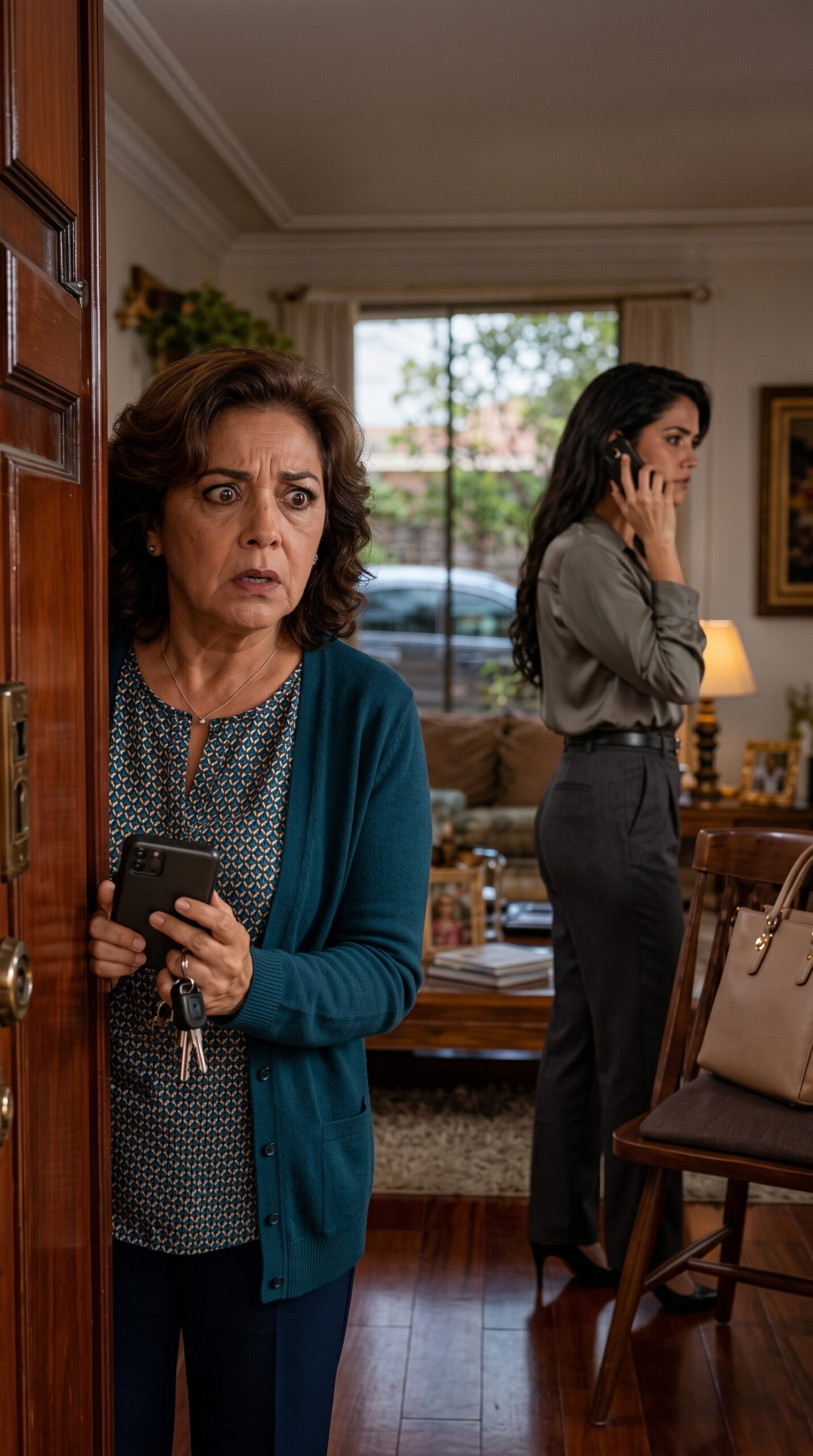
—Son, don’t go up alone. There are patrols downstairs. Renata is with me.
Julián nearly fell apart.
—Is she alright?
—Yes, but a man came. He said you’d had an accident and he had to take the girl to the hospital.
Julián closed his eyes in rage.
—You didn’t let him in, did you?
—Not a chance, son. I found him suspicious. He was wearing a black jacket and didn’t even know your full name.
When they arrived at the building, Renata was sitting on the sidewalk, wrapped in a blanket, hugging doña Maru. There was a kick mark on the door next to the lock.
—Dad!
The girl ran toward him crying.
Julián knelt and hugged her so tightly it felt like he wanted to pull her inside his chest.
—Did he do anything to you? Did he touch you?
—No —she sobbed—. Doña Maru yelled out the window, and the man left when he heard the siren.
Étienne watched silently.
There, under the yellow light of the hallway, he no longer seemed like a foreign magnate. He seemed like a man who had just realized that a poorly translated signature could put an invisible gun to a poor family’s head.
The police took statements.
The bodyguards checked the street.
Renata didn’t let go of her dad’s hand for a second.
—Did you get into trouble? —the girl asked.
Julián stroked her hair.
—I told the truth.
—And that’s why they came for me?
Julián didn’t know how to answer.
Doña Maru, her eyes red with anger, murmured:
—Damn world, where telling the truth costs more than lying.
That night, Étienne paid for a secure hotel for Julián, Renata, and doña Maru. He also arranged for private security while the prosecution opened an investigation.
Before dawn, the name Grupo Barranca began appearing in calls, deposits, and messages on Bruno’s phone.
It was a powerful construction company that had been trying to enter the same communities as the project for months. Their plan was simple and dirty: sabotage the social agreement, provoke anger among everyone, and then offer quick contracts, without scholarships, without clinics, without daycares, and with miserable wages.
Bruno was not only betraying Étienne.
He was helping to rob the future from thousands of families.
The news exploded the next day.
A security video from the restaurant leaked online. Julián was seen standing by the door, pale with fear, gripping the tray before speaking.
Bruno was seen mocking him.
The captain was seen trying to silence him.
And then it was heard clearly:
—Excuse me, Mr. Valdés… but that’s not what you said.
Within hours, half of Mexico shared the video.
Some called him a hero.
Others asked why a man who spoke French, English, and Spanish was still serving coffee.
Many wrote the same thing:
“How many qualified people are hidden behind a uniform?”
But virality did not protect him from fear.
Julián didn’t want interviews. He didn’t want cameras. He didn’t want Renata to appear anywhere.
—I didn’t do this to become famous —he told Étienne—. I did it because I couldn’t swallow the lie anymore.
Bruno was arrested two days later at the Toluca airport, with false documents and a ticket to Guatemala.
At first, he denied everything.
He said the waiter misunderstood him. That the messages were out of context. That the interpretation was “a subjective task.”
But when the prosecution showed him the deposits, the audios, the restaurant footage, and the photo of the man who went to Julián’s building, he broke down.
He confessed.
Grupo Barranca had promised him 4,000,000 pesos if he managed to make Étienne publicly sever ties with the community representatives.
The goal was to make him look classist and racist, while painting the communities as greedy and conflictive.
Then, Grupo Barranca would come with another “easier” project, without social clauses and with bought leaders.
But the worst was yet to come.
In a notebook found in Bruno’s apartment, there was a list of restaurant employees.
Next to Julián’s name it read:
“Speaks French. Daughter: Renata Cruz. School: morning shift.”
When Julián read it, he felt nauseous.
It was no coincidence that they threatened him.
They had investigated him beforehand.
His silence had already been planned.
His fear already had an address.
And that hurt him more than any insult.
For several days, Julián thought about quitting, changing cities, and hiding. Doña Maru told him to do whatever it took for the girl. Renata asked him if they could go home again.
Étienne didn’t pressure him.
He only offered legal help, security, and a conversation.
—The project will be rebuilt from scratch —he told him—. With certified translators, public reading of documents, and representatives from each community. I want you to be there.
Julián let out a bitter laugh.
—Sir, I’m just a waiter.
—No. You were the only one who understood what was really happening.
—I don’t have a degree.
—You have judgment. And that, believe me, cannot be bought.
Julián looked at Renata, who was coloring at the hotel table.
—I can’t risk putting her in danger again.
Étienne nodded.
—Then come with her. With protection. And with authority. No one will treat you as mere decoration again.
The new meeting was held a week later in a public auditorium in the Benito Juárez borough.
This time there were no closed rooms, no expensive glasses, no whispered phrases.
There were official cameras, certified interpreters, labor lawyers, community observers, and families seated in the back.
Julián arrived wearing a borrowed jacket that hung loosely on his shoulders. He sat at the back, nervous, with Renata and doña Maru nearby.
At first, he didn’t speak.
Then he heard a clause about worker transportation and raised his hand.
—Excuse me. That part could leave out those living in remote communities. If it’s not clarified, someone could charge them for transportation tomorrow.
Everyone turned to look.
A lawyer checked the document.
—You’re right.
Then he corrected a translation about daycares.
Next, he explained, in simple words, an environmental clause that no one had managed to understand well.
The leader from Oaxaca smiled.
—This kid doesn’t speak elegantly. He speaks clearly. That serves us more.
Julián lowered his gaze, moved.
For two months, the project was rebuilt point by point. Salaries above the local minimum were included, scholarships for workers' children, safe transportation, independent environmental review, monthly mobile clinics, and daycare centers near workplaces.
Each document was read aloud.
Each translation was reviewed by three people.
And one of Julián’s phrases was written as an internal rule:
“Small print hides big abuses.”
The restaurant had to issue a public apology to him. The captain sought him out one afternoon, his eyes weary.
—I wanted to silence you because I thought about the reputation of the place, not about the truth. Honestly, I was ashamed.
Julián listened without arrogance.
—I was also afraid to speak.
—Will you forgive me?
Julián took a few seconds.
—Yes. But don’t ever believe that a uniform is worth less than a suit.
The captain hung his head.
Soon after, Étienne offered him a formal position as a linguistic and community liaison for the project in Mexico. Good salary, benefits, insurance, stable hours, and support to finish the degree he had left pending.
Julián read the contract four times.
Not out of distrust.
Because life had taught him that a piece of paper could be a bridge or a trap.
—I have one year left to finish at UNAM —he admitted.
Étienne smiled.
—Then finish it.
Julián cried silently that night, in the hotel bathroom, so Renata wouldn’t see him fall apart.
But she heard him anyway.
She tiptoed in and hugged him around the waist.
—You’re not going to come home so tired anymore?
The question broke him.
Because he understood that his daughter wasn’t asking for toys, trips, or expensive clothes.
She was asking for a dad who still had the strength to have dinner with her.
Months later, the first community center opened in the Sierra Norte of Puebla. There were classrooms, a clinic, a dining room, workshops, and a small library with new tables.
Entire families arrived early. Women in shawls, restless children, young people looking for work, and men with hats watching everything with both distrust and hope.
Étienne took the stage, spoke about the project, and then asked Julián to step forward.
Julián shook his head.
Renata gave him a little push.
—Go, Dad. You told the truth.
Julián climbed up with sweaty hands.
In front of hundreds of people, he felt once again like he was back in that room, tray in hand, with all eyes on him.
But this time he was not alone.
—I’m not a hero —he said into the microphone—. I’m a dad who was scared.
The crowd fell silent.
—I was scared of losing my job, of not paying rent, of my daughter being left without school. I thought telling the truth was a luxury for those who could lose something without ending up on the street.
He took a deep breath.
—But staying silent costs too. Maybe I kept my job, but my daughter would learn that lies win when one is in need.
Renata began to cry in the front row.
Julián continued:
—Sometimes we think that only those with money, last names, or suits change the world. But those who serve coffee and listen to a lie also change it. So does the one who, even though scared, dares to say: this isn’t right.
The applause started softly.
Then it grew.
Then it became enormous.
At the entrance of the center, a simple plaque was placed.
It read:
“For those who told the truth when silence seemed safer.”
Renata read it slowly.
—Dad, it’s for you.
Julián stroked her braids.
—It’s for everyone who has been afraid and still did what was right.
The girl looked up at the sky.
—Mom would be proud.
Julián closed his eyes.
For the first time in three years, thinking of Clara didn’t hurt like an open wound. It hurt like a root.
—Yes, shorty —he whispered—. I believe she would.
Bruno lost his career, his freedom, and his mask of a refined man. Grupo Barranca faced investigations for threats, fraud, and corruption. Several officials who protected their contracts fell afterward.
Julián finished his degree a year later.
Étienne appointed him as the community liaison director for Mexico.
Renata received a scholarship, her own room, and something more important: a dad who came home before dinner got cold.
But Julián never threw away his waiter uniform.
He kept it clean, folded, in a box in the closet.
Not out of nostalgia for poverty.
Not out of shame.
But to remember the exact day he understood that dignity does not depend on the position, salary, or suit.
It depends on what a person decides to do when the truth needs a voice.
And every time Renata asked him why he kept that black shirt, Julián would respond the same:
—Because that day I learned, daughter, that even a waiter with a tray can change the future of many families if he dares to speak.