PART 1
Elena Cruz arrived at the mansion in Bosques de las Lomas with her eyes blindfolded, her heart racing, and one thought consuming her mind: the 200,000 pesos could keep her son alive.
Mateo was 8 years old and had a respiratory illness that turned every cold dawn into a threat. For months, Elena had fallen behind on rent, breaking her back between clandestine consultations and counting inhalers like they were gold coins.
Once, she had been a respected physical therapist.
After the divorce, the debts, and her ex-husband’s disappearance, she ended up treating injured construction workers, retired boxers, and men who came through the back door without giving names.
Everyone said the same thing about her.
She had hands that could find what machines couldn’t see.
That’s why Gabriel Ríos showed up that rainy night at her small clinic in the Doctores neighborhood. He closed the door, laid a thick envelope on the examination table, and spoke plainly.
—One session. 200,000 pesos.
Elena refused.
Then Gabriel mentioned Mateo’s name, the brand of his medication, and the pharmacy where she had bought the last inhaler.
It wasn’t a threat.
It was worse: a demonstration that they already knew everything.
Minutes later, Elena was inside a black SUV, counting turns to avoid losing her orientation. When the blindfold was removed, she saw a huge, silent residence, watched over by armed men.
In a room next to a fireplace, Sebastián Salgado awaited her.
In Mexico City, almost no one spoke his name aloud. At 42, he controlled unions, construction companies, underground casinos, and political favors from a titanium chair made to order.
He didn’t need to yell.
People obeyed before he finished a sentence.
He had been paralyzed at 22, when a truck exploded outside a restaurant in Polanco. His father died instantly. Sebastián was found among glass, metal, and smoke.
The best doctors in Mexico and the United States repeated the same diagnosis for 20 years.
He would never walk again.
Sebastián observed Elena’s worn uniform and smiled with disdain.
—Let’s see, doctor. Do you bring crystals, miracle ointments, or a speech about positive energy?
—I bring hands —she replied—. And you bring too much fear disguised as sarcasm.
Gabriel lowered his gaze. No one spoke that way in front of Sebastián.
Elena began with his back, then his hip and left leg. She found hardened muscles, deep scars, and minimal nerve response where there shouldn’t be any.
Sebastián felt no pain.
But he did feel pressure.
That was enough to disturb her.
—Who did your last full evaluation?
—My doctor for the past 20 years.
—Well, someone stopped searching too soon.
The atmosphere shifted.
Elena held his left foot, pressed beneath the ankle, and slid two fingers toward an area covered by an old scar.
The big toe moved.
It was just a tremor.
But Gabriel saw it.
Sebastián did too.
Everyone froze.
Elena repeated the maneuver.
The toe moved again.
Sebastián looked at his foot as if it belonged to another man.
—What the hell did you do?
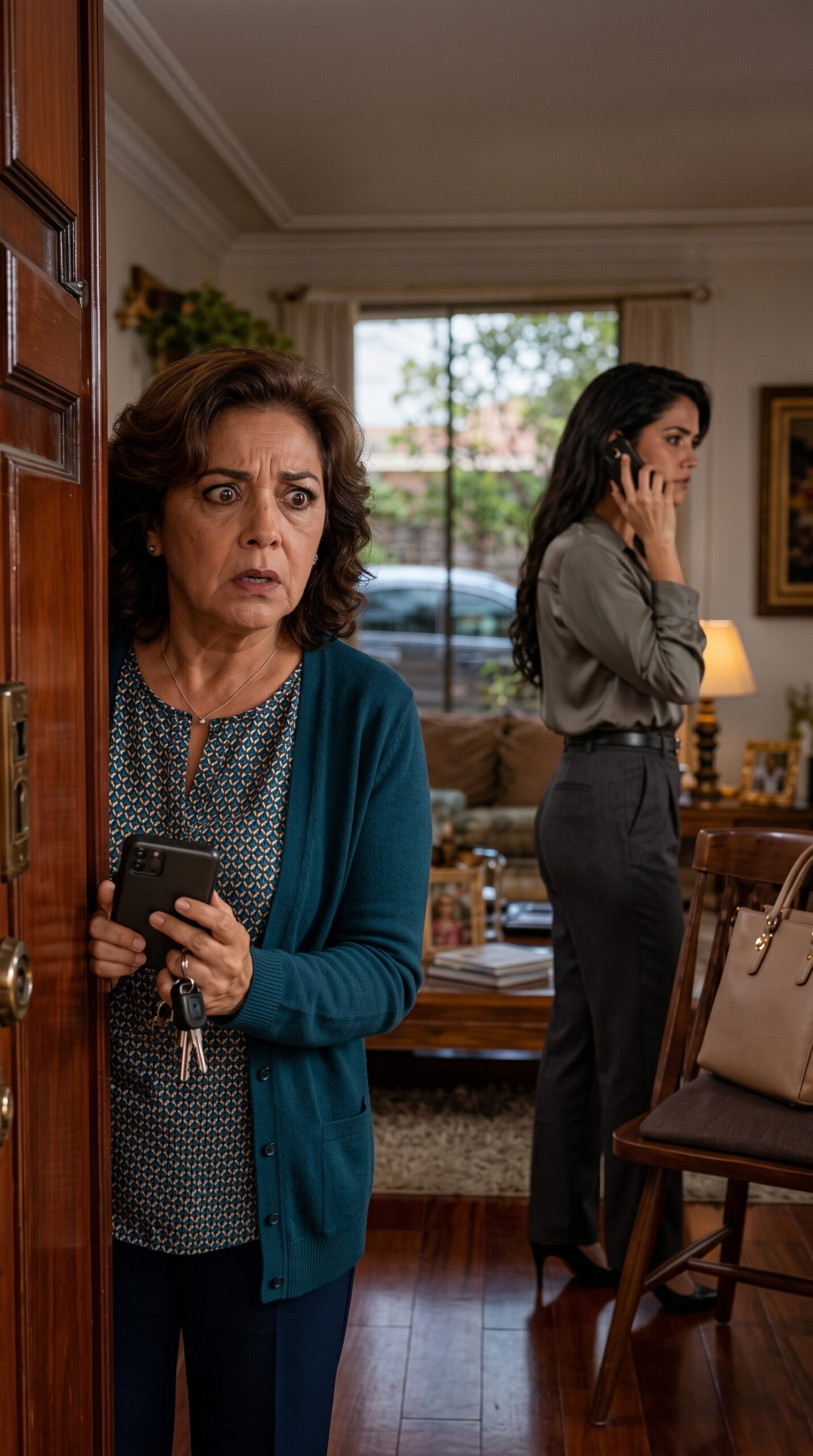
Before Elena could answer, her phone vibrated inside her bag.
It was a message from an unknown number.
“STOP TREATING HIM. ASK ABOUT MATEO’S FATHER.”
Elena raised her eyes, pale.
And when Gabriel read the message, Sebastián’s most loyal man recoiled as if he had just seen a corpse.
PART 2
Sebastián ordered the mansion closed.
No one would enter. No one would leave.
Elena demanded to know what Daniel Cruz, her ex-husband, had to do with a paralyzed crime lord and a family that had buried secrets for decades.
Gabriel took too long to answer.
That was enough.
Daniel had worked in medical logistics for a company called Project Nemesis, a private network that moved patients, files, and experimental treatments between clinics shielded by criminal money.
Elena remembered that name.
Daniel had mentioned it during a fight, just before disappearing. He told her she would never understand what Nemesis was trying to do.
At that moment, Elena thought it was just another one of his lies.
Now, she was no longer sure of anything.
Gabriel traced the message. The signal had come from a guesthouse within the same property.
There lived Armando Salgado, Sebastián’s uncle and the family administrator since the attack.
Sebastián turned his wheelchair toward the door.
Elena stepped in front.
—You’re not going out furious.
The silence became heavy.
—Step aside —he said.
—No. Whoever sent that message wants you to react without thinking. Seriously, if you’ve been controlling half the city for 20 years, you can control 5 more minutes.
Gabriel held his breath.
Sebastián looked at her with a mix of rage and surprise. No one told him no. Much less a woman who had come for money.
Yet, he stopped.
They reviewed the medical files stored in the room. Elena found a transfer authorization signed by a specialist named Lucio Beltrán.
The document was dated three weeks after the attack.
It indicated that Sebastián retained partial nerve activity and was a candidate for an experimental recovery protocol.
But the transfer had never occurred.
At that moment, another guard reported that Armando was trying to leave through the south door accompanied by Dr. Rivera, Sebastián’s personal physician.
The automatic security blocked the vehicle inside the old greenhouse on the property.
Sebastián, Elena, and Gabriel arrived under a freezing rain.
Armando awaited them near a fountain, impeccable in his dark coat. Rivera clutched a briefcase to his chest.
—So she was the one who moved your foot —said Armando.
Sebastián didn’t blink.
—Did you cancel my treatment?
Armando fell silent.
Rivera began to cry.
The truth came out in pieces.
After the explosion, Lucio Beltrán found signs that the spinal cord was not completely destroyed. The damage was severe, but there was a real possibility of regaining movement with surgery, stimulation, and immediate rehabilitation.
Armando canceled the transfer.
He bribed doctors.
He altered studies.
He paid for definitive diagnoses.
—I kept you alive —he said, convinced of his own justice—. An heir recovering would have sparked a war. In a chair, you were untouchable. You inspired pity at first and fear later.
Sebastián let out a dry laugh.
—you turned me into a prisoner and called it protection.
—I made you a king.
—No. You taught me obedience and named it love.
The blow wasn’t physical, but Armando lowered his gaze.
Gabriel asked about Lucio Beltrán.
Armando confessed that Lucio had tried to get Sebastián out of the country with all the files. Weeks later, he died in a supposed car accident in Querétaro.
No one believed it had been an accident.
Sebastián could have ordered them killed right then.
Everyone expected that.
But something had changed.
He asked for a federal prosecutor, his lawyer, and two journalists with automatic copies of the files to be called.
Armando looked horrified.
—Are you going to turn in your own blood?
—My blood robbed me of 20 years.
At that moment, Elena’s phone rang.
Unknown number.
A male voice pronounced her name.
She gasped.
—Daniel?
There was a shattered silence.
—Yes.
Elena felt seven years of rage explode in her chest. Daniel wasn’t dead nor had he run off with another woman. He lived under federal protection.
He had copied files from Nemesis and testified against doctors, businessmen, and officials. They had forbidden him from contacting his family because they could use Mateo to find him.
—You let him believe you didn’t want him —said Elena, crying with fury.
—I know. And there’s no explanation that can give those years back.
Daniel revealed something worse.
Mateo’s illness wasn’t exactly what he had been diagnosed with. Nemesis had detected a hereditary immune marker and hid the result because the child could relate several cases manipulated by the network.
There was treatment.
Difficult, costly, and slow.
But it existed.
Elena doubled over the fountain, crying as she hadn’t allowed herself to cry in years.
For all that time, she had been fighting against a medical sentence that was also a lie.
Daniel explained that Lucio left a sealed file inside the mansion. It contained Sebastián’s original studies and Mateo’s genetic report.
—It’s where Sebastián’s mother grew roses in winter.
Everyone looked toward the far end of the greenhouse.
Under a broken glass roof, a garden of white roses thrived.
Gabriel found a compartment behind a planter. Inside was a metal box with X-rays, recordings, files, and a letter written by Isabel, Sebastián’s mother.
Sebastián read in silence.
His mother warned him that someone might try to decide his life for him. She asked him to trust Lucio and Gabriel, reminding him that stillness was not the same as defeat.
She also wrote that he was not born to inherit his father’s darkness.
He was born to end it.
Sebastián did not cry.
But he placed a hand over his mother’s signature, and all the hardness in his face shattered.
Gabriel then revealed another secret: Lucio had raised him after his mother’s death. Isabel treated him like family, but Armando kept him apart for not carrying the Salgado surname.
Still, Gabriel returned after the attack to protect the child of the only woman who had ever made him feel part of a home.
The sirens arrived before dawn.
Armando and Rivera were arrested. The Nemesis files sparked a national investigation for medical corruption, money laundering, and disappearance of evidence.
Sebastián surprised everyone.
He cooperated.
He turned over companies used to buy silence, freed men trapped by debts, and placed part of his fortune under judicial supervision.
The city said Elena had changed him.
She knew that wasn’t true.
The truth had opened a door.
Sebastián decided to cross it.
Mateo was evaluated by specialists in Monterrey. They confirmed he could improve with specific treatment. The first time a doctor said, “your son can recover,” Elena went out into the hallway and cried against a wall.
Daniel returned slowly.
There was no movie-style hug.
There were supervised calls, therapy, awkward questions, and a child who didn’t know whether to call him “dad” or Daniel.
Elena didn’t forgive him immediately.
Mateo didn’t either.
But Daniel stayed.
And staying, day after day, was the first honest form of repair.
Sebastián began rehabilitation three times a week.
He hated the exercises, the applause, and any motivational phrases.
—Lift your knee —Elena ordered.
—I’m lifting it.
—You’re looking at it with hatred.
—Sometimes fear works.
—Your knee isn’t afraid.
Mateo, sitting nearby with his inhaler, laughed heartily.
Months later, Sebastián managed to stand between parallel bars. He wore splints under his pants, and the chair remained behind him.
It wasn’t a miracle.
It was pain, discipline, and an opportunity he should have received 20 years earlier.
The day he took his first step, Mateo asked:
—Does that count as walking?
Sebastián breathed heavily.
—Counts as me fighting with the floor.
—And did you win?
Sebastián looked at Elena, then at Gabriel, and finally at the garden.
—For the first time, I think I did.
In spring, the old greenhouse became the Isabel Beltrán Foundation, dedicated to rejected, misdiagnosed, or financially struggling patients.
At the entrance, they placed a phrase suggested by Mateo:
“No one has the right to decide that your story is over.”
During the inauguration, Sebastián found one last photograph inside Lucio’s file.
In it was Isabel next to another young nurse.
Elena recognized her own grandmother.
It was she who helped hide the files and, years later, guided Daniel to find the first evidence.
Elena then understood why her grandmother always had that special way of touching an injury, of listening to a body, and of insisting when a doctor said there was nothing left to do.
The hands that awakened Sebastián’s foot hadn’t appeared out of nowhere.
They were part of a promise that two brave women had buried for decades.
A desperate mother walked into a mansion seeking money to save her child.
A feared man awaited another disappointment.
Neither knew they would end up saving each other in different ways.
And as Sebastián took another awkward step toward the roses, Elena walked beside him without holding him.
Just close enough to remind him that standing up doesn’t always mean doing it alone.