PART 1
—Don’t sign, son… that man has already taken my life once.
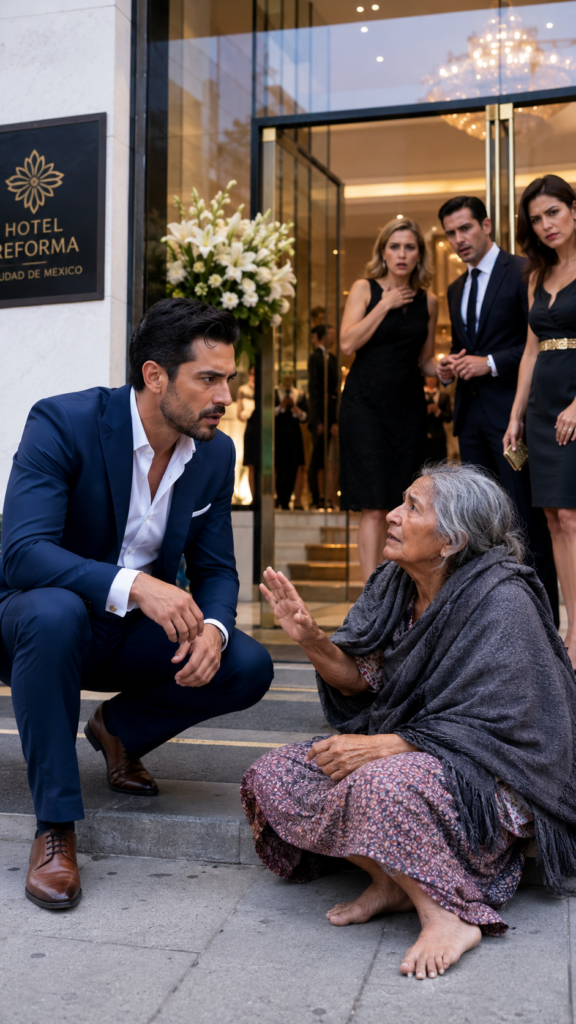
The words came from a hunched woman by the entrance of the Hotel Imperial Reforma, in the heart of Mexico City. She wore a gray shawl, her swollen feet stuffed into broken sandals, and her face was etched with years of hardship.
People passed by without a glance.
A guard gestured for her to leave. A lady in an expensive dress covered her nose. A businessman let out a mocking laugh, commenting that at million-dollar events, someone always appeared wanting pity.
But Sebastián Rivas stood frozen.
At 39 years old, dressed in a black suit, a fine watch on his wrist, and the weary gaze of a man who had spent half his life obeying his father. Today, he was set to sign the sale of Rivas Construction, the family business that built luxury towers, plazas, and subdivisions in Monterrey, Querétaro, and the capital.
Inside the hotel, investors, lawyers, press cameras, and his father, Octavio Rivas, awaited him, ready to close a deal worth over 800 million pesos.
—Mr. Sebastián —whispered Bruno, his assistant—, 6 minutes left.
Sebastián didn’t respond.
The old woman watched him as if she knew him before he could walk.
—Don’t go in, dear —she repeated—. He isn’t selling a company. He’s burying evidence.
The guard yanked her arm.
—Get out of here, ma'am. Don’t cause trouble.
Sebastián stepped forward.
—Let her go.
The guard froze.
The woman raised her hand to shield her face, and the sleeve of her sweater slipped down to her elbow. Then Sebastián saw an old gold bracelet, with a nearly erased Virgin of Guadalupe.
Next to the bracelet was a curved scar, like a crescent moon.
The air left his chest.
That mark belonged to his mother.
Lucía Salvatierra, the woman who, according to Octavio, had died when Sebastián was 14 in an accident on the way to Cuernavaca. The woman in the photo on the family altar. The woman he had cried for in front of a closed urn.
—It can’t be… —he murmured.
The old woman lifted her face.
Beneath the dirt, wrinkles, and fear, those green eyes were still there, the ones that had watched over him as a child with fever. Those same eyes Octavio forbade him to mention again.
—Sebas… —she said, her voice broken.
Bruno covered his mouth.
The mocking chatter fell silent.
Sebastián knelt on the pavement, not caring about dirtying his pants.
—Mom?
The woman tried to touch his cheek but hesitated, as if afraid he would reject her.
—Your father locked me away. He erased me. He told me that if I came back for you, he would make you disappear too.
Sebastián felt the whole city dimming around him.
Inside the hotel, his father was toasting.
Outside, the truth stood barefoot.
—Bruno —Sebastián said, with a calm that felt frightening—. Take her to a private room. A doctor, a notary, and no one touches her.
—And the signature?
Sebastián looked at the golden doors of the hall.
—Let it begin.
His mother gripped his wrist.
—You don’t know what he’s capable of.
Sebastián took off his jacket and covered her.
—I do know. I’ve been investigating for 2 years.
Lucía paled.
—Then you also know about Tomás.
Sebastián turned his head.
—Tomás?
She glanced at the hotel’s head of security, a gray-haired man who had just hidden behind a column.
—He drove the truck the night they made me disappear.
And when Sebastián saw Tomás running toward the back door, he understood he wasn’t entering a contract.
He was entering the place where his own blood awaited him with the final trap.
PART 2
Sebastián entered the hall 18 minutes late.
Everything was arranged to appear victorious. There were white tablecloths, expensive flowers, champagne glasses, and a huge screen with the Rivas Construction logo gleaming over the main table. The foreign investors smiled. The lawyers organized folders. The reporters prepared their cameras.
At the center stood Octavio Rivas.
He was 68 years old, with silver hair, a navy blue suit, and that smile of a man who never apologized because he always bought silence first.
—Finally, my son has arrived —he said, raising his glass—. Apologies. Sebastián inherited that flair for drama from his mother when we’re all just trying to work.
Some chuckled nervously.
Sebastián walked to his seat.
—There was someone outside.
Octavio didn’t even blink.
—There are always people outside. That’s why some enter through the front door and others stay begging for coins.
The statement hit like a stone.
In a room on the 12th floor, Lucía Salvatierra listened intently from Bruno’s cellphone. A doctor checked her blood pressure. A notary public took notes. And below, in an unmarked truck, prosecutor Daniela Mier received a file with documents Sebastián had gathered over 2 years.
It wasn’t a coincidence.
For months, Sebastián suspected his father’s company was rotten. He had found properties bought for peanuts after threats, evictions disguised as trials, payments to municipal officials, and accounts opened in the names of dead employees.
But he never imagined that the first victim had been his own mother.
Octavio pushed a pen toward him.
—Sign. After today you’ll be free. Clean money, comfortable life, and no tough decisions. Just what you’ve always wanted.
Sebastián took the pen.
—First, I want to talk about mom.
The hall froze.
Octavio set his glass on the table.
—Your mother died 25 years ago.
—Did you see her dead?
A lawyer cleared his throat.
Octavio smiled without joy.
—Be careful, son. There are questions that can make the family look bad.
—The family looked bad when you buried an empty urn.
No one breathed.
Octavio leaned toward him.
—You don’t know what you’re talking about.
—Then explain it to me.
—Your mother was sick. She was unstable. She got involved in company matters, cried for families she didn’t even know, and threatened to destroy everything I had built.
The pen on the table had a micro-camera.
Sebastián’s watch transmitted audio.
Bruno’s cellphone sent a live signal to the prosecutor’s office.
Octavio, believing he still controlled his son, continued speaking.
—There are women who don’t understand that a surname weighs more than their tantrums.
Sebastián clenched his jaw.
—Is that why you made her disappear?
Octavio laughed uproariously.
—Don’t be ridiculous.
At that moment, Sebastián’s cellphone vibrated.
Message from Bruno: “Tomás is detained in the kitchen. He recognized her. He wants to talk.”
Sebastián looked up toward the side entrance.
Tomás Cárdenas, Octavio’s former driver, was pale between two plainclothes agents. For years, that man had been the “witness” of the accident where Lucía supposedly died. He had said he found the burned car on the road and couldn’t do anything.
Octavio saw him too.
His face changed slightly, but Sebastián noticed.
—Tomás —ordered Octavio—. Take my son to the private room. It seems he needs to remember who’s in charge here.
Tomás didn’t move.
—No, Mr. Octavio.
The silence was brutal.
Octavio narrowed his eyes.
—What did you say?
Tomás lowered his head.
—I’m not going to lie anymore.
The investors looked at each other. The press began recording more boldly. One of the lawyers at the table closed her folder, as if suddenly wanting to vanish.
Sebastián stood up.
—Go ahead, Tomás. Say it here.
The man swallowed hard.
—Mrs. Lucía didn’t die in any accident. That night, I took her from the house in Lomas Verdes. She was sedated. Mr. Octavio told me it was for her own good, that they would take her to a private clinic because she was crazy.
Lucía, from the 12th floor, shut her eyes.
Tomás continued.
—Then they forced me to sign the accident report. They burned an empty car. They paid me off. Then they threatened my children. They told me that if I spoke, I would lose them.
Octavio slammed his hand on the table.
—Liar!
Tomás cried openly.
—I was cowardly. But you were a monster.
Prosecutor Daniela Mier entered the hall with four agents and a search warrant. She didn’t shout. She didn’t put on a show. She simply laid a folder in front of Octavio.
—Mr. Rivas, we have statements, transfers, altered documents, false medical records, and the location of a property in Tepoztlán registered under a phantom company.
Octavio smiled, but he no longer seemed confident.
—You have no idea who you’re messing with.
—Yes, we do —replied the prosecutor—. That’s why we came with cameras.
The main screen turned off.
Then, a recording appeared.
Octavio’s voice filled the hall:
“There are women who don’t understand that a surname weighs more than their tantrums.”
Then another phrase, captured minutes before:
“Your mother was sick. She got involved in company matters.”
Sebastián felt nausea.
It was not just a financial crime. It was a life stolen. It was his childhood turned into a lie. It was every birthday in front of a photo. Every Christmas with an empty chair. Every time he asked about his mother, and Octavio replied that men don’t cry for the dead.
Then the side door opened.
Bruno appeared, holding Lucía.
The woman walked slowly, wrapped in her son’s jacket. Her gray hair was barely combed with her fingers. Her hands trembled. The old bracelet sparkled under the hall lights.
Everyone stood up.
Octavio stepped back.
—You…
Lucía looked him straight in the eye.
—Yes, Octavio. I’m alive. Despite you.
Octavio’s face hardened.
—This woman is not my wife. She’s an impostor. My wife is dead.
The notary approached with a folder.
—Mr. Rivas, a preliminary fingerprint match has already been verified with official documents prior to her supposed death. Additionally, the lady has dental records, family photographs, and a scar documented in a medical file from 1998.
Lucía raised her wrist.
—You made me believe my son hated me. You showed me magazines where you appeared with him at events, and you said: “Look how happy he is without you.”
Sebastián covered his mouth.
—I searched for you, mom.
She looked at him, her voice breaking.
—I know now, dear.
—He told me that talking about you made me weak.
—He told me that you no longer asked.
Octavio lost his patience.
—Because if I let them be together, they would destroy everything!
The room went cold.
That phrase was worse than any document.
The prosecutor looked up.
—Destroy what, Mr. Rivas?
Octavio breathed heavily.
—She wanted to report operations she didn’t even understand. She wanted to hand over deeds, payments, names of officials. Do you know how many families eat off this company? Do you know what it costs to build an empire in this country?
Lucía stepped forward.
—It was not an empire. It was a cemetery for poor people.
Sebastián had never heard his mother speak like that. Broken, yes. Tired, yes. But not defeated.
The screen displayed photos of the property in Tepoztlán. A bedroom locked from the outside. Receipts for medications in a false name. Letters kept in a box.
Sebastián recognized his teenage handwriting.
—What is that?
The prosecutor replied:
—Letters you wrote to your mother after her supposed death. They were never sent. They were kept in the property.
Lucía clutched her hands to her chest.
—Did you write to me?
Sebastián nodded, crying.
—For years. Even when they told me it was stupid to write to a dead person.
Lucía could take no more.
She crossed the hall and embraced her son with the clumsy strength of someone who hadn’t held without fear in 25 years. Sebastián folded over her as if he were 14 again. He didn’t care about the cameras, nor the partners, nor the lawyers. He cried with an old pain, one that leaves the body like glass.
Octavio watched them with contempt.
—What a cheap scene.
Sebastián slowly pulled away.
—Don’t ever speak again.
—I am your father.
—A father doesn’t lock away the mother of his child.
Octavio lowered his voice.
—I did it all for you.
—No. You did it for yourself, for your ego, and for your fear that a woman could have more value than you.
The prosecutor signaled.
Two agents approached.
—Octavio Rivas, you are under arrest for abduction by individuals, illegal deprivation of liberty, forgery of documents, fraud, operations with illicit funds, threats, and obstruction of justice.
Octavio stood up violently.
—You can’t touch me! I have ministers, judges, governors!
—You also have open microphones —said the prosecutor.
Reporters crowded around.
The partners who had been toasting with him moments before began to distance themselves. No one wanted to defend him. No one wanted to be near the man who had just confessed before half of Mexico’s business community.
Octavio glared at Sebastián with hatred.
—Without me, you’re nobody.
Sebastián held his mother’s bracelet.
—Without you, I finally know who I am.
The agents took him away amidst flashes.
Lucía stood until the doors closed. Then her legs gave way. Sebastián caught her before she fell.
—Mom.
—I’m here —she whispered—. This time, I’m really here.
In the following months, the Rivas case exploded across all news outlets.
The property was raided. They found photographs of Lucía taken over the years, expired medications, locks, false medical records, and a list of people paid to keep quiet. They also discovered over 60 files of evicted families with altered documents.
The sale of the construction company was canceled.
The accounts were frozen.
Several municipal officials fell alongside Octavio. Some businessmen tried to claim ignorance, but the contracts had signatures, stamps, and dates. The truth was, nobody believed them.
Lucía spent weeks in the hospital. Not just for her body, but for her memory. Sometimes she woke up screaming. Sometimes she hid food under her pillow. Sometimes she apologized to Sebastián for not having come back sooner.
He always responded the same:
—You survived. That was already too much.
At the first hearing, Octavio arrived impeccably dressed, as if an expensive suit could cover 25 years of horror. He looked at Lucía without remorse.
She testified standing up.
She recounted the night she found papers about stolen land. She told how Octavio slammed her against a glass table, leaving the crescent-shaped scar. She recounted the truck, the property, the years of confinement, and the day they abandoned her near a terminal because keeping her alive was becoming too costly.
When she finished, she raised her wrist.
—This mark was what my son recognized in me. For years I thought it was a shame. Today I understand it was my proof of life.
Sebastián couldn’t look away.
Later, the company changed its name. Many said Sebastián did it for image. Others claimed it was guilt disguised as justice. He didn’t care.
With the files submitted to the prosecutor’s office, he started a legal program to return homes and land to deceived families. The first delivery was in Iztapalapa, to a widow who had lost her property due to a forged signature.
Lucía went with him.
She didn’t speak in front of cameras. She just walked through the small house, touched a freshly painted wall, and said:
—This really feels like home.
Sebastián smiled sadly.
—There’s still a long way to go.
She squeezed his hand.
—Then don’t tire yourself. But don’t become him either.
That phrase stuck with him.
Years later, whenever Sebastián entered a hotel, an office, or a luxury tower, he did something he had never done before: he looked first at those who were outside.
Those no one saw.
Those who got in the way.
Those the world called crazy, beggars, or problems.
Because one afternoon, in front of a hotel full of millions, a barefoot woman lifted her wrist and showed him that the truth doesn’t always come through the front door.
Sometimes it waits on the sidewalk, trembling, until someone finally decides to look.