PART 1
—Elias, sorry to intrude, but every afternoon I hear a girl screaming inside your house.
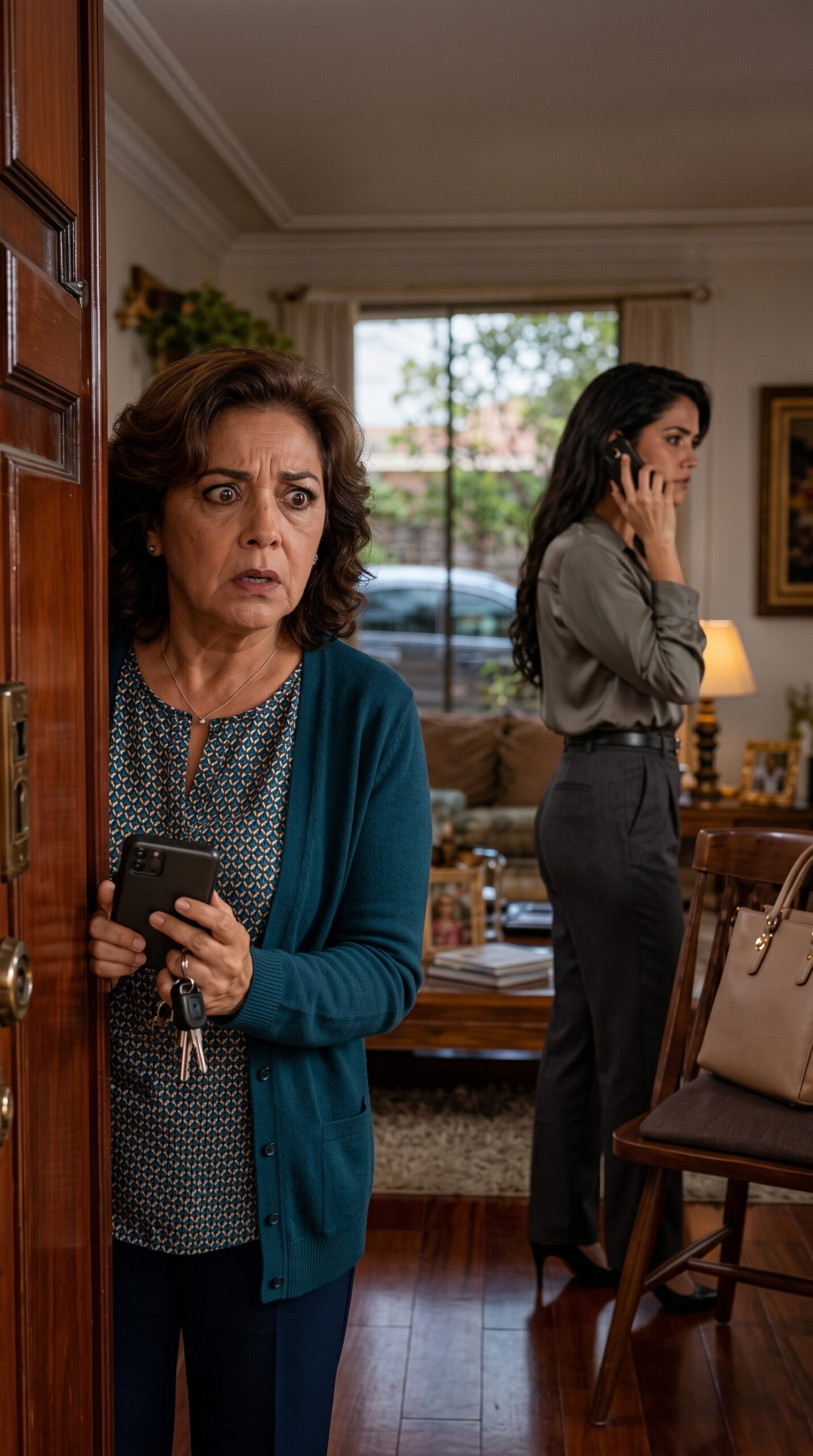
Elias Mendoza stood frozen next to the metal gate, keys still in hand, boots caked with cement.
It was nearly 8 PM in a neighborhood of Nezahualcóyotl, and he was exhausted from a job in Santa Fe.
The last thing he wanted was to listen to gossip from Doña Chabela, the neighbor who always knew who arrived late, who owed electricity, and who fought in the street.
—You must be mistaken, Doña Chabela —he replied, forcing a weary smile—. At that hour, there’s no one at my house.
The woman didn’t lower her gaze.
—Then you don’t know what’s happening inside your own house, son.
That phrase sank like a dagger into his heart.
Elias was 43, and for a long time, he believed that being a good father meant paying rent, stocking the fridge, and bringing home money every two weeks.
His wife, Rebeca, worked at a dental clinic in Roma.
His daughter, Josefina, was 15 and lately seemed to live behind a locked door.
She barely ate.
She answered in short phrases.
She no longer sang while doing her hair or laughed at silly videos on her phone.
Elias told himself it was just her age, that high school changed everyone, that girls got weird.
That night, he told Rebeca what the neighbor had said.
She set her bag down on the couch and let out a dry laugh.
—Oh, please, Elias. That woman is alone. She invents dramas to feel important.
He wanted to believe her.
It was easier.
But two days later, Doña Chabela was waiting for him again by the gate.
—Today she screamed louder —she said, her face pale—. She was saying: “Please, let me go.” Don’t tell me you didn’t check, because something is definitely wrong.
That night, Elias went up to Josefina’s room.
She was sitting on the bed, headphones on, staring blankly at her phone.
—Everything okay, sweetheart?
—Yeah, Dad. Everything’s normal.
“Normal.”
The word sounded false.
The next day, Elias pretended to leave for work.
He made coffee, put on his jacket, kissed Rebeca on the forehead, and left with his backpack.
Josefina came out later, dressed in her school uniform and carrying her backpack.
Rebeca left twenty minutes after.
Elias drove a few blocks, parked, and walked back.
He entered through the back door, trying to be quiet.
The house was silent.
He checked the living room, the kitchen, the hallway, and the bedrooms.
Nothing.
He felt ridiculous.
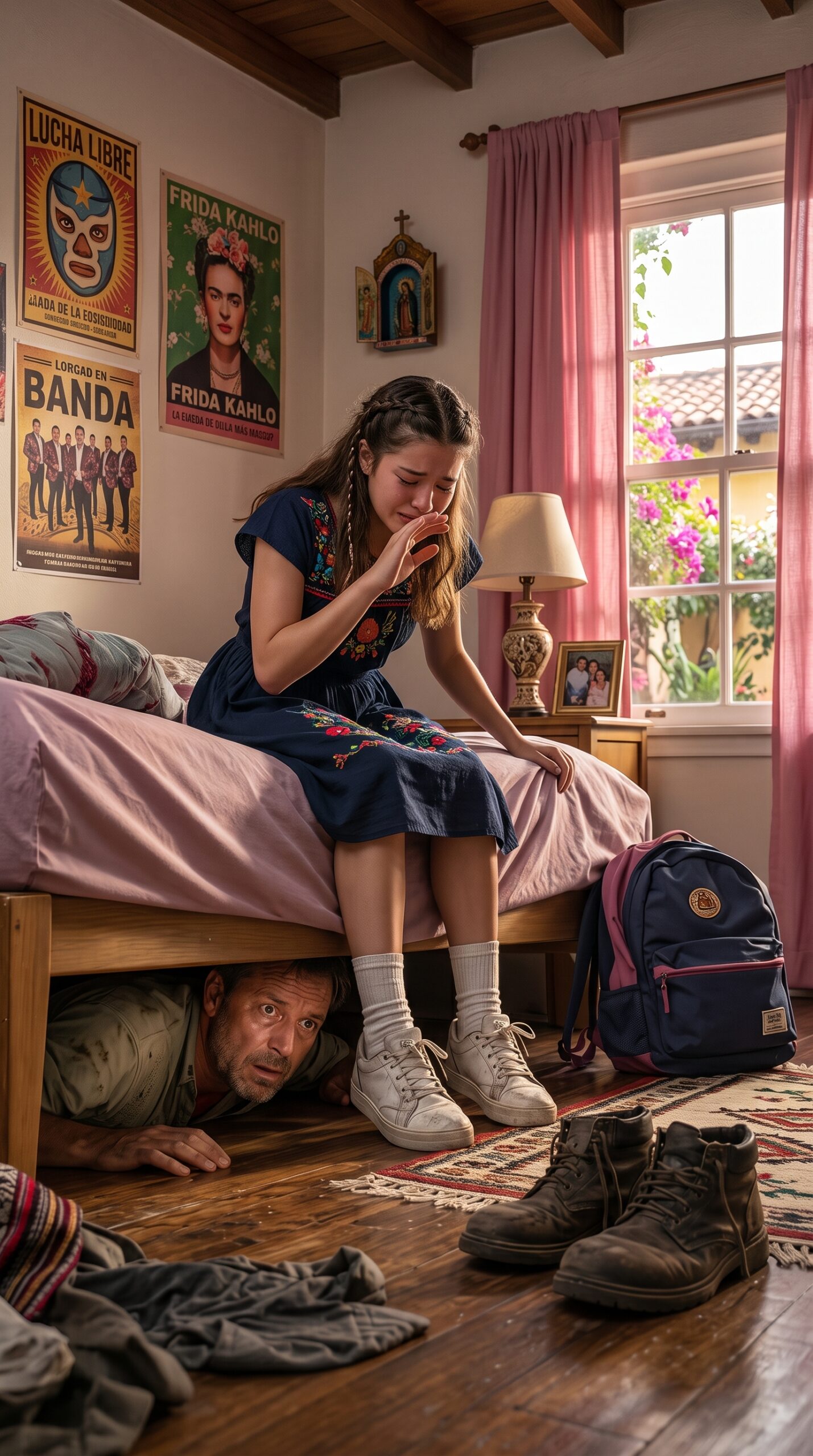
Then he crawled under his own bed.
Twenty minutes passed.
Then he heard the front door open.
Light footsteps climbed the stairs.
Someone entered his bedroom.
The mattress sank.
First, he heard a sob.
Then another.
Finally, a broken voice whispered:
—Please… no more.
It was Josefina.
His daughter, who should have been at school, was sitting on her parents’ bed, crying as if the world was collapsing around her.
From beneath, Elias could only see her white sneakers and school laces.
—I won’t lose —she murmured through tears—. I won’t let them destroy me.
Then her phone vibrated.
Josefina answered with trembling hands.
—Mom, please… tell him not to come. You know what he does to me.
Elias stopped breathing.
And then he heard Rebeca’s voice entering the room:
—Are you ready to apologize in front of the camera?
PART 2
Elias felt the ground open beneath his chest.
From his hiding spot, he saw Rebeca’s beige heels stop beside the bed.
Behind her appeared other shoes: big, dirty black sneakers belonging to a man.
Josefina recoiled on the mattress.
—No, Mom… not him.
—Don’t make a scene —Rebeca said, with a calmness that was terrifying—. You’re just going to say you made it all up, that Alan never bothered you, and this little show ends.
Alan.
Elias knew that name.
He was Rebeca’s 19-year-old nephew, a boy who, according to her, was “looking for a job” and needed family support.
He’d seen him several times sitting in the living room, eating as if the house were his.
Elias never imagined he was also coming in when he wasn’t home.
—Aunt, just record her already —Alan said, annoyed—. My mom is waiting for the video.
Josefina cried louder.
—I didn’t lie. You locked me in the laundry room. You took away my phone. You pulled my arm. You told me that if I spoke, you’d post those edited photos.
Alan let out a mocking laugh.
—Oh, Josefina, don’t make things up. No one is going to believe you. You play the innocent, but you know how to provoke.
Elias clenched his fists beneath the bed.
He wanted to burst out right then, but something held him back.
He needed to hear everything.
He needed the truth not to be hidden again.
Rebeca sat next to Josefina.
—Listen, girl, I’m tired of this. Alan is family. Your dad comes home exhausted; he doesn’t have the bandwidth for your dramas. If you destroy my nephew, you destroy all of us.
—And what am I? —Josefina asked in a tiny voice that sounded like she was 8 years old—. Am I not your family?
Silence.
Then Rebeca answered in a way that shattered Elias inside.
—You’re his daughter. I raised you because it was my duty, not because I chose you.
The words hit like a rock.
Josefina covered her mouth.
Elias did too.
Because here lay the first secret: Rebeca had never loved Josefina as a daughter.
She had tolerated her.
She had cared for her in front of everyone.
But inside, she saw her as a burden from Elias’s first relationship.
Rebeca pulled out her phone and activated the camera.
—You’re going to say: “I, Josefina Mendoza, accept that I exaggerated and that Alan was just playing.” And then you’ll apologize.
Josefina shook her head.
—No.
Alan stepped closer.
—Don’t act brave, girl.
Then Elias crawled out from beneath the bed.
He didn’t scream at first.
He simply stood up, covered in dust, with a face twisted in shock.
Rebeca dropped the phone.
Alan took a step back.
Josefina stood frozen, as if she couldn’t tell if she were dreaming.
—Dad… —she whispered.
Elias looked at his daughter and saw everything he hadn’t wanted to see.
Her swollen eyes.
Long sleeves in the heat.
The way she flinched every time someone raised their voice.
—Get out of my house —he told Alan.
—Uncle, I…
—I’m not your uncle. Get out of my house before I forget you’re in front of my daughter.
Rebeca interjected.
—Elias, calm down. You’re overreacting. This is just teenage stuff.
He looked at her with icy rage.
—No. What I just heard is called violence. It’s called a threat. It’s called covering up. And if for you that’s “teenage stuff,” then you’re part of it too.
Alan tried to walk toward the door, but Elias already had the phone in hand.
He had recorded everything from under the bed.
The voice of Josefina.
The threat from Alan.
The pressure from Rebeca.
The phrase no mother should ever say.
At that moment, Doña Chabela rang the doorbell like a frantic person.
—Elias! Open up! I heard screams again!
He went down and opened the door.
The neighbor entered, hands shaking, but with a plastic bag pressed to her chest.
—Sorry, son. I didn’t want to intrude more, but I recorded several days from my yard. You can’t see much, but you can hear the screams. You can hear doors. You can hear that boy saying no one would believe.
Rebeca turned pale.
—Nosy old woman…
—I’m not nosy —Doña Chabela replied—. I’m a neighbor. And sometimes, a neighbor does what a mother wouldn’t do.
The police arrived 15 minutes later.
Doña Chabela had called before knocking.
Alan tried to deny everything.
He said Josefina was obsessed with him.
He said it was just a joke.
He said young people talked that way.
But Josefina, with her father’s hand gripping hers, finally spoke.
She recounted that Alan had been entering the house every afternoon for almost four months.
She revealed that Rebeca had given him a key “to keep the house safe.”
She shared that when she complained, Rebeca called her dramatic.
She explained that Alan took photos from her phone, edited them, and threatened to post them in her school groups.
She recounted that was why she had stopped going to classes some days.
She shared that she hid in Elias’s bedroom because it was the only place that still smelled like her dad and felt a little safe.
Elias had to sit down.
Each word felt like a slap.
Not from Josefina.
But from reality.
He had been so busy carrying rebar, cement, and bills that he hadn’t seen his own daughter carrying fear every day.
At the prosecutor’s office, the story grew larger.
The principal from the school showed emails sent to Rebeca for weeks.
They had called the parents regarding absences, behavioral changes, and a harassment report.
Elias had never received anything.
Rebeca had signed as if she were him.
She had also requested Josefina’s temporary withdrawal without consulting him.
The plan was to send her to an aunt’s place in Puebla “until the scandal calmed down.”
And here came the second blow.
They didn’t want to protect Josefina.
They wanted to erase the problem.
Rebeca’s family arrived furious.
Rebeca’s sister shouted that Alan was a good boy, that Elias was ruining his future over a dramatic girl.
An uncle said these things should be fixed at home.
A cousin murmured that Josefina had probably provoked something.
Elias stood up amidst them all.
—My daughter will not bear the shame of a man who threatened her nor a woman who silenced her. If Alan’s future depended on destroying a 15-year-old girl, then that future was already rotten.
Rebeca cried.
But not for Josefina.
She cried when she heard she could face charges for domestic violence, cover-up, and forgery.
—Elias, please —she pleaded—. We are husband and wife. Don’t throw so many years away.
He looked at her as if seeing a stranger.
—You threw everything away the day my daughter asked you for help and you gave the key to her fear.
Josefina didn’t want to return to that house for weeks.
She stayed with Elias in a small room he rented near the site, with damp walls and a borrowed table.
It wasn’t pretty.
It didn’t have a new living room.
It didn’t have a complete set of dishes.
But for the first time in months, Josefina slept without placing a chair behind the door.
Elias apologized many times.
Not with long speeches.
With actions.
He took her to therapy.
He attended every school appointment.
He learned to listen without interrupting.
He stopped saying “it’s just her age” when something hurt.
And one afternoon, while they were eating tacos on a bench, Josefina asked him:
—Did you believe me because you heard her or because you heard me?
Elias didn’t know how to respond at first.
The question was harsh, but fair.
Then he lowered his gaze.
—I should have believed you before listening to anyone.
Josefina didn’t smile.
She just nodded.
Sometimes forgiveness doesn’t arrive like a hug.
Sometimes it arrives as silence without fear.
Months later, Alan faced trial.
Rebeca lost her right to approach Josefina while the investigation progressed.
Doña Chabela resumed watering her pots as always, but in the neighborhood, no one mocked her for being “nosy.”
Some neighbors said she had meddled where she shouldn’t have.
Others said thanks to her, a girl stayed alive inside.
Elias never returned to being the same.
Every time he passed in front of the gate, he remembered the phrase he almost ignored:
“Then you don’t know what’s happening inside your own house.”
And he understood something many parents prefer not to accept.
It’s not enough to pay the bills.
It’s not enough to bring food.
It’s not enough to arrive tired and say everything is fine.
Because sometimes the scream that saves a child doesn’t come from family.
Sometimes it comes from a nosy neighbor.
And sometimes, the hardest part isn’t discovering the truth, but accepting that it had been screaming inside your own house while you held the keys in hand.