PART 1
When Diego Arriaga died on the Mexico-Cuernavaca highway, Mariana was three months pregnant and had an entire life planned in a blue notebook.
That night, the rain was pouring down.
Diego had left the office in Santa Fe with a small bag in the passenger seat: a pair of tiny white shoes he had bought for the baby. He sent Mariana a voice message saying he was on his way, to brew the coffee, and that he had a surprise.
At 11:42 p.m., two police officers knocked on the door.
By dawn, Mariana was already a widow.
The funeral was held in an elegant chapel in Coyoacán. Everyone spoke of Diego as if he belonged to his mother, Doña Rebeca Arriaga, a woman with perfect hair, discreet jewelry, and an icy gaze.
Doña Rebeca wept by the coffin, but she never embraced Mariana.
Not once did she look at her belly.
Three days after the burial, Mariana remained in the house that Diego had purchased before they married, but which he had also put in her name when they learned of the pregnancy. It was a quiet house in San Jerónimo, with bougainvilleas at the entrance and a mint-green room for the baby.
Mariana was packing Diego’s shirts into a box when Doña Rebeca arrived with her sister Lourdes and a yellow folder.
She didn’t ask for permission.
She entered as if she still had authority there.
“You need to make a decision,” she said, placing the folder on the table.
Mariana wiped her tears.
“About what?”
Doña Rebeca glanced down at her belly.
“About that pregnancy.”
The air turned heavy.
“That baby is Diego’s son,” Mariana replied, almost in a whisper.
“Diego is gone,” said Doña Rebeca. “And you are young. You can rebuild your life. There’s no point in clinging to a child that will only bring problems.”
Mariana stepped back, incredulous.
“Are you serious?”
Doña Rebeca opened the folder. Inside were documents for Mariana to give up her share of the house to the Arriaga family.
“You’re going to sign this. Then you’re going to a clinic. I’ll pay for everything, and that’s the end of it.”
Mariana felt the floor shifting beneath her.
“You’re asking me to give up my house and my child on the same day.”
“I’m telling you what’s best,” Rebeca replied. “Don’t play the victim.”
Mariana closed the folder.
“No.”
Doña Rebeca’s face changed.
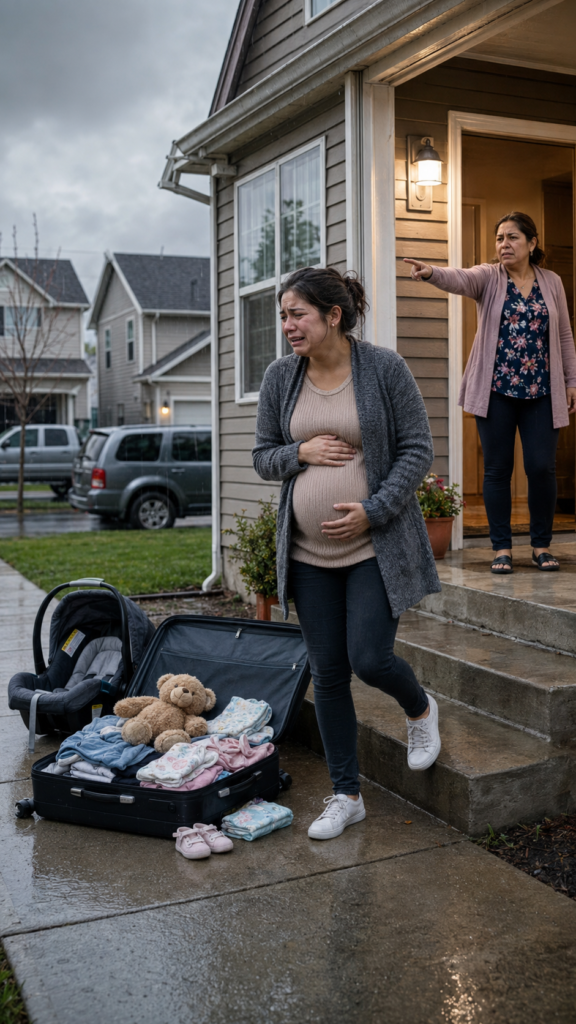
She grabbed Mariana’s suitcase from the hallway, dragged it to the entrance, and tossed it into the wet garden. Then she threw the box of memories. Diego’s shirts fell into the mud.
“Get out,” she shouted. “And don’t come back until you get rid of that baby.”
Mariana felt a sharp pain in her belly. She doubled over, drenched by the rain, as Lourdes shut the door from inside.
At the hospital, trembling and with her clothes clinging to her body, Mariana thought she was going to lose everything.
Then a doctor approached and said softly:
“Mrs. Arriaga, come with me. Someone is waiting for you.”
And behind that door was a person that no one in the family imagined could stand up to Doña Rebeca.
PART 2
Mariana thought the doctor had made a mistake.
No one knew she was in the hospital, except the nurse who received her in the emergency room. Her parents had died years ago, she had no siblings, and her only close friend lived in Monterrey.
Diego had been her home, her family, her everything.
Now he was dead, and her mother had just thrown her out as if Mariana and the baby were trash.
“Who wants to see me?” she asked fearfully.
Doctor Herrera looked down the hallway and lowered his voice.
“Don Tomás Arriaga.”
Mariana froze.
Don Tomás was Diego’s grandfather. The founder of the family business, Arriaga Constructores. Everyone said he was too old, that he hardly spoke, that he didn’t get involved in disputes.
Mariana had seen him only twice.
But she remembered his eyes.
Silent, sad, as if they knew more than they let on.
“Is he here?” she whispered.
“He asked to be notified if you arrived at the hospital in a delicate situation,” the doctor explained. “Your husband had him listed as an emergency contact two months ago.”
Mariana closed her eyes.
Diego.
Even in death, he was still looking out for her.
The doctor led her to a private room. Don Tomás was sitting in a wheelchair by the window. He wore a gray sweater and held a dark wooden cane across his lap.
Beside him was a woman in a navy blue suit, serious, with a folder full of documents.
When Don Tomás saw Mariana, wet and pale, cradling her belly, his face broke.
“Oh, my child,” he said in a hoarse voice. “What did Rebeca do to you?”
Mariana tried to respond, but she couldn’t.
That’s where she broke.
She hadn’t crumbled when they informed her of the accident. Not in front of the coffin. Not when she saw the tiny white shoes Diego never got to deliver.
But that question, asked with tenderness, opened her chest wide.
She cried as if all the pain in the world had fallen onto her.
She told them everything.
The folder.
The threat.
The clinic.
The suitcase.
Diego’s shirts in the mud.
The woman in the suit introduced herself as Licenciada Valeria Márquez, Don Tomás’s personal attorney.
She opened her folder and took out several papers.
“Diego came to see me six weeks ago,” she said. “He was worried about you and the baby.”
Mariana lifted her gaze, confused.
“Did Diego know something could happen?”
Don Tomás tightened his grip on the cane.
“My grandson knew your mother better than anyone. Rebeca always believed that love was control. And when she couldn’t control, she destroyed.”
The attorney slid a document in front of Mariana.
“Diego created a trust for you and your child. The house, part of his savings, his life insurance, and the shares that belonged to him are legally protected. Doña Rebeca cannot touch them.”
Mariana covered her mouth.
“But she said the house belonged to the family.”
“She lied,” Valeria said. “The house is yours and your baby’s. And there’s more.”
Don Tomás took a deep breath.
“Diego suspected that Rebeca was moving money from the company to accounts belonging to her brother. He didn’t have time to prove everything before the accident, but he left instructions.”
Mariana felt a shiver run down her spine.
“What instructions?”
The attorney slid another sheet of paper across.
“If Doña Rebeca tried to pressure you, force you out of the house, or harm you or the pregnancy, we were to act immediately.”
At that moment, Mariana’s phone vibrated.
It was a message from Doña Rebeca.
“Sign by tomorrow or I swear you’ll be left without a house, without money, and without a last name. That child will not live off my family.”
Mariana read the message with trembling hands.
Don Tomás leaned in slightly and saw it.
For the first time, he smiled.
But it wasn’t a sweet smile.
It was cold.
“Perfect,” he said. “That woman just gave us the proof we needed.”
The next morning, Doña Rebeca’s world began to crumble.
Licenciada Valeria filed an urgent measure to prevent any changes in the ownership of the house. She also submitted to the judge the threatening messages, the attempted dispossession, and the medical report confirming that Mariana had arrived at the hospital with abdominal pain caused by extreme stress and mild hypothermia.
Don Tomás did something no one expected.
From his wheelchair, he called the board of Arriaga Constructores and froze Rebeca’s access to several family accounts while suspicious transactions were investigated.
Doña Rebeca called Mariana 37 times.
Mariana didn’t answer a single one.
By noon, Valeria took her back to the house with two security personnel, a locksmith, and a police patrol requested to avoid problems.
The suitcase was still in the garden.
Diego’s shirts were soaked, stained with dirt, stuck together as if they too had spent the night crying.
Mariana picked up a blue shirt, Diego’s favorite, and pressed it against her chest.
“Forgive me,” she murmured. “I couldn’t protect your things.”
Don Tomás, who had followed in another truck, heard that and shook his head.
“No, Mariana. You are protecting the only thing he wanted most.”
She touched her belly.
An hour later, a black truck screeched to a halt in front of the house.
Doña Rebeca got out in a fury, wearing dark glasses and heels that splashed water with every step. Lourdes followed behind like a shadow.
“What a pathetic show!” Rebeca shouted from the sidewalk. “Do you feel like you own everything just because you’re carrying a memory?”
Mariana stood frozen.
Don Tomás rolled his wheelchair to the entrance.
“It’s not a memory, Rebeca,” he said calmly. “It’s Diego’s child. And you will not set foot in this house again.”
Doña Rebeca took off her glasses.
For the first time, her face showed fear.
“Dad, don’t get involved. This woman is manipulating you.”
“Don’t call me dad when you’ve been waiting for me to die for years to take my things.”
The street went silent.
Even Lourdes opened her mouth.
Rebeca turned pale.
“That’s disrespectful.”
“Disrespectful was throwing a pregnant woman out in the rain,” Don Tomás replied. “Disrespectful was asking her to make her own child disappear. Disrespectful was stealing money from the company using your brother as a front.”
Doña Rebeca attempted to laugh.
“What nonsense is that?”
Licenciada Valeria pulled out a folder.
“Transfers to three companies registered in Toluca. Fake work invoices. Duplicate signatures. Emails sent from an account you swore you didn’t know.”
Rebeca stopped moving.
Mariana then understood the real motive.
It wasn’t just hatred.
It wasn’t just mourning.
Mariana’s baby was an obstacle.
If born, he would inherit Diego’s share and have direct protection from Don Tomás. Rebeca wouldn’t be able to move the house or shares without someone reviewing everything.
That’s why she wanted him gone.
That’s why she treated her like a problem.
That’s why she had thrown her out.
“Seriously, you have no heart,” murmured one of the neighbors watching from across the street.
Rebeca heard and turned in anger.
“Stay out of your own business!”
But it was too late.
A neighbor had recorded part of the argument. Another neighbor testified to having seen Lourdes throw the box of memories into the garden. The security camera from the gated community showed Doña Rebeca entering with the folder and leaving minutes later without Mariana.
Everything began to fall into place.
Everything began to speak.
And the truth, when the evidence finally comes together, doesn’t need to shout.
A week later, Valeria visited Mariana at the house. She handed her a handwritten letter.
“Diego left this for you,” she said. “He asked me to give it to you only if your mother tried to harm you.”
Mariana recognized the handwriting before opening the envelope.
She sat in the baby’s room, between the unassembled crib and the mint-green walls, and read.
“Mariana, if you’re reading this, it means I couldn’t be there to defend you. I’m sorry. But listen closely: our baby is not a burden. He is proof that what we lived is still alive. My mother can use fear as if it were love, but don’t believe her. The house is yours because that’s where we dreamed of our family. Raise our child with joy. Tell him I loved him before I knew his face. And never doubt this: I chose you. I would choose you a thousand times.”
Mariana cried until night fell.
But this time, she didn’t cry alone.
She cried with one hand on her belly and the other on the letter, feeling that Diego, in some impossible way, was still there.
The following months were hard.
Doña Rebeca tried to defend herself, saying she was “devastated by grief.” She declared that Mariana had provoked her, that it was all a misunderstanding, that she only wanted to “avoid suffering.”
But the judge was unmoved.
The hospital report, the messages, the videos, the false documents, and the transfers spoke louder than her elegant tears.
The financial investigation progressed. Lourdes was also summoned. Rebeca’s brother had to explain why three newly created companies were receiving money from inflated contracts.
Don Tomás publicly renounced protecting the family reputation.
“Reputation without decency is worth nothing,” he said before the board.
That statement became a blow.
Because for years, the Arriaga family had prioritized appearances over truth.
When the baby was born, Mariana named him Mateo Tomás Arriaga.
He weighed three kilos, cried loudly, and opened his eyes as if he had come to claim his place in the world.
Don Tomás held him with trembling hands.
“Hello, little one,” he whispered. “You came to set things right.”
Mariana smiled for the first time in months.
Days later, Doña Rebeca requested visits through her lawyer. She wanted to appear in photos, to say she had met her grandson, to clean her image in front of the family.
The judge denied visitation until she underwent psychological treatment, repaired the economic harm, and stopped intimidating Mariana.
Rebeca never apologized.
She only sent a letter saying she acted “out of pain.”
Mariana read it once and stored it in a box.
She didn’t tear it up.
She didn’t respond.
She simply understood something that many people take years to accept: pain can explain a wound, but it doesn’t justify becoming the executioner.
Mateo grew up in the house his father protected before dying.
At night, Mariana would sit in the rocking chair that Diego had built with his own hands and tell her son stories of the man who bought those tiny white shoes on a rainy night, unaware that it would be his last act of love.
People said that family should always forgive.
But Mariana learned something else.
True family is not the one that demands blood, a surname, or silence.
True family is the one that protects when everyone else pushes you to the ground.
And that’s why, when years later Mateo asked why he didn’t see his grandmother Rebeca, Mariana didn’t speak with hatred.
She simply said:
“Because sometimes closing a door is not revenge, son. Sometimes it’s the only way to let peace in.”
And that’s the question many dare not answer: if someone tries to destroy you at the worst moment of your life, do they truly deserve forgiveness just because they share your blood?