PART 1
Rodrigo's silence on the phone was colder than the dawn outside the Jamaica Market.
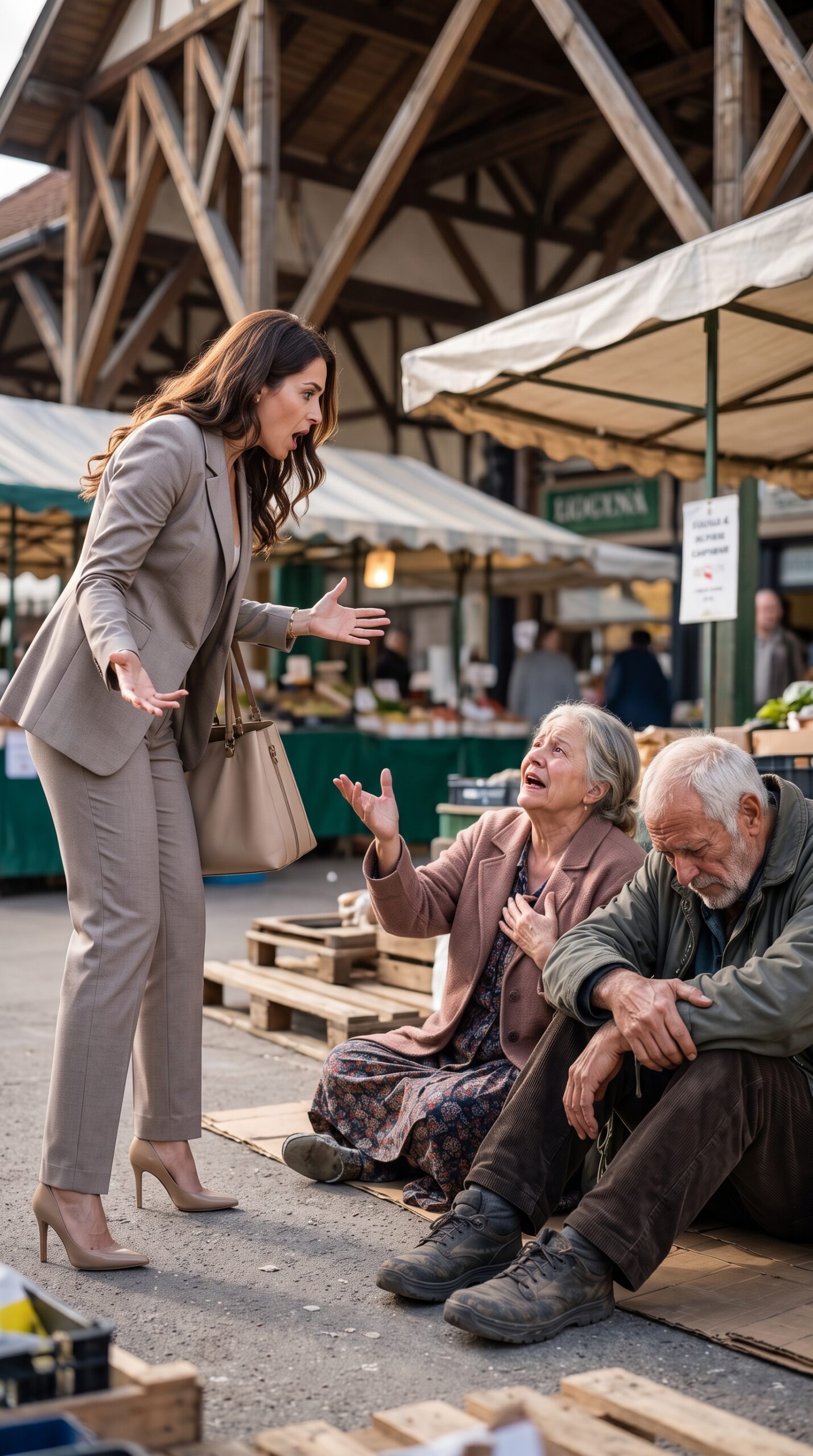
Valeria stood next to a closed metal curtain, watching her parents sit on damp cardboard. Doña Lupita tried to wrap an old blanket around Don Manuel, as if she could still make him feel at home.
Don Manuel held a plastic bag with his medications, his glasses, and two changes of clothes.
Nothing more.
—Valeria… where are you? —Rodrigo finally asked.
His voice no longer sounded sweet. He was no longer the charming husband who smiled at family meals. Now it sounded nervous.
—I’m watching my parents sleep on the street —she said—. In February. On cardboard.
Rodrigo took a deep breath.
—That’s not how it was. Your parents got confused.
Don Manuel lifted his gaze.
Valeria felt something inside her dim.
—Confused?
—Your dad forgets things, Vale. Your mom exaggerates when she gets sentimental.
Doña Lupita lowered her head, ashamed, as if she had done something wrong.
At that moment, Valeria understood that the blow wasn’t just about throwing them out of a house.
It was about humiliating them.
Making them feel old, useless, a burden.
—Repeat that —Valeria said quietly.
—Don’t start, please.
—Repeat that my dad got confused while sitting on the sidewalk with his pills because you threw him out of the house I bought.
Rodrigo changed his tone.
—You’re making this too big.
—You made it big when you left them homeless.
A truck passed, splashing dirty water. Doña Lupita took Valeria’s hand.
—Mijita, don’t fight with him for us.
That hurt more than anything.
Her parents had worked thirty years to put her through school. They had sold food, sewn clothes, cleaned offices, and endured humiliation for Valeria to become a corporate lawyer.
And still, they felt like a burden.
—Mom, listen to me —Valeria said, kneeling in front of her—. You are not a problem. No one has the right to throw you out of your home. No one.
Rodrigo spoke again.
—Come home. We’ll talk calmly.
—No. You come here.
—I’m not driving out to that area at midnight.
—Then I’ll go to my parents' place in Portales. If your sister opens the door for me, I’ll call the police in front of her kids.
Rodrigo fell silent.
That silence said more than any confession.
—Don’t bring the police into this —he pleaded.
Valeria looked at her parents. Doña Lupita cried silently. Don Manuel clutched the bag of medications as if it were the only thing left of his dignity.
—Too late.
She hung up.
First, she called 911.
Then she called Mariana Treviño, the lawyer who had prepared the family trust when Valeria bought the house for her parents.
Mariana answered groggy.
—Valeria? Did something happen?
—Rodrigo moved his mom and sister into my parents' house. He told them I signed papers.
Mariana’s voice changed instantly.
—That sounds like forgery.
Within fifteen minutes, two patrol cars arrived.
Doña Lupita recounted everything through sobs.
Three weeks earlier, Rodrigo had come with his mother, Doña Graciela, and his sister Karina. They told them that Valeria and Rodrigo were having financial problems, that they needed to “settle” the house temporarily, and that Karina, recently divorced, had nowhere to live with her two children.
Don Manuel said no.
Then Graciela dropped the phrase that broke them.
—Valeria already agreed. Don’t make your daughter have problems with her husband.
Doña Lupita thought she was protecting Valeria.
So did Don Manuel.
So they packed two bags and left.
First, they tried to sleep at an acquaintance's place in Neza. There was no space. Then they went to a parish. Eventually, they ended up under a tarp, near the market.
—How long have you been here? —a police officer asked.
Doña Lupita looked at the ground.
—Eleven nights.
Valeria felt her heart shatter with a cruel precision.
For eleven nights, Rodrigo had dined with her.
For eleven nights, he had asked her how work went.
For eleven nights, he had slept next to her while her parents trembled on the street.
At 12:50 a.m., a black van parked in front of them.
Doña Graciela got out first, wearing a beige coat, pearls around her neck, her face showing annoyance.
Then Karina got out, clutching an expensive bag.
Rodrigo followed at the end.
Handsome, clean, perfectly groomed.
As if he had come to apologize instead of facing a betrayal.
—Valeria —he said—. Let’s not make a scene.
She looked at him with a calm that frightened even him.
—The scene was made when you threw my parents out to sleep on cardboard.
PART 2
Doña Graciela clicked her tongue.
—No one threw them out. They left because they wanted to.
Doña Lupita shrank behind the patrol car.
Valeria stepped forward.
—Don’t talk about my mother again.
—I’m still your mother-in-law.
—No. You are an invader with a pearl necklace.
Karina opened her mouth, indignant. Rodrigo clenched his jaw.
—Careful, Valeria.
That tone used to work. It was the tone he used when he wanted to silence her at parties, when he squeezed her elbow to keep her from contradicting his mother, when he made humiliation seem like “advice.”
But that night, it didn’t.
A police officer approached.
—Sir, we need to ask you some questions about the house in Portales.
Rodrigo smiled.
—Of course, officer. This is a family misunderstanding.
Mariana’s voice came from Valeria’s phone on speaker.
—It’s not.
Rodrigo turned towards the phone.
—Mariana, don’t get involved.
—I’m already involved —she replied—. I have the deed and the trust right in front of me. The property belongs solely to Valeria Sandoval. Rodrigo Cárdenas has no rights. Neither does his mother. Nor his sister.
Graciela paled slightly.
Mariana continued:
—I also found a supposed power of attorney electronically signed by Valeria a week ago. Valeria, did you sign anything authorizing occupancy, transfer, or change of use?
—No.
—Did you sign anything on February 2?
—No.
—Then we’re looking at a forged document.
Rodrigo tried to laugh.
—Don’t exaggerate. We’re married.
—And yet the house isn’t yours —Mariana said—. You should stop talking.
The police officer requested identifications.
Graciela began insisting that the elderly were confused, that it was all private, that decent families don’t air their problems in public.
Then Don Manuel spoke.
—I understood enough when you changed the locks.
Everyone fell silent.
He pulled out a keychain from the bag.
—These keys stopped opening that day.
Doña Lupita added, almost in a whisper:
—And Mrs. Graciela said that if we returned, she would call Immigration.
Valeria felt a furious heat in her chest.
Her parents were Mexican. They had been born in Puebla.
But Graciela knew that Doña Lupita had lived in fear in the United States for years before returning to Mexico. She knew which wound to touch.
—Did you say that? —Valeria asked.
Graciela raised her chin.
—I told you not to make a scene.
—You threatened her.
Rodrigo took Valeria's arm.
Not tightly.
Just enough to remind her who was in charge.
Valeria looked at his hand.
Then she looked at the police officer.
—Please note that he is touching me after I asked him to keep his distance.
Rodrigo immediately let go.
And then Karina broke down.
—I told you this would end badly —she shouted at Rodrigo—. I told you Valeria would find out.
Graciela turned.
—Shut up!
—No, Mom. I’m not going down alone. Rodrigo said the papers were clean. He said Valeria never checked anything. He said that once we were inside, he would feel embarrassed to kick us out because we are family.
Valeria felt each word like a slap.
Never checked anything.
He would feel embarrassed.
Family.
Mariana spoke from the phone.
—Officer, I hope that was recorded.
The police officer pointed to his body camera.
—It was.
At 2:15 a.m., Valeria took her parents to a hotel in Roma.
Not for luxury.
For warmth, clean sheets, and a door with a lock.
Doña Lupita cried at the sight of two beds.
—Mijita, this costs a lot.
—A lot was sleeping on cardboard, Mom.
Don Manuel sat on the edge of the bed.
—I should have called you.
Valeria knelt in front of him.
—You were scared.
—I was ashamed. A father must protect his family.
—You did for thirty-four years. Now it’s my turn.
At 9:30 in the morning, Valeria arrived at the Portales house with Mariana, two police officers, and a provisional order.
Karina opened the door wearing Doña Lupita's blue robe.
The robe with embroidered flowers.
For a second, Valeria forgot everything legal.
She only saw a stranger wearing her mother’s warmth.
The house was unrecognizable.
Doña Lupita’s plants were in black bags. Valeria's graduation photos had disappeared from the hallway. There were toys in the living room. Graciela was drinking coffee from Don Manuel's favorite mug.
Rodrigo was there too.
—Valeria, think carefully before destroying everything.
—I thought all night.
Mariana handed over the order.
—You must vacate immediately while the procedure is resolved.
Karina began to cry.
—And my kids? Where do I take them?
Valeria looked at the children watching cartoons under their parents' blanket.
—Your kids didn’t do this. You did. Your mom did. My husband did. Don’t use them as a shield.
Graciela slammed the mug against the table.
—You’re selfish. Money has made you arrogant.
Valeria walked into the kitchen.
—I paid Rodrigo’s debts twice. I covered eight months of Karina’s car payment. I donated eighty thousand pesos to her parish because you said the roof was falling. I bought jackets for your grandchildren and let you say they were your gifts.
Graciela pressed her lips together.
—And while I helped your family, you sent mine to sleep on the street.
Rodrigo murmured:
—Enough already.
—No. This is just the beginning.
Mariana placed a folder on the counter.
—We traced the IP from where the supposed power of attorney was uploaded.
Rodrigo didn’t move.
—It came from your office —Mariana said.
Karina covered her mouth.
Graciela looked at her son.
Not with shame.
With panic.
The perfect son had left traces.
Rodrigo attempted one last play.
—Valeria, you know me.
She almost smiled sadly.
Yes, she knew him.
She knew how he made cruelty seem reasonable. The way he called betrayal a “misunderstanding.” The patience with which he waited to see her tired to ask for things she would never accept during the day.
—I know you —she said—. That’s why I’m done.
—Done?
—With the house. With the lies. With you.
Graciela stood up.
—You can’t end a marriage over a family dispute.
Valeria looked at her mother’s robe on Karina's shoulders.
—Family dispute? You robbed a house and left two elderly adults on the street.
By noon, Karina and Graciela were outside.
Their things piled on the sidewalk. Karina cried to make the neighbors feel pity. Graciela called Valeria cruel, ungrateful, poisoned.
Rodrigo remained silent.
He had understood that every word could become evidence.
When they changed the locks, Valeria walked through the house alone.
She found family photos in a black bag.
Don Manuel’s pill organizer tossed in a drawer.
Her grandmother’s quilt under a dog bed.
And in the room where Doña Lupita prayed, she found the worst.
Graciela had placed a vanity.
The altar was destroyed. The photo of the grandmother was upside down. The candlesticks were broken. The wooden cross carved by Don Manuel was split in two.
Valeria sat on the floor with the broken cross in her hands.
Mariana sat next to her.
—We’re going to make them answer for everything.
Valeria nodded.
But she no longer wanted just punishment.
She wanted her parents to walk back in without fear.
The next day, Doña Lupita and Don Manuel returned.
The house smelled of lemon, fresh paint, and hot soup. The plants were by the window. The photos returned to the hallway. The little altar was rebuilt.
Doña Lupita touched each frame as if greeting someone she thought lost.
In the kitchen, there were rice, noodle soup, and three plates.
Don Manuel hugged his wife.
For the first time since that night, he stood up straight.
In the middle of the meal, Valeria’s phone vibrated.
Rodrigo.
She didn’t answer.
Messages arrived.
“I need to explain.”
“My mom is difficult, you know.”
“Don’t let Mariana fill your head.”
Then the last one:
“If you file for divorce, you will regret it.”
Valeria sent it to Mariana.
The lawyer replied:
“Perfect. Keep digging your own grave.”
Three days later, the real estate company where Rodrigo worked suspended him.
One week later, the parish removed Graciela from the charity committee when it was discovered that the roof collection had raised almost four times more than necessary.
Two weeks later, Karina’s ex-husband requested custody review due to unstable housing and possible fraud.
Then Rodrigo stopped threatening.
He started sending flowers.
One card read:
“I’m sorry if things got out of hand. I love you. Come back home.”
Valeria read the phrase twice.
Things.
Got out of hand.
As if her parents hadn’t slept eleven nights on cardboard.
She filed the card in a folder marked EVIDENCE.
The divorce was filed on a Monday.
That afternoon, Rodrigo waited for her outside her office on Reforma.
—Give me five minutes —he pleaded.
Valeria kept walking.
—You had eleven nights.
He stood still.
—I panicked. Karina needed help. My mom said your parents had a big house and she had kids. I thought it would be temporary.
—You changed the locks.
—I didn’t know they had nowhere to go.
—You didn’t ask.
Rodrigo rubbed his face.
—I knew you would say no.
It was the first truth.
Valeria looked at him.
—And you were right.
—I made a mistake.
—No. You made a plan. You forged papers. You scared my parents. And then you slept next to me every night as if nothing happened.
Rodrigo had no answer.
—You didn’t lose me because of your mom or your sister —Valeria said—. You lost me because when you had to choose between my heart and your comfort, you chose your comfort.
—I loved you —he whispered.
—Yes. But you loved yourself more.
And she walked away.
The hearing was six weeks later.
Doña Lupita testified with a trembling voice. The judge asked her why she didn’t call her daughter.
She looked at Valeria and straightened up.
—Because they used my love for her against me. They told me that a good mother doesn’t cause problems in her daughter’s marriage. But now I understand something: silence doesn’t protect children. Sometimes it only gives more space to the cruel.
The room went quiet.
Valeria cried silently.
Her mother had just regained the dignity they tried to strip away.
The judge confirmed protective measures, ordered Rodrigo not to approach the house, and notified the Public Ministry for forgery and dispossession.
It seemed like the end.
But two days later, an unmarked envelope arrived at Valeria’s office.
Inside were bank statements, printed emails, and a note.
“I worked for Doña Graciela. What was done to your parents wasn’t the first time. Check the marked names.”
There were four names.
Four elderly people.
Four properties.
Four “temporary loans.”
Four families pressured to give up what was theirs.
Valeria understood everything.
Her parents hadn’t been an accident.
They had been practice.
That night, she went to Portales and laid the documents on the table.
Doña Lupita was making tea. Don Manuel was fixing a hinge broken by Karina.
—What is that? —he asked.
Valeria looked at her parents.
Then looked at the house they almost lost.
—This isn’t over —she said—. But now we’re not just going to fight for us.
Outside, the porch light illuminated the new lock.
Inside, her parents were sitting at their own table.
And for the first time in weeks, Doña Lupita no longer had fear in her eyes.
She had something much stronger.
The gaze of a woman who stopped apologizing for surviving.
And the daughter willing to make every robbed house speak.