PART 1
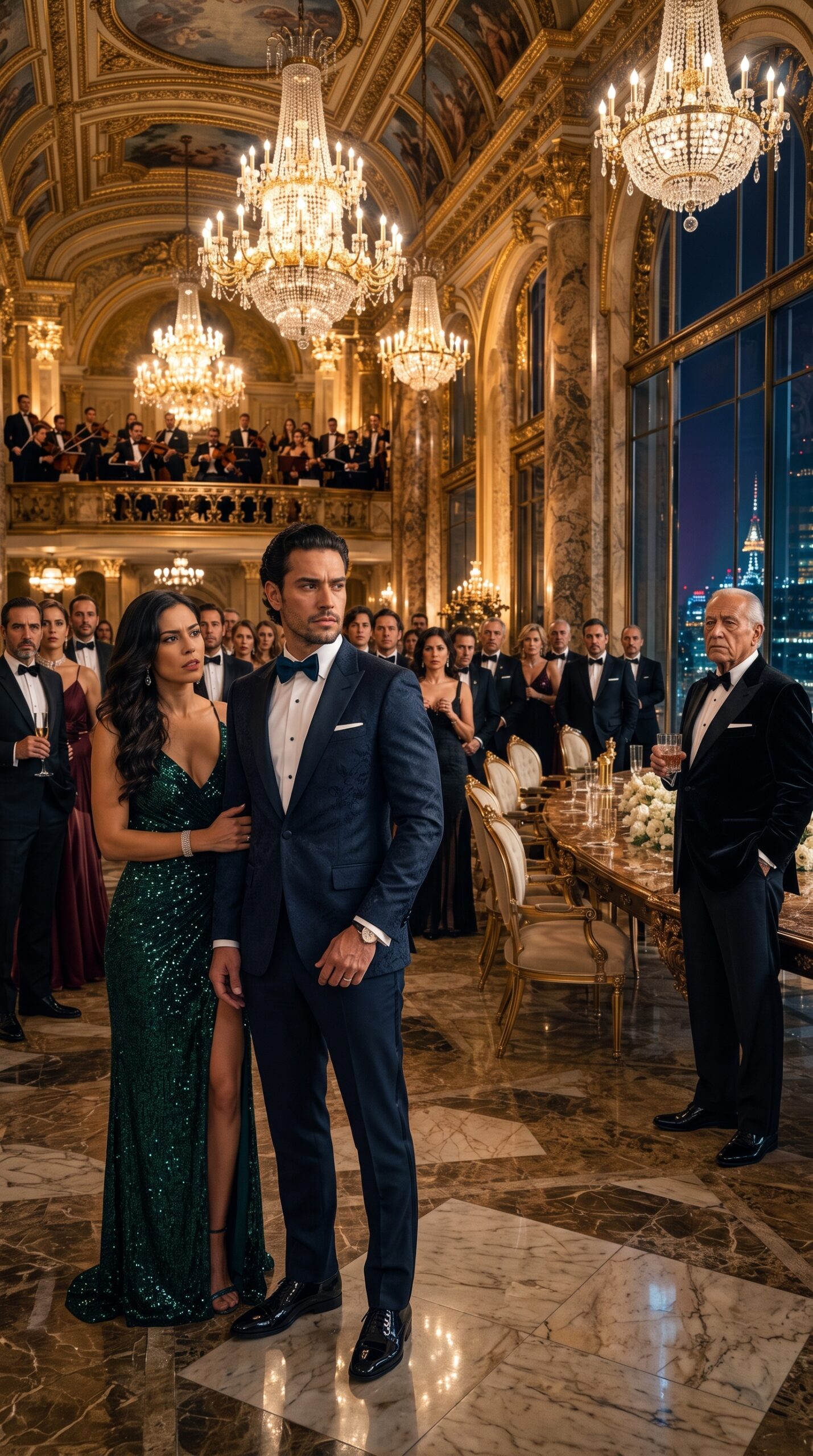
When Damián Luján strode into the Imperial Hall of the Reforma Hotel, his arm linked with another woman, the music played on, but the atmosphere died instantly.
It wasn't because of Valeria Montes's red dress.
Though, honestly, it seemed designed to provoke stares. It shimmered with every step, hugging her figure as if she had been born to walk among chandeliers, bodyguards, and expensive champagne flutes. Her hair flowed free, dark lips painted, and a smile that screamed: "Today everyone will know who I am."
But no one smiled.
No one applauded.
No one came to greet her.
The 43 most important guests from the North Table, from Bajío, from the Coast, and from the capital stood frozen, as if they had just witnessed a disrespect so enormous that it didn't even warrant shouting.
Because Damián hadn’t arrived with his wife.
He came without Renata Luján.
And that, in this world, was no minor detail.
It was a declaration of war.
The hall had been ready since 8:00. White tablecloths, French china, bougainvillea arrangements, discreet security at every door, and a main table reserved for the 7 families that had spent years distributing businesses, favors, and silences.
Damián descended the staircase as if he were the owner of the country.
He was 40, clad in a tailored black suit, and wore that cold arrogance of men who inherited too soon a chair that was too big. His father had raised the Luján name from a fleet of trucks in Tamaulipas to a network of construction companies, private security, and political contacts.
Damián inherited money.
He inherited fear.
But he confused both with respect.
Valeria clung tighter to his arm.
"Everyone is watching us, love," she whispered.
"Let them look," he said. "It was time for them to understand that Renata doesn’t run my life."
Valeria smiled, convinced she had won.
For 11 months, she had listened to Damián complain about his wife. That Renata was too serious. That she always talked about codes, commitments, widows, old agreements. That she never showed him off. That she never made him feel like a king.
Valeria did.
That’s why that night he didn’t just bring her to the gala.
He also sent Renata a message through his assistant:
"Mrs. Luján will not be required tonight."
He didn’t even have the guts to tell her to her face.
The first to approach was Don Aurelio Treviño from Monterrey. A broad, gray-haired man, with a gaze like a loaded gun.
"Damián."
"Don Aurelio."
The old man didn’t look at Valeria.
"Where's Renata?"
Damián let out a short laugh.
"At home. Resting."
"Resting?"
"I decided to come with someone who better represents this new phase."
Valeria raised her chin.
Don Aurelio glanced at her for a second. No more, no less.
"I see."
And he walked away.
Then Leticia Cárdenas from Puebla asked.
Then Ramiro Beltrán from Guadalajara.
Later, Doña Amparo Urrutia from Chihuahua left her untouched glass on a tray and said:
"If Renata doesn’t come, I won’t sit."
Damián blinked.
"Excuse me?"
"I said I’m waiting for Renata."
The phrase began to spread like wildfire.
"We’re waiting for Renata."
By 8:30, no one occupied their chair.
By 9:05, they all stood.
By 9:20, the waiters no longer knew where to look.
Damián searched for the event coordinator, who was pale next to the service door.
"What the hell is going on?"
"Mr. Luján... the main guests refuse to begin."
"Why?"
The man swallowed hard.
"They say Mrs. Renata is missing."
Damián felt a stab of rage.
"This is a farce."
But when he turned, he saw that Valeria no longer smiled the same way.
She remained beautiful.
But her security was crumbling like cheap makeup in the rain.
Then Damián walked towards the oldest man in the hall.
Don Ernesto Robles.
82 years old.
The only one whom even the fiercest spoke to with respect.
"Don Ernesto, we must start."
The old man raised his gaze.
"No."
"No?"
"Renata is missing."
Damián clenched his jaw.
"Renata is my wife, not the owner of this table."
Don Ernesto looked at him with a calmness that was frightening.
"Therein lies your mistake, boy."
And before Damián could respond, the hall doors swung open abruptly.
Everyone turned.
But it wasn’t Renata.
It was the driver of the Luján household, drenched in sweat, holding a black envelope in his hands.
"Sir... Mrs. Renata left this before she left."
Damián opened the envelope.
Inside was a single card.
And on it, written in perfect handwriting, it said:
"Today everyone will know who held up your surname while you played at being powerful."
PART 2
Damián read the card twice.
The first time, he didn’t understand.
The second time, he felt something sinking in his chest.
Valeria tried to peek over his shoulder, but he closed his hand and crumpled the card.
"Where’s my wife?" he asked, devoid of arrogance now.
The driver lowered his gaze.
"I don’t know, sir. She only said you needed to learn to arrive alone at places you don’t deserve to enter accompanied."
The silence was brutal.
Don Ernesto set his glass down on the table and walked slowly toward Damián.
"Your father never told you the truth, did he?"
"What truth?"
Don Aurelio returned from the other side of the hall.
"That this table didn’t accept the Lujáns because of your father."
Damián let out a dry laugh.
"My father founded all this."
"Your father had trucks, money, and armed men," Doña Amparo said. "But he also had an animal temperament. He broke agreements out of pride. He threatened when he should have negotiated. He burned bridges because he felt untouchable."
"Don’t dare speak of him like that."
Don Ernesto remained unfazed.
"We dare because we were there. Sixteen years ago, when the Tampico Agreement nearly fell apart, no one wanted to sign with your family."
Damián felt heat rise in his face.
"That’s a lie."
"No," Don Ernesto replied. "The only thing that saved the Luján name was a girl named Renata Valdés, just 24 years old."
Valeria's eyes widened.
Damián stood frozen.
"Renata was a piano teacher."
Some let out a sad laugh.
Not out of mockery.
Out of pity.
"That’s what she let you believe," Leticia Cárdenas said. "Because she never needed to show off anything about you."
Don Ernesto pulled out an old notebook, its leather worn.
"Renata is the daughter of Joaquín Valdés."
Damián turned pale.
Joaquín Valdés.
The name weighed heavier than any gun. He had been the most respected negotiator in the country. The man who had avoided disputes at ports, borders, political campaigns, and even within families that hated each other to death.
"Joaquín died years ago," Damián murmured.
"He died sick," Don Ernesto said. "But he left a letter for us."
He opened the notebook with slow hands.
"When I'm gone, listen to Renata. She has more patience than I do, more memory than all of you, and more heart than any man sitting at that table."
Damián said nothing.
Because suddenly, memories he had always ignored began to resurface.
The calls Renata answered in the middle of the night.
The trips to Querétaro without explanation.
The funerals where everyone embraced her first.
The wives who sought her advice.
The sick children whose treatments appeared paid for without anyone knowing by whom.
The conflicts that calmed before exploding.
The times he walked into a meeting and everyone seemed to already agree, as if the world conspired for Damián to sit and feel important.
It was no magic.
It was Renata.
"For 15 years," Don Aurelio said, "she prevented Monterrey and Guadalajara from killing each other over a route."
"She negotiated with Veracruz when you lost 12 contracts," Leticia added.
"She supported 9 widows when no one wanted to take responsibility," Doña Amparo said.
"She convinced a prosecutor to drop an investigation that would have sunk 3 families," Ramiro continued.
Don Ernesto stepped closer.
"And while you posed for magazines saying you were 'the new face of business security,' your wife cleaned up the disasters you left behind."
Valeria stepped back.
Her red dress no longer seemed powerful.
It felt like a scream out of place.
"Damián, I didn’t know…" she whispered.
He turned to her with red eyes.
"You knew I was married."
"But you said she was nobody."
That phrase hit like a slap.
No one in the hall breathed.
Damián understood too late that he hadn’t humiliated a bored wife.
He had spat in the face of the only person who kept everyone from seeing him as he truly was: a vain heir, propped up by a woman he never learned to see.
Then a phone rang.
It was Don Ernesto’s.
He read the message.
For the first time that night, he smiled.
"Now she’s here."
The main doors opened.
Renata entered alone.
She had no bodyguards.
No gaudy jewelry.
She wore a simple black suit, her hair pulled back, lips almost colorless, and a calmness that made Valeria look like a girl pretending to be a lady.
The entire hall stood.
43 people.
At the same time.
Men who wouldn’t stand for governors.
Women who wouldn’t bow their heads to anyone.
All standing for Renata.
Damián felt the floor shift beneath him.
Valeria began to cry silently, realizing she had never competed with Renata.
She had only been used to insult her.
Renata walked to the main table.
"I apologize for the delay," she said.
Don Ernesto took her hand.
"We were waiting for you, daughter."
She looked at Damián.
Then at Valeria.
She didn’t shout.
She didn’t insult.
And that hurt more.
"Renata..." Damián said. "Forgive me."
"Why?"
He swallowed hard.
"For bringing you this humiliation."
"No, Damián. You brought the humiliation upon yourself."
The hall fell silent.
"I only came to close a door."
Damián took a step closer.
"I love you."
Renata looked at him like one looks at an old photo that no longer hurts, but also doesn’t belong.
"No. You liked it when I arranged your life. You liked arriving at agreements you didn’t build. You liked everyone respecting you without knowing that respect wasn’t yours."
Damián cried.
"Give me another chance."
Renata opened her purse and pulled out a white envelope.
"I didn’t come to give you chances. I came to return your consequences."
He opened the envelope with trembling hands.
They were divorce papers.
Signed.
Dated two weeks before.
"Did you already know about Valeria?"
Renata looked at the young woman.
"For 9 months."
Valeria covered her mouth.
"How?"
Renata smiled faintly.
"Honey, I’m the daughter of Joaquín Valdés. In this country, before someone lies, I already know who lent them their tongue."
Some lowered their gaze to avoid laughing.
Then Renata pulled out another folder.
"I also came to deliver this."
Don Ernesto received it with respect.
"Are you sure?"
"More than ever."
Damián frowned.
"What is it?"
Don Ernesto spoke loudly for everyone to hear.
"The resignation of Renata Valdés Luján as the principal mediator of the Table."
A murmur ran through the hall.
Doña Amparo placed a hand on her chest.
"Renata, you can’t leave like this."
"Yes, I can," she replied. "I’ve fulfilled my duty. I’ve cared for agreements that weren’t mine. I’ve extinguished fires I didn’t start. I’ve supported men who confused my patience with obligation."
Damián lowered his gaze.
"I wanted them to choose Renata as the official representative today," Don Ernesto said. "Unanimously."
Renata slowly shook her head.
"I don’t accept."
"Why?" Don Aurelio asked.
She took a deep breath.
"Because I want to live."
No one said a word.
"I want to wake up without calls at 3:00 in the morning. I want to play piano without checking encrypted messages. I want to walk through a plaza without someone asking me to resolve their family’s life. I want to stop being useful so I can be happy."
Doña Amparo was the first to hug her.
Then Leticia.
Then Don Aurelio kissed her forehead.
One by one, the 43 guests approached to say goodbye.
Not as one bids farewell to a betrayed wife.
But as one bids farewell to a queen tired of saving others' kingdoms.
Valeria approached with a broken voice.
"Mrs. Renata... I..."
Renata stopped her with a hand.
"Don’t ask me for forgiveness to feel clean. Learn not to sit where another woman was erased."
Valeria bowed her head and left.
Without Damián.
Without looking back.
Damián stood alone before his wife.
"What do I do now?" he asked like a lost child.
Renata tucked the empty envelopes into her purse.
"For the first time, something I won’t do for you."
That night, the gala ended without a toast.
The Table chose a temporary committee.
Damián lost more than a wife. He lost calls, alliances, open doors, and greetings that had never been meant for him.
For months, he tried to regain his ground, but every meeting reminded him of the same truth: fear can force someone to obey, but it never compels them to respect.
Renata moved to San Miguel de Allende three months later.
She bought a small house with bougainvillea, opened a music school for underprivileged children, and reclaimed her Valdés surname, guilt-free and unchained.
Every morning, she played the piano with the windows open.
Sometimes a neighbor would bring sweet bread.
Sometimes the children would play so out of tune that she would laugh until she cried.
One afternoon, she received a letter from Damián.
He didn’t ask to come back.
He only said:
"Thank you for holding my world while I believed it was mine. Forgive me for understanding too late that your silence was never weakness; it was greatness."
Renata folded the letter.
She placed it in a drawer.
And continued to play.
Because there are women who don’t need to destroy who betrayed them.
They just need to shed the weight of saving him.
And when the sun set over the red roofs of San Miguel, Renata understood what many silence for years out of love, habit, or fear:
She didn’t lose a marriage.
She stopped carrying a man who never learned to walk beside her.