PART 1
The girl's voice was so quiet it almost got lost amid the noise of the pharmacy.
But Leonardo Arriaga heard it as if someone had shouted in his ear.
—Mommy, don’t cry… I can stop being sick. I promise.
Leonardo stood frozen at the entrance of the Farmacia Guadalajara in Polanco, his cell vibrating in the pocket of his black coat. It was a call from the chairman of Arriaga Corporativo, but for the first time in years, he didn’t care to answer.
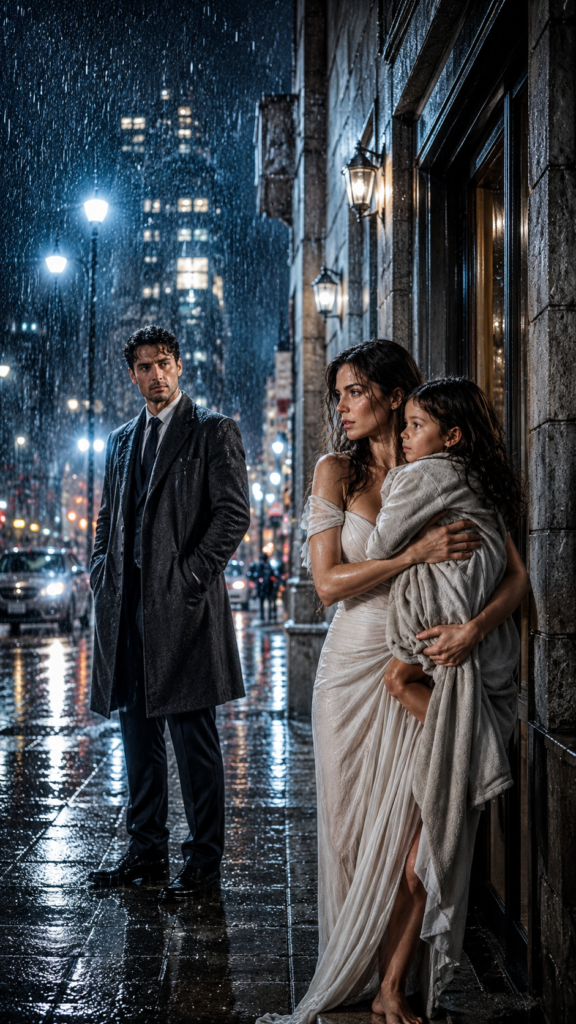
He had only entered because heavy rain was falling outside on Avenida Horacio, and his driver had stopped around the corner.
But then he saw her.
A woman standing at the counter, wearing a worn blue coat, her brown hair half-up, a crumpled prescription between her fingers.
Leonardo knew those shoulders.
He knew that way of standing tall even when the world was crushing her.
It was Mariana Beltrán.
His ex-wife.
The woman who three years ago had left the mansion in Las Lomas, her wedding ring on the dining table and a brief letter that said, “Forgive me, I can’t do this anymore.”
Since then, Leonardo had tried to track her down, to no avail. Or so he thought.
—I can leave half today —Mariana said to the pharmacist, her voice weary—. I’ll bring the rest on Friday. Please, my daughter needs the antibiotic tonight.
The employee lowered his gaze, uncomfortable.
—I’m really sorry, ma’am. The insurance denied coverage. Without authorization, it’s 4,860 pesos.
Mariana pressed the prescription against her chest.
She didn’t cry all at once.
She just closed her eyes for a moment, as if she were counting how much she could sell, how much she could borrow, how much more she could endure.
Next to her, a girl of almost three wore pink boots with yellow ducks. She had fair skin, dark hair, and enormous gray eyes.
The same gray eyes as Leonardo.
The girl tugged at Mariana’s sleeve.
—Mommy, I don’t need the medicine. I’m brave.
Leonardo felt the air leaving his lungs.
He stepped forward.
—Fill the prescription completely —he ordered.
Mariana froze.
Then she slowly turned.
When their eyes met, all the noise in the pharmacy faded away: the rain, the plastic bags, the cash register, the cough of an old lady by the vitamin aisle.
—Leo —she said.
Just that.
But in that word lay three years of absence, rage, and pain.
Leonardo looked at the girl.
—What’s your name?
The little one hid a bit behind Mariana.
—Sofía.
He swallowed hard.
—Hello, Sofía.
Mariana immediately scooped her up in her arms.
—We’re leaving.
—No —Leonardo said, louder than he intended.
Mariana’s eyes lit up with anger.
—Don’t give me orders.
Leonardo pulled out a black card and placed it on the counter.
—Antibiotic, fever medication, saline solution, thermometer, everything you need.
—Leonardo, no —Mariana whispered, furious.
He didn’t look at her.
He looked at Sofía.
—It’s not for you.
Mariana stood as if that sentence had hurt more than a blow.
The pharmacist handed over the bag. Mariana took it without thanking him, covering Sofía with her coat and walking out into the rain.
Leonardo followed at a distance.
He didn’t want to corner her.
Too much had already been taken from him to show up now with his money and guilt.
Mariana walked two blocks to an old building above a laundromat. A simple, damp place with peeling paint and a creaking door.
—Mariana —he called.
She stopped without turning.
—Please.
That word made her turn.
The rain hit her eyelashes.
—We have nothing to talk about.
Leonardo looked at Sofía, sleepy against her mother’s shoulder.
—How old is she?
Mariana’s face tensed.
—Don’t ask that.
—How old?
She took a deep breath.
—Two years and eight months.
Leonardo felt the world tilt.
—She’s mine.
It wasn’t a question.
Mariana looked at him with a sadness so old that something broke inside him.
—Yes.
The rain fell harder.
—Why didn’t you tell me?
Mariana let out a dry laugh.
—I tried.
—What?
—I called your office six times. Sent letters. Ultrasounds. Went to your house. I even waited outside one afternoon.
Leonardo stood frozen.
—I never received anything.
—I know —she said—. That was the plan.
—Whose?
Mariana looked down at the street.
—Your mother’s.
Leonardo clenched his fists.
—My mother died two years ago.
—But when I was pregnant, she didn’t.
Sofía coughed.
It was a small but deep cough.
Mariana changed completely. The anger vanished, leaving only fear.
—Mommy… my chest hurts again —the girl whispered.
Leonardo pulled out his phone.
—To the hospital. Now.
This time, Mariana didn’t argue.
The driver arrived in minutes. On the way to Hospital Ángeles, Leonardo called pediatricians, specialists, and executives. But upon admitting Sofía, a nurse frowned at the computer.
—Ms. Beltrán… there’s a financial restriction on the minor’s account.
Mariana paled.
—Restriction?
The nurse barely turned the screen.
Leonardo read the authorized name.
Fideicomiso Familia Arriaga.
Authorized by: Elena Arriaga de la Vega.
His mother.
Date: November 14.
Leonardo felt cold blood run through him.
That date was impossible.
Because Elena Arriaga had been buried for six months when someone signed that order.
PART 2
Leonardo stared at the screen as if he could erase those words with the force of his rage.
Authorized by: Elena Arriaga de la Vega.
His dead mother.
The nurse swallowed hard.
—The restriction doesn’t prevent emergency care, sir, but it blocks special authorizations, pharmaceutical support, payment agreements, and certain external treatments.
Mariana covered her mouth with a hand.
—That’s why they rejected everything...
Leonardo understood in seconds what Mariana had lived through for years.
It hadn’t just been poverty.
Someone had closed every door before she arrived. Every prescription, every appointment, every call to the insurance, every chance to breathe.
And all with the Arriaga name looming over it.
Sofía coughed again. The sound was so weak that Mariana ran to the stretcher and kissed her forehead.
—I’m here, my love. Breathe with me, okay? Slowly.
A doctor entered, wearing a white coat and a serene expression.
—I’m Dr. Camila Robles. First, we’re going to take care of Sofía. The rest can wait.
But for Leonardo, nothing was waiting.
While they examined the girl, while they placed oxygen on her and Mariana held her little hand as if she could anchor her to life, he made three calls.
The first was to his personal lawyer.
—Wake up the entire legal team. I want to know who accessed the Arriaga Trust after my mother’s death.
The second was to corporate security.
—I need digital experts, forensic accountants, and all private files of Elena Arriaga.
The third was to the hospital administration.
In less than thirty minutes, the restriction was provisionally lifted, two specialists arrived in the room, and Sofía received the treatment she needed.
Mariana caught up with him in the hallway.
—Don’t buy your way into her life.
Leonardo turned.
—I’m trying to save her.
—So am I —she replied.
That left him defenseless.
Because Mariana didn’t shout. She didn’t demand with drama. She spoke only with the weariness of a mother who had fought alone so many nights that even help felt like a threat.
—You don’t know what it was like to sit in waiting rooms and hear that my card didn’t go through —she said—. You don’t know what it was like to receive letters with your family’s seal saying that if I insisted on seeking you, I’d be accused of harassment. You don’t know what it was like to think you knew about Sofía and yet had erased us.
Leonardo stood frozen.
—What letters?
Mariana looked at him intently.
She searched for the lie.
She didn’t find it.
—Did you really not know?
—No.
She leaned against the wall.
—For three years, I thought you did.
Before he could say anything, Sofía woke up in the room.
—Mommy…
Mariana entered immediately. Leonardo opened the door and stepped aside.
That minimal gesture made her hesitate for a second.
And that second was the closest thing to trust he had received.
At three in the morning, the doctor confirmed the diagnosis: pneumonia with a severe respiratory infection. Treatable, yes, but dangerous because the right antibiotic had been delayed.
Leonardo felt each word like a sentence.
Delayed.
Rejected.
Blocked.
Denied.
When Sofía opened her eyes, she first looked at Mariana and then at him.
—Are you the medicine man?
Leonardo stepped closer slowly.
—Yes.
—You have sad eyes like my mommy.
Mariana lowered her gaze.
He felt a knot in his throat.
—Your mommy has the bravest eyes I’ve ever seen.
Sofía thought about it seriously.
—Are you my daddy?
The room fell silent.
Leonardo looked at Mariana. He wasn’t going to rob her of that answer. Not after everything.
She tightened the blanket between her fingers.
—Yes, my love —she finally said—. He is your daddy.
Sofía blinked.
—And where were you?
Leonardo had spoken before presidents, banks, and judges.
But that question destroyed him.
—I didn’t know about you —he said—. But I should have known.
The girl closed her eyes, tired.
—Mommy wrote you letters. In a blue box. She cried quietly.
Mariana stood up quickly.
—She needs to sleep.
But Sofía was already asleep.
Leonardo stepped into the hallway when his phone vibrated.
It was Arturo Cárdenas, his lawyer.
—We found something —Arturo said—. The restriction was not activated directly by your mother. It was an automatic protocol created before her death. It triggered when Sofía entered the pediatric system 18 months ago.
—Who programmed it?
There was silence.
—Germán Hale.
Leonardo felt his blood freeze.
Germán Hale was his closest advisor, the man who had managed family affairs after Elena’s death.
The man who held the keys to everything.
—There’s more —Arturo continued—. There’s a folder called Nightingale. It contains surveillance reports on Mariana, returned letters, drafts of custody demands, and an order to prevent the girl from being linked to the Arriaga assets.
—Find him.
—Leo, there’s something missing. In the file, Sofía appears as a potential heir, but there’s also a sealed record.
—Open it.
—I need your biometric authorization.
By morning, Arturo arrived at the hospital with a leather folder.
Mariana was beside Sofía’s bed, exhausted. Leonardo hadn’t slept.
They entered a consultation room.
Arturo first placed six envelopes on the table.
Mariana stopped breathing.
They were her letters.
“Leo, I’m pregnant.”
“Today I heard her heart.”
“I don’t think you’re rejecting my calls. Please, find me.”
Six screams unopened.
Leonardo took one with trembling hands.
—I never saw them.
—I know —Mariana said, her eyes full—. But that doesn’t give me back the years.
Arturo took out another document.
—There’s something else.
It was a birth certificate.
Beltrán, Sofía Elena. Born at 3:14 a.m.
Below it was another certificate.
Beltrán, Samuel Mateo. Born at 3:21 a.m.
Mariana stepped back.
—No...
Leonardo didn’t understand. Or didn’t want to understand.
Arturo spoke carefully.
—Mariana, according to this record, you gave birth to twins.
—No —she whispered—. I was unconscious. They told me there were complications, that Sofía was born small, that I lost blood. They never told me there was another baby.
Arturo produced a transfer authorization.
Signed by Dr. Henry Valdés.
Witness: Germán Hale.
Approved by Elena Arriaga.
Male baby transferred to private neonatal care.
Destination: confidential.
Mariana let out a sound that didn’t seem human.
Leonardo caught her before she fell.
For the first time in three years, she didn’t push him away.
She clung to his coat, trembling.
—They took my baby away...
Leonardo held her with a broken soul.
—Our baby.
The door opened.
A pale nurse appeared.
—Mr. Arriaga… there’s a man asking for you at reception. He left this.
It was a cream-colored envelope.
Leonardo recognized his mother’s handwriting.
Inside was a photo.
A boy of almost three, dark hair, fair skin, gray eyes, standing next to a woman dressed in black.
On the back, six words written in fine ink:
“You found Sofía. Now find Samuel.”
Before they could process it, Germán Hale entered the hallway with two lawyers and a calm smile.
—What a touching scene —he said—. But the custody of the girl is under review by the trust.
Mariana stepped in front of the door.
—No one touches my daughter.
Germán looked at her as if she were an annoyance.
—Your medical negligence has already been documented. You delayed treatment.
Leonardo advanced toward him.
—You blocked the treatment.
Germán smiled.
—You can’t prove it.
—Not yet.
Germán’s face barely changed.
—You should have left things as they were, Leonardo. Sofía activated blood clauses. Stocks, control, inheritance. Everything your father denied me.
Mariana’s eyes widened.
—What is he saying?
Germán let out a bitter laugh.
—That I’m also Ernesto Arriaga’s son. The half-brother of the great Leonardo. The hidden bastard while he inherited the empire.
Leonardo felt disgusted.
—That’s why you stole Samuel.
—I protected him —Germán said—. Unlike you, I understood his value.
At that moment, Sofía began to cough violently. Her oxygen levels dropped.
Mariana shouted for the doctor.
Leonardo forgot Germán.
Dr. Robles rushed in with nurses. They needed advanced treatment and urgent genetic tests.
—The trust hasn’t authorized —Germán murmured.
An elderly voice responded from the end of the hallway:
—No authorization is needed.
Everyone turned.
A white-haired man held up a USB drive and a notarized folder.
—I’m Joaquín Voss, private lawyer for Elena Arriaga. And I’ve been waiting three years for Germán Hale to make this mistake.
Germán paled.
Joaquín connected the USB to a laptop.
On the screen appeared Elena Arriaga, thin, ill, but with the same imposing gaze.
—Leonardo —she said in the video—, I did terrible things believing I was protecting this family. I believed false documents about Mariana. I threatened her. I kept her away. But then I discovered that Germán intercepted her letters and manipulated my fear.
Mariana cried silently.
—If there is a girl —Elena continued—, her legal guardian will be Mariana Beltrán. Not Leonardo. Not Germán. Not the board. Mariana. And if there is a second baby, find him before Germán uses him as a weapon.
The video continued.
—Leonardo, if you want forgiveness, don’t buy it. Earn it.
The screen went dark.
Joaquín handed the documents to the officials.
—The custody order is fraudulent. The medical restriction is annulled. And every action taken with Elena’s signature after her death is recorded. Including Germán Hale’s.
Security arrived minutes later.
Germán tried to speak, threaten, negotiate.
But his power unraveled in the hallway of a hospital, in front of a mother who was no longer alone.
Weeks later, Sofía improved. Leonardo turned out to be a match for the treatment she needed.
—Three years absent —he said one night—, and the only useful thing I can give you now is blood.
Mariana looked at him.
—No. You can give her tomorrow.
The search for Samuel lasted forty-seven days.
They found him in Querétaro, under another name, cared for by a retired nurse who thought she was protecting him under legal orders. When Mariana hugged him for the first time, she fell to her knees on the ground and repeated his name until she lost her voice.
Leonardo didn’t ask to return to the mansion.
He bought the building above the laundromat and transformed it into a family clinic called La Puerta de Sofía, with support for medicine, lawyers for single mothers, and social workers to fight paperwork before a prescription turned into tragedy.
The top floor remained empty.
—For what? —Mariana asked.
Leonardo handed her a key.
—For the life you choose. With locks only you control.
She held the key for a long time.
—One day at a time.
Leonardo nodded.
—That’s all I ask.
Months later, people said that Leonardo Arriaga found his daughter in a pharmacy.
But it wasn’t true.
He found his daughter when a sick girl wanted to stop suffering so her mommy wouldn’t spend money.
He found his son in a photo that his own mother left as a trap.
He found Mariana in six letters that should never have stayed sealed.
And he found himself not in his company, nor in his name, nor in the millions that everyone envied.
But on an ordinary night, when two small voices shouted from the room:
—Daddy, story!
Leonardo looked at Mariana.
She smiled.
—Go.
And he went.
Because this time, no one had to be brave alone.