PART 1
Mateo drove to his parents' house in a quiet neighborhood of Querétaro, his hands clenched around the steering wheel, a knot in his throat.
It was Don Ernesto's 60th birthday, and the whole family had gathered to eat carnitas, rice, tres leches cake, and take that obligatory photo where everyone smiles even though they’re tearing each other apart inside.
In the backseat was Camila, his 6-year-old daughter, clutching a brown stuffed puppy.
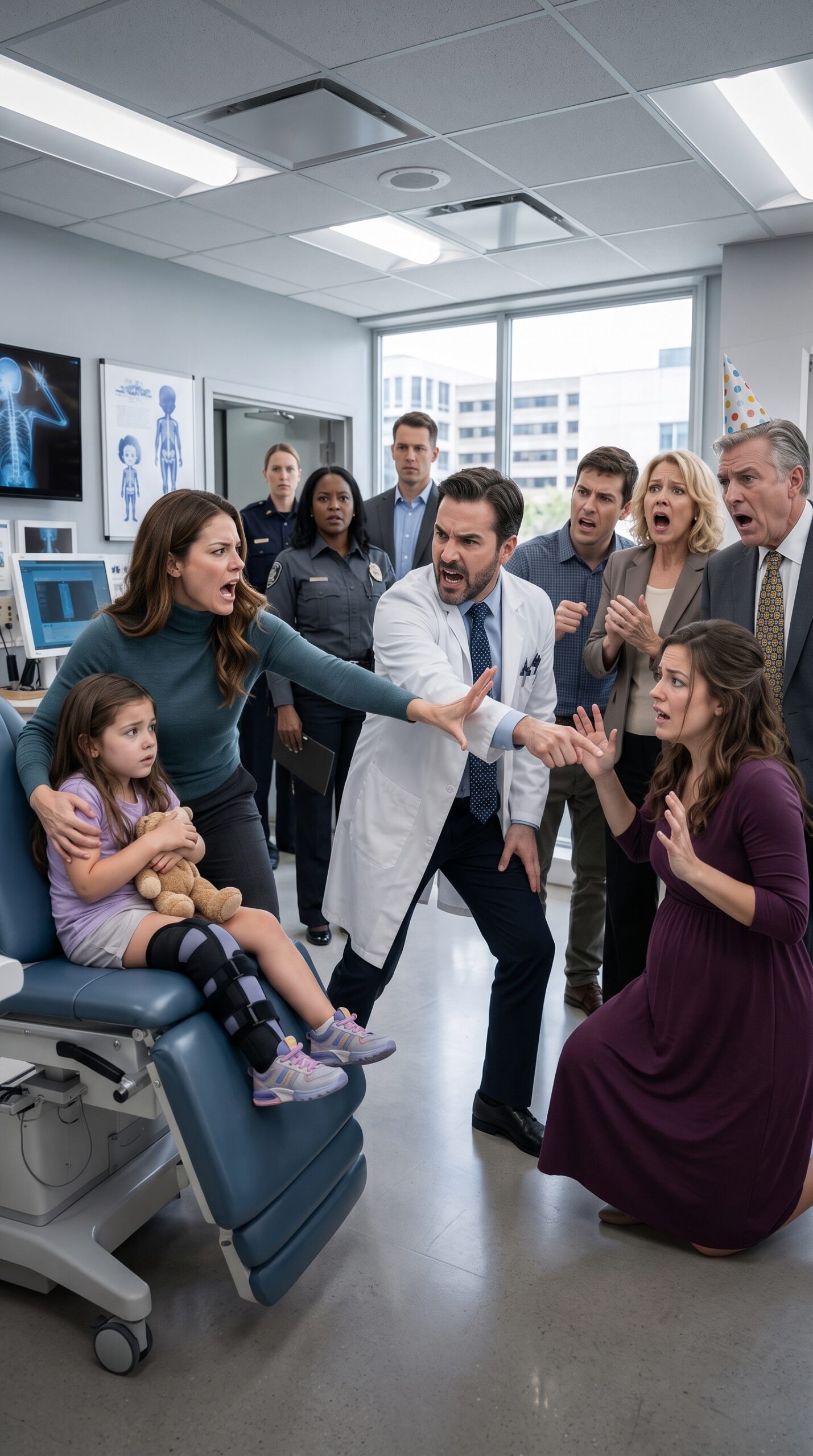
The little girl wore a purple brace on her left leg, secured with Velcro, because three months ago, they had reconstructed her knee due to a congenital malformation.
For Camila, walking was no game.
Every step pained her.
Every sidewalk was a test.
“Are we going to take long, Daddy?” she asked softly, eyeing the facade as if it were a dangerous place.
Mateo glanced at her in the mirror, forcing a smile.
“We'll eat, sing the birthday song, and then we’ll go, sweetheart. I promise.”
Camila squeezed her stuffed toy tighter.
“Is Aunt Maribel going to be there?”
A chill gripped Mateo's chest.
Maribel, his older sister, always claimed that Camila was “just being delicate.” That kids in her day would fall, get up, and keep running. That Mateo was raising her like “a glass flower.”
But the worst part wasn’t the jokes in front of everyone.
It was how Camila hid behind her father every time she heard her aunt's voice.
As they entered, Doña Alicia, the grandmother, greeted them with a quick kiss and an uneasy glance at the brace.
“Oh, look who’s here, the spoiled one of the house.”
Mateo took a deep breath.
In the dining room was Maribel, wearing a green blouse, wine glass in hand, and that smile that felt like a hug but stung like a needle.
“Look at you, Camilita,” she said, pointing at the leg. “Still with your little device? I thought the expensive surgery worked miracles.”
The girl lowered her head.
Mateo replied without raising his voice.
“The orthopedist said she needs to wear it until further notice. It’s not a whim.”
“Of course,” Maribel retorted, “here, everything the doctor says is law, right?”
The meal proceeded amid fake laughs, venomous comments, and silences that hurt more than obscenities.
Don Ernesto spoke about working 14-hour days at the hardware store, never asking for a break.
“Nowadays, everyone breaks down over anything,” he said. “They feel a little pain in their knee and they want an ambulance.”
Camila tried to adjust in her chair. Her leg trembled, and she pressed her lips together to hold back tears.
Mateo leaned toward her.
“Does it hurt?”
“A little,” she whispered.
Maribel burst into laughter.
“Does she also want us to roll out the red carpet to go to the bathroom?”
Some laughed.
Not all laughed loudly.
But they laughed.
Mateo was about to stand when the doorbell rang.
Doña Alicia opened the door to reveal Dr. Santiago Robles, Camila's specialist. Mateo had asked him to come by quickly because the brace had been rubbing her since the morning.
“Good afternoon,” the doctor said. “Sorry to interrupt. I just need to check on Camila for five minutes.”
The girl barely lifted her hand.
“Hi, doctor.”
“Hi, champ. How's that brave knee?”
Before she could answer, Doña Alicia turned off the lights for the cake. Everyone gathered around Don Ernesto, the candles illuminating his serious face.
They sang the birthday song.
Camila stood next to Mateo, holding onto the back of a chair.
And then Maribel shot her an annoyed glare, as if other people's happiness bothered her.
“That's enough,” she said abruptly. “Stop pretending to be invalid. You just want everyone to feel sorry for you.”
Mateo managed to say:
“Maribel, don’t you dare.”
But she was already crouched down.
Her hands yanked the brace.
The Velcro snapped in the middle of the dining room.
The device fell to the floor.
And Camila’s knee buckled.
The little girl collapsed onto the tiles with a tiny, broken scream, the kind that lingers in memory.
“Daddy, it hurts!”
For one second, no one moved.
Then cousin Julio let out a nervous laugh.
Aunt Nora covered her mouth.
Don Ernesto murmured:
“Don’t start with the theatrics.”
Maribel crossed her arms, satisfied.
“See? If she wanted to walk, she would.”
Then a firm voice came from behind her.
Dr. Robles approached, looking her straight in the eye.
“Ma'am, you just assaulted a minor with a serious orthopedic injury.”
PART 2
Maribel froze.
For a moment, she stopped looking like the confident woman who always dominated the family table and became someone who just realized her cruelty hadn’t remained hidden this time.
“Assault?” she repeated, forcing a false laugh. “Oh, doctor, please. She fell because she wanted to. The girl always puts on a show.”
No one answered.
Doña Alicia glanced toward the kitchen.
Julio turned his phone face down.
Aunt Nora, who had been laughing a minute ago, now had her eyes glued to her plate.
Mateo knelt beside Camila, not daring to move her. The girl cried against his chest, trembling, her leg twisted in a position that stole his breath away.
“I’m here, my love. I won’t let you go.”
Dr. Robles crouched down carefully.
“Camila, it’s me. I need to touch your knee a little, okay?”
She nodded through her sobs.
The doctor placed two fingers above the joint. Camila screamed.
Mateo felt something shatter inside him.
“Is it serious?” he asked.
The doctor didn’t sugarcoat the truth.
“There’s instability. The graft may have been compromised. She needs X-rays and evaluation today.”
“Oh, come on!” Maribel exclaimed. “Kids fall every day.”
The doctor looked at her coldly.
“Not every child comes out of knee reconstruction.”
Don Ernesto stood up angrily, as if the offense wasn’t seeing his granddaughter on the floor, but that they were ruining his party.
“Well, that’s enough. She can go tomorrow. It’s my birthday, for crying out loud. We’re not turning this into a drama.”
Mateo raised his gaze.
There was no fear in his eyes anymore.
Just sharp sadness.
“They ripped a medical device off my daughter and she fell because of it. And you’re worried about your cake?”
“I’m worried about the family,” Don Ernesto replied. “These things get settled here, not in front of strangers.”
Dr. Robles stood up.
“I’m not a stranger. I’m Camila’s treating physician. And if a minor with a documented injury was intentionally harmed, I have an obligation to report it.”
The word “report” dropped onto the table like a stone.
Maribel opened her mouth, but found no mockery to save her.
Mateo lifted Camila with the doctor's help. The brace remained on the floor, beside an extinguished candle and a plate of cake that no one would touch again.
As they were leaving, Maribel tried to stop them.
“Mateo, you’re really overreacting. That girl manipulates you. We all see it.”
Camila flinched at the sound of her voice.
That gesture was enough.
Mateo turned slowly.
“Don’t ever speak to my daughter again. Not today. Not ever.”
At the hospital, the night turned white, cold, and interminable.
Camila went through X-rays, examination, and pain medication. Mateo stayed by her side the whole time, holding her hand as she asked if she would ever be able to dance like her classmates.
“Yes, my girl,” he told her. “Step by step. No rush.”
Hours later, Dr. Robles entered the cubicle with a tired face.
“The graft didn’t completely rupture,” he explained. “That’s good news. But the fall did cause damage. There’s more swelling, more pain, and a risk of delaying recovery.”
Mateo closed his eyes.
It wasn’t an irreversible tragedy.
But it was damage.
Unnecessary damage.
Damage caused by someone who called herself family.
“I’m also going to leave a medical report,” the doctor added. “What I witnessed was not an accident. It was a direct aggression against a child with a medical condition.”
Mateo looked at Camila, asleep, with her stuffed puppy pressed against her chest.
For years, he had tolerated comments to avoid fights.
That he was exaggerated.
That he was henpecked.
That he didn’t know how to raise her.
That a girl needed “character.”
That night, he understood something that hurt more than anything: his silence had been taken as permission.
“Make the report,” he said. “And give me a copy of everything.”
The next day, the messages began to arrive.
Doña Alicia wrote first:
“Your sister didn’t mean to hurt anyone. She has her way, but she’s good. Don’t destroy the family over a bad moment.”
Don Ernesto sent another:
“When the girl’s tantrum passes, you come apologize for the scene.”
Maribel was crueler.
“You made me look like a monster. You know Camila exaggerates. It was clear in front of everyone.”
Mateo didn’t respond.
Not yet.
First, he opened the family chat he had silenced for months.
He read old messages.
Maribel had written two weeks before the surgery:
“So, are you really going to operate on the mini actress? How convenient to have a sick daughter so everyone cuts her slack.”
Julio replied with laughing emojis.
Don Ernesto wrote:
“In the past, those things were corrected by walking, not by paying doctors.”
Doña Alicia added:
“Mateo has always been very sensitive since he was a child.”
Mateo took screenshots.
He kept scrolling.
And found something that froze his blood.
A message from Maribel said:
“Let me be alone with that girl for five minutes and I’ll fix her crookedness. You’ll see how she walks when no one’s praising her little show.”
Mateo felt nauseous.
It wasn’t just anger at the moment.
It was intent.
That same afternoon, he called Camila’s school.
The principal, Ms. Rebeca, fell silent when Mateo asked if Maribel had ever picked up the girl.
“She came three times,” she admitted. “She was on the emergency list.”
“Did something happen?”
There was a long pause.
“There’s a video I think you should see.”
Mateo arrived at the school with a tight chest.
In the hallway footage, Maribel was seen pulling Camila by the hand. She walked too fast. The girl struggled to keep up with the brace, stumbling with each step.
There was no audio.
But Camila’s face said it all.
Fear.
Shame.
Pain.
Afterward, Maribel mimicked her walking in front of another mom, moving her leg mockingly.
The principal covered her mouth with her hand.
“She said you were too protective. She told us the doctor had asked us to push Camila more.”
Mateo didn’t shout.
He didn’t smash anything.
He just asked for a copy of the video.
That night, while Camila slept, he put together a folder.
Screenshots of the chat.
Video from the school.
Medical directives.
Doctor’s report.
Photos of the broken brace.
He even printed an email where Maribel asked the school not to indulge the girl’s “dramas.”
The pattern was clear.
Maribel hadn’t exploded at the birthday party.
She had escalated a cruelty she had been practicing for months.
The following Friday, Mateo returned to his parents' house.
This time he was alone.
Camila stayed with a neighbor watching cartoons. When he told her she didn’t have to go, the girl let out a sigh so deep it hurt Mateo more than any accusation.
In the dining room, everyone was there.
Don Ernesto at the head.
Doña Alicia with swollen eyes.
Maribel made up but looked nervous.
Julio and Aunt Nora pretended to look at their phones.
Mateo placed the folder on the table.
“Before you say I’m exaggerating, you’re going to see everything.”
Maribel let out a dry laugh.
“What a big shot, are you a lawyer now or what?”
“No,” Mateo replied. “I’m a dad. And you’re all experts at rewriting history afterward.”
He pulled out the screenshots and read the messages where they called Camila “the actress,” “the drama queen,” “the little hospital princess.”
Doña Alicia turned pale.
“I didn’t mean it with bad intentions.”
“Intentions didn’t take the fear away from my daughter,” he replied.
Then he laid the images from the school video on the table.
Maribel frowned.
“That’s out of context.”
“Then explain to me the context of mocking how a six-year-old girl walks.”
No one spoke.
Don Ernesto slammed the table.
“That’s enough. Your sister made a mistake, yes. But you’re enjoying this too. You always wanted to play the victim.”
Mateo looked at him with old sadness.
“No, Dad. I learned to be a victim in this house. Today I’m learning to stop being one.”
Then he pulled out the last document.
Dr. Robles’s report.
He placed it in front of Maribel.
“It says here that what you did was non-accidental trauma. It states that it could have caused her a permanent disability. It says that the report has already been sent to the relevant authorities.”
Maribel read two lines and started to tremble.
“You can’t do this to me. I’m your sister.”
“You stopped being an aunt when you hurt my daughter.”
“It was a mistake!”
Mateo shook his head.
“A mistake is dropping a glass. A mistake is forgetting an appointment. You watched over her, humiliated her, convinced everyone she was lying, and then you ripped the brace off in front of the family.”
Maribel began to cry.
But her tears sounded like fear, not remorse.
“Mom, say something. Dad, please.”
Don Ernesto glared at the report with rage.
“Doctors exaggerate. This gets fixed among us.”
Then, from the entrance, Dr. Robles appeared.
Mateo had called him to deliver a sealed copy of the report.
The dining room froze.
“Good evening,” the doctor said. “I came to confirm that the report is real, that I witnessed the aggression, and that Camila suffered physical harm as a consequence.”
Maribel covered her mouth.
Doña Alicia began to cry.
Don Ernesto tried to assert himself, but his voice didn’t sound as strong anymore.
“You don’t understand. We are family.”
The doctor replied without hesitation:
“That’s precisely why you should have protected her.”
The statement pierced the house.
Because it was true.
They hadn’t protected her.
They laughed.
They stayed silent.
They looked the other way.
Then they wanted to clean the cruelty with the word family, as if that word could erase everything.
Mateo gathered the folder.
“Camila will never return to this house. Maribel will not approach her. And if anyone tries to see her without my permission, I will use all this legally.”
“You’re going to destroy the family,” Doña Alicia cried.
Mateo paused at the door.
“No, Mom. I’m just stopping you from destroying my daughter.”
Months passed.
There were reports, interviews, mandatory therapy for Maribel, and a restraining order prohibiting her from approaching Camila.
The family said Mateo had overreacted.
That he had become cold.
That he preferred to believe a doctor over his own blood.
But one afternoon, while Camila was doing rehabilitation in the living room, she took four steps without crying.
Mateo knelt before her.
“You did it, champ.”
She smiled shyly.
“Do I never have to see Aunt Maribel again?”
Mateo felt that question shatter his soul.
“Never again.”
Camila hugged him tightly.
And in that embrace, Mateo understood what many adults forget for fear of what others might say:
Family isn’t who sits with you at the table.
Family is who gets up when they see you fall.