PART 1
When Santiago Arriaga hired Lucía Mendoza to care for his son, he didn't do it out of trust. He did it because he could no longer pretend that the house in Las Lomas wasn't quietly falling apart.
Mateo was four years old, had a collection of dinosaurs, and a sadness that seemed too big for his small body. Ever since his mother, Isabel, died in a car accident on the Mexico-Cuernavaca highway, the boy spoke little, ate less, and slept clutching a jacket that still smelled like her.
Santiago owned a technology company in Santa Fe. He had a chauffeur, bodyguards, a house with a huge garden, and meetings starting at 7 a.m. He also had a son who asked every night if the sky was very far away.
Lucía arrived on a Monday with a simple backpack, her hair tied back, and an unusual calm. She didn’t seem impressed by the marble floors or the expensive paintings.
Mateo was in the living room, stacking blue blocks.
—What are you doing? —Lucía asked, sitting on the floor, careful not to invade his space.
—A tower —he said.
—For whom?
Mateo placed another block with great care.
—So my mom can see it from the sky.
Santiago, standing behind the door, felt something crack inside his chest. He hoped Lucía would say one of those false phrases everyone repeated: “Your mom is always with you,” “Don’t be sad,” “Everything will be alright.”
But she only looked at the tower.
—Then we need to make it strong —she said softly—. Tall things need a good base.
Mateo looked at her for the first time. And then, for the first time in weeks, he picked up another block.
That afternoon, Santiago hired her.
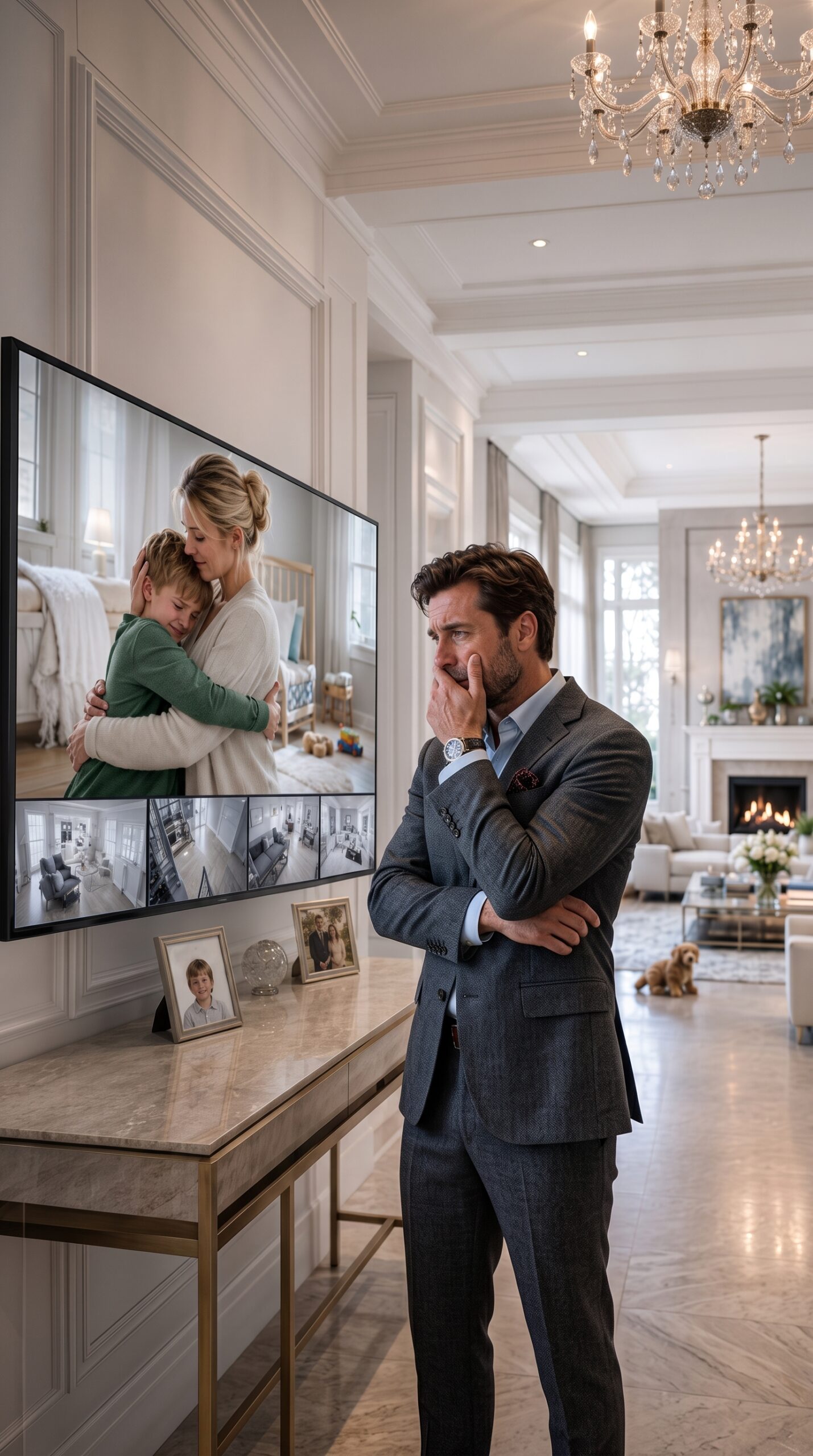
That night, he had hidden cameras installed.
He told himself it was for security. That any responsible parent would do it. That his son was vulnerable, that a stranger would enter his home, that there were already too many horrible stories in the news.
The technicians arrived while Mateo slept. They installed cameras in the kitchen, the living room, the hallway, the garden, the playroom, the front entrance, and even in the boy's bedroom.
Santiago hesitated before authorizing that last one.
Isabel would have hated him.
But fear won.
At 11:14 that night, the eight cameras appeared on his laptop. Santiago watched the screens with a false sense of control.
The next day, before arriving at his office, he opened the app from the car.
Lucía arrived at 7:58. She greeted Martina, the woman who helped around the house, washed her hands, and prepared scrambled eggs.
At 8:20, she knocked on Mateo's door.
—Good morning, champ. Can I come in?
The boy mumbled something.
Lucía entered.
Mateo was sitting on the bed with his stuffed dinosaur clutched against his chest.
—I made eggy.
—My mom made it with yellow cheese —he said.
Santiago tightened his grip on the phone.
There it was. The mistake. The comparison. The moment when Lucía would try to replace Isabel.
But Lucía barely smiled.
—I don’t know how to make it like your mom. But you do. Will you teach me?
Mateo raised his head.
—Me?
—Of course. You’re the expert chef.
The boy climbed down from the bed.
Half an hour later, Santiago watched from his phone as Mateo told Lucía that it needed more cheese, not to stir so fast, that his mom used the blue plate.
And then something happened that left him frozen.
Mateo laughed.
A small, rusty laugh, as if it had been kept inside for months.
Santiago was on the Periférico, heading to a million-dollar meeting, but he stopped listening to the driver. He only stared at the screen.
All day he reviewed the cameras. Lucía didn’t shout. She didn’t neglect the boy. She didn’t do anything suspicious.
And that made him angrier.
Because the cameras weren’t proving that Lucía was dangerous.
They were proving that he was not there.
That night, while reviewing a recording from Mateo's room, Santiago heard the boy talking to himself in front of his tower of blocks.
—Mommy, Lucía came today. She’s nice. Not like you, because no one is like you...
Santiago turned up the volume.
Mateo placed the last block on top and whispered:
—Is it wrong if I don’t want to be sad all the time?
PART 2
Santiago stood paralyzed in front of the laptop.
The house was silent, but in his head, that question sounded like a dull thud against a closed door.
“Is it wrong if I don’t want to be sad all the time?”
Mateo wasn’t talking to Lucía. He wasn’t talking to Martina. He was talking to his dead mother, asking for permission to live.
Santiago slammed the laptop shut, as if turning off the screen could erase his guilt. But that night he didn’t sleep. He paced his bedroom, opened a bottle of whiskey and didn’t drink it. He looked at Isabel’s photo on his nightstand and felt a shame so deep he couldn’t even cry.
The following week, Santiago watched even more closely.
He said it was to protect Mateo, but in reality, he watched because he didn’t know how to approach his own son.
At the office, while his lawyers discussed contracts, he watched Lucía sit on the floor to play with dinosaurs. While his financial director talked about losses and gains, he saw Mateo cutting apples with cookie cutters to make “T-Rex tracks.”
Lucía wasn’t trying to erase Isabel.
On the contrary.
She asked Mateo what his mom smelled like, what songs she sang, what stories she liked to read. And when the boy cried, she didn’t say “stop crying.” She just stayed there.
One afternoon, Santiago arrived early and found the living room turned into a castle. Cushions, sheets, a broom as a sword, and Mateo wearing a cardboard crown.
—Dad! —the boy shouted—. Come into the castle!
Santiago stood in the doorway with his jacket still on.
Lucía was sitting on the floor with a crooked crown.
—The kingdom welcomes visitors —she said.
Mateo ran and took her hand.
—I’m the king. Lucía is the dragon, but a good dragon.
Santiago looked at his son’s little hand over his. It was small. Warm. Trusting.
—I have work —he replied automatically.
The sparkle in Mateo’s eyes didn’t disappear suddenly. It dimmed slowly, like a candle without air.
—Oh. Okay.
—Maybe later —Santiago added.
But Mateo already knew that “later” almost always meant never.
Santiago went up to his office, closed the door, and opened the cameras.
In the living room, Lucía was picking up a fallen sheet.
—Your dad works a lot to take care of you —she said.
Mateo kicked a cushion.
—I don’t need that many things.
Santiago moved closer to the screen.
—I need him.
The phrase pierced him worse than any insult.
Lucía didn’t try to fix it quickly.
—I know —she said.
—Do you think my dad loves me?
Santiago stopped breathing.
Lucía caressed the edge of the cardboard crown.
—Yes. I’m sure.
—How do you know?
—Because when he looks at you and thinks no one sees him, it seems like his heart is going to break.
Mateo lowered his head.
—He always looks sad.
—Sometimes people look sad because they love so much that it scares them.
—Does loving scare?
—Yes. But it can also be brave.
Santiago closed the laptop.
That night he went down to the kitchen and found Lucía washing a cup.
—Martina can do that tomorrow —he said.
—I know. She helps me think.
He stood beside the island, uncomfortable in his own home.
—Mateo seems different.
—Maybe he’s remembering he can still be a child.
Santiago frowned.
—What do you mean by that?
Lucía dried her hands calmly.
—that he has been trying not to be a problem for you.
—I never asked him for that.
—not with words.
The defense rose in him like fire.
—You’ve been here for six days. You don’t know this family.
—No —she replied—. But I know children. And I know how a child looks when they think their sadness is a burden.
Santiago clenched his jaw.
—That’s enough.
Lucía nodded.
—Good night, Mr. Arriaga.
He wanted to get angry. Anger was easier than the truth. But the truth didn’t go away, even when you threw rage on top of it.
At midnight, he opened the cameras again.
Mateo was awake, staring at the ceiling. Lucía entered slowly.
—Can’t you sleep?
The boy shook his head.
—Do you want me to sit for a bit?
Mateo nodded.
Several seconds passed in silence.
—Do you think my mom gets mad? —he asked.
—Why would she get mad?
Mateo spoke so softly that Santiago had to turn up the volume.
—Because sometimes I wish I had a mom here. And that means I’m bad.
Santiago felt the air escaping from his lungs.
Lucía knelt beside the bed and took the boy’s hands.
—Mateo Arriaga, listen to me carefully. Wanting someone to hug you doesn’t make you bad. Missing your mom doesn’t mean you have to stay sad forever. Loving someone who is here doesn’t mean you stop loving those who are gone.
Mateo’s eyes were filled with tears.
—Really?
—Really. The beautiful love isn’t jealous. The beautiful love wants you to be cared for.
—I like you, Lucía.
She swallowed hard.
—I like you very much too, little guy.
—Are you going to stay?
—As long as I can.
—Real promise?
—Real promise.
When Mateo fell asleep, Santiago turned off the screen with trembling hands.
The cameras had shown him what he demanded to see.
No abuse.
No neglect.
Love.
And that scared him more than any danger.
The next morning, a scream woke him.
Santiago ran down the hall. Mateo was sitting up in bed, crying, with the blankets tangled around him.
—Dad!
Santiago scooped him up without thinking.
—I’m here. I’m here.
—I dreamed you were leaving too.
The boy’s voice broke Santiago’s heart.
—No, my love. I’m not leaving.
—Real promise?
Santiago hugged him tighter.
—Real promise.
Lucía appeared in the doorway, disheveled, in sweatpants and a hoodie.
—Is he okay?
—Nightmare —Santiago said.
She looked at Santiago’s arms around the boy and took a step back.
—Do you need anything?
He shook his head.
Lucía left.
It was the first time she allowed Santiago to occupy his place.
Later, when Mateo fell asleep again, Santiago found Lucía in the hallway.
—Thank you.
—Why?
—for not entering.
She looked at him with a calm sadness.
—it wasn’t my place. It was yours.
Santiago looked down.
—I don’t know how to do this.
—No one knows in the beginning.
—Isabel did. She knew which cry was for hunger, which was for fear, which dinosaur had to sleep on the left side. I was the provider. I worked, paid for everything. I thought that was enough.
Lucía didn’t contradict him.
—it wasn’t enough —he said.
—No. But it can start to be different.
Santiago let out a bitter laugh.
—you make it sound easy.
—it’s simple, not easy. Show up. Stay when it hurts. Speak the truth. Apologize when you fail. Try again.
Over the next two weeks, Santiago awkwardly changed.
He came home for dinner.
The first night, Mateo looked at him suspiciously over a plate of nuggets.
—Are you going to eat here?
—Yes.
—Why?
Santiago swallowed hard.
—Because I want to.
Mateo thought for a few seconds.
—you can use my ketchup.
For Santiago, that felt like forgiveness.
He started reading stories before bed. At first, his voice sounded like a board meeting, stiff and serious. Mateo didn’t care. He leaned against his arm as if his dad were gifting him gold.
On a Friday, Santiago went out to the garden and saw Lucía pushing Mateo on the swing.
—Higher!
—Higher and you’ll go all the way to Puebla —she joked.
Mateo let out a huge laugh.
When he saw Santiago, the laughter stopped.
That hurt.
—Can I try? —he asked.
Mateo’s eyes widened.
—you’re going to push me?
—Yes.
Lucía stepped aside.
As Santiago passed by her, she murmured:
—Gentle at first.
—I know how to push a swing.
She looked at him as if to say “Yeah, right.”
He almost smiled.
He placed his hands on the back of the swing and pushed.
—Higher, dad!
And Santiago pushed higher.
For fifteen minutes, he didn’t make money, didn’t sign contracts, didn’t resolve pending issues.
He just pushed a swing.
And something inside him, something he had buried for months, began to breathe.
That night, he found Lucía in the hallway.
—I have to tell you something.
—The cameras? —she asked.
Santiago was left speechless.
—you knew?
—I found one in the smoke detector in the kitchen on the second day. Then the one in the playroom. Then the hallway.
—Why didn’t you quit?
—Because Mateo needed me.
He didn’t know what to say.
—and because I understood you weren’t watching me for me —Lucía continued—. You were watching because you once lost everything you loved and believed that if you controlled enough, it wouldn’t happen again.
Santiago’s throat closed up.
—I violated your privacy.
—Yes.
—Forgive me.
—Thank you for saying it.
—I’m going to remove them all.
—that would be the right thing to do.
The next day, Santiago called the security company.
—I want you to remove the entire system.
—All the cameras, Mr. Arriaga?
Santiago looked out the window. Mateo was coloring with Lucía.
—All of them.
—Was there a technical failure?
—Yes —he said—. The failure was me.
When the technicians took away the last camera, the house seemed to release its breath.
That Sunday, Mateo appeared in the kitchen hugging his dinosaur.
—Are you going to work today?
—No.
—Nothing?
—Nothing.
—Then what are you going to do?
Santiago squatted in front of him.
—Whatever you want.
Mateo thought as if he’d been given the keys to a kingdom.
—Can we go to the duck park?
Santiago felt a blow to the chest.
It was Chapultepec Park where Isabel used to take Mateo on Sundays. She always brought oats for the ducks, sunscreen, extra socks, and coffee for Santiago, even though he often ended up answering emails on a bench.
He hadn’t been back since the accident.
Lucía, by the coffee maker, watched him silently.
—Yes —Santiago said—. We can go.
At the park, Mateo ran toward the lake.
Santiago stood still.
—This was our place —he told Lucía—. Isabel loved coming here.
—We can leave.
Mateo shouted excitedly:
—Baby duckies!
Santiago took a deep breath.
—No. It’s time.
They walked to the water. Mateo crouched by the shore.
—Mom always brought food.
—Yes —Santiago said—. Your mom didn’t forget anything. Oats, water, your blue cup, my coffee. Once she brought three umbrellas because she said I looked like a man capable of forgetting that rain existed.
Mateo smiled.
—Did you forget?
—Yes.
—Did mom get mad?
—No. She laughed so hard that she almost dropped the bag.
For an hour, Santiago told stories about Isabel. How she danced cumbias in the kitchen, how she cried at puppy commercials, how once she burned pancakes and said they were “gourmet style.”
Mateo listened as if recovering pieces of a treasure.
Lucía walked a few steps behind, giving them space.
That night, Santiago finally opened the cedar trunk that held Isabel’s things. There were photos, tickets, hospital bracelets, and a letter with his name.
“Santi.”
He opened it with trembling hands.
Isabel had written to him before she died, as if she had known that one day he would need a shake-up.
“I know your way of surviving,” the letter said. “You’re going to close all the doors of your heart and call it strength. Don’t do it. Mateo doesn’t need a perfect man. He needs the man I loved.
Let him talk about me. Tell him silly things. Tell him I burned pancakes and sang horribly. Tell him he can love me always and still be happy.
And if one day someone good comes into your life or into our son’s, don’t punish yourself for smiling. Love isn’t a room with one chair. It’s a house that grows when we let others in.
Live, Santi.
For him.
For me.
For you.”
Santiago cried like he hadn’t cried in months.
Not with hidden tears. Not with pride. He cried like a man finally releasing an entire building he had been carrying with his hands.
At four in the morning, he entered Mateo’s room and sat beside his bed.
—I promise to be here —he whispered—. Not just in this house. Here. With you.
Mateo opened his eyes.
—Did you get lost, dad?
Santiago closed his eyes.
—Yes, my love. I got lost. But I’m coming back.
Weeks later, on Mateo's fourth birthday, there were dinosaur balloons, chocolate cake, and children running around the garden. Santiago ended up with icing on his shirt and grass on his shoes.
Mateo handed him a card drawn with Lucía’s help.
In the drawing were three figures under a yellow sun: a tall man, a small boy, and a woman with dark hair. The three holding hands.
—It’s us —Mateo said—. You, me, and Aunt Lucía.
Santiago felt his throat close up.
Inside, in crooked letters, it said:
“Thank you for coming back, dad. I love you.”
Santiago cried in front of his son.
Mateo got scared.
—Are you sad?
—No —he said, hugging him—. I’m happy. So happy that my heart doesn’t know what to do with so much.
Lucía watched them from the door, with tears in her eyes.
A few months later, they returned to the duck park. Mateo ran between the trees and suddenly came back with a blue feather in his hand.
—It’s mom’s —he announced—. She sent it to say she’s happy because we are happy.
Santiago looked at the feather, at his son, and at Lucía, who was by his side. He didn’t know if that was a sign. He no longer needed to know.
Mateo had found peace.
That was enough.
Santiago took Lucía’s hand and hugged his son with the other arm.
—Your mom wants us to be happy —he said.
—And are we happy? —Mateo asked.
Santiago looked at his life.
It wasn’t perfect. It wasn’t easy. It wasn’t free of pain.
But it was real.
It was alive.
—Yes —he replied—. We are.
The cameras had shown the truth, but not the one Santiago expected. He put them in place to catch a stranger doing something wrong. Instead, they captured a boy being brave, a nanny choosing tenderness over resentment, and a father hiding from love for fear of losing it again.
In the end, what saved that family wasn’t control.
It was presence.
It was asking for forgiveness.
It was a boy building towers for the sky.
And it was understanding that love isn’t measured by how much you close your heart to avoid pain, but by how much courage you have to open it again.