PART 1
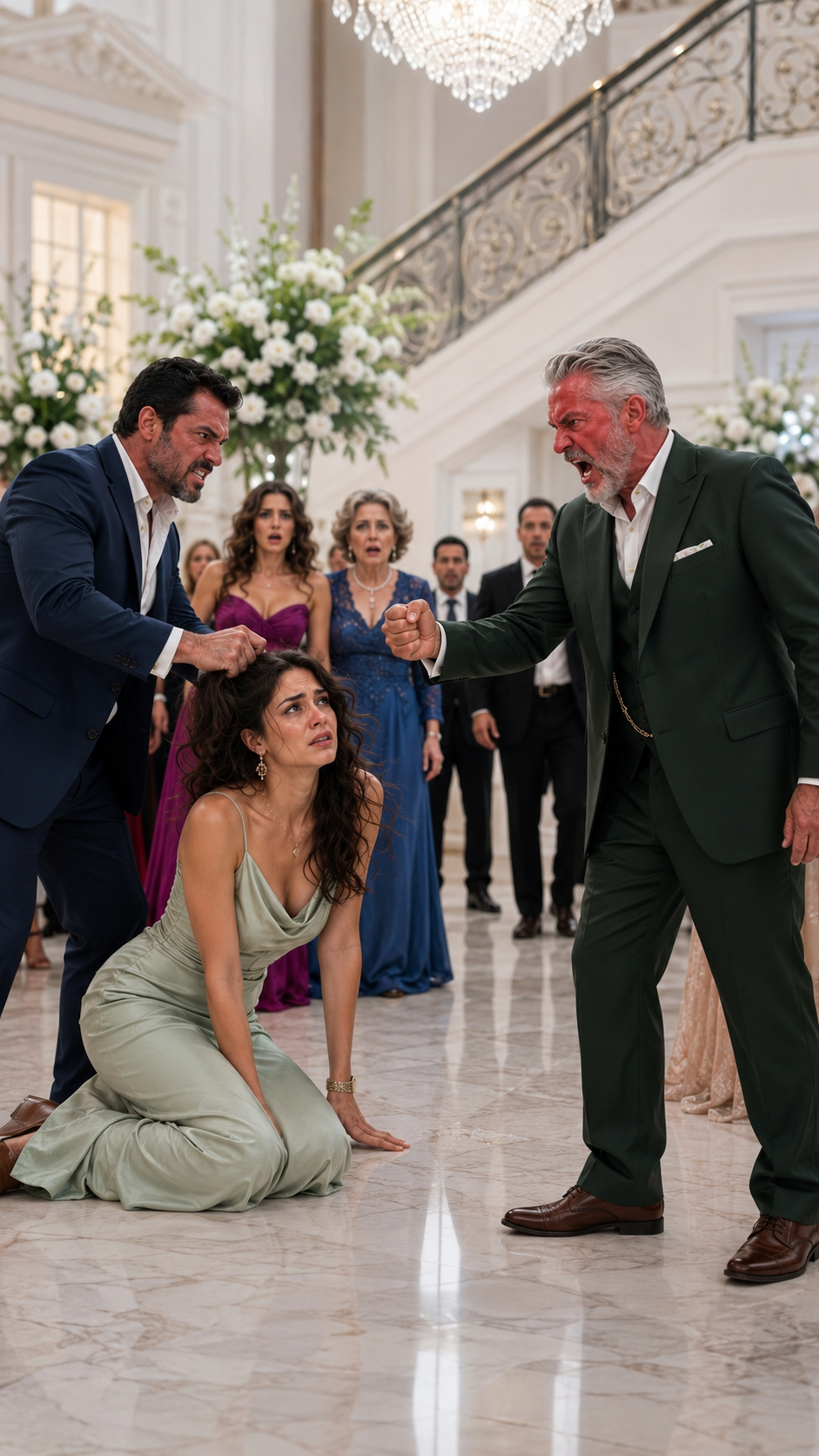
“When Julián is buried, the house and the general store will be mine,” Ramiro said in front of everyone, clutching a folder to his chest. “So start packing your things.”
Silence fell over the chapel of the San Mateo municipal cemetery like a bucket of ice water.
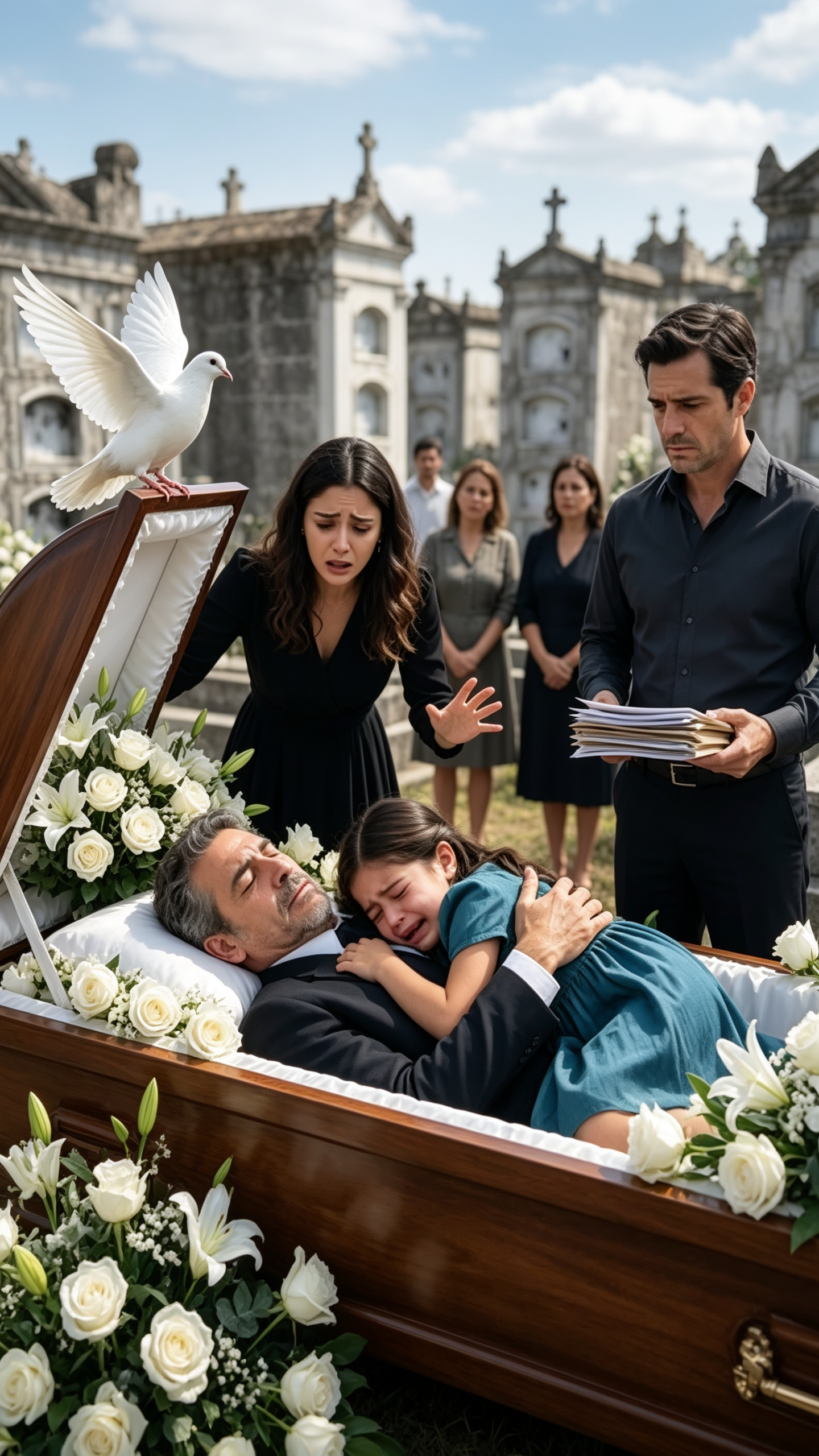
Rosa, dressed in black and with eyes swollen from crying, could barely hold the hand of Lucía, her 5-year-old daughter. The little girl didn’t understand why her uncle was talking about houses, keys, and papers while her father lay in a white coffin, covered in flowers.
“Mommy… why does Uncle Ramiro want our house?” Lucía asked softly.
Rosa didn’t answer. A lump formed in her throat.
Julián had died just the previous morning, after a six-month battle with an illness that slowly weakened his body, but never extinguished his gaze. Until his last day, he asked about the store, the accounts, Rosa, and his "little one," as he'd called Lucía since she was born.
The general store "La Bendición" wasn't much to the town's wealthy. A small shop with an old refrigerator, sacks of beans, votive candles, sodas, and candy for the elementary school children.
But for Julián, it was his whole life.
He had started by selling gelatin outside the market. Then he set up a table with sweet bread. Later, he bought a used shelf, rented a small room, and, with Rosa by his side, transformed that humble business into the place where everyone bought on credit when their paycheck wasn't enough.
Ramiro, his older brother, never showed up during the hard times.
He wasn't there when Julián slept on the floor of the storage room. He didn't lend a single peso when Lucía was born prematurely. He didn't help when Rosa closed the store at night carrying the baby while Julián, feverish, stacked boxes.
But when he learned that Julián was sick, he returned to the village wearing shiny shoes, an expensive watch, and a smile that didn't reach his eyes.
"I'm your brother, man. Let me help you," he'd say.
Julián didn't trust him.
Rosa noticed. Every time Ramiro arrived at the hospital, Julián clutched the sheet, begged them not to leave Lucía alone, and changed the subject when they asked him what was wrong.
"Just promise me one thing, Rosita," he said one night, his voice breaking. "If my brother speaks at my funeral, don't believe a word he says before you open what I left you."
Rosa thought he was delirious from the medication.
Now, standing before the coffin, she understood that he wasn't.
“I have signed documents,” Ramiro announced, holding up the folder for everyone to see. “Julián gave me the house and the general store to settle an old debt. The widow has three days to leave.”
The neighbors began to murmur.
Doña Meche, who had bought milk on credit for years, crossed herself angrily. Don Chava, the butcher, lowered his gaze as if ashamed to witness such cruelty.
“Ramiro, please,” Rosa pleaded. “We’re burying your brother today.”
“Don’t give me any of that drama,” he replied. “Business is business.”
Lucía let go of her mother’s hand and walked toward the coffin.
“I want to hug my dad,” she said.
Rosa tried to stop her, but the little girl was already pressing her face against the white wood.
Ramiro let out a dry laugh.
“Go on, give him a big hug.” Because when they lower that coffin, the show will be over.
Lucía closed her eyes, hugged the coffin with her small arms, and whispered something no one could hear.
Then, from the trees of the cemetery, a white dove appeared, flying straight toward the flowers on the coffin.
And no one could believe what was about to happen…
PART 2
The dove didn't circle or get lost among the people. It flew as if it knew exactly where to go and landed on the coffin, right where Lucía's little hands were resting.
A stifled cry echoed through the open chapel.
"My God…" murmured Doña Meche.
Father Gabriel stopped praying. Even the men carrying the ropes to lower the coffin froze.
Lucía lifted her tear-streaked face and looked at the bird with a calmness that moved everyone.
"It's my dad," she said. "He heard me."
Ramiro pursed his lips.
"Don't talk nonsense. It's just a filthy pigeon. Enough with the show."
He took a step to shoo it away with the folder, but the bird didn't move. On the contrary, it pecked gently among the white flowers until it pulled a thin ribbon, hidden beneath a bouquet of calla lilies.
The ribbon came loose.
Underneath appeared a small, yellowish envelope, with Rosa's name written in Julián's shaky handwriting.
Rosa felt her knees buckle.
"That envelope..." she whispered. "That's his handwriting."
Ramiro paled slightly, but quickly recovered.
"You probably put it there. How awful, Rosa. You won't even leave my brother in peace."
"Shut up, you wretch!" Doña Meche shouted, not caring that they were at a funeral. "I arranged those flowers with the funeral home girl." That envelope was inside Julián's sack. I thought it was a prayer.
Rosa took the envelope with trembling hands.
On the back it said: “Open it when Ramiro tries to take everything from you.”
The murmurs grew louder.
Ramiro clenched his jaw.
“That’s a family matter. Give it to me.”
Rosa looked at him for the first time without fear.
“Julián’s family is Lucía and me.”
Before she could open it, a man in a gray suit rushed into the cemetery. He was sweating, carrying an old briefcase.
“Don’t lower the coffin!” he demanded. “I’m Esteban Robles, notary of San Mateo. Don Julián left precise instructions.”
Ramiro took a step back.
"What are you doing here?"
"Fulfilling your brother's wishes," the notary replied. "He asked me to come if you intended to claim the house during the funeral."
The air grew heavy.
Rosa opened the envelope. Inside were a letter, a small key, and a USB drive wrapped in paper. The notary asked permission to read the letter aloud. Rosa nodded, holding Lucía close to her chest.
The first line broke everyone's hearts.
"My dear Rosita, forgive me for not telling you everything. I didn't want you to carry any more fear while I was fading away."
Rosa covered her mouth.
The notary continued reading.
“Ramiro came back when he found out I was dying. He told me you wouldn’t know how to run the general store, that Lucía was too young, and that the best thing to do was put everything in his name to ‘protect’ him. When I said no, he started threatening me. He reminded me of an 18,000-peso debt he lent me years ago, but I already paid that debt in full, with interest, by selling merchandise in the early morning hours.”
Ramiro snorted.
“That doesn’t prove anything.”
The notary didn’t stop.
“I kept the receipts in the box buried next to the lemon tree in the yard. I also left recordings. I didn’t do it out of anger, but because I know my brother. If he’s reading this in front of everyone, it’s because he tried to take everything from them on the day of my funeral.”
A murmur of indignation rose like fire.
Lucía looked at her uncle, her eyes red.
“My father didn’t lie.”
Ramiro pointed at her.
"Nobody asked you, brat."
Rosa stepped forward.
"Don't you ever speak to my daughter like that again."
It was the first time, since Julián died, that her voice didn't sound broken.
Attorney Esteban opened his briefcase and showed several stamped copies.
He explained that Julián had left the house to Rosa, with lifetime usufruct rights, and the general store to Rosa and Lucía. He also left a clause: no one could sell the store until Lucía turned 25, unless both of them agreed.
"Don Julián came to see me four weeks before he was admitted to the hospital," the notary said. "He could barely walk. He told me, 'Attorney, I have no fortune. I have a wife who supported me when I was worthless and a daughter who taught me what life is for. I'm not going to let my brother steal that from them.'"
Rosa broke down.
She knelt beside the coffin, kissed the white wood, and wept with a pain that seemed to rise from her very bones.
"Forgive me, Julián." I thought you were hiding problems from me because you didn't trust me.
The white dove flapped its wings, but remained there, still, watching Lucía.
Ramiro, desperate, opened his folder.
"Here's the assignment. Signed by Julián. All legal."
The notary took the paper. He looked at it for only a few seconds.
"This signature doesn't match the one on file with the notary. Also, the date written here corresponds to the day Don Julián was sedated in the hospital."
A woman raised her hand among those present. It was Maribel, the night shift nurse.
"I was there that day," she said. "That man came in when Mrs. Rosa went to get coffee. He yelled at Don Julián that if he didn't sign, he was going to leave his daughter sleeping on the street. Don Julián couldn't even hold a pen. I reported the incident."
Ramiro went pale.
He no longer looked like the confident man who had come to give orders. He looked like a thief caught red-handed.
"This is all a trap!" he shouted. "Rosa manipulated them!"
Doña Meche stood in front of him.
"No, Ramiro. You brought this on yourself. And what a disgrace, because you don't even respect the dead."
The notary made a call. Two municipal police officers, who were already waiting nearby after being alerted, entered the cemetery. There was no banging or commotion. Only the sharp sound of the fake folder closing in an officer's hand.
Ramiro tried to look at the people, searching for support, but no one would meet his gaze.
Not his cousins. Not his neighbors. Not the customers at the store.
Because everyone remembered Julián giving ripe plantains to children without lunch, lending rice to single mothers, opening the general store on Sundays to sell medicine when someone was sick.
"I'm his blood too," Ramiro spat as they carried him away.
Rosa looked at him with tears and anger.
"Blood is worthless when you come to your brother's funeral to steal from a 5-year-old girl."
That phrase hung in the air of the cemetery like a sentence.
Father Gabriel asked if they could continue. Rosa nodded.
Lucía hugged the coffin again.
"Dad, don't worry anymore. Mom and I will take care of your store."
The white dove took flight just as they began to lower the coffin. She circled slowly over the grave and disappeared into the clouds, as if she had waited until she was sure everything was in order.
Many wept. Others knelt. Some said it was a miracle. Others, a coincidence.
Rosa didn't argue with anyone.
That night, she returned home with Lucía, the small key in her hand. They went to the patio, to the lemon tree that Julián had planted the day his daughter was born. Under a flat stone, they found a metal box.
Inside were the receipts for the paid debt, copies of documents, a tape recorder, and another letter.
This one was for Lucía.
“My little one: maybe I won't be able to take you to elementary school or teach you how to count change at the store. Maybe I won't see you turn 15. But I want you to know something: ambitious people exist, yes, but good people exist too. And as long as you and your mother have each other, no one will be able to take away what we built with love.”
Lucía pinned the letter to her chest.
"Mom, are we opening the shop tomorrow?"
Rosa looked at her in surprise.
"Tomorrow?"
"Yes. Dad always said people need milk, bread, and hope."
Rosa let out a laugh mixed with tears.
The next day, the general store "La Bendición" opened its doors. There was no music, no party, no fake smile. Just a widow with a broken heart and a little girl sitting behind the counter, arranging sweets like her father used to.
The neighbors arrived one by one. They bought more than they needed. They left white flowers. A boy placed a paper dove next to the cash register.
Weeks later, Rosa changed the sign.
Now it read: "Julián's Dove General Store."
Ramiro faced charges of forgery, threats, and abuse of a sick person. But his true punishment was something else: to remain alive in a town where no one ever called him "don" again.
The years passed. Lucía grew up surrounded by notebooks, cookie tins, accounts, and memories. Every anniversary, she visited her father's grave with white flowers. And almost always, a white dove would appear on a tree or a wire in the cemetery.
Perhaps it was the same one. Perhaps not.
But Rosa learned that not all signs need explanation.
When Lucía turned 15, she didn't ask for a big party. She asked to distribute food baskets to families who didn't have enough to eat. When she finished high school, she put a small box in the store to help sick people who couldn't afford medicine.
"My dad sold bread, milk, and fruit," she would say, "but he was really teaching people not to give up."
Rosa grew old with gray hair and scars, but she never felt alone again.
She understood that true love doesn't prevent death, nor does it erase injustice, nor does it stop cruel people from existing. But it does leave roots so deep that neither a brother's ambition, nor a false file, nor an open grave can uproot them.
Because some goodbyes feel like finalities.
And there are parents who, even after leaving, find a way to fly back to protect the only thing that truly matters.