PART 1
Don Rafael Cárdenas shouldn’t have been at home that night.
Everyone believed he was still in Monterrey, closing a deal with businessmen who smiled like angels but laundered money like demons. No one in the Las Lomas mansion expected to see him before Friday.
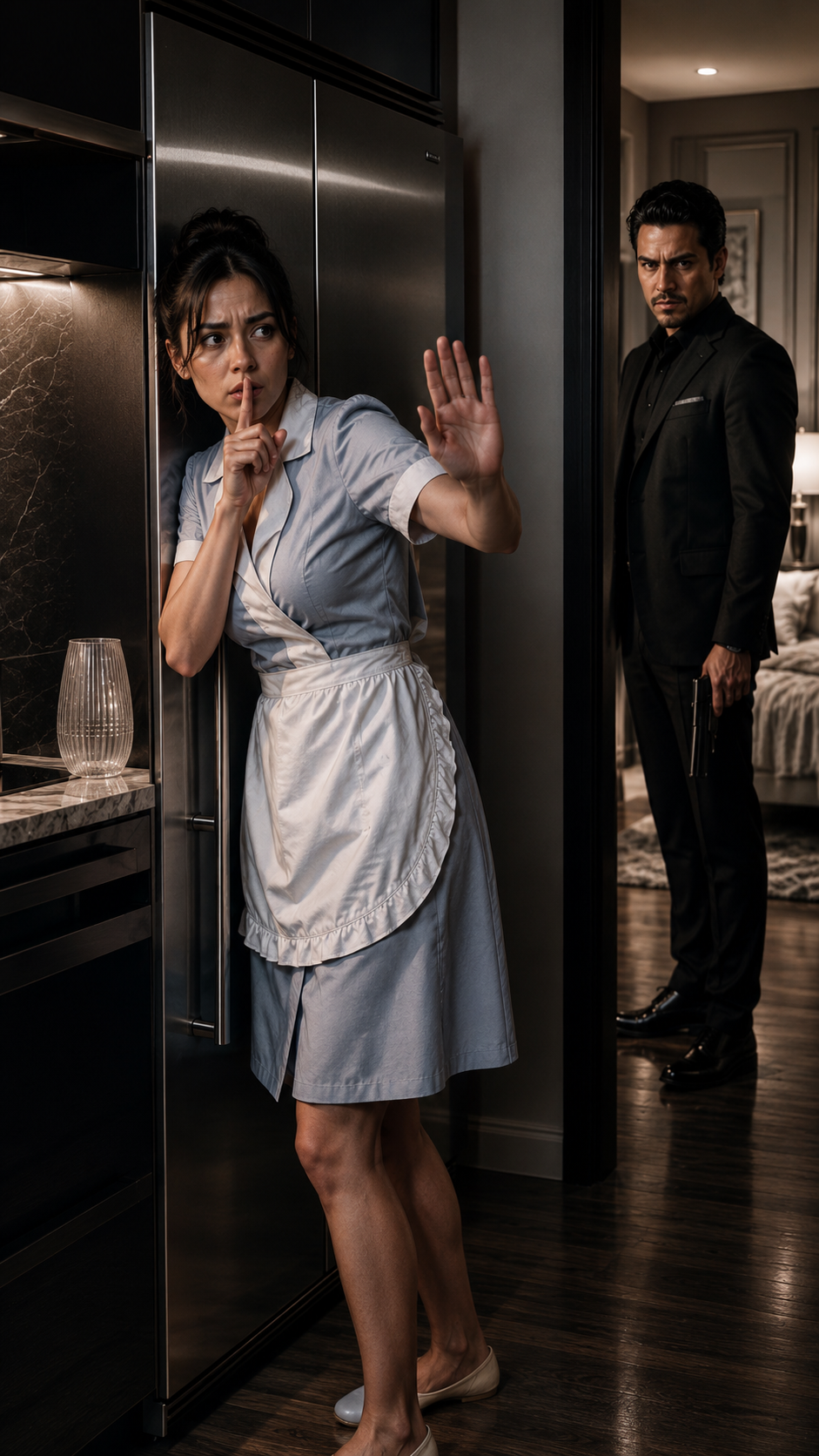
So when he silently entered his bedroom, still in the dusty suit from the road, a hand shot out of the darkness and covered his mouth.
“Don’t breathe, boss.”
It was Lupita, the maid.
The same one who had served him coffee for three years without ever looking him in the eye. The same one who mopped the marble floors, arranged the family portraits, and seemed oblivious to everything.
But that night, she didn’t tremble like a scared servant.
She trembled like someone who knew too much.
Lupita pulled him into the walk-in closet and carefully closed the door. Rafael wanted to push her aside, but she locked eyes with him.
“If you make a sound, they’ll kill you right here.”
Rafael Cárdenas wasn’t just any rich man.
In Guadalajara, they called him “El Licenciado,” because he wore expensive suits, spoke softly, and signed contracts before having anyone who got in his way disappeared. For thirty years, he had built an empire of construction companies, warehouses, restaurants, and political favors.
His enemies feared him.
His family owed him everything.
Or so he believed.
From the crack in the closet, he saw the light flick on in his bedroom. First, two armed men entered. Then another, taller, in a black shirt and with the gait of a master.
They rummaged through drawers, mattresses, paintings, and even the nightstand where Rafael kept a photo of his children.
“The old man has to show up,” said a cold voice. “Tony reported he left the warehouse an hour ago.”
Rafael felt his body turn to stone.
That voice belonged to Mateo.
His nephew.
The son of his deceased brother. The kid Rafael had raised as his own, the one he had paid for schools, cars, bodyguards, and even casino debts. The same one who sat to his right at family dinners.
Lupita lowered her gaze.
She didn’t seem surprised.
That was what hurt Rafael the most.
“Have they checked the safe?” Mateo asked.
“Just cash and jewelry. Nothing important.”
Mateo let out a dry laugh.
“The good papers are hidden away. We just need the old man alive for a bit. After that, you know what’s next.”
Rafael clenched his fists.
But Lupita pressed two fingers against his chest, commanding him to stay still. That’s when he noticed something he could never have imagined.
She had a gun pressed against her thigh, beneath her black uniform.
The invisible maid of his house was armed.
“Where’s my wife?” Rafael whispered barely.
Lupita didn’t answer.
A cellphone rang in the bedroom. Mateo answered quickly.
“Yeah, we’re inside. No, we haven’t found the file yet. Tell her everything is going according to plan.”
Her.
Rafael thought of Verónica, his wife.
The elegant woman who had sent him a heart-filled message that morning saying she would spend the night with her sister in Polanco. The mother of his two children. The queen of his table.
His stomach churned.
Mateo walked straight to the closet.
“Check in there,” he ordered.
Lupita pulled out her cellphone and typed a quick message. The light from the screen illuminated her face for just a second.
Rafael saw a badge hidden between her blouse and skin.
It didn’t say maid.
It said Federal Prosecutor’s Office.
The doorknob of the closet began to turn slowly.
And Rafael understood, too late, that the woman who had cleaned his house for three years hadn’t come to serve him coffee, but to bury him or save his life.
PART 2
Before the door opened, a shout echoed from the hallway.
“Mateo, there’s movement in the service wing!”
The men ran out, leaving Lupita to wait three seconds. Then she exhaled, lowered the gun, and looked at Rafael as if there was no time left for lies.
“We have a maximum of five minutes.”
Rafael grabbed her arm.
“Who the hell are you?”
She pulled out the full badge.
“Agent Lucía Medina. Federal Prosecutor’s Office. I’ve been infiltrating your home for three years.”
The silence in the closet weighed heavier than any gunfire.
Rafael recalled every morning she placed coffee on his desk. Every private meeting where he spoke freely because “the maid” didn’t count. Every call, every code, every name.
He had lived with a spy under his roof.
“So you came to bury me,” he said.
Lucía didn’t blink.
“Yes. But forty minutes ago, I intercepted something that changed everything. This is no longer an operation against you. It’s an execution.”
She showed him a recording.
Mateo’s voice rang clear, mocking, speaking with men from rival territories. He promised routes, warehouses, contacts, and accounts. He also promised something else.
Rafael’s death.
“Your nephew sold you to four different groups,” Lucía said. “He offered pieces of your business in exchange for support. But he’s not the brains behind it.”
Rafael looked at her.
“Verónica.”
Lucía fell silent.
That was enough.
For eighteen years, Rafael had slept next to a woman who knew his schedule, his weaknesses, and his fears. She knew where the documents were, which lawyers could buy judges, which politicians owed favors.
Mateo was ambitious.
Verónica was patient.
And patience had always been the more dangerous trait.
A loud bang sounded at the bedroom door. The men were returning.
Lucía pulled a small remote from her pocket.
“When I press this, the lights in the whole house go out. We have sixty seconds to reach the service elevator.”
“And why should I trust you?”
Lucía stepped close enough that Rafael could see the exhaustion in her eyes.
“Because your family has already decided you’re worth more dead. And because if Mateo discovers me, he’ll kill me too. Right now, it suits us to breathe from the same side.”
The doorknob turned again.
Rafael wasn’t a man of prayers, but that night he understood why people closed their eyes before they fell.
“Do it.”
Lucía pressed the button.
The mansion was plunged into darkness.
Screams, footsteps, furniture crashing. The darkness swallowed the white walls and the perfect family portraits.
Lucía pulled Rafael down a side hallway. He had known that house for fifteen years, but she moved better than he did. They descended a hidden staircase behind the kitchen, crossed the laundry room, and reached a panel that looked like part of the wall.
Lucía entered a code.
The panel opened.
“What is this?” Rafael asked.
“The exit your wife had built when she remodeled the east wing.”
Rafael felt another stab.
Verónica had told him she wanted a wine cellar to host guests. She had chosen tiles, lamps, and furniture. She had smiled while preparing a tunnel for the day they would hunt him like an animal in his own home.
They descended a narrow elevator to a basement Rafael had never seen.
At the end of the hall, a black car idled, engine running. At the wheel was a dark-skinned man with a short beard and the weary gaze of a cop.
“Agent Robles,” Lucía said. “He’s going to get us out.”
Rafael climbed into the back. For the first time in decades, he was not escorted by his men.
He was fleeing with federal agents.
The car exited through a hidden ramp three streets down from the mansion. In the distance, sirens began to wail.
“Your children,” Lucía said, turning to him. “You need to take this calmly.”
Rafael felt his throat close.
“Sofía is in Querétaro, at university.”
Robles shook his head.
“No. Mateo moved her to a house in Valle de Bravo yesterday. He told her it was for her safety, that you had enemies nearby.”
“And Julián?”
“In Madrid, but under surveillance. Once they confirm your death, they’ll go after him too.”
Rafael slammed his fist against the seat.
Not for the money.
Not for the warehouses.
Not for the empire.
For his children.
The same ones he had tried to keep away from the blood, even though the blood always ended up splattering the family table.
Lucía handed him a tablet.
On the screen were transfers, properties, contracts, and encrypted messages. Everything pointed to Verónica.
These weren’t the movements of a scared wife.
These were the moves of a strategist.
For five years, she had siphoned money from Rafael’s companies and funneled it into clean accounts. She purchased land in Yucatán, boutique hotels in Oaxaca, a foundation against violence, and even a consultancy with former officials.
All under other names.
All set up to appear as an elegant widow who inherited chaos and turned it into legitimate business.
“She didn’t want to keep your world as it was,” Lucía explained. “She wanted to clean it up. Becoming a respectable businesswoman. You dead was just the last step she needed.”
Rafael stared out the window.
The city passed by blurred.
The taco stands closing, the night trucks, the lights of avenues he had believed he controlled. Everything remained the same, even though his life had just shattered into pieces.
“There’s more,” Robles said.
Rafael closed his eyes.
“There’s always more.”
Robles turned on the car radio. A reporter was speaking live outside the Cárdenas mansion.
“Close sources confirm that businessman Rafael Cárdenas was reportedly assassinated during a violent robbery at his home…”
Then Verónica appeared.
She cried with a perfection that was terrifying. She wore a black dress, her hair up, and her voice cracked just enough.
“My husband was a family man,” she said before the cameras. “All I ask for is justice.”
Rafael felt nauseous.
That woman wasn’t mourning his death.
She was rehearsing for her coronation.
Then the camera showed Mateo embracing her.
As a son.
As a partner.
As a traitor.
“They’ve announced the news,” Lucía said. “For the country, you are dead.”
“And the bodies?”
“Three of Mateo’s men. They were left burned in the bedroom. One was wearing your watch.”
Rafael remembered the Rolex he had lost weeks ago.
He hadn’t lost it.
They had stolen it to fabricate his corpse.
The car arrived at a common house on the outskirts of Toluca. Gray facade, unkempt garden, old curtains. From the outside, it looked like the home of retired teachers.
Inside, it was a bunker.
Monitors, registered weapons, radios, maps, files. A gray-haired woman awaited him with a folder in hand.
“I’m Commander Salas,” she said. “Welcome to federal custody, Mr. Cárdenas.”
Rafael let out a bitter laugh.
“Spent my whole life avoiding the federals and today you welcome me with coffee.”
“Don’t get confused,” Salas replied. “You’re not a guest. You’re a protected witness while you decide to collaborate.”
Rafael looked at Lucía.
“Collaborate against my wife?”
“Against everyone,” the commander said. “Mateo, Verónica, your partners, your politicians, your routes. You want to save your children. We want to take down a network that has been rotting half the country for years. For once, perhaps, we can benefit from the same enemy.”
Rafael remained silent.
On another screen, Sofía appeared, captured by a surveillance camera. She was in an elegant room, crying in front of her cellphone. Mateo had sent her the news of her father’s death.
Sofía pressed her hand to her chest.
Rafael took a step toward the screen, as if he could cross through it.
“My girl…”
Lucía lowered her voice.
“She doesn’t know she’s being held. She thinks they’re keeping her safe.”
In another image, Julián was seen exiting a hotel in Madrid. Two men followed him from a distance.
Rafael then understood the magnitude of the punishment.
For years, he believed that giving them money and a surname was protecting them. But the surname was the cage. The money, the chain. His power had made his children heirs to a war they didn’t choose.
“There’s a way to get them out,” Salas said. “But we need Verónica to let her guard down.”
Rafael turned slowly.
“What do you want?”
The commander placed an old phone on the table.
“Call your wife.”
Lucía explained the plan.
The call had to sound desperate, broken, as if Rafael were wounded and hiding. Verónica couldn’t know he was with federal agents. She needed to believe her husband was still alone, bleeding, not understanding who had betrayed him.
If she took the bait, she would send someone.
And that someone would lead them to Sofía.
Rafael took the phone.
For the first time in thirty years, his hands trembled.
Not from fear of dying.
But from fear of hearing Verónica pretend to love him.
Robles activated the recording. Salas gave the signal.
Rafael dialed.
The phone rang twice.
“Hello?” Verónica answered, her voice soft.
Rafael breathed as if his chest hurt.
“Vero…”
On the other end, there was silence.
A long silence.
Too long.
“Rafael,” she whispered. “Where are you?”
She didn’t ask if he was alive.
She didn’t shout.
She didn’t cry.
She just wanted to locate him.
Lucía and Salas exchanged glances.
Rafael swallowed.
“I’ve been hit. I don’t know who. I need to see you.”
Verónica took three seconds to respond.
“My love, tell me where you are. I’ll come for you.”
The lie flowed so smoothly it hurt.
Rafael closed his eyes.
“Only you, Vero. I don’t trust anyone.”
She sighed.
“Of course, my life. Only me.”
But on the screen, the agents traced another call coming from Verónica’s phone instantly. The number went straight to Mateo.
The mask had fallen.
Salas smiled slightly.
“We’ve got her.”
Two hours later, federal agents intercepted a truck headed for Valle de Bravo. Four of Mateo’s men were inside with orders to move Sofía “before the old man shows up.”
Sofía was rescued without a shot fired.
When she saw her father in the safe house, she didn’t run to hug him.
First, she slapped him.
“All this is for your life, right?” she said, crying. “Mom betrayed us, Mateo used us… but you built the table where everyone learned to lie.”
Rafael didn’t defend himself.
Because for the first time, an accusation against him was completely justified.
At dawn, Verónica was arrested in front of cameras. She no longer wore the black dress. She wore dark glasses and a rage that no makeup could hide.
Mateo fell one day later, hiding in a house in Cuernavaca, surrounded by money and with no one willing to die for him.
Julián was extracted from Spain under consular protection.
The news exploded across all of Mexico.
A kingpin presumed dead.
A wife widowed too soon.
A maid who was an agent.
A family that rotted from within.
Rafael gave up names, routes, and documents. Not out of kindness. Not out of pure repentance. He did it because he realized that power which does not protect one’s children only serves to buy funerals.
Lucía Medina saw him again weeks later, now out of her service uniform.
He was in a white room, under custody, waiting to testify.
“I never saw her,” Rafael said. “In three years, I never really saw her.”
Lucía looked at him without hatred.
“That was your mistake, Mr. Cárdenas. You thought the invisible people didn’t have eyes.”
Rafael lowered his gaze.
Outside, Sofía and Julián waited to decide if they still wanted to call him father.
And perhaps that was the true condemnation.
Not the prison.
Not the betrayal.
But discovering that family doesn’t get lost when you’re stabbed in the back, but much earlier, when you stop looking at those in front of you.