PART 1
—That boy was always fragile. He fell for anything.
Aurelia Moncada said those words with a handkerchief in hand, standing in the hallway of the Children’s Hospital in Toluca, pretending to wipe away her tears.
In front of her was Julián Rivas, still wearing his dusty work uniform, a backpack slung over his shoulder and a small wooden box clutched in his fingers.
Inside the box was a painted blue top for his six-year-old son, Emiliano.
Julián had spent 89 days away from Mexico on an offshore oil rig. He couldn’t use his phone whenever he wanted. He couldn’t return home, even if his heart broke. Every night, he thought of Emiliano sleeping at his maternal grandmother's house, cared for by people who, in his mind, loved him.
But when he arrived home in Metepec, he found no toys in the living room.
He didn’t find the boy’s red jacket.
He didn’t find his dinosaur cup.
The neighbor, Doña Tere, saw him from the window and crossed herself. When Julián asked where Emiliano was, she could only say:
—Go to the hospital, son… and don’t go alone.
Julián didn’t ask for an explanation.
Twelve minutes later, he was standing in front of Dr. Marisol Castañeda, a serious-looking pediatrician holding a thick folder against her chest.
—Mr. Rivas, I need you to breathe before seeing this.
—I didn’t come to breathe, Doctor. I came for my son.
Marisol opened the folder.
—Emiliano has 42 fractures. Some are recent. Others are weeks old. There are broken ribs, wrists, a collarbone, and a leg that healed poorly because no one brought him in on time.
Julián didn’t scream.
He only squeezed the top box until the wood creaked.
The doctor showed him the X-rays, then some photographs. There were circular marks on the boy's arms, small and repeated burns, as if someone had calmly tested his pain.
—This wasn’t a fall —she said—. And it wasn’t an accident either.
Julián walked into the room.
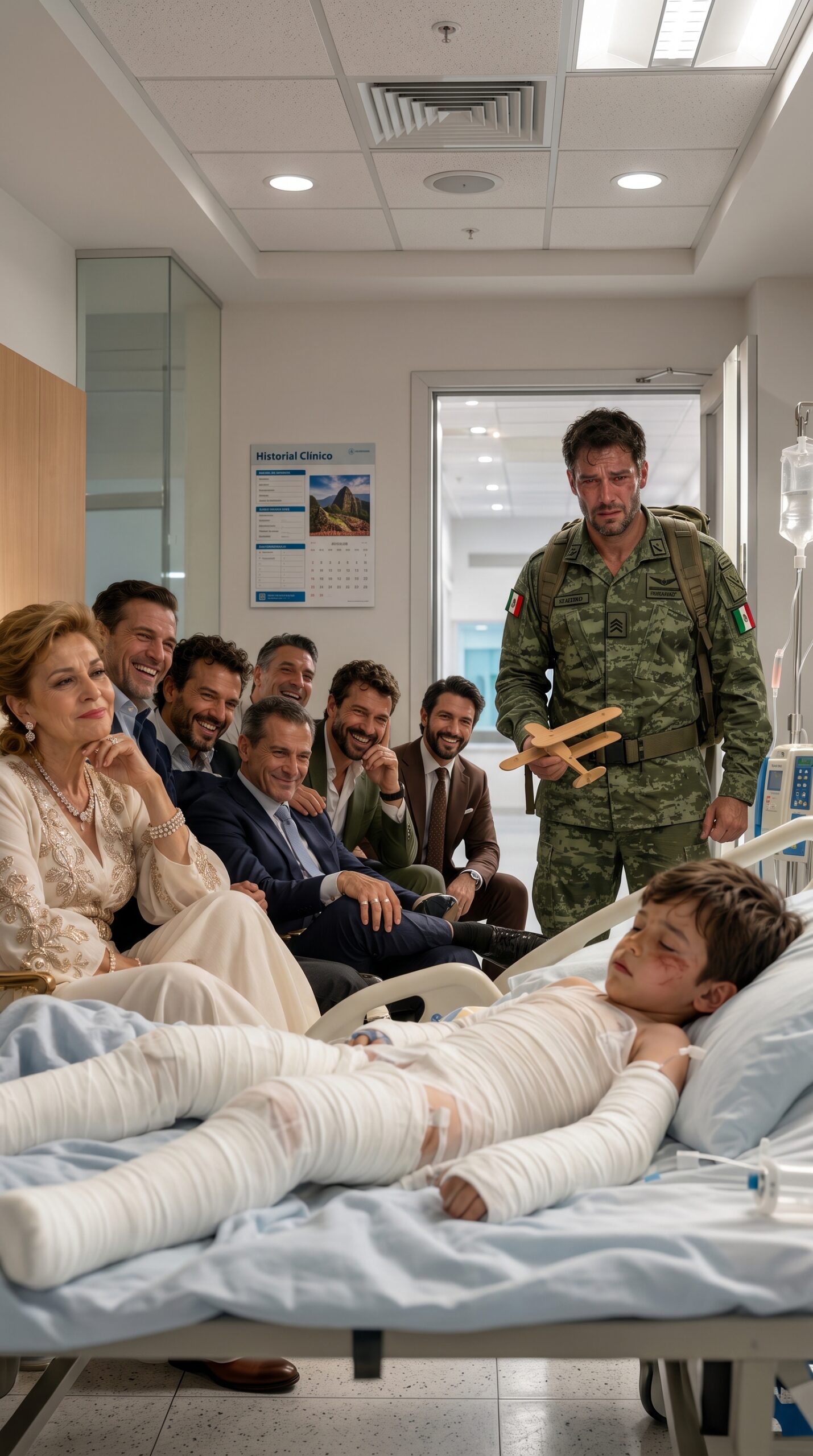
Emiliano was asleep, bandaged, hooked up to machines. His little face looked smaller than before. On the table lay a report signed by Aurelia Moncada, stating that the boy had “tripped while going down to the yard.”
Then Julián stepped out into the waiting area.
There were Aurelia and her five children: Ramiro, the owner of cranes and junkyards; Saúl, involved in municipal permits; Beto, glued to his phone; Néstor, chuckling quietly; and Darío, the youngest, pale as if he wanted to disappear.
Twenty meters from Emiliano, they were drinking coffee.
Aurelia quickly stood up and opened her arms.
—Oh, Julián, thank God you made it. I took care of him like he was mine.
Julián stared at her without blinking.
—42.
No one spoke.
In that silence, Julián understood that hell doesn’t always scream. Sometimes it sits in a waiting room, sips coffee, and pretends to be family.
And when Aurelia tried to hug him, he stepped back, signed the urgent transfer of Emiliano to another hospital, and pulled from his pocket a USB drive that no one knew existed.
PART 2
The ambulance left Toluca before dawn.
Aurelia tried to stop it. She shouted that she was the grandmother, that she had cared for the boy, that Julián was an absent father and had no right to take him as if Emiliano were a suitcase.
But Dr. Marisol had already signed the transfer for complex trauma.
—The minor needs care outside this jurisdiction —she said firmly—. And away from anyone involved in his admission.
Ramiro Moncada approached Julián in the parking lot.
He was broad, heavyset, wearing expensive boots and that smile of a man used to making everyone step aside.
—Think carefully, brother-in-law. A wrongly filed complaint can cost you. You know we all know each other here.
Julián looked at him.
—That’s exactly why I’m taking him.
There was no blow.
There was no threat.
That’s what unsettled Ramiro the most.
Julián traveled behind the ambulance to Querétaro. During the journey, he didn’t cry. He just watched the red lights reflect on the windshield and mentally repeated every word of the doctor: 42 fractures, old injuries, non-accidental marks.
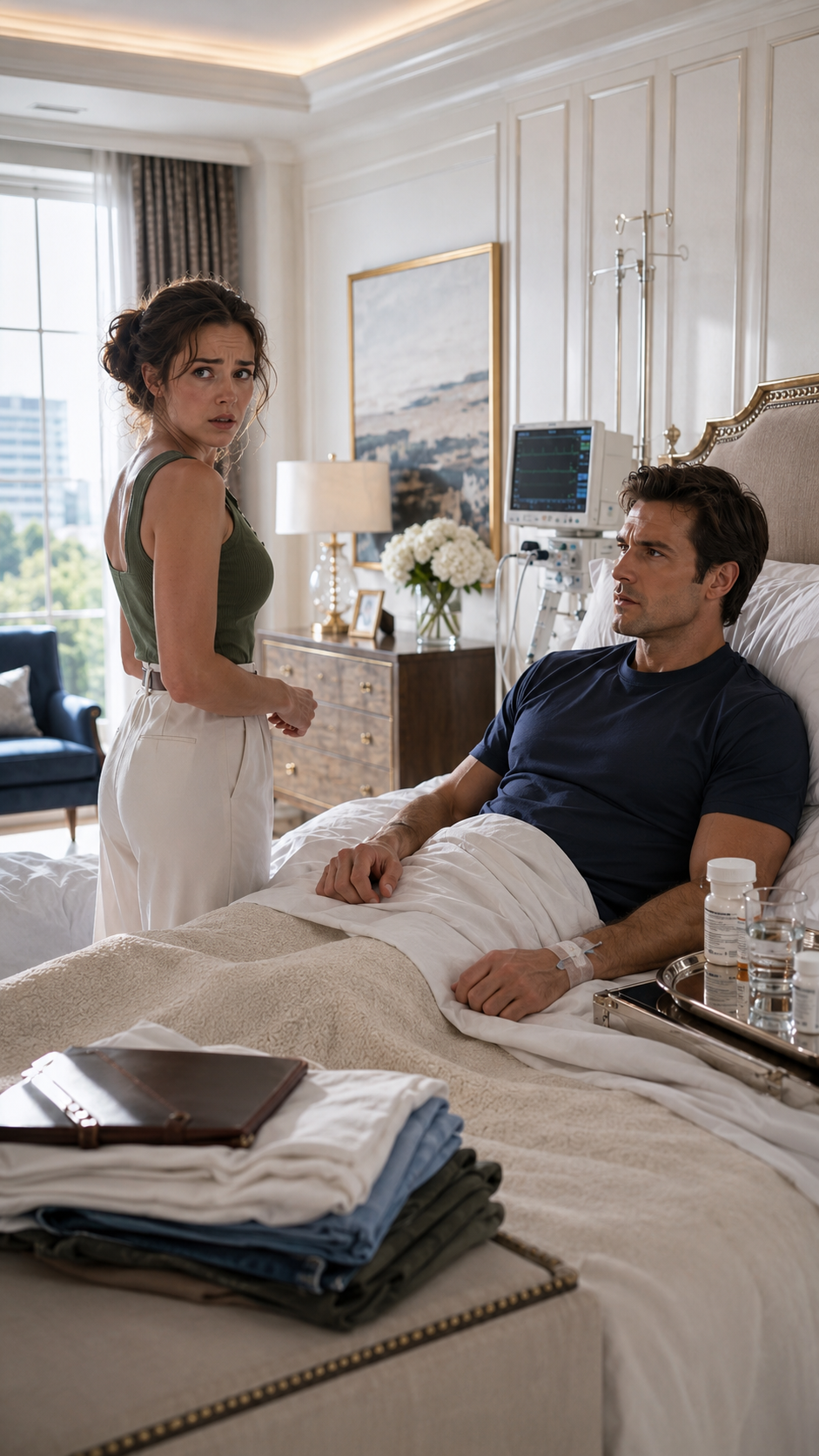
At the new hospital, Emiliano was placed in pediatric therapy. Julián sat by the bed, placed the blue top on the table, and touched the blanket with two fingers, as if asking for permission.
—I’m here, champ —he whispered—. Sorry for taking so long.
That same afternoon, Clara Villaseñor, a family lawyer working at a small firm near downtown, showed up.
She didn’t have a luxury SUV or expensive suits, but she had been fighting cases that no one wanted to touch for years.
Clara listened to Julián and then opened her own folder.
—This was submitted ten weeks ago in a court in Toluca.
It was a request for temporary custody.
Aurelia Moncada appeared as the legal guardian of Emiliano. The document stated that Julián had abandoned the boy due to “job instability, prolonged absence, and a history of aggressive behavior.”
Julián felt the blood drain from his face.
—I sent money every week.
—I know —Clara replied—. They also forged a psychological evaluation where you appear as a dangerous father. The supposed psychologist claims to have interviewed you three times.
—I’ve never seen him.
—That’s precisely why they chose him. They wanted you to return, explode, hit someone, and confirm the character they invented.
Julián lowered his gaze.
Everything was planned.
Not only had they hurt Emiliano. They wanted to keep him forever.
Clara placed another sheet on the table. They were reports from the DIF closed for two years. There had been four anonymous warnings about screams, hits, and a child locked in the Moncada house. All had ended the same way: “without sufficient evidence.”
—Ramiro has friends in the municipality —Clara said—. Judges, police, officials. If we fight only there, they’ll crush us.
Julián looked out the hospital window.
—Then let’s not fight only there.
The USB drive he carried in his pocket didn’t contain videos of Emiliano. It held something his wife, Daniela, had saved before she died.
Daniela was Aurelia’s daughter. She died a year earlier in a crash that everyone called an accident. But weeks before she died, she had sent Julián a sealed package with a note: “If my mom tries to take Emi, open this.”
Julián had never opened it because he wanted to believe that pain was speaking for her.
That night, with Clara in front of him, he plugged in the drive.
There were audios, photos of documents, screenshots of transfers, and a video where Daniela cried inside a car.
—My mom doesn’t want Emiliano —she said in the recording—. She wants him because my dad left a trust in his name. If Emi lives with her, she can collect as the administrator. If Julián takes him away, their money runs out.
Clara was frozen.
The fortune wasn’t huge, but it was enough: a house in Valle de Bravo, two rented shops, and an investment account opened by Emiliano’s grandfather. Aurelia and Ramiro had been trying for months to prove that Julián was unfit to manage anything.
The boy wasn’t a grandson to them.
He was a key.
He was a signature.
He was money.
The cruelest twist appeared in the last audio. Daniela was arguing with Ramiro.
—Don’t ever hit my son again —she screamed.
—Then sign the authorization —he replied—. Or that kid is going to learn the hard way.
Julián stood up so fast that the chair fell to the floor.
Clara didn’t forcefully stop him. She only said one phrase:
—If you go out looking for him now, they win.
Julián trembled with rage.
But he didn’t leave.
He stayed.
And that decision was the beginning of the Moncada family’s downfall.
Clara requested a change of venue due to a conflict of interest. Dr. Marisol delivered the complete medical file. The new hospital confirmed that the injuries were repeated and non-accidental. Doña Tere, the neighbor who had once been afraid, agreed to testify when she learned that the case no longer depended on Toluca.
But the human proof was still missing.
It came with Darío, Aurelia’s younger brother.
Darío appeared one night in the hospital parking lot, wearing a low hat and sweaty hands.
—I didn’t touch him —he said as soon as he saw Julián—. I swear, I couldn’t stop them, but I didn’t lay a hand on him.
Julián wanted to hit him.
He didn’t.
Darío recounted how Aurelia locked Emiliano up when he cried for his dad. Ramiro punished him so he would “stop being sensitive.” They used his medical visits to justify expenses from the trust. They bought expensive medicines they never gave him. They presented fake receipts. They claimed Julián didn’t send money, even though every transfer arrived on time.
—And Daniela? —Clara asked.
Darío swallowed hard.
—Daniela was going to take the boy. That week, she found papers. Ramiro knew.
Silence fell heavily.
—The crash? —Julián asked.
Darío didn’t respond immediately.
He only pulled out an old cell phone.
There was a conversation with Ramiro dated two days before the accident. It didn’t prove everything, but it opened a horrible door: “Don’t let him leave Metepec with the boy. Do whatever is necessary.”
Clara didn’t promise what she couldn’t prove.
But she took everything to the federal prosecutor’s office.
Ramiro felt the blow before seeing it. His contacts stopped answering. The judge who had signed the custody request took medical leave. A commander who always had coffee with him denied knowing him. His crane permits were reviewed. His accounts were frozen due to movements related to a minor's trust.
For the first time, the Moncada family stopped walking as if they owned the town.
Aurelia called Julián crying.
—Son, this is a misunderstanding. I lost my daughter, too.
—And you almost took my son from me —he replied.
—Emiliano needs his family.
Julián looked at the sleeping boy, his arms bandaged.
—No. He needs to be far away from you.
The hearing took place in Querétaro.
Aurelia arrived dressed in black, with a rosary in hand, ready to act as the devastated grandmother. Ramiro arrived with two lawyers and a face that tried to look calm.
Julián arrived without a uniform, without medals, without shouting.
Clara presented the X-rays of the 42 fractures. Then the DIF reports. After that, the fraudulent custody, the false psychological evaluation, the transfers, the invented receipts, and Daniela’s memory.
When Daniela’s video appeared on the screen, Aurelia stopped crying.
She no longer looked like a grandmother.
She looked like a calculating woman.
Darío testified last. His voice broke when he said that Emiliano asked for water at night and Aurelia ordered him to shut up because “dramatic children inherit nothing.”
The judge suspended the custody immediately.
She ordered total protection for Emiliano, an investigation against Aurelia and Ramiro, a review of the trust, and the sending of the file to the federal prosecutor’s office for abuse, fraud, forgery, and possible cover-up in Daniela’s death.
Ramiro exploded.
—That boy is our blood!
Julián stood up slowly.
—No. That boy belongs to no one. He is just a boy.
The phrase lingered in the room.
Aurelia tried to approach him.
—Julián, please…
He didn’t look at her.
That was her harshest sentence: she no longer had power over her pain.
Months later, Emiliano left the hospital. He walked slowly, afraid of closed doors and loud voices. Some nights he woke up crying, and Julián sat on the floor, not touching him, until the boy reached out his hand.
—Is my grandma not coming anymore? —he asked.
—No, champ. Not anymore.
—And my uncle Ramiro?
—Neither.
At first, Emiliano didn’t believe him.
Then he began to sleep with the light off.
Julián bought a small house near Valle de Bravo. It wasn’t the big house from the trust. That one would remain protected for Emiliano when he grew up. It was a simple house, with trees, a wooden table, and a window from where the water could be seen.
One afternoon, Emiliano found the blue top.
He stared at it for a long time before making it spin.
The top danced crookedly on the table, fell, and got back up.
Emiliano smiled just a little.
—It looks like me —he said.
Julián felt his chest break, but this time in a different way.
—Yes —he replied—. But you’re going to spin better.
The Moncada case hit the newspapers weeks later. People talked about corruption, monstrous grandmothers, greedy uncles, sold judges, and families hiding hell behind a decent facade.
But few understood the most important thing.
Julián didn’t win because he was stronger.
He won because he didn’t give them the explosion they were waiting for.
He didn’t scream when they wanted to see him go crazy.
He didn’t hit when they wanted to label him dangerous.
He didn’t break when they wanted to take his son away forever.
And that’s why the story hurt so much on Facebook, at family dinners, and in comments filled with rage.
Because it reminded everyone of an uncomfortable truth: not all families deserve to be called family, and not everyone crying beside a bed loves the child who is suffering.
Sometimes, justice doesn’t come crashing through doors.
Sometimes it arrives quietly, with a folder, a signature, and a father who has already decided not to lose the only thing he has left.