PART 1
—Let's see if you learn this time, Lucía. You came into my life with nothing and you're leaving the same way: with no home, no money, and without my son.
Adrián Montalvo's voice was not a shout. It was a low, venomous whisper, spoken close to her ear as the judge finished reading the ruling in a family court in Mexico City.
Lucía was eight months pregnant. She felt her feet swollen, her back aching, and the baby moving inside her, as if it had also heard its father's cruelty.
The judge closed the file.
—The dissolution of the marriage is decreed. No spousal support will be granted. The assets will remain in the name of Mr. Adrián Montalvo.
Every word fell on her like a heavy stone.
No home.
No support.
No savings.
Nothing.
Adrián, impeccable in his black suit, barely smiled. Beside him, his lawyer calmly organized the papers, as if he had already won.
Lucía clenched her hands over her belly. She was not going to cry in front of him. She would not give him that satisfaction.
Just four years earlier, Adrián had met her in a café in the Roma neighborhood, when she worked mornings at an insurance company and sold pastries in the afternoons to get by. He would arrive with flowers, sweet words, and that rich man's confidence that seemed to have the world figured out.
—You have suffered enough, Lucía —he told her—. Let me take care of you.
And she believed him.
She believed him because she had grown up in foster homes, moving from one temporary family to another, her clothes in black garbage bags and a permanent feeling of being a burden.
First, he asked her to stop working so much. Then he told her he would manage the money "to protect her." After that, he began checking her calls, her messages, her medical appointments.
—I’m not controlling —he said—. I’m your husband.
But when Lucía became pregnant, Adrián changed. He grew cold, impatient, cruel. He repeatedly told her that a woman with "so many wounds" could not raise a child well. That she was unstable. That she cried too much. That no one would believe her if she ever dared to accuse him.
A month later, he filed for divorce.
In the petition, Adrián presented her as dependent, conflictive, unemployed, and emotionally incapable of caring for a baby. He even attached a false letter from a former social worker stating that Lucía had always been "problematic."
She knew it was all a lie.
But no one listened to her.
That morning, after the hearing, Adrián leaned toward her again.
—When the baby is born, don't be surprised if you also lose custody. I can give him a dignified life.
Lucía felt her blood freeze.
He not only wanted to leave her on the street.
He wanted to take her child.
She slowly stood up, leaning on the table. She didn’t know where to go. She had no family, no money, no one waiting for her outside.
She only had her baby.
And still, she thought that somehow she would survive.
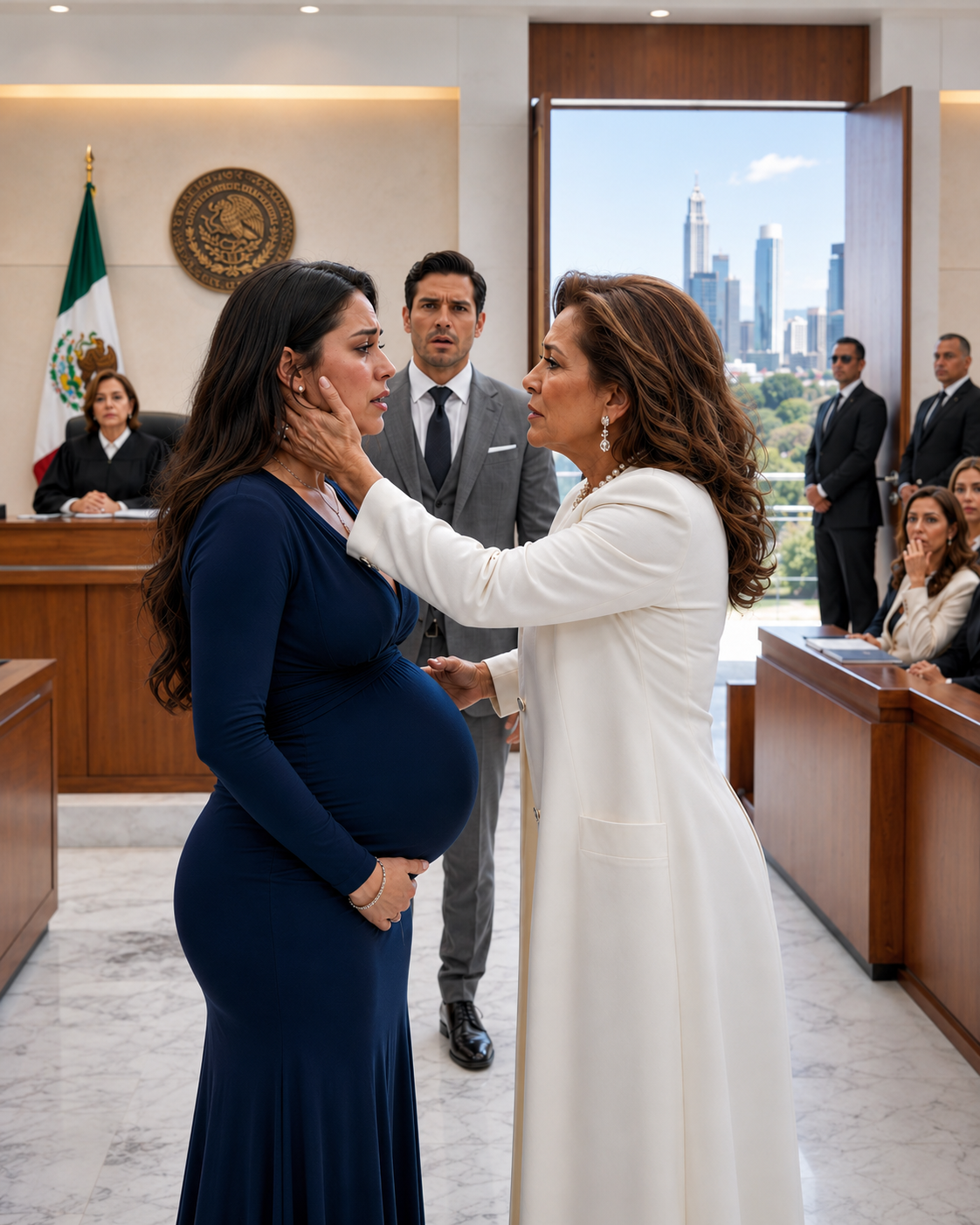
Then the large doors of the courthouse swung open suddenly.
Four men in dark suits entered first. Behind them appeared an older woman, elegant, wearing a white coat, her hair tied up, with a presence that silenced the entire room.
It was Elena Arriaga.
The most powerful businesswoman in Mexico.
Owner of hotels, banks, construction companies, and media. A woman whom politicians, businessmen, and judges greeted with caution.
Adrián turned pale.
—Mrs. Elena... what a surprise...
She didn’t even look at him.
She walked straight toward Lucía.
Her light eyes locked onto hers.
Lucía felt the world stop.
Because she had exactly the same eyes.
The woman raised a trembling hand and touched her cheek with a tenderness that broke her inside.
—My girl —she whispered—. I finally found you.
Adrián let out a nervous laugh.
—Your girl? Mrs. Elena, Lucía is an orphan.
Elena barely turned her head.
—No. Lucía is not an orphan.
The silence was absolute.
The businesswoman took Lucía’s hand as if fearing she would disappear.
—My daughter was stolen from me 30 years ago.
And then Adrián stopped smiling.
He couldn’t believe what was about to happen...
PART 2
The judge called for order, but even he seemed to not understand what was happening.
Lucía couldn’t speak. She stared at Elena Arriaga, the woman who appeared in magazines, on news broadcasts, at inaugurations with governors, and who now looked at her as if she had found the piece of life that had been taken from her.
—This is madness —Adrián said, standing up—. You can't come here and invent a novel in the middle of court.
An attorney with gray hair entered with a thick folder under her arm.
—This is not a novel, Mr. Montalvo. This is evidence.
It was Patricia Campos, famous for winning cases of corporate corruption. She positioned herself in front of the judge and requested an immediate suspension of the ruling.
—The resolution was based on falsified documents, concealment of assets, and a possible criminal conspiracy related to Mr. Adrián Montalvo.
Adrián clenched his jaw.
—What does this have to do with me?
Patricia opened the folder.
—Thirty years ago, Elena Arriaga gave birth to a girl at the Santa Clara Hospital in Polanco. During a false fire alarm, the baby disappeared from the maternity area. The nurse who coordinated the evacuation was named Rosa Montalvo.
Lucía felt the baby moving strongly.
Adrián looked down.
—Rosa Montalvo —the lawyer continued— was Mr. Adrián's mother.
Everyone turned to look at him.
—My mother is dead —he spat—. She can’t defend herself against such nonsense.
—She doesn’t need to —Patricia replied—. She left records, hospital bracelets, false certificates, and payments from an illegal adoption network.
Lucía could barely ask:
—Are you saying that your mother stole me?
Elena closed her eyes.
—They took you from the hospital. They told me you had died. Later I found out it was a lie and I spent 30 years searching for you.
Lucía felt something inside her break.
Her whole life, she had been told that no one loved her. That her mother had probably abandoned her. That she shouldn’t ask so many questions because there were no answers.
And now that powerful woman was crying in front of her.
—So she didn’t abandon me?
Elena covered her mouth.
—Never. I was torn from your arms.
Patricia placed a study on the table.
—The DNA analysis confirms the maternity with 99.9998% probability.
Lucía read the blurry number through her tears.
For years, she had blown out candles on other people's cakes, worn donated clothes, and slept in borrowed beds feeling like a mistake. And in the meantime, her mother had been searching for her.
Elena hugged her.
Not like a businesswoman.
Like a mother desperate to reclaim 30 years in a single second.
But Adrián spoke with an unpleasant calm.
—Very touching, really. But none of this changes the divorce. Lucía signed a prenuptial agreement.
Patricia turned to him.
—You're right. Except when the marriage was conducted through deliberate fraud.
Adrián stopped breathing for a moment.
The lawyer pulled out printed emails, transfers, and reports from a private investigator. Four years earlier, Adrián had found a box among his mother's belongings containing the original bracelet of baby Arriaga.
He hired a man to track down that lost girl.
And the trail led him to Lucía.
Patricia read an email from Adrián:
—"If that girl is Elena Arriaga's lost heir, I need to get close before someone else finds her."
Lucía looked at him as if she had just seen a stranger.
—You knew who I was before inviting me for coffee?
Adrián swallowed hard.
—Lucía, listen to me...
—Don’t say my name.
The truth came out piece by piece.
Adrián approached her for money. When he discovered that the Arriaga inheritance had clauses preventing a husband from directly controlling the assets, he changed his plan.
He got her pregnant.
He isolated her.
He left her unemployed.
He fabricated evidence to make her seem unstable.
And he planned to ask for custody of the baby after birth to control, as a father, all the money intended for the child.
Lucía was trembling, but no longer from fear.
From rage.
Then two federal agents entered.
Behind them appeared a thin, nervous man with an old briefcase.
—He is Daniel Urrutia —Patricia said—. The investigator Adrián hired. He sought us out when he discovered that Mr. Montalvo was planning to take the baby from Lucía.
Daniel pulled out a small recorder.
—Rosa Montalvo confessed before she died. But she didn’t just confess to the baby’s theft.
The room went cold.
He pressed play.
An elderly, broken voice filled the courtroom.
—I didn’t take the girl for money only. I was ordered to do so by Elena's husband. He said that baby wasn’t his and that he would destroy everything.
Elena turned pale.
Patricia lowered her voice.
—Arturo Arriaga ordered the baby to be disappeared because he had discovered that she was not his biological daughter.
The judge, who had remained stiff until then, placed a hand on the desk.
Elena looked at him.
—Ramiro...
Lucía felt the air grow heavy.
Elena recounted the truth through tears. Thirty years ago, trapped in a marriage full of threats and appearances, she had sought legal help to separate from Arturo. The young lawyer who advised her was Ramiro Salcedo, the same man who was now the judge.
They fell in love in secret.
Arturo discovered it.
He threatened to destroy him.
Elena cut all contact.
Months later, the baby was born. Arturo ordered secret tests and, upon confirming she was not his daughter, ordered her to be disappeared.
Ramiro looked down.
—I never knew you were alive —he said, looking at Lucía—. Elena told me the girl had died.
Lucía felt dizzy.
Her mother was in front of her.
Her father too.
But neither had protected her that day.
—You signed a ruling that left me pregnant and on the street —she told the judge.
Ramiro didn’t try to defend himself.
—I believed in false evidence. And that is my fault too.
That honesty hurt more than any excuse.
Adrián let out a desperate laugh.
—How convenient. Now it turns out she is the daughter of a millionaire and a judge. Are they going to make her a princess now?
Lucía looked at him calmly.
For years, he had used her fear of abandonment as a leash. He made her believe she should be grateful for his love. That no one else would stay. That without him, she was nobody.
But in that moment, she understood something that neither money nor a surname could give her:
She was already worth something before she knew where she came from.
Elena stood up.
—Lucía is my daughter. But that is not what should scare you, Adrián.
Patricia handed the agents a list of accounts, shell companies, and transfers.
—Mr. Montalvo concealed assets, forged documents, presented altered testimonies, and conspired to gain custody of a minor for economic purposes.
One of the agents approached.
Adrián stepped back.
—Lucía isn’t going to report me. She’s pregnant with my son.
Then he tried to soften his voice.
—Honey, think of our family.
Lucía let out a dry laugh.
—Family? You planned to leave me homeless and take my baby before I could hold him.
—I made mistakes.
—No. You made plans.
The phrase lingered in the room.
Adrián looked down for the first time.
But he wasn’t crying out of regret.
He was crying because he had lost.
When the agents put handcuffs on him, he looked at Elena with hatred.
—She will never be like you. She doesn’t know how to speak, she doesn’t know how to dress, she doesn’t belong to your world.
Elena replied without blinking:
—My daughter could walk into a board meeting with torn shoes and still have more dignity than your entire family combined.
The doors closed behind Adrián.
The judge suspended the ruling and recused himself from the case due to personal conflict. His voice trembled.
—Lucía, I am deeply sorry.
She didn’t respond.
At that moment, a sharp pain shot through her belly.
She grabbed onto the table.
Elena rushed toward her.
—What’s happening?
Lucía felt wetness running down her legs.
—My water broke.
The courtroom became chaotic. Elena shouted for an ambulance, Patricia held her by the arm, and Ramiro ran into the hallway shouting for help like a desperate father, not like a judge.
The baby was born seven hours later in a hospital in Mexico City.
He was small, cranky, and perfect.
When they placed him on her chest, Lucía understood that nothing that had happened could erase that moment. Not Adrián, not the lies, not the millions, not the surnames.
Only her son mattered.
She named him Daniel, after the man who chose to tell the truth when he could have stayed silent and collected.
Weeks later, the case against Adrián exploded throughout Mexico. Emails, payments, falsified certificates, and the custody petition he had already prepared were discovered.
But the final blow came with Rosa Montalvo's notebooks.
Adrián had not only found the lead that led him to Lucía. He had also discovered that his mother was planning to confess everything to Elena. To prevent this, he altered her heart medication and caused the failure that killed her.
The man who swore to protect Lucía had been capable of killing his own mother to protect his plan.
He was sentenced to decades in prison.
He never held his son.
He never touched a peso of the inheritance.
He never called her love again.
One year later, Lucía returned to the same courthouse, but not to lose everything.
This time she was there to announce the creation of the Open Door Foundation, aimed at providing housing, lawyers, medical attention, and education to pregnant women escaping abusive marriages and to young people exiting foster homes without support.
Elena was in the front row holding the baby. Ramiro sat beside her, still not daring to ask for a place he hadn’t earned.
A reporter asked:
—Lucía, you just recovered a huge fortune. Why donate so much so soon?
She looked at her son, then at her mother, then at the building where they almost took her life.
—Because money didn’t save me —she said—. The truth saved me. And no woman should need a powerful surname for anyone to believe her.
As they left, Elena handed her a little blue box.
Inside was an old hospital bracelet.
It read: Baby Arriaga.
Lucía held it between her fingers, feeling like she was closing a wound that had lasted 30 years.
Adrián had told her she would return to nothing.
He was wrong.
Lucía had never come from nothing.
She came from a mother who never stopped searching for her, from a buried truth that finally came to light, and from a strength that no man could take away from her.
That day she left the courthouse with her son in her arms.
Not as the abandoned wife.
Not as the lost girl.
Not as the woman they tried to erase.
She left as Lucía Arriaga: mother, daughter, survivor, and owner of a truth that no one could hide anymore.