PART 1
—Don’t tell Lucía that the baby has Andrés's eyes… not yet.
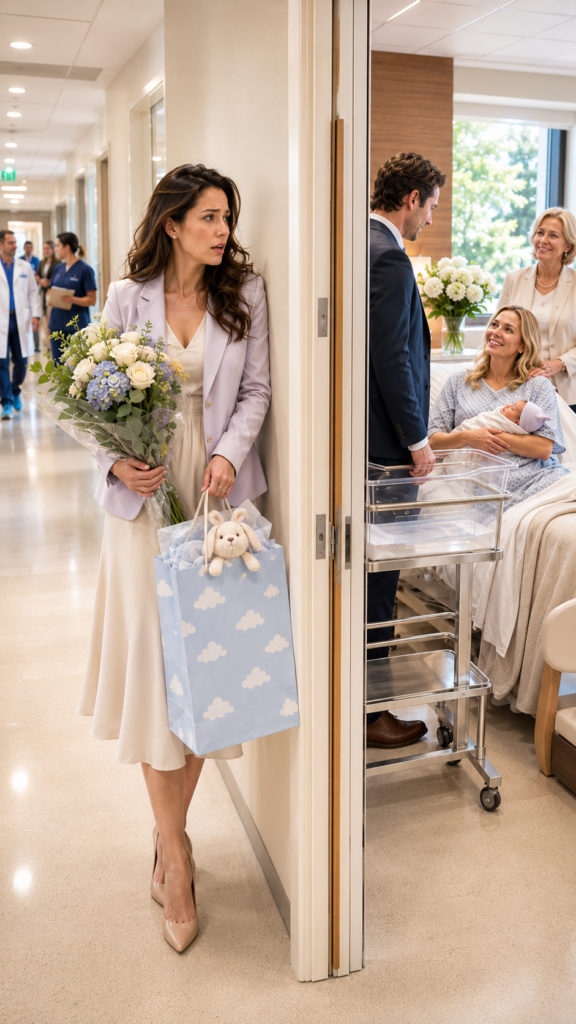
Lucía Mendoza stood frozen before the half-open door of room 218 in the maternity ward of Hospital Ángeles in Guadalajara, a gift bag dangling from her arm and a bouquet of white gerberas pressed against her chest.
She had arrived filled with joy.
In the bag, she had onesies, a little blanket knitted by her own hands, and a brown teddy bear she bought at Plaza Andares because her younger sister, Camila, couldn’t sleep as a child without hugging one.
That morning, Lucía still believed her family was complicated but not cruel.
She believed Andrés Villalobos, her husband, was absent because his job at a real estate firm had him overwhelmed with deals, clients, and supposed meetings in Querétaro.
She believed her mother, Doña Rebeca, was cold towards her because she had always been a tough woman, the kind that confuses strength with a lack of affection.
She believed Camila had hidden the baby’s father out of fear of what people would say.
And above all, she believed her marriage was hurt but still salvageable.
Andrés had left that morning at 8:10, cologned, well-groomed, and wearing his immaculate navy suit.
He kissed her on the forehead as she wrapped the gift.
—I would have loved to go with you, sweetheart, but a meeting with the partners came up. You know how these guys are.
Lucía smiled, feeling confident.
—It’s fine. I’ll tell Cami you send your blessings.
Andrés didn’t hesitate.
—Tell her I’m glad she and the baby are doing well.
Not a crack in his voice.
Not a nervous glance.
Nothing.
So when Lucía heard his laughter inside room 218, she first thought she had made a mistake. That maybe it was someone with a similar voice. That the pain of so many months trying to get pregnant was finally playing tricks on her.
But then she heard that voice again.
—Lucía still believes my sleepless nights are due to the project in Querétaro—Andrés said—. Until last week, she deposited again for the treatment, thinking we were still going to try.
Lucía felt the ground drop from beneath her.
Then her mother spoke.
—Leave it be. As long as she believes there’s hope, she won’t ask questions. Besides, Lucía has always been better at helping than receiving.
The bag cut into her wrist.
Camila sighed softly, almost happily.
—When she sees the baby, she’ll understand. Andrés and I were able to form a family. She was never able to give him a child.
Andrés let out a low laugh.
—He has my eyes. Sooner or later, it’s going to show.
Lucía didn’t cry.
She stood there, behind the door, listening to her husband, her sister, and her own mother talk about her life as if she were a foolish pawn, an open wallet, a woman with no right to break.
She lowered the bouquet slowly.
She walked toward a metal trash can and tossed the gerberas in quietly. Then she pulled out the teddy bear, looked at it for a few seconds, and put it back.
She didn’t enter.
She didn’t scream.
She didn’t ask for explanations.
She turned around and walked down the white corridor, passing nurses, newborns, and happy families, while she felt as if someone had just ripped her skin from the inside.
Before reaching the elevator, she reached into her bag.
She touched the small digital recorder she used to dictate ideas for her decorating projects.
She had accidentally turned it on since leaving the house.
And then she understood something that froze her blood.
Not only had she heard the betrayal.
She had recorded it.
PART 2
The return to Zapopan felt false, as if the city continued the same just to mock her. The same traffic lights. The same flower vendors at the corners. The same guard at the gated community greeting her confidently.
Everything was the same.
Except Lucía.
She entered her house, placed the baby’s bag on the dining table, and stared at it for several minutes.
Then she opened the online banking app.
For 2 years, she and Andrés had saved money for a fertility treatment at a private clinic. Lucía had taken on more projects, sold a pair of her grandmother’s earrings, stopped traveling, and even postponed home renovations.
Every peso was a promise.
Every deposit was a hope.
The account was empty.
Not low.
Not reduced.
Empty.
Lucía checked the history with trembling hands. There were transfers to Camila Mendoza’s name. Hospital payments. Pregnancy tests. A 4D ultrasound. Newborn clothing. A private room. Even a photo package for the baby.
The money Lucía dreamed of using to become a mother had paid for her sister’s pregnancy with her own husband.
She felt nauseous, but she didn’t scream.
She downloaded statements. Took screenshots. Printed receipts. Crossed dates.
Then she opened the family laptop.
Andrés had never set a password because he thought she was too noble to check.
And there she found more.
Messages from Camila sending ultrasound photos.
Hearts from Andrés.
Voice notes from Doña Rebeca organizing medical visits so Lucía would never overlap.
And a phrase that shattered her soul:
“My sister is useful as long as she believes we’re fixing her marriage.”
Lucía printed that too.
That night, Andrés arrived with sushi, as if nothing had happened.
—How is Camila?—he asked, kissing her cheek—. Did she like what you bought?
Lucía looked at him from the kitchen.
—She was asleep when I got there.
The lie rolled off her tongue perfectly.
Andrés smiled.
—Poor thing. First-time moms are exhausted.
Lucía felt the urge to smash the plate in his face, but she stayed still.
For 3 weeks, she lived within an act.
She made coffee. Smiled. Asked about the supposed project in Querétaro. Answered calls from her mother. Pretended tenderness when Camila sent pictures of the baby, always cropped so Andrés's hands wouldn’t show.
While they were at ease, she gathered evidence.
Her cousin Natalia, a family lawyer in Mexico City, was the first to hear the full audio.
She didn’t interrupt.
In the end, she simply said:
—Don’t confront them from a place of pain. Do it from the truth. And make sure they have nowhere to escape.
Lucía obeyed.
She compiled a folder with statements, conversations, receipts, screenshots, audios, and dates. She also included the prenuptial agreement Andrés had demanded before marrying, thinking it would protect his money.
She never imagined that paper would protect Lucía more than him.
When her father, Don Gabriel, returned from working 5 months supervising projects in Sonora, Lucía summoned him to a quiet café.
She played the hospital audio.
The man listened without moving. Only his hands, clenched around the cup, revealed his rage.
When the recording finished, he asked:
—Did your mother know?
Lucía swallowed hard.
—Not only did she know. She helped.
Don Gabriel closed his eyes.
He seemed to age 20 years.
—I left my daughters in the hands of a woman who chose one and destroyed the other.
Lucía took his hand.
—I don’t need you to blame yourself. I need you to be with me on Friday.
He lifted his gaze.
—What’s going to happen on Friday?
Lucía took a deep breath.
—They’re coming for dinner.
On Friday night, Lucía set the table as if a family still existed. She prepared pork loin, white rice, salad, warm tortillas, and lemonade.
She wanted the truth to fall on clean plates.
Camila arrived with the baby wrapped in a beige blanket. She looked tired, beautiful, protected by that fragility she wore as a shield.
Doña Rebeca entered behind her, carrying a diaper bag, giving instructions, and rearranging things as if she were the owner of the house.
Andrés arrived last.
He came from “the office.”
Seeing the baby, he smiled.
Not as an uncle.
Not as a brother-in-law.
As a father.
Lucía saw that gesture and felt something inside her die completely.
During dinner, Camila talked about colic, diapers, and sleepless nights. Doña Rebeca laughed too loudly. Andrés asked if the baby was taking the formula well.
Lucía listened.
Don Gabriel barely touched his plate.
Finally, Andrés looked at her.
—You’re very quiet, love.
Lucía set her utensils down on the table.
—I’ve been listening a lot lately.
She pulled out a manila envelope from the chair beside her and placed it in front of him.
—Open it.
Andrés tried to smile.
—And what is this?
—What you thought I would never find.
Andrés opened the envelope.
Inside were the divorce papers, the bank statements, the transfers, the printed messages, and a photo of the zero balance in the fertility account.
His face drained of color.
Camila lowered her gaze.
Doña Rebeca pressed her lips together.
—Lucía, don’t make a scene—said the mother.
Lucía took out her cell phone and pressed play.
Andrés’s voice filled the dining room.
—Lucía still believes my sleepless nights are due to the project in Querétaro. Until last week, she deposited again for the treatment, thinking we were still going to try.
Camila began to cry.
Then Doña Rebeca's voice was heard.
—Lucía has always been better at helping than receiving.
Don Gabriel stood up.
The chair scraped the floor like thunder.
—Rebeca, tell me that’s not you.
She tried to hold his gaze, but she couldn’t.
—you don’t know what it was like to carry everything while you were working far away.
Don Gabriel let out a bitter laugh.
—No. Today I’m seeing what you carried: preference, lies, and cruelty.
Andrés threw the papers onto the table.
—Did you record me? Are you crazy?
Lucía didn’t move.
—No. Crazy was continuing to pay for my sister’s pregnancy believing I was paying for my future.
Camila hugged the baby.
—I didn’t want it to happen this way.
Lucía looked at her without shouting.
—But you did want it to happen.
The silence was brutal.
Andrés hardened his voice.
—Be careful, Lucía. A divorce can be very expensive for you.
Then Natalia came out of the hallway.
She carried another folder under her arm.
—It’s going to cost you more, Mr. Villalobos.
Andrés froze.
—What is she doing here?
Lucía replied: —She’s at her client’s house.
Natalia laid the folder on the table.
—We have evidence of misappropriation of marital funds, financial abuse, asset concealment, and unauthorized transfers. We have also requested a review of certain expenses reported by you as business travel.
Andrés swallowed hard.
Doña Rebeca stood up, furious.
—This is low! Camila just had a baby.
Don Gabriel pointed at her with eyes full of sadness.
—and you helped rob your daughter to gift a false life to the other.
That phrase split the table in two.
Weeks later, the first hearing was a blow to Andrés. The judge ordered part of his accounts frozen, financial movements reviewed, and the money withdrawn from the fertility account returned.
The real estate firm where he worked opened an internal investigation when it found out some payments for the pregnancy had been disguised as travel expenses.
Camila cried in the courthouse hallway.
—I loved him—she told Lucía.
Lucía looked at her without hatred, but also without tenderness.
—No. You loved that he used me to pay for what you wanted to live.
Camila lowered her head.
—At first, I didn’t know about the account.
—But then you did.
Camila didn’t respond.
And that silence was more honest than any apology.
The divorce finalized 6 months later. Andrés had to return the money, assume debts related to the pregnancy, and give up any attempts to emotionally blame Lucía.
Doña Rebeca signed a statement acknowledging her involvement in the concealment.
When she hesitated, Don Gabriel said: —Sign. For once in your life, stop making Lucía pay for your preferences.
She signed crying, but it was too late.
Upon leaving the courthouse, Andrés caught up with Lucía.
—Are you really never going to forgive me?
Lucía looked at him the way one looks at a burned house where nothing is left to save.
—I forgave you many times without knowing what you were doing. That was my last form of love.
—And now?
—Now it’s my turn to love myself.
A year later, Lucía opened a consultancy in Guadalajara for women who needed to organize their finances after marriages filled with lies.
She didn’t become cold.
She became clear.
Many women arrived crying with statements, hidden credits, and debts they didn’t even know existed.
Lucía always told them: —Realizing late doesn’t make you foolish. It makes you a survivor.
Don Gabriel visited her every Sunday. He separated from Doña Rebeca and never again justified with work the things he didn’t want to see.
Camila sent a message when the boy turned 1.
“I’m not asking you to forgive me. I just want you to know that I understood my son wasn’t a victory. It was proof of how much damage we caused.”
Lucía simply replied: “Teach him to be honest.”
She heard little from Andrés. He lost his job, moved to Monterrey, and his relationship with Camila broke apart amid debts, diapers, and a shame they could no longer hide.
Lucía didn’t celebrate.
Celebrating would have meant staying connected to them.
One morning, she opened the window of her office and watched the city awaken: the traffic, the coffee stands, the women walking quickly toward lives no one knows completely.
She thought of that door of room 218, of the teddy bear tucked away, of the audio that changed everything.
And she understood that the truth didn’t take away a family.
It took away a lie.
That day, she closed the folder, took her coffee, and smiled without guilt.
She was no longer behind any door.
Now she held the keys.