PART 1
—Invite the girl who cleans the company too —Rebeca Santillán said, raising her glass as if she had just had a brilliant idea—. But tell her to come dressed up. I really want to see what rag she shows up in.
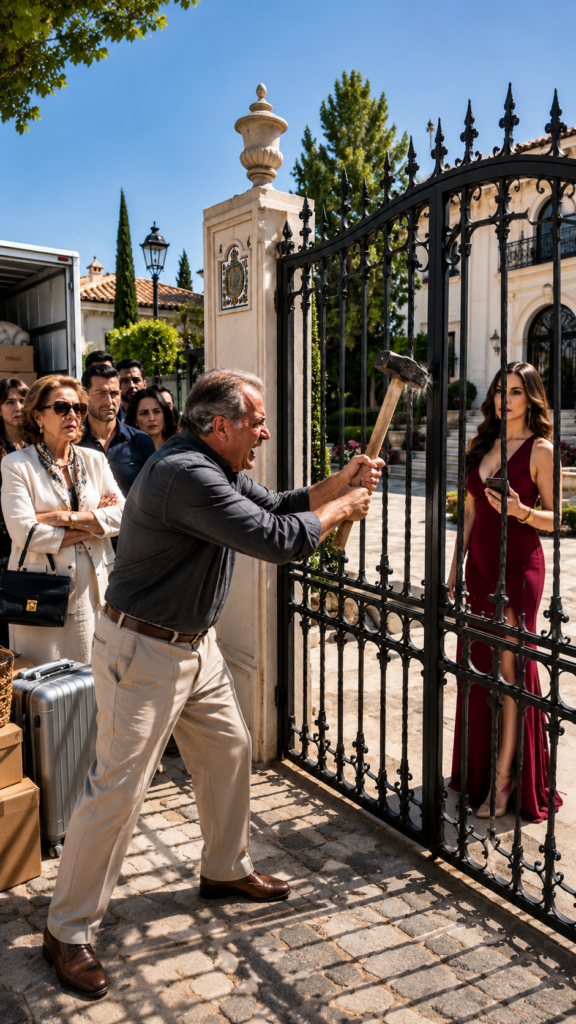
Laughter erupted on the terrace of the Santillán mansion in Lomas de Chapultepec, while the sunset reflected in the enormous windows and in the flutes of French champagne.
Amalia Santillán, the owner of the house and heiress to one of the most powerful real estate groups in Mexico City, smiled cruelly.
—What a great idea, Rebeca. It’ll be the fun touch for my birthday.
A few meters away, Camila Ríos was finishing cleaning a marble table. She wore a gray uniform, plain shoes, and her hair tied back with a black band. At 28, she had a calm gaze and a way of walking that irritated Amalia: she never seemed defeated.
Camila had worked for the Santillán family for three years.
She arrived before 7 in the morning.
She cleaned offices where no one said thank you.
She arranged rooms where million-dollar deals were closed.
She polished mahogany desks where contracts were signed that could change the lives of thousands.
And yet, to Amalia, she was still “the cleaning girl.”
—Camila! —Amalia shouted.
The young woman approached slowly.
—Yes, ma’am?
Amalia handed her a white envelope with golden letters.
—Saturday is my birthday. Politicians, businessmen, journalists, important people will come. I want you to be there.
Camila took the invitation with both hands.
—Thank you for considering me.
Rebeca let out a barely concealed laugh.
—Just make sure to come dressed up, honey. We don’t want you to be confused with the service staff.
Camila glanced up.
She didn’t respond with anger.
She only held Amalia’s gaze for a second.
—Of course. I understood the invitation very well.
When she left, the women laughed again.
—I bet she’ll ask to borrow a dress from Tepito —said another guest.
—Or she’ll show up in quinceañera shoes —Rebeca added.
Amalia brought the glass to her lips.
—People need to learn their place.
None of them noticed that Camila kept that invitation as if it were a key.
That night, in her small apartment in the Portales neighborhood, Camila opened an old box she kept under her bed.
Inside was a photo of a young woman holding a baby.
A gold brooch with a green stone.
An old certificate.
And a yellowing letter with a surname written in blue ink:
Montemayor Aranda.
Camila took a deep breath.
Then she took her cellphone and dialed a number.
—Grandpa —she said when they answered—. It happened.
The voice on the other end sounded grave.
—Did Mrs. Santillán invite you?
—Yes. To humiliate me.
There was silence.
—Then the day has come, daughter.
Camila closed her eyes.
—I’m ready.
On Saturday, the Santillán mansion looked like a lit museum. There was elegant mariachi, waiters in white gloves, arrangements of orchids, influencers recording stories, and over 300 guests walking among sculptures, fountains, and tables overflowing with luxury.
At 8:30 p.m., Amalia appeared on the main staircase in a silver dress.
Everyone applauded.
She smiled like a queen.
But her smile froze when a black SUV stopped in front of the entrance.
The driver got down first.
He opened the back door.
Camila descended.
She wasn’t wearing a uniform.
She wore a bottle-green dress, sober, elegant, tailored to fit. Around her neck was an antique diamond necklace. In her hand, a black clutch. Her hair fell in soft waves, and her face showed no fear.
Conversations began to fade.
Rebeca opened her mouth.
—No way...
Amalia took several seconds to recognize her.
But when she saw the older man who descended behind Camila, leaning on a silver cane, she felt the blood drain from her body.
It was Don Ernesto Montemayor Aranda.
And he was heading straight for her.
PART 2
Don Ernesto Montemayor Aranda needed no introduction.
In Mexico, his surname appeared on private hospitals, universities, construction companies, hotels, and entire developments. He was a retired businessman, yes, but a single call from him was enough to make a bank nervous or a notary double-check any deed.
Amalia Santillán went pale.
—Don Ernesto… what a surprise.
The elderly man didn’t smile.
—The surprise was yours, Amalia. Although the invitation was for my granddaughter.
The word fell in the party like a stone.
Granddaughter.
Guests began to murmur.
Camila moved forward, holding her grandfather’s arm. Each step seemed to erase years of humiliation, of curt orders, of condescending glances.
Rebeca tried to laugh.
—Oh, well, it’s surely a confusion. Everyone invents surnames these days to make themselves important.
Camila looked at her calmly.
—I wish it were an invention. My mom would have suffered less.
Amalia tightened her grip on the glass.
—Camila, I don’t know what show you’re trying to put on, but this is my house.
—That will also be made clear today —Camila replied.
The atmosphere turned heavy.
The music stopped.
The mariachi left their instruments silent.
A photographer lowered the camera.
Don Ernesto gestured. From a second SUV, two lawyers and a woman in a navy blue suit with a thick folder got out.
—Good evening —she said—. I am Licenciada Mariela Castañeda, Notary Public 29 of Mexico City.
Amalia stepped back.
—A notary at my birthday?
Camila pulled out the same golden invitation Amalia had given her.
—You asked me to come elegantly. You asked me not to embarrass you. Believe me, I tried to be discreet. But there are truths that don’t fit in a kitchen and can’t be hidden under an expensive rug.
Some guests moved closer.
Others began recording on their cellphones.
Amalia pointed to the guards.
—Get her out.
But before anyone moved, Mauricio Santillán, Amalia’s son and the director of the family group, appeared.
—No one touches her —he said firmly.
Amalia looked at him in indignation.
—Excuse me?
Mauricio looked at Camila.
—I suspected for months that something was off.
Camila didn’t reply.
The notary opened the folder.
—The documents to be presented tonight have already been submitted to civil and commercial courts. They are not mere copies. They are certified proofs.
Amalia let out a nervous laugh.
—This is ridiculous.
Don Ernesto stepped forward.
—Ridiculous was believing you could rob my daughter of her life and erase my granddaughter as if she were trash.
Silence became absolute.
On the giant screen where photos of Amalia in Paris had been displayed, the first document appeared.
Birth certificate.
Name: Camila Isabel Ríos Montemayor.
Mother: Lucía Ríos Montemayor.
Father: Álvaro Santillán Robles.
Murmurs exploded.
Mauricio stood frozen.
Álvaro Santillán had been his father.
Amalia’s deceased husband.
The founder of the Santillán Group.
Amalia shook her head.
—That’s false.
The notary lifted another sheet.
—The signature was validated by experts. There are also DNA tests done with legally preserved samples from Álvaro Santillán. The result confirms direct kinship.
Rebeca set her glass on a table.
—Amalia… did you know?
Amalia glared at her in rage.
—Shut up.
Camila took a deep breath.
—My mother worked in a construction company owned by Álvaro Santillán. He seduced her, promised to acknowledge me, and also asked her to use inherited shares from my family to launch three developments in Santa Fe.
The screen changed.
A private contract appeared.
Álvaro Santillán acknowledged a debt to Lucía Ríos Montemayor and committed to giving her 30% participation in several real estate projects.
A businessman whispered:
—That’s worth a fortune.
Camila continued:
—My mother died when I was five. I was told she was a deceived employee, a lone woman, a nobody. For years I grew up believing I had no right to ask questions.
Don Ernesto looked down.
—When I finally found my granddaughter, she had already learned to survive on her own.
Amalia tried to regain control.
—And is that why you got a job in my company? To spy on us?
Camila held her gaze.
—I entered because I needed to find what you hid. And you made it easy for me. You made me clean the private office, organize files, throw away old boxes. You never thought “the cleaning girl” could read financial statements, contracts, and deeds better than your own advisors.
Several people gasped in surprise.
The screen revealed printed messages.
Altered transfers.
Duplicated signatures.
Folders with notary seals.
Then came an audio.
Amalia’s voice sounded clear:
“As long as that girl uses the surname Ríos, she has nothing. Lucía is dead. Ernesto will never find the papers. And if the girl shows up, we’ll make her seem crazy.”
Amalia covered her mouth with a hand.
Mauricio looked at her as if he had just seen a stranger.
—Did you do that?
—I protected my family —Amalia shouted.
Camila replied without raising her voice.
—No. You protected your money.
The phrase sliced through the terrace.
Rebeca wanted to step away, but Don Ernesto pointed at her with his cane.
—Don’t leave so quickly. There are also messages from you.
Rebeca froze.
On the screen appeared screenshots of conversations.
Rebeca advised Amalia to invite Camila to the birthday to “put her in her place” and “remind her she was born to serve.”
The guests began to look at her with disdain.
—It was a joke —Rebeca stammered—. A joke between friends.
Camila looked at her.
—Jokes don’t destroy certificates, don’t hide inheritances, and don’t humiliate a woman for three years.
Then a voice spoke from the back.
It was Rosa, a cook from the mansion.
—I was humiliated too.
Everyone turned.
Rosa had trembling hands.
—Mrs. Amalia deducted two months of salary from me because your grandson broke a dish. I wasn’t even in the kitchen that day.
Another employee raised her hand.
—I was fired when I got sick with a back injury.
A gardener said:
—I was paid less than what I signed on the payroll.
The party turned into a public trial.
Amalia shouted:
—You’re all ungrateful!
But no one defended her.
The notary spoke again.
—This afternoon a provisional suspension was granted to freeze accounts and operations related to the specified developments. No assets may be sold, transferred, or hidden while the investigation lasts.
Amalia’s eyes widened.
—You can’t do that.
Mauricio spoke with pain.
—Yes, they can. I submitted the missing files.
Amalia slowly turned to her son.
—You?
Mauricio’s eyes were red.
—I found documents in Dad’s safe. I also found letters from Lucía. I stayed silent for weeks because I didn’t want to believe it. But the truth doesn’t stop existing because we choose to ignore it.
Amalia raised her hand as if to slap him, but stopped when she saw everyone looking at her.
Camila felt a knot in her throat.
That was the twist no one expected: Mauricio, the heir, the legitimate son, had decided to break his family’s silence.
—I didn’t do it for you —he said to Camila, his voice breaking—. I did it because my father also owed you a truth.
She looked at him with serene sadness.
—That’s enough for now.
Suddenly, two government agents entered through the main door accompanied by a lawyer.
—Mrs. Amalia Santillán —one said—, we need you to accompany us to make a statement for alleged fraudulent administration, forgery of documents, and labor exploitation.
Amalia looked around for support.
Rebeca pretended to answer a call.
Her friends lowered their heads.
The businessmen who had once toasted with her took a step back.
The woman who had prepared a party to humiliate an employee stood alone in front of over 300 people.
—Camila —Amalia said with a trembling voice—. This can be fixed.
Camila slowly shook her head.
—My mom also wanted to fix it. You let her die in fear.
Amalia was escorted to the exit.
No one applauded.
No one shouted.
Only the sound of her heels clicking against the marble echoed, growing fainter, until the door closed.
Camila thought she would feel joy.
But no.
She felt exhaustion.
She felt ancient rage.
She felt the weight of a mother who couldn’t defend herself and of a girl who grew up believing her story was worthless.
Don Ernesto embraced her.
—Your mother would be proud, honey.
Camila closed her eyes.
—I wish she were here.
—She is —he replied—. In your voice.
Months later, the Santillán scandal was everywhere.
The frozen accounts revealed diversions, false contracts, and illegal payments.
The group had to acknowledge Camila’s hereditary participation.
Several employees received compensation.
Amalia faced legal proceedings, and her friends disappeared from the social circle they once flaunted.
But Camila didn’t ask to keep the mansion.
She asked for something different.
With part of what was recovered, she created the Lucía Montemayor Foundation, a center for legal support and training for domestic workers, cleaning staff, and women unjustly dismissed.
The terrace where they had mocked her became a classroom.
The office where they hid documents turned into a labor advisory office.
The kitchen where Rosa was humiliated transformed into a community dining room.
A year later, Camila returned to the main entrance.
No longer as an employee.
No longer as a victim.
She arrived as the director of the foundation, with her grandfather by her side and dozens of women waiting for her with flowers.
Mauricio was there too.
He had resigned from the leadership of the group and was working without pay, organizing files so that other women could recover what they were owed.
He approached Camila with a folder.
—The first 50 compensations have been approved.
Camila took the documents.
—Thank you.
Mauricio looked down.
—I know that doesn’t erase anything.
—No —she replied—. But it starts something different.
Before cutting the ribbon, Camila climbed onto the small stage.
In front of her were reporters, neighbors, former workers, businessmen, and women who once believed they had to endure everything in silence.
She took the microphone.
—For three years, I cleaned floors in this house —she said—. Many thought that made me less. But no honest work takes away a person’s dignity. Dignity is lost when someone humiliates, steals, and believes they are untouchable.
The silence was profound.
—My mother left me a surname. My grandfather returned me a story. But life taught me something stronger: when a woman keeps the truth, it may take years to speak… but when she speaks, even empires tremble.
Applause filled the garden.
This time it wasn’t out of surprise.
It was out of respect.
Camila looked at the entrance where that night she had arrived dressed in green, with proof in hand and a burning heart.
And she smiled.
Because Amalia Santillán did make her birthday unforgettable.
Just not by humiliating an employee.
But because that night all of Mexico saw how a silent woman arrived with her surname, her truth, and her dignity…
And reminded everyone that no one is insignificant when they have proof and the courage to rise.