PART 1
"You were the one who insisted on having that child, Mariana. So you take care of it."
Esteban spat the words from the hallway of the bedroom, one hand clutching his jacket, the other gripping his phone, as if he were discussing an uncomfortable debt, not his newborn son.
It was 6:35 AM in an apartment in the Del Valle neighborhood of Mexico City. Outside, the noise of the microbuses began to blend with the whistling of the tamale vendor.
Inside, Mariana could barely walk.
She had given birth 6 days ago. Stitches throbbed, her breasts were swollen, she had a low fever, and her eyes were so puffy from sleeplessness that she looked like a different person.
In her arms, Gael cried with that small, desperate wail that cuts through walls.
"I just asked for 15 minutes," she said, nearly voiceless. "I need to shower, Esteban. I haven’t eaten anything since yesterday."
He rolled his eyes.
"I have a meeting in Reforma. I can’t show up looking like a wreck because you don’t know how to organize yourself with a baby."
From the kitchen, Doña Raquel let out a dry chuckle.
The mother-in-law had been camped out in the apartment for 6 days, claiming she was "here to help." But she hadn’t washed a single onesie, hadn’t made soup, hadn’t held the baby for more than 3 minutes.
What she did do was offer her unsolicited opinions on everything.
"Oh, Mariana, stop exaggerating," she said, stirring her coffee in a cup that wasn’t hers. "In my day, a woman got up the next day to clean. Now, any little thing makes you feel like you’re in a soap opera."
Mariana pressed Gael closer to her chest.
"I’m not exaggerating. I’m in pain."
Doña Raquel set the spoon down on the table.
"Well, you should have thought about that before getting pregnant. No one forced you."
Mariana lifted her gaze.
"He’s your grandson."
"My grandson isn’t to blame for your attempts to trap my son with a child."
The words hit like a slap.
Esteban didn’t correct his mother. He didn’t seem outraged. He didn’t even pretend to be upset.
He merely adjusted his watch.
"Don’t start, Mariana."
"Your mother just said I used Gael to catch you."
"Well, she’s not entirely wrong."
The baby’s cries seemed to fill the entire apartment.
Mariana looked at the man she had married four years earlier. The same man who, in the baby shower photos, had embraced her belly and wrote, "my family, my drive." The same man who now couldn’t even spare her 15 minutes to shower.
"Tell me you didn’t mean that," she whispered.
Esteban grabbed his keys.
"What I’m saying is you wanted to be a mom. So act like one."
Doña Raquel smiled with that venomous calm of someone who knows they’re protected.
"And when your hysteria subsides, you can apologize. Because that’s no way to speak to a husband."
They expected to see her cry.
They expected Mariana to lower her head, as she had so many times before. To apologize for being tired. To swallow the humiliation so that no one would say she was a bad wife.
But that morning, something broke.
She didn’t shout. She didn’t throw anything. She didn’t insult.
She just took a deep breath.
She laid Gael in the bassinet, opened the closet, and pulled out a gray backpack. She stuffed it with diapers, two onesies, a blanket, her medical records, the provisional birth certificate, and a black folder she had been hiding behind a shoebox for weeks.
Esteban frowned.
"What are you doing?"
Mariana carefully cradled the baby.
"I’m going to my dad’s."
Doña Raquel burst out laughing.
"You’ll be back before lunch. No new mother can handle being alone."
Mariana gave her one last look, watching her sip from her cup, seated in her kitchen, the owner of a house that didn’t even belong to her.
She didn’t respond.
Because before being the exhausted wife they thought would be easy to crush, Mariana had been a financial auditor at a firm in Polanco.
And Esteban didn’t know that by firing her, he had just pushed her to open the folder that could sink him forever.
PART 2
Don Julián opened the door before Mariana could ring the bell.
He lived in an old house in the Portales neighborhood, with tiled floors, clay pots at the entrance, and the smell of coffee brewing. He was 70 years old, with a weary back, strong hands, and a gaze of a man who had spent half his life fighting abuses in commercial courts.
When he saw his daughter standing there, pale, with Gael sleeping against her chest, he asked nothing.
He just opened the door wider.
"Come in, daughter."
Mariana crossed the living room and her legs buckled.
Don Julián managed to catch her. He didn’t say, "I told you so." He didn’t ask why she had put up with so much. He didn’t make her feel ashamed.
He simply took the baby with enormous tenderness.
"This child needs peace," he said softly. "And you need to sleep."
Mariana cried silently.
She cried like women do when they can’t fall apart completely because someone small depends on them. She cried with one hand on her wound, the other reaching for her child, as if still afraid someone might take him away.
That afternoon, while Gael slept in a borrowed crib, Mariana placed the black folder on the dining room table.
Don Julián put on his glasses.
"What do you have there?"
"What Esteban thought I would never find."
Inside were bank statements, contracts, screenshots of emails, duplicate invoices, transfers, and documents from Esteban’s company: Rivera Design and Construction.
On Instagram, Esteban portrayed himself as a young, successful entrepreneur, one of those who remodels apartments in Roma, offices in Santa Fe, and houses in Jardines del Pedregal.
He posted photos with a white hard hat, a luxury truck, and quotes about leadership.
But Mariana knew how to read what others tried to hide.
There were duplicate payments. Nonexistent suppliers. Materials billed three times. Transfers to an account linked to Doña Raquel’s maiden name.
And most troubling: a line of credit where Mariana’s signature appeared.
A signature she had never made.
The date froze Don Julián.
The credit had been authorized the same day Mariana was hospitalized for preeclampsia, two days before Gael was born.
Don Julián set the papers down on the table.
"Since when do you know?"
"Since January."
"You were seven months pregnant."
"Yes."
"And why didn’t you tell me?"
Mariana glanced toward the crib.
"Because I needed Gael to be born healthy. Because Esteban checked my phone. Because his mother intruded even on my doctor appointments. Because if I spoke up, they would say I was hormonal, crazy, exaggerating."
Don Julián clenched his jaw.
"You weren’t crazy. You were gathering evidence."
The messages started that night.
"Have you calmed down yet? Come back."
Then:
"My mom says you’re embarrassing yourself."
Later:
"If you don’t come back tomorrow, I’m going to say you abandoned the household and took my child without permission."
Mariana read everything without replying.
Before, those threats would have made her tremble. She would have explained, pleaded, begged for calm.
Now she just took screenshots.
Doña Raquel sent audio messages.
"Mariana, don’t be common. A decent woman doesn’t run to her dad every time her husband sets limits. That child needs his father, not a resentful mother."
Mariana didn’t respond.
Don Julián listened to the entire audio and let out a bitter laugh.
"What nerve. First, they step on your neck, and then they get offended because you make noise while breathing."
The first blow came from where Esteban least expected it.
The Del Valle apartment wasn’t his.
Doña Raquel called it "my son’s apartment" at family gatherings, and Esteban let everyone believe that. But the property belonged to a trust set up by Mariana’s mother before she died.
Esteban lived there by marriage, not by right.
Three days later, Doña Raquel made the mistake that changed everything.
She posted a photo on Facebook.
She appeared in Mariana's kitchen, holding a glass of white wine, smiling in front of a tray of enchiladas.
The text read:
"Finally, peace has returned to my son's house. Some women were just not meant to create a home."
Don Julián read the post and smiled without joy.
"Perfect."
Mariana blinked.
"Perfect?"
"She just publicly admitted to occupying someone else's property after you left due to emotional violence and threats."
That same afternoon, attorney Abril Montes, family lawyer and friend of Don Julián, received the complete folder. She also received the audio messages, the screenshots, the medical records, the baby’s birth certificate, and the Facebook post.
Mariana didn’t want to destroy anyone.
She wanted to breathe.
She wanted to sleep without fear.
She wanted her child to grow up in a home where his cries weren’t treated as an annoyance.
But she soon understood something: when a woman stops obeying, abusers label any boundary as vengeance.
The notification arrived at the apartment on a Tuesday at 9:10 AM.
Esteban called furious 5 minutes later.
"What the hell did you do, Mariana?"
She sat at her dad’s dining table, with Gael sleeping on her chest. She put the phone on speaker.
"You received a legal notification."
"Are you kicking me out of my house?"
"It’s not your house."
A heavy silence fell.
In the background, Doña Raquel could be heard.
"Tell her to stop acting important!"
Esteban breathed hard.
"My mom and I aren’t going anywhere."
"You have 48 hours to vacate. The trust has revoked your usage rights."
"You’re sick."
"No. I’m informed."
He lowered his tone, as if suddenly remembering he could feign tenderness.
"Mariana, you just gave birth. You’re emotional. Your dad’s filling your head."
She looked at Gael. The baby stirred slightly in his sleep, searching for milk.
"The only manipulation was telling me I was alone in raising your child while you forged my signature on a loan."
On the other end, there was no response.
It was no longer anger.
It was fear.
"What are you talking about?"
"About the line authorized when I was hospitalized. About the duplicate invoices. About the phantom suppliers. About the accounts linked to your mom."
A crash sounded, as if someone had knocked over a chair.
Doña Raquel shouted:
"That woman is making things up!"
Mariana closed her eyes.
"Then explain it with documents."
Esteban lowered his voice.
"Don’t do something stupid."
For him, the stupid thing wasn’t leaving her alone 6 days after childbirth. It wasn’t allowing his mother to humiliate her. It wasn’t threatening to take their baby away. It wasn’t forging a signature.
The stupid thing was that she had stopped bowing her head.
"I’m not doing something stupid," she replied. "I’m doing what I should have done long ago."
"You can’t take my son away from me."
"You said I clung to having him. You said I should raise him."
The phrase fell between them like a massive stone.
Esteban tried to fix it.
"I was tired."
"So was I."
"My mom just wanted to help."
"Your mom wanted to control."
"We can talk."
"You already talked. And it was recorded."
The silence turned cold.
Mariana continued:
"Attorney Montes will request provisional custody, supervised visits for Esteban, and measures to prevent your mom from approaching me or Gael without judicial authorization. Financial matters will proceed through the appropriate channels."
"You’re going to ruin me."
"No, Esteban. You built all this. I just stopped covering it up."
And she hung up.
For 2 days, Esteban and Doña Raquel did what they knew best: make noise.
He sent messages saying he loved her, then that he hated her, then that without him she wouldn’t be able to afford even diapers.
Doña Raquel called cousins, aunts, and neighbors to say that Mariana had become arrogant because her dad was a lawyer.
Esteban’s family began to weigh in:
"A child needs his father."
"Women these days can’t endure anything."
"Poor Esteban, he must be confused."
No one asked who had carried the baby all night.
No one asked if Mariana had a fever.
No one asked why a mother-in-law was smiling in someone else’s kitchen while a new mother asked for 15 minutes to shower.
The eviction was discreet, but enough to strip away their masks.
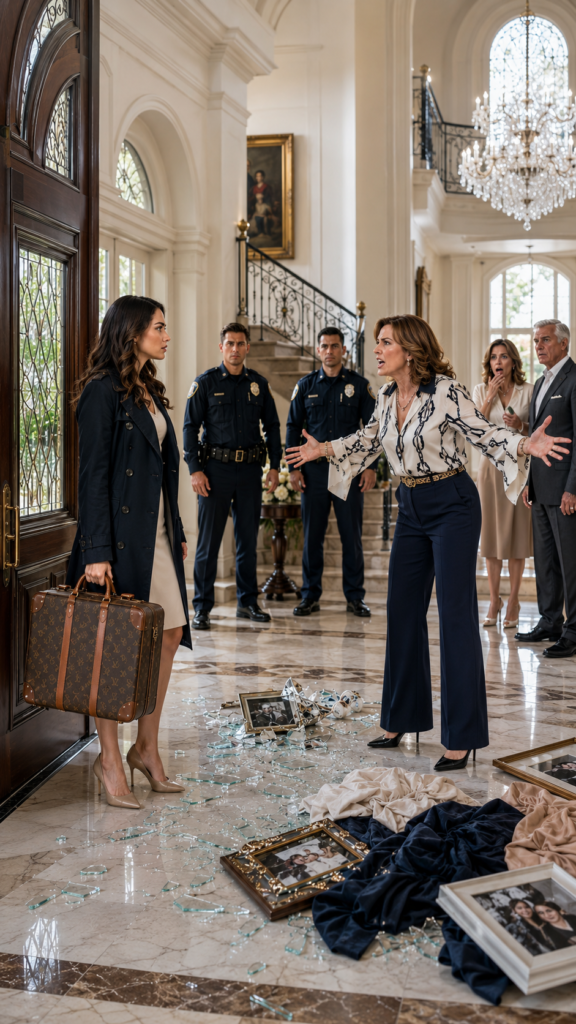
An attorney, two representatives from the trust, and private security arrived. Esteban tried to speak of "spousal rights." Doña Raquel exited with dark glasses, clutching a designer bag and declaring that it was a disgrace.
Neighbors looked on from their windows.
Mariana didn’t go.
She didn’t need to see them leave.
The Facebook photo entered the case file. So did the audio messages. So did the texts where Esteban threatened to use custody as punishment.
The family hearing took place three weeks later.
Esteban showed up in a blue suit, trimmed beard, and the practiced expression of a wounded father. Doña Raquel sat behind him, rosary in hand, as if praying could erase bank transfers.
Mariana arrived in a simple black dress, hair pulled back, and a firm gaze. Gael stayed at Don Julián’s house with a nurse recommended by Abril.
The judge listened to everything.
She didn’t make gestures. She didn’t fall for easy tears. She reviewed the medical records, the screenshots, the ownership of the apartment, the audio recordings, and the context of postpartum vulnerability.
When Esteban’s recording played, the room froze.
"You were the one who insisted on having that child, Mariana. So you take care of it."
Esteban lowered his gaze.
Doña Raquel stopped moving the rosary.
The judge granted provisional custody to Mariana. She ordered supervised visits for Esteban while the environment was assessed. She prohibited Doña Raquel from approaching Mariana or the baby without judicial authorization.
She also noted that any threat to use custody as leverage would be considered during the process.
As they left, Esteban tried to approach her.
"Mariana, please. Don’t make this bigger."
She looked at him without hatred.
That was what hurt him the most.
Because hatred still binds. Indifference does not.
"You made it big when you treated your child as punishment," she said.
The financial part moved forward separately.
The bank froze the line of credit. An expert reviewed the forged signature. Several clients paused contracts with Rivera Design and Construction. One supplier agreed to testify that he issued inflated invoices at Esteban's orders.
And the accounts linked to Doña Raquel began to appear in reports she swore she didn’t understand.
The woman who claimed that women of the past endured more ended up sitting in front of a lawyer, explaining why she was receiving money from a company she didn’t work for.
Esteban didn’t crash all at once.
It was worse.
He fell gradually.
First, he lost the apartment. Then he lost his image. After that, he lost clients. Finally, he understood that the wife he called exaggerated had been the only person holding his disaster together so it wouldn’t explode before Gael was born.
By the time he tried to come back, it was too late.
He sent flowers.
Mariana didn’t receive them.
He sent messages saying he missed his son.
Attorney Montes responded for her.
She sent an audio of her crying.
"My mom is shattered. She says she hasn’t slept since she stopped seeing the baby."
Mariana listened to the audio once.
Then she looked at Gael, asleep in his crib, with tiny hands open and a peaceful face.
Don Julián, from the kitchen, said:
"How strange. Some people hurt losing control, but they call it love."
Mariana didn’t reply.
She had learned that not everything deserves a response.
Some things deserve a file.
Six months later, the Del Valle apartment began to breathe again.
There were no more poisonous comments in the kitchen. No more television blaring to drown out the baby’s cries. No more mother-in-law rifling through someone else’s drawers or a husband making her feel guilty for asking for help.
There was a stroller by the entrance. There were bottles drying. There was soft music in the mornings. There was a small office where Mariana returned to work as an independent financial auditor.
Her first client was a construction company that had severed ties with Esteban.
Life, sometimes, collects debts with tremendous elegance.
One rainy afternoon, Gael let out his first laugh in Don Julián’s arms. It was a small, pure laugh, like a bell.
Mariana looked at him and cried.
But she no longer cried out of fear.
She cried because she understood that her son would never learn that love humiliates, abandons, or threatens.
Days later, while tidying up the kitchen, she found the white cup Doña Raquel had used that morning.
She held it for a few seconds.
She remembered her mother-in-law’s smile. She remembered Esteban’s voice. She recalled that phrase that had broken something inside her when she still had stitches, a fever, and fatigue.
"So you take care of it."
Mariana washed the cup calmly, dried it, and stored it at the back of the cupboard.
Not because she had forgotten.
But because that memory no longer held power.
When some relatives said she had been too harsh, she didn’t argue.
When someone commented that a baby needs his father, she didn’t fight either.
Of course, a baby needs love.
He needs clean arms. He needs a home where his cries are not a nuisance. He needs adults who don’t use blood as permission to do harm.
But a mother also needs something.
She needs to remember that saving her child sometimes starts with stopping asking for permission to save herself.
Mariana didn’t destroy Esteban.
She just stopped protecting him from the consequences.
And that was the one thing he could never forgive her for.