PART 1
Renata Cárdenas had been warned not to make a scene.
That was the warning from her husband, Sebastián Luján, before they entered his mother’s house in Las Lomas de Chapultepec. It was doña Amparo’s 65th birthday, an elegant, cold woman who greeted with air kisses and dismissed with a piercing gaze.
Renata arrived with a huge three-tiered cake, decorated in white and emerald green. She had spent two nights preparing it, not because she wanted to win over her mother-in-law, but because she still had the bad habit of caring for even those who hurt her.
Sebastián walked beside her, impeccable in a gray suit, smiling like a businessman in a magazine.
On the other side of the dining room stood Valeria Murat.
She was introduced as the “image consultant” for Grupo Luján, though everyone knew she was much more than that. Even doña Amparo seemed to relish it.
“What a lovely cake,” Valeria said, lifting her phone. “I hope it doesn’t taste as dull as its maker.”
The table erupted with giggles.
Renata didn’t respond. She had swallowed comments like that for eight years. “You look classier when you keep quiet,” Sebastián would tell her when she tried to defend herself. “Don’t take everything personally,” he would repeat after each humiliation.
Doña Amparo raised her glass.
“Let’s toast to the real family. The one that has class, vision, and a name.”
Renata felt the blow before she even understood it.
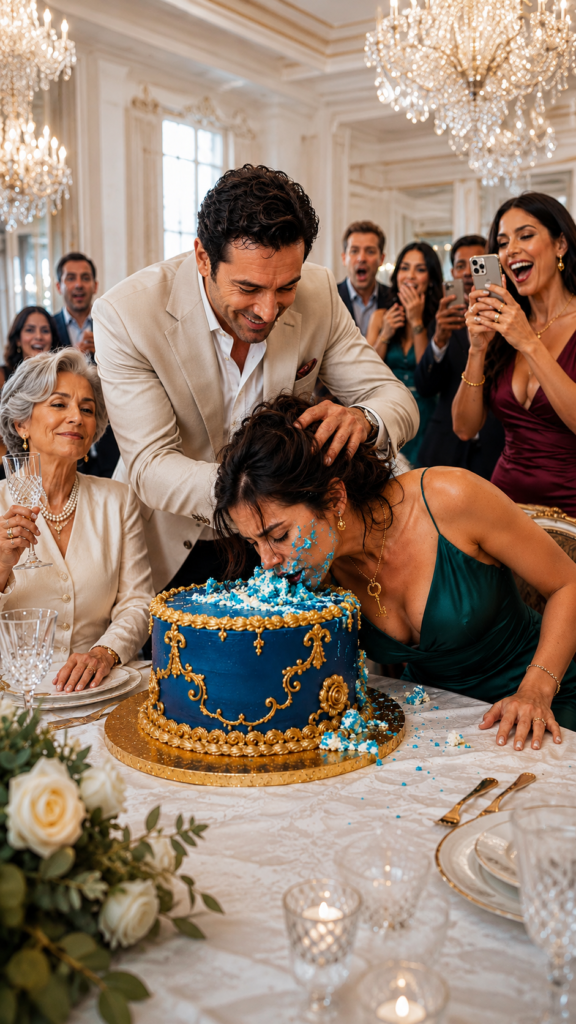
Sebastián’s hand fell on her neck and shoved her face into the cake. The frosting filled her nose, her lips, her eyelashes. The table exploded in laughter.
“Come on!” shouted Diego, Sebastián’s brother. “This is going on TikTok!”
Valeria was recording up close.
“She learned her place,” she whispered, but the phone captured every word.
Sebastián let out a nervous laugh, as if cruelty needed to disguise itself as a joke.
“Come on, Renata. Don’t overreact. It’s just cake, not acid.”
She slowly lifted her head. Her face was covered in green frosting. The ivory dress was ruined. But her eyes didn’t cry.
That discomforted everyone.
Renata took a napkin, wiped her mouth, and then ran her fingers over the small gold charm she wore around her neck: an ancient key, delicate, almost invisible to those who only valued brands and names.
“Enjoy your party,” she said.
She didn’t scream. She didn’t insult. She didn’t plead.
She left the dining room while Valeria uploaded the video with the venomous caption: “When the filler wife finally serves to decorate.”
Outside, Renata breathed as best as she could. The frosting smelled of vanilla and shame. She climbed into her car and slammed the door with trembling hands.
Then her phone vibrated.
It was an email from Horizonte Patrimonial.
“Subject: Urgent Review of Grupo Luján — Approval Required by Controlling Beneficiary.”
Renata read the message once.
Then she looked toward the illuminated house, where Sebastián was still toasting with his lover, unaware that he had just humiliated the only woman who could decide whether his empire would survive or sink that very week.
PART 2
Renata didn’t go back into the party.
She stayed in the car for ten minutes, wiping her face with tissues that couldn’t erase the feeling of the blow. Outside, the guards of the house pretended not to see her. Inside, the music continued as if nothing had happened.
Sebastián sent her a message 18 minutes later.
“Don’t make a drama. My mom is already upset about your attitude.”
Renata stared at the screen until it went dark.
He had shoved her in front of his mother, his mistress, and half of the family. And yet, she was the one to blame. That was the trap of all those years: turning her pain into exaggeration and her silence into permission.
She drove to the house in Pedregal that Sebastián always called “my house.”
“My roof, my rules,” he would say when he wanted to feel like he owned everything.
Renata never corrected him. Not because she couldn’t, but because her grandfather taught her that people who sign documents without reading end up confessing who they are without the need for interrogation.
The house didn’t belong to Sebastián.
It wasn’t even owned by the Luján family.
It was under a trust created by the Cárdenas before Renata got married. Sebastián had signed the occupancy agreement eight years ago, mocking the notary because, according to him, “the rich complicate even love.”
Renata entered the kitchen. On the counter, there were boxes of sugar, clean spatulas, edible flowers, and a mold she hadn’t gotten to use. She almost cried there.
Not for the cake.
But for all the times she tried to do something nice for people who were just waiting for an opportunity to see her on her knees.
Sebastián arrived past midnight. He smelled of whiskey, another woman’s perfume, and arrogance.
“You left without saying goodbye,” he said, tossing the keys.
“I had already been dismissed from your family,” Renata replied.
He froze.
He hadn’t expected that voice.
“Don’t start. It was a joke.”
“No. It was a decision.”
Sebastián loosened his tie.
“Look, Renata, my mom is right. You never fit in. And after today, it’s clear to me that this isn’t working anymore.”
His phone vibrated. Valeria’s name appeared on the screen with a green heart.
Renata saw it.
Sebastián smiled before hiding the phone.
That gesture hurt more than the cake.
As she climbed to the bedroom, Renata opened her computer. She hadn’t responded to the email from Horizonte Patrimonial yet. First, she checked her bank alerts, those she had been reviewing in silence for months.
There they were.
Three charges from a boutique in Polanco. An emerald handbag. An evening dress. A pair of heels. All under a card Renata never applied for.
Withdrawal by client: Valeria Murat.
Renata felt a coldness in her stomach.
Sebastián was not just cheating on her. He had also used her information to finance his mistress. And Valeria, in the same dress bought in her name, had just recorded her covered in cake.
Downstairs, Sebastián was speaking softly on the phone.
“Yes, love. Don’t worry. She’s going to calm down. She always calms down.”
Renata began to gather evidence.
Screenshots. Dates. Videos. Messages. Bank statements. Links. The audio from the video where Valeria said, “She learned her place.” Sebastián’s message. Everything.
At 1:12 in the morning, she called Lucía Santillán, her family lawyer.
“Are you sure you’re not in danger?” Lucía asked.
“He’s in the house, but he hasn’t touched me since the party.”
“Then don’t confront him about the cards. If he did one, there could be more. Send me everything and let him think you’re still alone.”
Renata touched the gold key at her neck.
“He thinks I have nothing.”
Lucía let out a slow breath.
“Perfect. Let him keep thinking that until tomorrow.”
The next day, the video was already in group chats.
But it had also recorded something that no smart lawyer would ignore: public humiliation, connection with the mistress, and a family celebrating the abuse.
At 11:30, doña Amparo called.
Renata activated the recorder.
“You embarrassed my son,” the woman said without greeting. “A decent wife laughs it off. She doesn’t leave like an offended maid.”
“Anything else?”
“Yes. Leave that house before Sebastián has to throw you out. Valeria, at least, knows how to be with an important man.”
Renata closed her eyes.
“Thank you for clarifying.”
She hung up.
An hour later, Sebastián arrived with a white folder.
“My lawyer prepared something,” he said, placing it on the table. “I don’t want to make it harder.”
Renata opened the folder.
It was a divorce petition. He requested that she leave the house in 30 days and accept to take her personal belongings: clothes, books, kitchen utensils, and “baking equipment.”
Renata read that phrase twice.
The man who had shoved her face into a cake was being so generous as to allow her to keep the mixer.
“I won’t sign anything without my lawyer,” she said.
Sebastián laughed.
“Your lawyer? Renata, please. You’re not in a Netflix series. I paid for this house. I paid for this life. Don’t make a fool of yourself fighting over things you don’t understand.”
She looked at him with a calmness that irritated him.
“Then you won’t have a problem demonstrating it.”
Sebastián tightened his jaw.
“I’m going to the National Business Mobility Gala tonight. I was invited as a finalist for investment. I’ll take Valeria. After your little stunt, I need someone who knows how to behave.”
Renata’s phone vibrated on the table.
New email from Horizonte Patrimonial:
“National Business Mobility Gala — Executive Access and Final Capital Decision.”
Sebastián didn’t get to read it.
“I hope the gala gives you what you deserve,” she said.
“That’s the spirit,” he replied, believing he had won.
In the afternoon, Renata arrived at the Horizonte Patrimonial offices in Santa Fe. Lucía was waiting for her with two folders, a secure tablet, and a serious face.
Horizonte wasn’t just any company. It was the investment arm of the Cárdenas family, dedicated to rescuing family businesses with potential, provided they accepted strict audits.
Grupo Luján was one of those companies.
It had overdue debts, unpaid suppliers, inflated reports, and an urgent capital request. Sebastián believed he would secure money to expand that night.
He didn’t know that the person with the decisive vote was Renata.
“The decision must be clean,” Lucía said. “No revenge. If the company is viable, it’s rescued. If there’s fraud, it’s documented. The personal goes through legal channels.”
Renata nodded.
“I don’t want to destroy anyone.”
Lucía looked at her.
“It’s not necessary. Sometimes it’s enough to stop protecting them.”
That night, Sebastián entered the Grand Hotel of Mexico City with Valeria on his arm. She wore the emerald dress from the boutique in Polanco. Doña Amparo walked behind with a pearl necklace and a victorious smile. Diego was recording everything.
“Now you look like a serious businessman,” Valeria murmured.
Sebastián leaned toward her.
“When the money from Horizonte comes in, no one can touch us.”
In another room, two floors above, Renata was reviewing documents with Horizonte executives. She wore a simple black dress, her hair pulled back, and the gold key resting against her chest.
She didn’t need to shine.
That night she wasn’t there to compete with Valeria. She was there to remember who she was before she had to shrink herself to fit into a marriage that felt too small.
At 8:00, the main room’s lights dimmed.
The presenter thanked entrepreneurs, bankers, suppliers, and strategic partners. Then he announced that Horizonte Patrimonial was starting a new phase of investment in Mexican companies with transparent corporate governance.
Sebastián applauded loudly.
Valeria squeezed his hand.
“It’s time,” she whispered. “This is our moment.”
Then the presenter changed his tone.
“Tonight, we also present the new chair of the investment committee and controlling beneficiary of the Cárdenas Trust.”
Sebastián stopped clapping.
The side doors opened.
Renata entered.
The entire room turned.
She didn’t come through the guest entrance. She came through the reserved access, escorted by Lucía and two Horizonte advisors. Her face no longer had frosting. Her gaze held no fear.
Doña Amparo let out a barely audible murmur.
“It can’t be.”
Valeria let go of Sebastián’s arm as if it were burning.
Renata walked past their table without stopping. That was what hurt the most. She didn’t ignore them out of pride. She ignored them because, finally, they were no longer the center of her life.
She climbed onto the stage.
“Ladies and gentlemen,” said the lead advisor, “licenciada Renata Cárdenas.”
At first, there was silence.
Then the room stood.
Sebastián felt his mouth go dry. Executives who had barely shaken his hand were now applauding the woman he had wanted to push out of “his” house with a list of utensils.
Renata took the microphone.
“Capital should not reward appearances,” she said. “It should support companies that can speak the truth about what they owe, where they failed, and what they are willing to correct.”
She didn’t mention Sebastián.
She didn’t mention the cake.
She didn’t mention Valeria.
And yet, every word hit him.
On the screen, Grupo Luján appeared among several companies under structural review. Not as a winner. Not as untouchable. As a company with urgent debt, unverified expenses, and deficient internal controls.
Valeria looked toward the exit.
Before she could get up, a man in a gray suit approached her with an envelope.
“Miss Murat, you are hereby notified.”
She paled.
“Notified of what?”
“Preservation of electronic evidence, disputed credit activity, and documentation requirement related to purchases made in the name of Mrs. Cárdenas.”
Sebastián stood up furiously.
“This is a trap.”
Lucía appeared next to the table.
“No. This is a procedure. You can come to the executive room with your lawyer, if you have one.”
Doña Amparo tried to intervene.
“This is an abuse. Renata is acting out of spite.”
Renata finally looked at her from the entrance of the executive room.
“You asked me to leave a house that was never your son’s. I just came to organize the papers.”
No one responded.
In the room, Sebastián tried to maintain his dignity, but his hands trembled.
“You hid who you were from me,” he said.
Renata looked at him with sadness.
“I gave you a marriage without my last name. You gave me a divorce petition and a list that allowed me to take my baking molds.”
“If you had told me about Horizonte, none of this would have happened.”
There it was.
No remorse. Just wounded convenience.
Renata breathed slowly.
“If I had told you I had power, you would have treated me better. That’s why I never told you.”
Valeria broke the silence.
“Sebastián told me that card was for representation expenses.”
Everyone looked at her.
“Shut up,” he snapped.
But it was too late.
Lucía took notes. Doña Amparo looked down. Diego stopped recording.
Over the next 48 hours, Horizonte froze any negotiations with Grupo Luján until the audit was completed. Banks requested clarifications. Suppliers demanded payments. The company placed Sebastián on administrative leave while they reviewed expenses, contracts, and lines of credit.
The statement was brief and cold.
It didn’t mention lovers.
It didn’t mention cake.
It mentioned financial controls.
That was worse. Because without drama, there was no way to play the victim.
Doña Amparo called Renata nine times. In the last one, she left a message.
“Daughter, I think we all let ourselves go. The family needs to talk before we hurt each other.”
Renata saved the audio and sent it to Lucía.
She didn’t respond.
Valeria deleted the video, but the screenshots were already preserved. The emerald dress, the charges, the messages, and her own comment became part of a file she could no longer control.
Sebastián sought Renata five days later, outside the Horizonte offices.
He had grown a beard, his tie was loose, and his eyes were red.
“I’m losing everything,” he said.
Renata stopped.
For eight years she would have rushed to comfort him. She would have searched for a phrase to save him from his own guilt.
Not anymore.
“You’re not losing everything,” she replied. “You’re getting to know what you chose.”
“I loved you.”
She felt a clean pain, like a wound that was finally healing.
“No. You loved that I endured.”
The divorce wasn’t quick, but it was clear. The house was off the table thanks to the trust. The fraudulent cards were disputed. Grupo Luján survived, but under external supervision and without Sebastián in daily command.
They didn’t destroy him.
Renata didn’t need to see him on the street to know there was justice.
Justice, sometimes, is when an arrogant person loses the right to keep harming from a big chair.
Months later, Renata sold the house in Pedregal. Not because Sebastián was right, but because she no longer wanted to live in a place where she had learned to walk small.
She moved into an apartment with more light, close to her office and a small bakery in Roma Norte.
On her next birthday, she baked again.
A white cake with green details.
When she placed it on the table, no one laughed. No one lifted a phone to humiliate her. No one shoved her head.
Renata calmly cut the first slice.
The gold key rested against her chest.
It was no longer a secret.
It was a reminder.
She never had to prove her worth.
She just had to stop giving her value to people who never knew how to see it.