PART 1
—Mrs. Valeria, come to the school right now. It's urgent. It has to do with your daughter.
The principal's voice was so harsh that Valeria felt the coffee cooling in her hand.
It was 8:23 in the morning in the Narvarte neighborhood of Mexico City. Outside, the gas truck rumbled by, a woman sold tamales on the corner, and the everyday noise of the city seemed to disregard anyone’s pain.
Valeria had spent four months trying to learn how to live without Andrés, her husband. He had died after a long battle with cancer, leaving a house that was too quiet and a 12-year-old daughter who no longer sang while getting ready in front of the mirror.
Sofía used to have long, shiny chestnut hair that cascaded halfway down her back. Andrés would say she looked like a shampoo commercial, and she would laugh, tossing her hair across her dad's face.
But the night before, Valeria had found the bathroom door locked.
—Sofi, are you okay?
There was no answer.
When she opened the door, she saw clumps of hair scattered across the tiles, in the sink, stuck to droplets of water. Sofía stood in front of the mirror, a pair of school scissors in her hand, her hair cut unevenly, as if she had torn it from within.
—What did you do, my love? —Valeria whispered, unable to move.
Sofía had red eyes, but she didn’t seem remorseful.
—It’s for Camila.
Camila was a girl from her class. Valeria had seen her several times outside school, always wearing a pink hat, holding her mother’s hand. She knew Camila was sick, though no one talked much about it.
—Today she lost her hat at recess —Sofía said—. Some kids laughed. They called her bald, little skull, said she looked old. She ran to the bathroom.
Valeria swallowed hard.
Sofía squeezed a lock of hair between her fingers.
—I heard her crying, like Dad did when his hair started to fall out from the chemo. I heard him, Mom. He said it didn’t matter, but it did.
Valeria felt something break inside her chest.
—I looked it up online —the girl continued—. I saw they make wigs from real hair. Maybe mine isn’t enough, but it’ll help. Maybe Camila can feel beautiful again.
Valeria couldn’t scold her. She simply crossed the bathroom and hugged her, crying with her on the floor littered with hair.
That same night, they went to doña Lupita, a trusted stylist in the Del Valle neighborhood. Upon hearing the story, the woman didn’t charge a single peso. She evened out Sofía’s cut and called a foundation that made wigs for children with cancer.
The next morning, Sofía left for school with short hair, a nervous smile, and a little white box carrying a temporary wig for Camila.
—I’m going to give it to her without anyone seeing —she said—. I don’t want her to feel weird.
Valeria kissed her on the forehead.
For the first time in four months, she felt pride without it hurting so much.
Until the phone rang.
Now, in front of the school gate, Valeria found the principal pale, his tie crooked and his gaze tense.
—Where is my daughter? —she asked.
—In my office.
Valeria rushed inside.
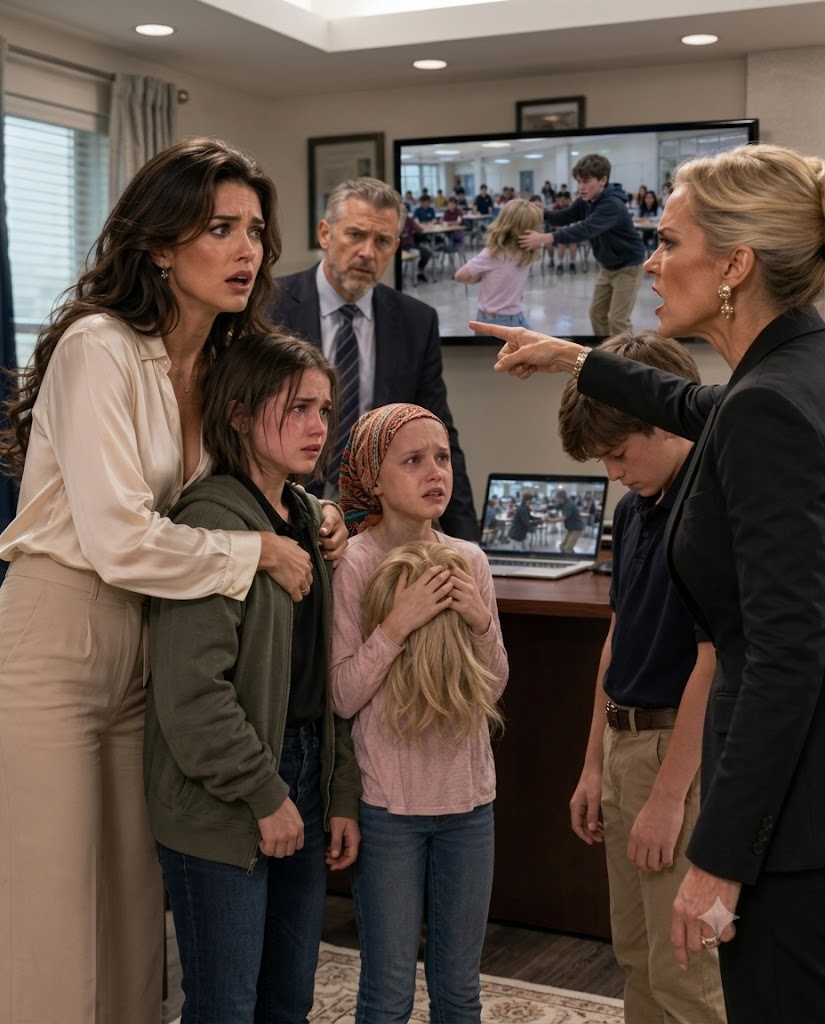
Sofía sat there with her uniform stained with dust, a scraped cheek, and eyes filled with tears. Next to her, Camila hugged the wig as if it were a shield.
In front of them stood Renata Santillán, the most powerful mother in the school, wife of a businessman from the board.
She held her son Diego by the arm and shouted:
—That girl pushed my son, and she won’t leave here without being expelled!
Valeria looked at Sofía.
The girl lifted her face, breathed in trembling, and said:
—I would do it again.
PART 2
The silence fell like a stone.
Renata Santillán opened her eyes with a mix of triumph and disdain, as if she had just heard the confession she needed.
—Did you hear that, principal? —she said, pointing at Sofía—. The girl admits she attacked my son. There’s nothing else to discuss.
Valeria walked towards her daughter, kneeling in front of her.
—Sofi, look at me. What happened?
Sofía swallowed hard. Her hands were clenched over her skirt, and her jaw was tight.
—I pushed him because he was ripping off Camila’s wig.
Camila’s mother, a thin woman named Elena, let out a sob from a chair in the corner. She looked exhausted, with deep dark circles under her eyes and a bag of medications at her feet.
—That’s not true —Renata immediately said—. Diego was just playing. Kids joke around. Don’t exaggerate, please.
Camila shrank in her seat.
—It wasn’t a joke —she murmured.
Renata turned to her with a fake smile.
—Come on, sweetie, you’re very sensitive about your situation. You probably misunderstood.
Elena stood up abruptly.
—Don’t talk to my daughter like that.
Principal Medina raised his hands, trying to control the office.
—Please, we need to hear everyone.
—No, principal —Renata interrupted—. There are rules. Zero violence policy. The daughter of that lady pushed my Diego in front of everyone. I demand expulsion right now.
Valeria felt anger rising to her face.
—And humiliating a girl with cancer doesn’t count as violence?
Renata looked her up and down, measuring her simple clothes, her tired eyes, her recent pain.
—Ma’am, I understand you’re affected by your husband’s situation, but don’t use your tragedy to justify your daughter being aggressive.
Sofía stood up suddenly.
—Don’t talk about my dad!
Valeria grabbed her shoulder before she could take another step.
—Sofía, calm down.
Renata smiled.
—See? She has no control. Just imagine how she’ll be in the classroom.
Diego, her son, was silent. He was tall for his 12 years, wearing expensive sneakers and a new backpack. He looked at the floor, more embarrassed than hurt. On his elbow, he had a tiny scrape, nothing more.
Principal Medina slowly closed the folder in front of him.
—Mrs. Santillán, you asked to review the cameras.
—Exactly —she replied—. So it’s clear who attacked whom.
—We already reviewed them.
Renata lifted her chin.
—Perfect. Then proceed with the expulsion.
The principal said nothing. He connected his computer to a small screen on a table. His hands trembled slightly.
—Before showing the video, I want to clarify something. I called Mrs. Valeria not because her daughter was being expelled, but because I knew someone would try to use their influence to twist what happened.
The office froze.
Renata pressed her lips together.
—Be careful what you say, principal. My husband supports a large part of this school.
—Exactly for that reason I have to say it more carefully —he replied—. Money can’t erase what a camera recorded.
The screen lit up.
The cafeteria of the school came into view. Long tables, kids with trays, backpacks scattered on the floor. In the back, Camila wore the wig. She smiled shyly as Sofía adjusted something in her backpack.
For the first time, Camila looked like a calm girl.
Then Diego appeared with two other classmates.
The video had no sound, but their gestures were clear. They pointed at Camila, laughed, one pretended to be bald, another covered his mouth as if disgusted.
Camila lowered her gaze.
Sofía stood up.
Diego moved closer. He stretched his hand and yanked at the wig.
It wasn’t an accident.
The wig moved, the cap slipped, and Camila covered her head with both hands, bending over the table as if she wanted to disappear from the world.
Elena brought her hand to her mouth.
Valeria felt Andrés's pain hit her again: the hospital nights, the nausea, the clumps on the pillow, the silent shame he pretended not to feel.
On the screen, Sofía pushed Diego’s hand away. He tried to pull the wig again, and then she shoved him hard.
Diego fell because he tripped over a backpack. Not because Sofía had hit him.
Renata wasn’t smiling anymore.
But the video continued.
Several middle school students stood up. They didn’t surround Diego. They surrounded Camila. A girl placed a hoodie over her shoulders. A boy gently picked up the wig from the floor, as if it were something sacred.
Another student pointed to the camera and then to the cafeteria supervisor.
The truth was there, complete, without embellishments.
The principal paused the video.
—This was bullying —he said firmly—. Public humiliation and aggression against a student with a vulnerable medical condition.
Renata crossed her arms.
—My son fell to the floor.
—Your son ripped the wig off a girl with cancer —Elena replied, her voice breaking—. My daughter has been enduring needles, vomiting, fear, and exhaustion for months. Today she dared to enter without her hat. And he made her feel ashamed of being alive.
Diego began to cry silently.
Renata didn’t even hug him.
—Elena, we all have problems. Let’s not dramatize.
Then the first twist no one expected happened.
The principal opened another file.
—There’s more.
Renata stiffened.
—More what?
—An audio sent yesterday to the group of moms from the class.
Valeria frowned. Elena did too.
The principal pressed play.
Renata’s voice came out clear from the speakers:
—Look, I know the girl is sick, and how sad, but we can’t allow our children to be in such a depressing environment. Diego says everyone feels uncomfortable. If the mom can’t handle it, she should change schools.
Elena gasped.
Valeria looked at Renata with a mix of disgust and sadness.
—Did you say that?
Renata lost color.
—That audio was taken out of context.
—No —said a voice from the door.
Everyone turned.
It was the Civic Education teacher, Professor Araceli, with a cellphone in hand. Behind her were two other mothers from the class.
—It wasn’t taken out of context —the teacher said—. You asked not to invite Camila to the spring festival because she “gave a bad image” in the school photos.
Elena covered her face and began to cry.
Camila lowered her head, hugging the wig against her chest.
Sofía took a step toward her.
—Don’t listen to them, Cami.
Renata tried to regain her tone of a powerful lady.
—This is an ambush. My husband will find out.
—Of course he will find out —said the principal—. The committee will too. Diego will be suspended for two weeks. The other two students will receive sanctions. There will be mandatory sessions on bullying and discrimination. And you, Mrs. Santillán, will step down from your position on the coexistence committee while we investigate your involvement in this exclusion campaign.
—You can’t do this to me.
—Yes, I can. And if the board prefers to defend money over children, then let them do it in writing.
The phrase hit hard.
For the first time, Renata had no response.
Valeria hugged Sofía by the shoulders.
—And my daughter? —she asked.
The principal looked at Sofía with respect.
—Sofía won’t be expelled. She pushed to stop a direct aggression. We don’t celebrate violence, but we also won’t punish a girl for protecting another when the adults didn’t arrive on time.
Sofía pressed her lips together to hold back tears.
Camila slowly stood up. She walked toward her and hugged her.
—I thought everyone would laugh again —she whispered.
—Not everyone —Sofía replied.
That small hug split the office in two: on one side were those who believed that power was meant to silence; on the other, those who finally understood that kindness could also make noise.
Diego released his mother’s arm.
—Mom, enough.
Renata glared at him furiously.
—Shut up.
But Diego shook his head. His face was red, and tears filled his eyes.
—I’m sorry, Camila.
The girl looked at him, unsure of what to say.
—I wanted everyone to laugh with me —he continued—. I didn’t think it would hurt you like this.
Sofía looked at him harshly.
—That’s the problem, dude. You needed everyone to laugh at her to feel like someone.
Diego lowered his head.
—Yeah. And it was wrong.
Renata opened her mouth to defend him, but her own son spoke first.
—I don’t want Dad to fix this. I did it. I have to pay.
The office fell silent.
Sometimes justice doesn’t come with shouts, but with a truth finally spoken.
Renata left without saying goodbye. She no longer walked like the queen of the school. She walked like someone who had lost control of her own theater.
Later, when Valeria, Sofía, Elena, and Camila stepped out into the yard, they thought there would be awkward stares.
But they found something different.
Several students were gathered with posters. Professor Araceli held a petition sheet. A boy from middle school approached.
—We want to start a hair donation campaign for kids with cancer —he said—. Also a talk against bullying. We’ve already talked to the foundation.
Camila looked at the sheet as if she couldn’t believe her name could provoke something good.
A girl with a long braid approached shyly.
—I want to donate my hair, but I’m scared I’ll look ugly.
Sofía touched her short cut, still strange, still new.
Then she smiled.
—Different doesn’t mean ugly.
Camila adjusted the wig carefully.
—Sometimes different means alive.
No one said anything for a few seconds.
Then someone started clapping.
At first, it was soft. Then louder. Until the entire yard filled with applause, not as a show, but as a promise.
Valeria looked at her daughter and thought of Andrés.
She remembered him shaving his head in front of the mirror, pretending bravery so Sofía wouldn’t be scared. She remembered him saying that kindness was useless if one kept it out of fear.
Sofía had understood that better than many adults.
—Mom —the girl said, squeezing her hand—, do you think Dad saw everything?
Valeria looked at the gray sky of the city, the wires, the buildings, the noise of the cars, and that strange light that appears after crying a lot.
She knelt in front of her daughter and wiped a tear away.
—He not only saw it, my love.
Sofía took a deep breath.
—Then what did he do?
Valeria smiled with a heart both broken and full at the same time.
—He surely stood up to applaud you first.