PART 1
For eight months, Mariana kept the side of the closet that belonged to her husband untouched.
Julián's shirts still hung in color order, his boots remained under the dresser, and his sweaters still held a hint of his cologne. She would open the door, take a deep breath, and close it again.
She still couldn’t touch a thing.
They had been married for thirteen years in Guadalajara. It wasn’t a perfect story, but it was a life built on Sundays filled with birria, mortgage payments, silly jokes, and plans to grow old together.
At least that’s what Mariana thought.
A year before Julián died of cancer, he changed suddenly.
First, he stopped conversing during dinner. Then he began sleeping on the couch, claiming his snoring kept her awake. After that, supposed work trips to Querétaro and Monterrey appeared, even though he hardly ever left the city before.
Mariana tried to ask him what was going on.
Julián responded with short phrases, avoided looking at her, and locked himself in the bathroom for hours.
The distance hurt, but what destroyed her came one night when she found a red lipstick and a small bottle of women's perfume inside his jacket pocket.
They weren’t hers.
Mariana felt thirteen years crashing down on her.
She didn’t make a scene. She placed the items on the table and, with a broken voice, asked him who the woman was.
Julián looked down.
—It’s not worth talking about.
That answer was worse than a confession.
Days later, Mariana placed the divorce papers in front of him. She expected an explanation, a plea, even if it was a desperate lie.
Julián took the pen and signed.
—Fine —he said.
He didn’t even fight for her.
Mariana left believing she had been replaced by someone younger, prettier, and less tired. She moved in with her sister Lupita and spent weeks wondering when she stopped being enough.
Then, one month later, Lupita called her crying.
—Don’t submit those papers. Julián has cancer.
Mariana returned.
She accompanied him to appointments, cleaned his vomit, learned to measure medications, and shaved her head when he lost his hair. She even took him to Puerto Vallarta to see the ocean one last time.
In the midst of sickness, something strange happened: they fell in love again.
Julián died in her arms, telling her he had loved her all his life.
Mariana chose to believe him, even though a part of her still thought there had been another woman.
Until that morning, eight months after the burial, when she finally emptied the closet.
Behind the sweaters, she found a brown folder.
Inside was Julián’s first diagnosis.
The date was eleven months before the night he moved to the couch.
Below were appointments from the IMSS and receipts from a private clinic. All coincided with the days of his supposed trips.
There were no hotels.
There were chemotherapy sessions.
Then she found the receipt from a store: a red lipstick and a perfume, paid for with Julián's card.
Mariana stopped breathing.
At the back of the folder was a sheet written by him, with precise instructions:
“Sleep on the couch.”
“Let her find the lipstick.”
“Sign the divorce even if it breaks my heart.”
And at the top, underlined twice, a phrase:
“It’s better for her to hate me today than to have to bury me tomorrow.”
PART 2
Mariana read the phrase so many times that the letters began to blur before her eyes.
The lipstick didn’t belong to any lover.
The perfume didn’t either.
Julián had bought them to fabricate a betrayal.
He had preferred to become the villain of their marriage rather than let her see him die.
With trembling hands, Mariana continued to sift through the folder. Beneath the sheets, she found a small, cheap phone, one of those bought at any convenience store.
She turned it on.
It still had battery.
On the screen appeared months of affectionate messages sent to a contact saved as “Diana.” There were hearts, flirty phrases, and imagined encounters in hotels Julián had never been to.
But when Mariana checked the numbers, she discovered something absurd.
The sender and recipient belonged to Julián.
He had sent the messages to himself.
He had invented a complete mistress for his wife to find sufficient evidence and leave without looking back.
Mariana felt nauseous.
Every night she cried, believing herself to be less than enough, Julián was on the couch enduring fever, pain, and fear in silence. Every time she smelled his shirts searching for another woman’s perfume, he was returning from a chemotherapy session done in secret.
He hadn’t been with another woman.
He had been alone.
On the phone was one last message sent to a real number.
It was for Lupita.
“When I can no longer hide it, tell her. Tell her about the cancer, but only at the end. Don’t let her waste her life taking care of me. I just want her to be able to say goodbye.”
The date was one year before her sister's call.
Mariana dialed immediately.
Lupita answered on the first ring.
—You found the folder —she said.
It wasn’t a question.
—Did you know? —Mariana asked, almost voiceless.
On the other end, there was a long silence.
—From the beginning.
Rage returned her breath.
Mariana accused her of watching her cry for months, allowing her to feel humiliated, replaceable, and ridiculous. She reminded her of all the family meals where she said Julián had traded her in for another while Lupita remained silent.
—How could you do this to me?
Lupita began to cry.
—Because I promised a dying man.
Mariana hung up.
That night she didn’t sleep. She spread out the medical appointments, the receipts, and Julián’s notes across the bed.
Among the papers, she found a folded napkin. On it, her husband had written:
“Buy cheap perfume.”
“Leave it in the jacket where she looks for the charger.”
“Don’t defend myself.”
“Make it seem like I no longer love her.”
He had planned it as if rehearsing a play.
Mariana remembered the night of the lipstick. Julián was sitting by the window when she appeared with the object in hand. He didn’t improvise an excuse or try to snatch it from her.
He simply lowered his head.
She thought it was guilt.
Now she understood it was pain.
Julián had watched how his wife bit the bait he laid out. He had endured every insult knowing the plan that would save her from caring for him was working.
She also remembered the couch.
He said he moved away because of his snoring, but in reality, he didn’t want Mariana to feel how his body was thinning out at night. He didn’t want her to touch his ribs or notice the fever.
He slept far away so she would be angry, not scared.
Every apparent disdain had been an act of love, terribly wrapped.
The next morning, Mariana drove to Lupita’s house. She needed to hear the whole truth while looking her in the eyes.
Her sister received her with a swollen face.
They sat in the kitchen of the family home, in front of the floral tablecloth that had belonged to their mother.
Mariana placed the folder on the table.
—Tell me everything. Don’t protect me anymore.
Lupita held the cup with both hands.
—Do you remember how you cared for Mom?
Mariana felt a knot in her stomach.
Of course she remembered.
For six years, she had taken care of her mother suffering from Alzheimer’s. She bathed her, changed her diapers, quit her job, and watched as the woman who taught her to speak ended up not recognizing her.
Those years took away her sleep, health, and a part of her youth.
—What does Mom have to do with this?
Lupita looked at her intently.
—Julián only fulfilled the promise you forced him to make on the day of the burial.
Mariana shook her head.
She didn’t remember any promise.
Then Lupita returned a scene she had buried for twelve years.
At the cemetery, exhausted after six years caring for her mother, Mariana hugged Julián and cried against his chest.
“Promise me that if I ever end up like this, you won’t just watch me fade away. I’d rather you stop loving me than to take care of me out of pity. Let me go first.”
Mariana had said those words overwhelmed by pain.
The next day she forgot them.
Julián didn’t.
He kept them for twelve years.
When he received a hopeless diagnosis, he recalled that request as if it were a sacred command. He was convinced Mariana wouldn’t bear to lose more years caring for someone she loved.
That’s why he decided to let her go.
But he knew she would never leave if she knew the truth.
He needed her to hate him.
—He said he preferred for you to remember him as a jerk —Lupita explained— and not as another body you had to carry for years.
—I would have chosen to stay —Mariana replied—. I would have cared for him gladly.
—I know. He knew that too. That’s why he deceived you that way.
The phrase shattered her inside.
Lupita then confessed another part she had hidden.
At first, Julián planned to leave without allowing any goodbyes. He wanted to rent a room and face the final stage alone. Lupita was the one who refused.
—I told him: “Come on, Julián. One thing is to keep a promise and another is to disappear as if you never loved my sister.”
After arguing for hours, they agreed to wait until the illness could no longer be hidden. Lupita would call him and Mariana would get to accompany him in the end, but without knowing how long he had been sick.
That agreement explained why her sister called just one month after the separation.
She hadn’t completely betrayed the promise.
She had twisted it so they could both say goodbye.
Julián never doubted Mariana’s love.
Precisely because he knew the depth of that love, he took away her choice.
Mariana no longer knew what to feel.
She loved him for trying to protect her.
She was also furious because he chose for her, made her feel useless, and robbed her of months they could have lived with honesty.
There was no simple culprit.
Julián acted out of love.
Lupita stayed silent out of love.
Mariana returned out of love.
And the three of them built a tragedy no one wanted to provoke.
As she left her sister’s house, Mariana didn’t take the road back.
She headed to the cemetery.
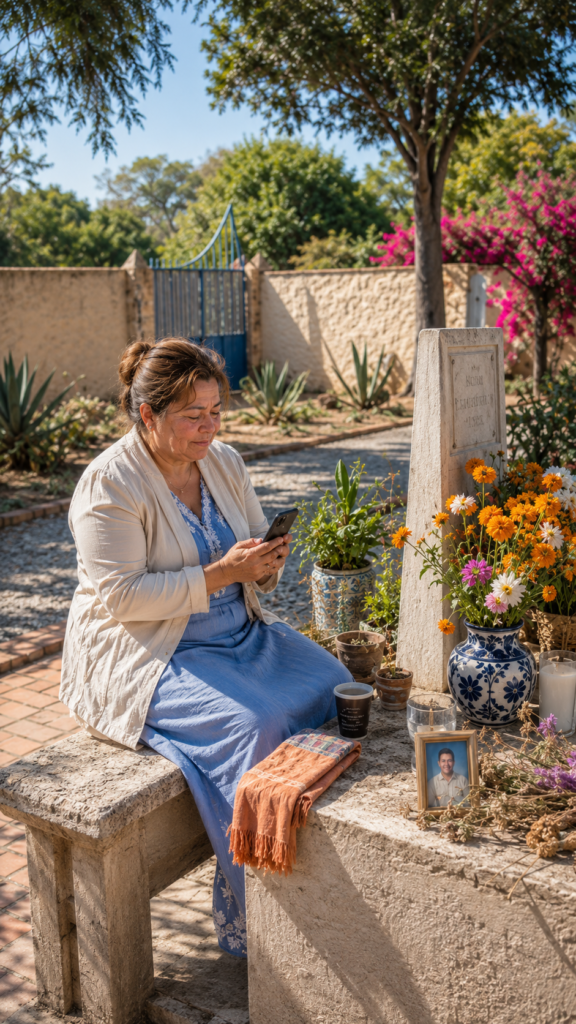
She carried the small phone inside her bag. She sat next to Julián’s gravestone, turned on the device, and opened the conversation with “Diana,” the woman who never existed.
She wrote:
“I know there was no one. Forgive me for taking so long to understand. I also loved you all my life.”
She pressed send.
The other phone, the one she carried in her bag, vibrated.
As both numbers had belonged to Julián, the message returned to her.
For two seconds, Mariana felt as if her husband had just answered her from some impossible place.
Then she cried as she hadn’t cried during the wake or the eight months of absence.
Until that day, she had cried for a man who supposedly betrayed her.
Now she cried for a man who loved her so much that he accepted dying while being despised.
That night she reviewed one by one the messages from the invented mistress.
At first, she found the false phrases Julián prepared to incriminate himself. However, among them were different texts, written in the early hours of the morning, without flirtation and with no intention of being discovered.
Julián had used that fictitious conversation as a secret diary.
He wrote to “Diana” about Mariana.
“Today she shaved her head so I wouldn’t feel alone. She doesn’t know I saw her crying in the kitchen.”
“She took me to the ocean. She stayed awake watching to see if I breathed.”
“She told me she loves me. I almost told her everything. I couldn’t.”
Mariana felt her heart constrict.
The letters directed to the supposed mistress spoke of her.
The proof of infidelity was, in reality, proof that Julián never stopped loving her.
Then she reached the last message.
It had been written the night before his death, when he could barely hold the phone:
“She fell asleep holding my hand. It was worth every lie. I go loving her, even if she thinks I betrayed her. It’s the last gift I can give her.”
Mariana pressed the phone against her chest.
Julián died not knowing that she would have chosen him even with fear, fatigue, and pain.
And she discovered the truth when she could no longer tell him that she didn’t need that sacrifice.
Since then, every Sunday she charges the phone's battery.
Sometimes she writes to the woman who never existed, because she was the only one to whom Julián confessed how much he loved his wife.
The night before, she sent only three words:
“I still choose you.”
The other phone vibrated inside the dark drawer.
Mariana closed her eyes.
For two seconds, she felt loved again.
Then she understood the question that still tormented her: does protecting someone mean preventing their pain… or respecting their right to choose it?