PART 1
Lucía burned a boiled egg the same week Doña Carmen told her son that maybe he had married the wrong woman.
Yes, a boiled egg.
No one in the family could explain how someone could burn something that was inside a pot of water.
But when Andrés entered the apartment in the Narvarte neighborhood, the smell was strange, the kitchen was smoky, and Lucía was standing in front of the stove with a face full of accusation, waiting for her sentence.
Lucía was 31 years old.
She was a family lawyer, one of those who defended women, children, impossible inheritances, and divorces where everyone ended up crying.
She could spend 10 hours in the courts of Mexico City without losing her voice.
But in front of a stove, she would forget to breathe.
Andrés was 34.
He worked at a logistics company, cooked decently, and had never seen it as a tragedy that his wife didn’t know how to make rice.
He’d known it since they were dating.
Once, Lucía called him very seriously to ask whether she should put the pasta in before or after the water boiled.
He laughed.
She did too.
"That's why I studied law, not gastronomy," she said.
For Andrés, that didn’t matter.
If he got home early, he made quesadillas, soup, or chicken with vegetables.
If they both arrived exhausted, they ordered food through an app.
Lucía didn’t cook, but she kept the accounts, paid bills, remembered medical appointments, birthdays, and even when it was time to change the water bottle.
The problem was never the cooking.
The problem was Doña Carmen.
Every time she visited the apartment, she looked at the stove like someone inspecting evidence of a crime.
"And has Lucía learned to make beans yet?"
Lucía smiled.
"Not yet, Doña Carmen. But if someone sues me over undercooked beans, I'll defend myself!"
Andrés laughed.
Doña Carmen didn’t always.
For her, a house without hot food was a neglected home.
She grew up in Puebla, with a tough mother and an even worse mother-in-law, hearing that a good wife was measured by her seasoning and cleanliness.
One Saturday afternoon, Lucía came home from the courthouse with her hair half up, her blouse wrinkled, and her eyes tired.
Doña Carmen was drinking coffee in the kitchen.
She looked at the empty table and casually remarked:
"I just say that a man comes home tired and deserves to find something ready, not just a bunch of plastic containers."
Lucía froze.
Andrés watched as her smile faded.
She dropped her keys, went to the bathroom, and closed the door.
When she came out, her face was washed, but her eyes were red.
That night, she barely had dinner.
Back in bed, she quietly asked Andrés:
"Do you also think I’m a bad wife?"
His chest tightened.
"No, my love. Not at all."
But Lucía continued staring at the ceiling.
Then Andrés understood that loving her silently wasn’t enough.
There were old words, like inherited knives, that continued to cut.
A few days later, Lucía left the office early.
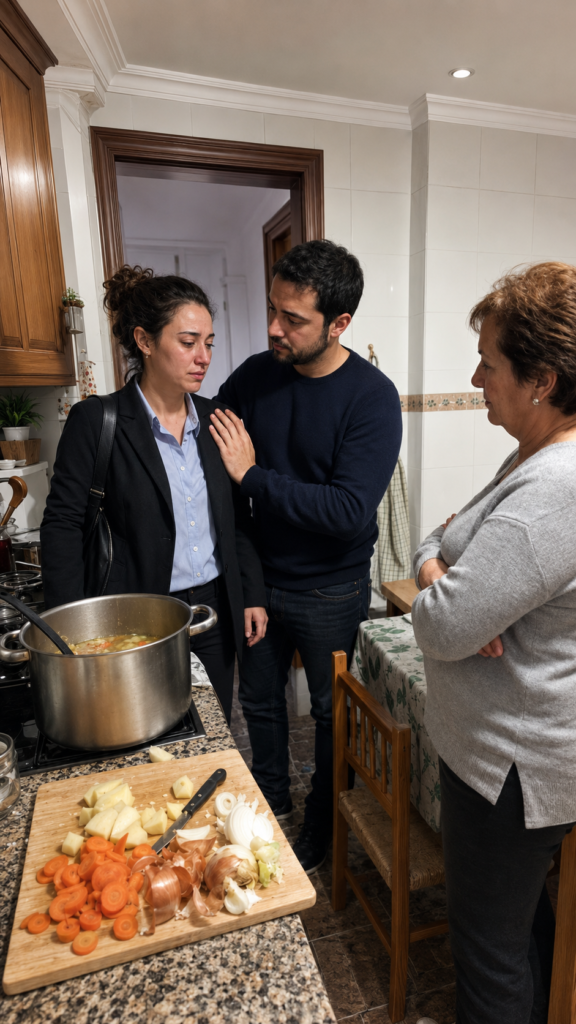
When Andrés arrived, he found her in the kitchen with chicken, potatoes, carrots, onions, and a sheet full of notes.
She had decided to make broth for Doña Carmen.
She trembled more than before entering a hearing.
Doña Carmen was seated at the table, silent, watching every movement.
Andrés knew this was going to end badly.
And it ended worse.
The potatoes were hard.
The carrots fell apart.
The chicken looked dry, even though it was floating.
And the salt felt like someone had dumped half a sack in.
Lucía served the plates with trembling hands.
Doña Carmen tasted a spoonful.
She said nothing.
That silence weighed more than any insult.
Lucía dropped the spoon on the table.
"I can speak in front of a judge without my voice trembling," she said. "But here, in this kitchen, I feel like a useless child."
Andrés looked at his mother.
"Mom, I didn’t marry Lucía because I needed a cook."
Doña Carmen pressed her lips together.
But before he could continue, she pushed the plate away and said something that froze the table:
"It’s sad that my son has a wife and still lives like a bachelor."
Lucía didn’t cry.
That was worse.
She simply got up, grabbed her bag, and left the apartment without saying a word.
Andrés ran after her, but when he opened the door, he only heard the elevator closing.
And in the kitchen, the pot continued boiling as if something much bigger was about to burn.
PART 2
Andrés rushed down the stairs.
He found Lucía outside the building, standing by the curb, hugging her bag against her chest.
She wasn’t screaming.
She wasn’t making a scene.
She was just breathing like someone trying not to break in public.
"Luci," he said.
She didn’t look at him.
"I’m tired of taking exams in my own home."
That phrase hit Andrés like a slap.
Because it was true.
Every visit from his mother had become a test.
If Lucía bought food, she was lazy.
If she tried to cook, she was useless.
If she laughed, she was shameless.
If she was quiet, she was cold.
Andrés wanted to hug her, but she took a step back.
"I’m not mad at you for today," she said. "I’m mad because you let it happen many times before."
He had no defense.
Because it was also true.
Upstairs, Doña Carmen was left alone in front of the salty broth.
For the first time, she didn’t feel like a winner.
She looked at Lucía’s empty chair, and something uncomfortable stirred in her chest.
It wasn’t guilt yet.
It was pride wounded.
When Andrés returned to the apartment with Lucía, Doña Carmen was already washing the dishes.
"I’m leaving," she said curtly.
Andrés stood at the kitchen door.
"No, Mom. Today we are going to talk."
Doña Carmen turned to him.
Lucía stayed silent in the back.
Andrés spoke slowly but firmly.
"Lucía works harder than I do many days. She comes home exhausted. Yet she cares about this house, about me, about you, about everything. Not knowing how to cook doesn’t make her any less of a woman."
Doña Carmen let out a bitter laugh.
"So now I’m the bad one."
"You’re not the bad one," Andrés replied. "But you’re causing harm."
That "harm" disarmed her for a second.
Then she lifted her chin.
"Nobody asked me if I wanted to cook. I did it because that’s how a family is sustained."
Lucía, who had been silent for too long, stepped forward.
"And who sustained you when you were tired?"
Doña Carmen opened her mouth.
But nothing came out.
The question hung in the air.
Heavy.
Uncomfortable.
That night ended badly, but not with shouting.
Doña Carmen left with her bag pressed to her body, saying she wouldn’t bother them anymore.
Lucía didn’t stop her.
Andrés didn’t either.
Three months passed.
The wound was still there, though no one named it.
Doña Carmen called less.
Lucía answered kindly but briefly.
Andrés visited his mother some Sundays, and she pretended everything was perfect.
Until one Tuesday morning.
It was before 8 when Andrés's cell phone rang in the bedroom.
He was in the shower.
Lucía answered.
At first, her voice was normal.
Then it dropped.
When Andrés came out with a towel around his neck, he found her pale by the door.
"Your mom is fine," she said quickly.
That didn’t ease his mind.
"What happened?"
"She says she got dizzy getting up. She says it’s nothing."
Andrés started dressing without asking more.
He knew that "it’s nothing."
It was the same one Doña Carmen used when something hurt, when she needed help, or when she was afraid of looking weak.
They arrived at her house in the Portales neighborhood.
Doña Carmen was on the couch, with a blanket over her legs and an untouched cup of chamomile tea.
Well-groomed.
In a clean robe.
With dignity worn like armor.
"You’re exaggerating," she said. "It was just a little dizziness."
Lucía approached.
She didn’t scold her.
She touched her forehead, looked at the cup, and asked:
"Did you drink anything?"
"I didn’t feel like it."
Andrés launched into his lecture.
That she should let them know.
That she couldn’t get up too fast.
That they needed to see a doctor.
Doña Carmen immediately closed herself off.
"I don’t need to be treated like an old useless woman."
Lucía sat beside her.
"We’re not going to treat you like an old woman," she said softly. "We’re going to treat you like someone we care about."
Doña Carmen looked at her.
For the first time, she found no response.
While Andrés made calls, Lucía went to the kitchen to find something to eat.
She opened the refrigerator.
Inside was half a dried lemon, two eggs, a piece of hard cheese, and expired yogurt.
Lucía froze.
She didn’t look judgmental.
She looked sad.
Andrés approached and saw too.
"Mom…"
Doña Carmen lowered her gaze from the couch.
"It’s not worth cooking for just me."
That phrase hit harder than any criticism.
The woman who judged a home by the hot food had been eating leftovers, sweet bread, and tea for weeks.
The woman who demanded care didn’t know how to let herself be cared for.
That was the first twist.
Lucía closed the refrigerator quietly.
She didn’t say, "I told you so."
She didn’t seek revenge.
She just took the two eggs and asked:
"Do you have tortillas?"
Doña Carmen frowned.
"For what?"
"To eat something. Even if I mess it up."
Andrés tried to help, but Lucía asked him to sit with his mother.
She prepared some scrambled eggs, slightly burned, with tortillas that were overcooked.
It wasn’t restaurant-worthy food.
But it was food.
Doña Carmen looked at the plate as if she didn’t know what to do with such embarrassment.
Lucía placed it in front of her.
"Today, seasoning doesn’t count," she said. "Today, eating is what matters."
Doña Carmen took a bite.
She didn’t say it was good.
She didn’t lie.
She just kept eating.
And while she ate, her eyes filled with tears.
In the following weeks, Andrés and Lucía started visiting her more.
Not every day.
Life continued to be heavy, with work, traffic, bills, exhaustion, and chores.
But Sundays stopped being about eating out.
Now they went to Doña Carmen's house.
At first, Andrés cooked.
Doña Carmen gave instructions from the table, like a retired general.
Lucía washed dishes, chopped cilantro, or opened bags.
Until one Sunday when she arrived with a new notebook.
She placed it on the table.
"This is my culinary survival notebook."
Andrés laughed.
Doña Carmen did too, though she tried to hide it.
The first recipe was noodle soup.
Something simple.
Doña Carmen repeated the same thing four times.
"A little oil. Don’t drown the noodles. A little salt. Little, Lucía. Not like that crime broth."
Lucía raised an eyebrow.
"Can we joke about that now or does it still hurt?"
Doña Carmen remained serious.
Then she said:
"It hurts, but less if we laugh together."
That was the first apology without saying sorry.
Lucía understood.
And kept writing.
She chopped the huge onion.
Burned the noodles a little.
Asked six times when to turn off the flame.
Doña Carmen bit her tongue several times to avoid criticizing.
Andrés saw her doing it.
It was almost a miracle.
When the soup was ready, the three of them sat down.
It wasn’t perfect.
But it tasted like effort.
Lucía tasted a spoonful.
"I didn’t destroy the kitchen."
Andrés smiled.
"That’s already professional level."
Doña Carmen raised her spoon.
"And you didn’t burn the water."
They laughed.
It wasn’t a big laugh.
It was a laugh that opened a crack where there used to be a wall.
Over time, the visits changed.
Lucía didn’t become a chef.
She still read recipes like they were legal contracts.
She still asked if "sauté" meant frying with patience.
She still left the kitchen looking like a battlefield.
But she stopped cooking in fear.
And Doña Carmen started correcting less.
One Sunday, while they were trying to make red rice, Lucía noticed an old box in the pantry.
It fell when she moved a pot.
Inside were yellowed notebooks, handwritten recipes, and a picture of a young Doña Carmen, crying in a kitchen.
There was also a letter.
Doña Carmen tried to take it away.
But it was too late.
Andrés read it silently.
The letter was from Doña Carmen's mother-in-law.
It said that a woman who burned tortillas was not fit to be a wife.
That if she didn’t learn, her husband would end up looking for “a real woman.”
Lucía looked up.
That was the second twist.
Doña Carmen hadn’t invented that cruelty.
She had inherited it.
And for years she had repeated it, believing it was teaching.
Doña Carmen sat down slowly.
"My first soup was horrible," she confessed. "Your political grandmother threw it in the sink. She told me that no man would stay home like that."
No one spoke.
The silence was no longer judgmental.
It was mourning.
Doña Carmen looked at Lucía.
"When I saw you not knowing, it made me angry. But not because of you. Because of me. Because I didn’t want to know either. I wanted to study nursing. I wanted to work. But I was told I first had to learn to serve."
Lucía swallowed hard.
"Is that why you treated me like that?"
Doña Carmen began to cry, but without making a scene.
With small, stubborn tears.
"Because I was afraid my son would suffer what I was taught men suffered without a woman in the kitchen. What nonsense, right? Really, what nonsense."
Andrés felt shame.
Not for his mother.
For taking so long to see behind her words.
Lucía approached.
She didn’t hug her immediately.
First, she said what was necessary:
"You hurt me."
Doña Carmen nodded.
"Yes."
"You made me feel less in my own home."
"Yes."
"And that doesn’t go away with a soup."
Doña Carmen lowered her head.
"I know."
Then Lucía placed a hand on her shoulder.
"But we can stop repeating it."
Doña Carmen covered her face.
That day, the rice turned out mushy.
Stuck to the bottom.
Almost a red paste.
But no one laughed.
They ordered roasted chicken from the corner and ate the rice anyway, because sometimes a bad meal accompanies a good conversation.
Months later, Doña Carmen's birthday arrived.
Andrés wanted to take her to a restaurant.
Lucía said no.
"I want to make the first dish."
Andrés looked at her carefully.
"Are you sure?"
"Yes. But I don’t want to do it alone."
The night before, they cooked zucchini cream.
Andrés washed.
Lucía chopped.
Doña Carmen, over a video call, explained without scolding.
There were onions on the floor, a blender too full, and a debate over whether "a splash" was a real measurement or a Mexican invention to cause anxiety.
But Lucía didn’t break.
She made mistakes and laughed.
That too was freedom.
The next day, Doña Carmen arrived with a small cake.
"Just in case," she said.
Lucía opened the door.
"Very prudent, mother-in-law."
They ate in Andrés and Lucía's apartment.
The cream turned out thick, but good.
Doña Carmen tasted the first spoonful.
Lucía held her breath.
Andrés did too.
Doña Carmen swallowed slowly.
"It’s good."
Lucía hesitated.
"Good for real or birthday good?"
"Good for real."
Then Lucía went to the bedroom and returned with an envelope.
She handed it to Doña Carmen.
Inside was a photo of the two of them in the kitchen, the day of the noodle soup.
On the back, Lucía had written:
"Thank you for learning to teach me without humiliating me."
Doña Carmen took off her glasses.
"I also need to thank you."
"Why?"
"For not letting me stay the same."
Lucía covered her mouth with her hand.
Andrés looked down because his eyes filled with tears.
Doña Carmen wasn’t one for speeches.
But that day she spoke.
"I thought love was doing everything for others, even if one ended up tired, alone, and angry. Now I think love is also letting someone sit with you, even if they burn the egg, even if they put in too much salt, even if it’s not like you."
No one said anything for a few seconds.
Then Lucía smiled.
"I didn’t burn anything today."
Doña Carmen raised her spoon.
"Not today, but don’t get too confident."
They laughed.
Since then, when Doña Carmen went to the apartment, she no longer asked what Lucía had prepared.
She asked:
"What are we doing together?"
That question changed the house.
Sometimes Andrés cooked.
Sometimes Lucía chopped vegetables.
Sometimes Doña Carmen made salsa.
Sometimes no one felt like it and they ordered pizza.
But there were no more exams.
No more court.
No more comparisons between women.
One Sunday, much later, Lucía managed to make rice.
Not perfect.
A bit overcooked.
Stuck at the bottom.
But rice.
Doña Carmen tasted it seriously.
Then looked at Andrés.
"This looks like a marriage of many years."
Lucía raised an eyebrow.
"Be careful, I can still burn dessert."
They all burst into laughter.
That night, while clearing the table, Doña Carmen touched Lucía’s arm.
"You don’t have to look like me to be good in this family."
Lucía froze.
Then she hugged her.
It wasn’t a movie hug.
It was simple.
Late.
Necessary.
Andrés watched them with the plates in hand and understood something he should have understood sooner.
His wife never had to learn to cook to deserve respect.
His mother never had to stop being who she was to ask for forgiveness.
And he should never have waited to see Lucía cry to set a boundary.
Now, in that house, there’s a recipe notebook with stains and crossed-out words.
On one page, Lucía wrote:
"A little salt. Very little. Don’t get too confident."
Below, Doña Carmen added:
"And if it goes wrong, order pizza."
That page better summarizes that family than any photo.
Imperfect.
Stubborn.
A little burnt at the edges.
But sitting at the same table.
Because a house isn’t held together by a perfect pot.
It’s held together by the way someone looks at you when something burns.