PART 1
"Your dad died a year ago, Mateo… and it’s just as well you didn’t get to say goodbye. This house isn’t yours anymore, so get out before I call the cops."
Patricia del Río said it with a calmness that sent chills down his spine.
Mateo had just been released from Barrientos prison in the State of Mexico after spending three years locked up for a fraud he never committed. He carried an old backpack, worn-out sneakers, and the same broken gaze of someone who learned not to cry where everyone expected to see him fall.
For 1,095 nights, he imagined his father, Don Ricardo Santillán, sitting in the brown leather armchair, his cup of coffee in hand, his gravelly voice telling him:
"Hang in there, son. The truth always finds a way out."
So when he crossed through the Del Valle neighborhood and stood before the house where he grew up, he felt his chest tighten.
The facade was no longer cream-colored. It was now a dark, elegant gray, cold as ice. The rose bushes his father tended every Sunday had vanished. The wooden door, where young Mateo had marked his height with pencil, was replaced by a shiny black door with a camera.
He knocked.
Not as a visitor.
As a son.
Patricia opened the door wearing a navy blue dress, perfect makeup, and pearl earrings. She scanned him from head to toe, as if his presence dirtied the entrance.
"You got out earlier than I expected," she said.
"Where’s my dad?"
Patricia let out a dry laugh.
"Buried. He died of cancer. Quick, ugly, sad. But that’s over now."
Mateo felt the floor shift beneath him.
"And no one told me? No one asked if I could see him?"
"You?" She raised an eyebrow. "You were in prison for stealing from your own father’s company. Do you really think he wanted to see you at his funeral?"
Mateo tightened the strap of his backpack.
"I didn’t steal anything."
"That’s what you said at trial, kid. And look how that turned out."
Bruno, her son, appeared behind her. Mateo’s half-brother. The one who always showed up smelling of alcohol, flaunting new watches, and getting into bets.
"Look who’s back," said Bruno. "The ex-convict returned for his inheritance. What a joke."
Mateo tried to glance inside. The family photos were gone. His father’s hat was missing. His mother’s portrait, lost when he was twelve, had vanished.
There were only expensive furniture, modern paintings, and an artificial smell of a stranger’s home.
"Let me in," Mateo pleaded. "I just want to see his room."
Patricia crossed her arms.
"His room doesn’t exist anymore. I turned it into a dressing room. This house has changed, Mateo. Just like your life has."
Then she leaned closer and lowered her voice.
"If you ever set foot on this property again, I’ll send you back to jail. With your record, no one will believe you."
And she slammed the door in his face.
Mateo didn’t scream.
He didn’t beg.
He walked away, backpack slung over his shoulder, toward the Jardines de la Luz Cemetery, where his father always said he wanted to rest next to his first wife.
But when he asked about Ricardo Santillán, an old gardener froze in place.
"You’re Mateo, aren’t you?"
Mateo felt a shiver run through him.
"How do you know?"
The man glanced around and pulled a yellowed envelope from his vest.
"Your dad asked me to give you this if you ever came looking for him."
Inside was a letter and a rusty key.
The key read: MINI STORAGE 108.
Mateo opened the letter with trembling fingers.
The first line read:
"Son, if you’re reading this, it’s because Patricia has already started lying to you."
And then Mateo understood: the worst part wasn’t that his father had died.
The worst part was that someone had buried a truth capable of destroying the entire family.
PART 2
Don Ricardo’s handwriting was still the same: large, firm, slanted to the right, as if even in sickness he wrote with rage and dignity.
"Son, forgive me for not coming to see you. It wasn’t because I thought you were guilty all along. It was because when I understood what they did to you, I was already too sick… and too watched."
Mateo had to sit on a bench in the cemetery.
The word watched burned inside him.
He continued reading.
"Patricia and Bruno made me believe you stole money from the construction company. They showed me emails, reports, screenshots, and bank movements. At first, I doubted. And for that doubt, I carry shame."
Mateo closed his eyes.
His father had doubted him.
That hurt more than prison.
But the letter continued.
"Later, I found duplicate invoices, fake suppliers, transfers to accounts that weren’t the company’s, and documents signed while I was sedated from chemotherapy. I also found your access codes written in a notebook of Patricia’s."
The gardener, Don Eusebio, watched him silently.
Mateo read on until the end.
"Everything is in mini storage 108, in Tlalnepantla. Don’t confront Patricia without seeing the evidence. Don’t trust anyone in that house. They let you carry a guilt that was never yours. I love you. Dad."
Don Eusebio gave him money for the bus.
"Your dad came here often," he murmured. "He was thin, almost without strength, but he said you didn’t deserve to leave prison empty-handed."
The mini storage was located in an industrial zone, between mechanic shops and taco stands. The key opened with difficulty. When he lifted the metal curtain, Mateo found something that left his throat dry.
There weren’t old furniture.
There were boxes.
Dozens of white boxes, obsessively organized. Each labeled by his father:
"BANK."
"CONTRACTS."
"FORGED SIGNATURES."
"PATRICIA."
"BRUNO."
On a folding table lay a USB drive and a note:
"Watch this first."
Mateo plugged the USB into the cheap phone they gave him upon release, using an old adapter he found in a box. The screen was cracked, but the video opened.
Don Ricardo appeared.
He looked thin, pale skin, wearing a wool hat and sunken eyes. Behind him was the house workshop, the place where he taught Mateo to use a tape measure and not overcharge anyone.
"Mateo," he said in a weak voice. "If you’re watching this, it means you’re out. Forgive me for not being there to hug you."
Mateo covered his mouth.
"You didn’t steal a dime. Bruno diverted money from the construction company using fake suppliers. Patricia gave him your passwords and planted files on your computer. She entered your apartment with a copy of the key. I found the duplicate in her bag."
Mateo felt three years of prison crashing down on him again.
"They also forged my signature to change company transactions and manipulate my will when I was already medicated. There are medical opinions, emails, receipts, videos, and bank records. I didn’t go to the police because Patricia isolated me. She said she was protecting me, but she was watching me."
Don Ricardo breathed heavily.
"And there’s something more. If she told you I’m buried next to your mother, it’s a lie. Don’t let them erase my name too."
The video ended.
Mateo sifted through documents for hours. There were emails between Bruno and an accountant from Monterrey. Transfers of millions to accounts in Cancun and Panama. Photographs of Patricia entering Mateo’s building two days before the audit. Records showing that his computer had been used while he was working on a project in Toluca.
Then he found a red folder.
It read: "CONFESSION."
Inside was a sheet signed by Bruno. He admitted to using Mateo’s account to divert money. He stated that Patricia promised to protect him because "Mateo was always the favorite son."
But the most crushing blow came from the bottom of the folder.
It was a funeral document.
Mateo read it three times, as if the words could change.
His father had purchased a double plot in Jardines de la Luz years earlier, next to Mateo’s mother. Everything was paid for. He even left in writing that he wanted to be buried there.
Patricia canceled the service after his death, requested a partial refund, collected a funeral insurance, and sent the body to a municipal cemetery on the outskirts of Ecatepec.
The provisional plaque barely said:
Ricardo S.
Not even his full name.
Mateo didn’t go to scream at her that night.
Before prison, he might have. He would have arrived to break down the door, demanding answers, giving Patricia the perfect scandal to paint him as violent again.
But he was no longer the same.
He slept sitting in the mini storage, with the USB hidden inside a sock and his father’s letter tucked under his shirt.
The next day, he went to a legal support office for released individuals. There he met Alma Robles, a lawyer with a dry voice and a hard gaze.
When Alma finished reviewing the documents, she took off her glasses.
"Mateo, this isn’t just to clear your name. This is fraud, forgery, identity theft, possible manipulation of the will, and concealment of funeral information. If we move it right, your conviction could be overturned."
"They already took three years from me," he said. "I won’t let them take my father too."
The notifications came 11 days later.
They froze accounts linked to Bruno. They requested to review Mateo’s sentence. They sought the original will and the funeral documents.
That afternoon, Patricia called.
"Mateo, son," she said in a sweet voice. "I received some horrible papers. I don’t know who’s filling your head, but we can talk as a family."
Mateo stared at the USB on the table.
"A family doesn’t put an innocent man in prison."
There was silence.
Then Patricia dropped the mask.
"You were in prison for three years. You’re a convict. Do you really think anyone will believe you?"
Mateo took a deep breath.
"They don’t have to believe me. They just have to listen to my dad."
He hung up.
The war lasted eight months.
Bruno was the first to crack. When the prosecutor showed him the transfers, the messages with the accountant, and his own signed confession, he began to sweat like a scolded child.
At first, he said he didn’t remember.
Then he said Patricia had forced him.
In the end, when they proved the money paid for bets, trips, watches, and an apartment in Querétaro, he decided to save himself.
He testified against his mother.
He told that Patricia copied Mateo’s passwords. That she entered his apartment to plant false files. That she convinced Don Ricardo not to visit his son, telling him Mateo hated him and only wanted to take his money.
He also confessed something even crueler.
When Don Ricardo began to suspect, Patricia took away his phone, filtered his calls, and told the doctors he "was delirious from the medicine."
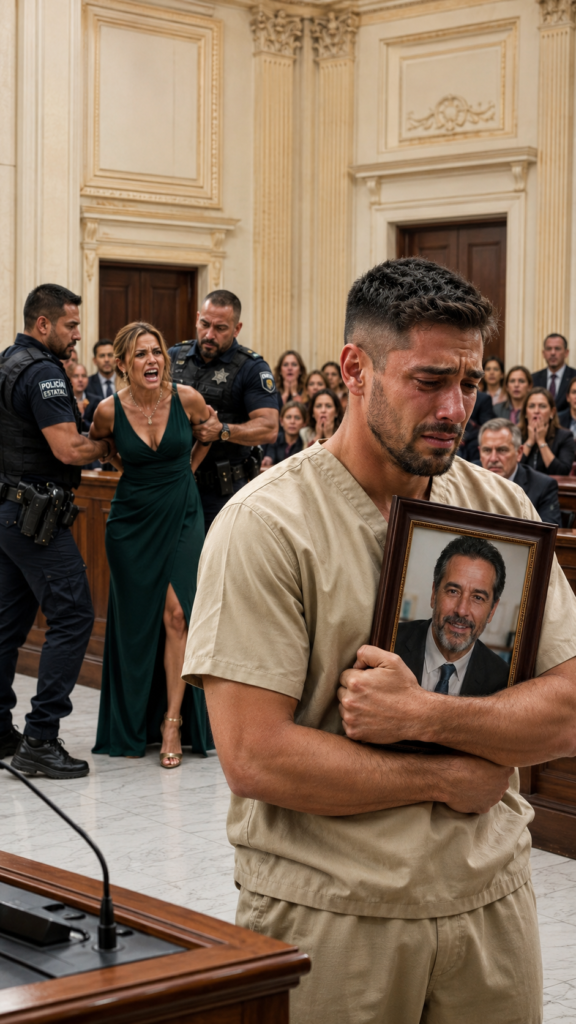
At the hearing, Patricia appeared dressed in white, rosary in hand, with rehearsed tears.
She spoke of love.
Of sacrifice.
Of a confused widow.
But Alma projected the video of Don Ricardo.
The room fell silent when his face appeared on the screen.
His weak voice filled the place like a sentence.
"My son Mateo is innocent. I arrived too late, but the truth didn’t."
Mateo didn’t cry at first.
He just gritted his teeth.
But when his father said, "I love you, son, even though I couldn’t hug you," something inside him broke completely.
Three weeks later, Mateo’s conviction was overturned. It was recognized that the evidence used against him had been fabricated.
His name was cleared.
But paper doesn’t give back three years.
It doesn’t return sleepless nights. It doesn’t return beatings. It doesn’t return the shame of walking with a false guilt plastered on his forehead. It doesn’t return the last Christmas with a sick father. It doesn’t return a goodbye.
Patricia and Bruno were charged with fraud, forgery, identity misuse, and criminal conspiracy. Bruno accepted a lesser sentence in exchange for providing more evidence.
Patricia fought until the end.
But what sank her wasn’t just the money.
It was the funeral.
The court confirmed that Patricia buried Don Ricardo far from his wife, with an incomplete plaque, not out of lack of resources, but out of revenge.
Because he had discovered her.
Because he wanted to save Mateo.
Because, even in dying, he had more dignity than she did alive.
When Alma gave Mateo the address of the municipal cemetery, Don Eusebio asked to accompany him.
"A son shouldn’t find his father alone for a second time," he said.
The place was dry, forgotten, filled with crooked crosses and plastic flowers burned by the sun. A caretaker led them to a row at the back.
"Here it is."
Mateo knelt before the rusty plaque.
Ricardo S.
He ran his fingers over those two incomplete words and finally cried.
He cried for his father. For his mother. For the boy who entered prison innocent. For the man who left with scars. For everything a lie can destroy when a family prefers to protect the guilty and sacrifice the innocent.
"I’m here, Dad," he whispered. "I know everything now. We won."
Months later, Mateo regained the house as part of the restitution. He entered only once.
Patricia’s expensive furniture looked ridiculous in that living room where José José used to play on Sundays. In his father’s old room, now a dressing room, he found a little wooden box behind a panel.
Inside was a photo of young Mateo, with a yellow toy helmet, standing next to Don Ricardo on a construction site.
It read on the back:
"My son Mateo, the only partner who will never betray me."
Mateo sold the house.
Not because he didn’t love it, but because some walls hold too many ghosts.
With that money, he paid for his father’s legal exhumation and finally took him next to his mother. He also opened a small business called Restauraciones Santillán, where he hired people coming out of prison that no one wanted to employ.
Because he knew what it was like to pay a guilt that wasn’t yours.
The day they placed the new gravestone, there were no grand speeches. Just a simple phrase:
Ricardo Santillán
Father, builder of truths.
Below, he had the words engraved that sustained him for three years:
"The truth always finds a way out."
Patricia lost the house, the money, and the mask of a respectable widow. But her worst punishment wasn’t the sentence.
It was hearing, in front of everyone, the voice of the man she tried to erase defending the son she sent to prison.
And that’s why, when people asked if Mateo had forgiven, he didn’t respond quickly.
Because perhaps justice clears a name.
But some pains even a sentence can’t bury.