PART 1
Camila arrived 28 minutes late to the blind date at a small restaurant in Roma, Mexico City.
She wasn’t dressed to impress.
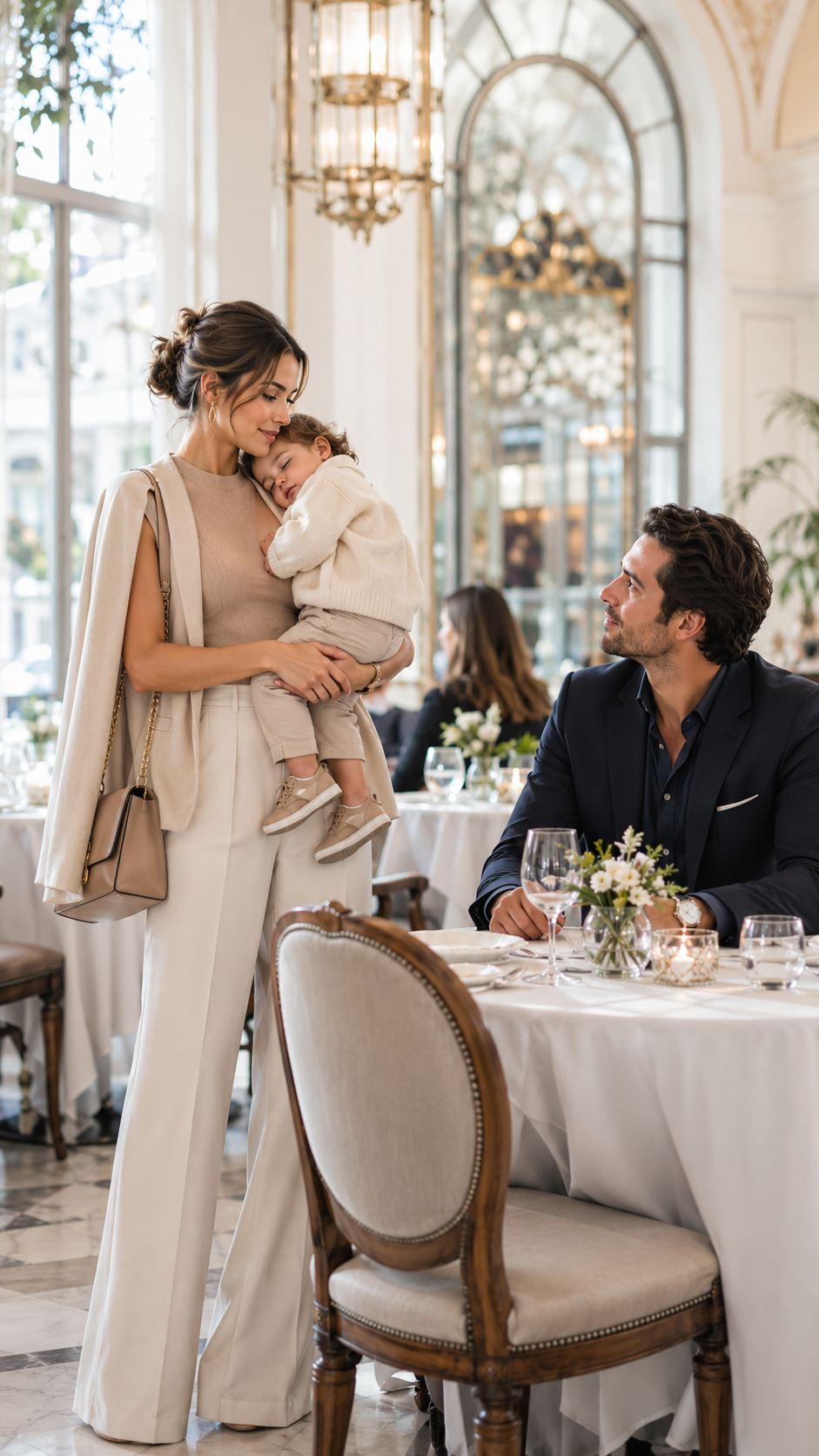
Her hair was damp from the rain, an old jacket draped over a simple blue dress, and cradled against her shoulder was a deeply sleeping four-year-old boy, mouth slightly ajar, clutching a plastic dinosaur tightly against his chest.
Diego Santamaría watched her enter from his table by the window.
He was a businessman, the owner of a tech firm in Santa Fe, the kind of man who always had an exit strategy prepared before entering any relationship.
His friends said Diego never stayed.
He claimed he was just being practical.
But when he saw Camila struggling to hold the child, close the umbrella, apologize to the waiter, and not die of embarrassment all at once, he didn’t get up.
Camila approached with a weary smile.
“Sorry. I’m really sorry. The lady who was supposed to watch him canceled just as I was getting on the Metro. I understand if you want to leave.”
Diego looked at the sleeping child.
Then at Camila.
“I’m not leaving.”
She let out a small, incredulous laugh.
“You don’t have to say that out of politeness.”
“I know.”
That silenced her.
During dinner, Camila ordered only a tortilla soup and plain water. Diego noticed she checked the prices before looking at the dishes.
He also noticed that every time the child stirred, she dropped everything to adjust his jacket, wipe his nose, or check if he was still breathing peacefully.
The boy was named Mateo.
He wore light-up sneakers, had a dinosaur named Don Mordidas, and had the uncanny ability to interrupt any conversation with bizarre phrases, even while asleep.
Midway through the night, as the rain hammered against the windows, Mateo barely opened his eyes.
His voice came out soft, ragged with sleep.
“Mom…”
Camila froze.
The word struck her like someone had reopened an old wound.
Diego saw the pain before she could hide it.
Camila stroked the child’s hair and whispered,
“No, my love. I’m Aunt Cami.”
Mateo closed his eyes again, trusting, as if that answer sufficed for him to continue living in peace.
Diego said nothing.
But in his mind, the whole night shifted.
She wasn’t a single mother arriving late to a date.
She was a woman carrying a story that no one at that table knew yet.
Camila lifted her gaze, embarrassed and sad.
“Thank you for not running away.”
Diego wanted to joke, but he couldn’t.
Because for the first time in a long time, he felt that staying was more dangerous than fleeing.
And no one in that restaurant could imagine what was about to unfold.
PART 2
Diego invited Camila out again because, according to him, the first date deserved a second chance.
A normal date.
Without a sleeping child, without a diaper bag, without dinosaurs on the table, and without a little stranger calling him “Mr. Expensive Shoes.”
But the second date also had Mateo.
And the third.
By the fourth, Diego stopped pretending to be surprised.
Camila always arrived apologizing.
“I swear I’m not trying to bring bodyguards,” she said as Mateo ran around a park in Coyoacán, chasing pigeons.
Diego watched him with a strange smile.
“He’s more fun than many adults I know.”
Mateo heard him and pointed at his shoes.
“Yes, because he looks rich, Auntie.”
Camila closed her eyes.
“Mateo, his name is Diego.”
“No. He’s Mr. Expensive Shoes.”
And that’s how it stayed.
Their dates stopped feeling like dates.
They became fragments of life squeezed in wherever possible.
Coffee on a bench while Mateo collected stones.
Dinner at a small diner where the boy declared that peas were “green crimes.”
A visit to a used bookstore, where Camila read a dinosaur story with different voices for each character while Diego watched her with a tenderness he didn’t know where to store.
Camila was tired all the time.
She worked as a kindergarten teacher in the mornings, cared for children three nights a week at a community center, and cleaned offices with a friend on Saturdays.
Once Diego asked her when she rested.
She smiled.
“At traffic lights.”
He thought she was joking.
Until one afternoon, he saw her close her eyes for five seconds in front of a red light, hands still on the wheel, her face pale from exhaustion.
Still, Camila never made Mateo feel like a burden.
She bought him strawberries even if she had cookies for dinner.
She remembered the pajama day at kindergarten even though she was two months behind on rent.
She laughed when she wanted to cry because Mateo looked at her face to know if the world was still safe.
The day Camila left Mateo with Diego for 20 minutes, he discovered that the businessman’s confidence was just a facade.
Mateo invented a game called Dinosaur Hospital.
He used all the couch cushions, four spoons, duct tape, an expensive tie, and half a box of tissues.
“Don Mordidas needs surgery,” he announced.
“Of what?”
“Of a fang.”
“Dinosaurs didn’t go to the dentist.”
Mateo looked at him very seriously.
“That’s why they went extinct.”
Diego had no argument.
When Camila returned, she found Diego sitting on the hallway floor, the neighbor’s dog covered in toothpaste on his forehead, and Mateo locked inside the apartment because he had pressed the automatic door shut.
From inside, the child yelled:
“I’m making soup!”
Defeated, Diego asked:
“Of what?”
“Cereal!”
Camila laughed so hard she dropped her keys.
Diego had never been happier making a fool of himself.
Slowly, Mateo stopped being “Camila’s child.”
He became part of the rhythm.
And Diego began replying to messages with drawings of dinosaurs, watching poorly recorded school festivals on video, and keeping gummy candies in the glove compartment just in case “Boss Mateo” needed them.
But not everyone viewed that relationship with tenderness.
Doña Teresa, Diego’s mother, discovered Camila through a photo from a school fundraiser.
The next day, she summoned him for lunch in Polanco.
Doña Teresa minced no words.
“That girl has a child.”
“It's her nephew.”
“And what are you doing there, Diego?”
He set his glass down on the table.
“Getting to know her.”
“That’s what men say when they’ve already gotten in too deep.”
Diego got annoyed.
“She’s not a gold digger, Mom.”
“I didn’t say that.”
“But you thought it.”
Doña Teresa took a deep breath.
“I’m not worried about her money. I’m worried that she’s already carrying too much. A child, a death, debts, exhaustion. And you’ve always been an expert at wanting hard things from a safe distance.”
Diego felt hurt because it was true.
“She’s not a project.”
“Then don’t treat her like one.”
That night, Camila told him the truth.
Her sister Mariana had died when Mateo was two, after an illness they first called “treatment” and later “palliative care.”
Before dying, Mariana made her promise that Mateo would never end up in a foster home.
Camila was 23 years old.
She didn’t know how to change diapers well, had no savings, and was barely starting her life.
But she promised.
And she kept it.
“I’m not his mother,” she said, tears filling her eyes. “But I’m the only stable thing he has left.”
Diego took her hand across the kitchen table.
“You’re not the only one. You’re the most important.”
She wanted to believe him.
That was the problem.
Because children don’t get attached gently.
Mateo began to wait for him.
He saved drawings for him.
He asked Camila to send voice notes.
Once he told the phone:
“Mr. Expensive Shoes, today I learned that herbivores don’t eat tacos.”
Diego replied:
“Professor Mateo, I confirm that this information is grave.”
Mateo listened to it nine times.
And Camila felt fear.
Fear that Diego would be another kind adult who would one day simply vanish.
Her dad had left when she was 14.
Mateo’s father hadn’t shown up even at Mariana’s funeral.
Previous boyfriends had drifted away when they realized that loving Camila also meant loving the chaos of a child with nightmares.
So she started canceling plans.
A dinner.
Then another.
Diego noticed.
One rainy night, while Mateo slept hugging Don Mordidas, Camila confronted him in her kitchen.
“I’m scared.”
“Of me?”
She lowered her gaze.
“Of Mateo wanting you too much.”
Diego didn’t answer quickly.
That’s what she liked about him.
He didn’t try to cover pain with pretty phrases.
“I love him too,” he finally said.
“That's why it scares me.”
He reached out his hand, without forcing her.
Camila took it.
The kiss almost happened there, between cups of cold tea and folded clothes.
Almost.
Until Mateo appeared in dinosaur pajamas, holding an empty plate.
“I have a cereal emergency.”
Diego cleared his throat.
“That’s one of the most serious emergencies.”
Camila almost laughed.
For the first time in years, life didn’t seem like mere survival.
It felt like home.
But a week later, Mateo overheard a call he shouldn’t have heard.
Diego was in Camila’s living room, speaking softly with an investor.
“Yes, I understand the Monterrey plan. If I accept, I’d have to move for at least a year.”
The dinosaur fell from Mateo’s hand.
Diego turned too late.
The child was staring at him, frozen.
Camila came out of the room with a laundry basket.
“What happened?”
Mateo didn’t look at her.
He only looked at Diego.
“You’re leaving.”
Diego opened his mouth but found no words.
The boy’s voice shrank.
“Like my mom.”
The silence that followed wasn’t broken that night.
Camila discovered the rest through an online article.
“Capital businessman prepares key expansion in Monterrey.”
There was a photo of Diego in a dark suit, smiling like important men do when no one sees their doubts.
The article talked about a year away, meetings with partners, and a possible permanent move.
Camila read it three times.
What hurt wasn’t that he was leaving.
It was that he hadn’t told her.
When Diego arrived with Japanese food, she was already waiting for him with the phone in hand.
He saw the screen and understood.
“Camila…”
“When were you planning to tell me?”
Diego hesitated.
That hesitation was worse than any answer.
“I was trying to figure it out.”
“It gets figured out by talking.”
He clenched his jaw.
“It’s not that simple.”
“For a four-year-old, it is. You’re either here or you’re not.”
The phrase hit him.
Camila pointed to Mateo’s room.
“He doesn’t understand business opportunities. He understands empty chairs.”
Diego looked down.
“I love them.”
“I know.”
“Then why do you act like you’re running away?”
Camila wanted to say no.
But part of her believed it.
Maybe Diego wasn’t running from her.
But he was leaving.
And for Mateo, the difference didn’t exist.
“You don’t owe us anything,” she said.
Diego looked up, hurt.
“That’s the problem.”
Camila frowned.
“What problem?”
“That I want to owe you something. I want to choose you.”
She felt her chest shatter.
Because she wanted to believe him.
And believing him meant opening the door to the same pain.
Days later, Diego accepted the position.
Camila ended the relationship before he could screw it up.
There were no shouts.
Just that adult pain carried while lunchboxes were prepared and “everything is fine” was said with a broken voice.
The day Diego left for Monterrey, it rained.
Mateo ran out in pajamas, shoes on the wrong feet.
“Wait!”
Diego knelt down.
“What happened, champ?”
Mateo pulled out Don Mordidas from his jacket.
The green dinosaur was scratched, bitten, and old.
He placed it in Diego’s hand.
“I’m lending it to you.”
Diego’s throat tightened.
“You’re lending it to me?”
“Until you come back.”
Diego almost promised.
Almost said what the child needed to hear.
But children deserve more than promises made out of guilt.
So he closed his fingers around the dinosaur as if it were something sacred.
“Thank you, Mateo.”
The boy hugged him tightly.
Camila saw Diego’s eyes fill with tears.
She said nothing.
Diego left.
But here came what no one expected.
He didn’t disappear.
Every Sunday at six, he called via video call.
Without fail.
From offices, airports, hotel rooms, and once from a gas station because the meeting had run long.
Mateo appeared with crumbs on his shirt.
“Hello, Mr. Expensive Shoes.”
“It’s Diego.”
“No.”
And so it went.
Diego watched via video the kindergarten’s Day of the Dead festival.
He sent pan de muerto when Mateo got sick.
He returned Don Mordidas after three months, but Mateo sent him another dinosaur “for emotional supervision.”
Camila didn’t forgive him immediately.
They spoke carefully.
Then honestly.
Then with desire.
She learned that leaving didn’t always mean disappearing.
He learned that love wasn’t returning with a grand speech but not missing out on small things when no one was applauding.
A year later, Diego returned to Mexico City.
Not because Monterrey had failed.
On the contrary.
The expansion had gone so well that his partners agreed to open a shared office and let him live where he had chosen to root down.
But he didn’t tell Camila first.
Lucía, her best friend, informed her.
“Put on the blue dress and get to the restaurant in Roma at seven.”
“I can’t, Mateo has homework.”
“Mateo is included. Don’t ask, comadre.”
Camila almost didn’t go.
But at 7:22, she walked into the same restaurant where it all began.
Mateo wore a bow tie over a T-Rex shirt and had a folded sheet of paper as if it were an official document.
Diego sat by the window.
The same table.
The same nervous glance.
But he no longer looked like a man searching for exits.
He looked like a man who had closed them all.
Camila stood frozen.
“What is this?”
Diego smiled.
“A blind date.”
“But I already know you.”
“Exactly, which makes it better.”
Mateo climbed onto the chair between the two and placed the sheet on the table.
“At the top, it read, with crooked letters:
Application to go out with my Aunt Cami.
Camila tried to take the sheet from him, but Diego already had the pen.
“You didn’t even read it.”
“I trust the author.”
Mateo smiled proudly.
The rules said:
No disappearing.
No lying.
Watch dinosaur movies.
Go to school festivals.
Don’t make Aunt Cami cry in the ugly way.
Camila couldn’t continue reading without her eyes blurring with tears.
Diego signed.
“I agree.”
Mateo raised a finger.
“And hotcakes.”
Camila looked at the sheet.
“That’s not written.”
“I added it in my heart.”
Diego nodded seriously.
“I accept that too.”
The dinner was a beautiful disaster.
Mateo stole Diego’s bread.
Lucía passed by the table twice to congratulate herself on her emotional manipulation.
Camila laughed like she hadn’t in months.
As they left, the rain had stopped.
The street shone under the city's lights.
Mateo ran ahead with Don Mordidas raised like a flag.
Diego took Camila’s hand.
“At our first date, you arrived 28 minutes late.”
She smiled through tears.
“I know.”
“I’m not saying that to complain. I’m saying it because everything important in my life arrived later than I planned.”
Camila squeezed his hand.
“Was it worth it to wait?”
Diego didn’t hesitate.
“Yes.”
Years later, when Mateo understood more of what adults wanted, he asked Diego if he had been scared to return.
Diego looked at Camila, who was preparing lunchboxes, pretending not to listen.
Then he looked at the boy.
“I was very scared.”
“Then why did you come back?”
Diego smiled.
“Because your aunt was worth it.”
Mateo thought for a second.
“And me?”
Diego touched the dinosaur on the table.
“You taught me how to do it.”
Camila turned quickly, but Diego caught a glimpse of her wiping her eyes.
This time, she cried in a beautiful way.